Emergency resilience starts before there is smoke in the air. Around the property, that means reducing combustible material and maintaining access. Inside the home, it means having working alarms, knowing when a portable fire extinguisher is appropriate, and knowing when the safest action is simply to get out and call Triple Zero.
A prepared property is not fireproof, and a portable extinguisher is not a substitute for firefighters. The aim is to remove avoidable hazards, control a very small fire only when it is safe to do so, and protect life first.
Emergency: Call 000
Reviewed: October 2026
Life safety comes before firefighting
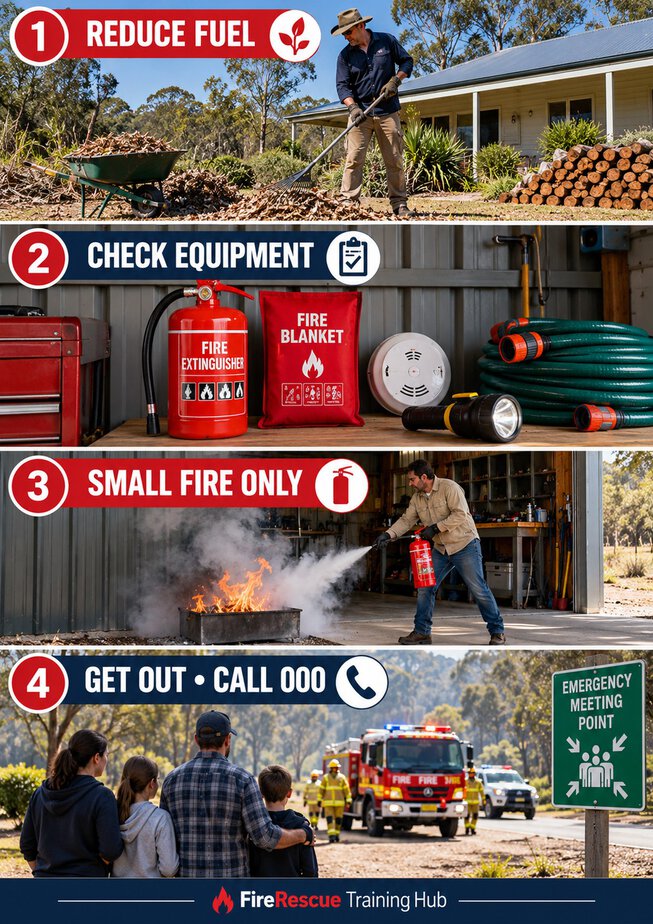
Only consider using a portable extinguisher on a small, early-stage fire if you have the correct extinguisher, feel confident using it and have a clear escape route behind you. If there is smoke, rapid fire growth, uncertainty or any danger to you, leave immediately, close doors if safe and call Triple Zero (000).
Fuel load: what it really means around a home
In bushfire planning, fuel is any material that can burn and contribute to fire spread or intensity. Around a property this can include long dry grass, leaf litter, twigs, loose bark, dead vegetation, woodpiles, organic mulch, stored timber, rubbish and other combustible material.
Reducing this fuel does not stop every bushfire and cannot guarantee that a building will survive. It can, however, reduce flame intensity close to the home, remove places where embers can start spot fires and make the property easier to protect.
NSW RFS and CFA both recommend regular property maintenance even when your plan is to leave early. A prepared property may be more likely to survive an ember attack and is less likely to create additional fire exposure for neighbours.
Start with the fine fuels
Small, dry material is often the easiest fuel for an ember to ignite. Routine maintenance is therefore one of the simplest ways to improve bushfire resilience.
- Keep gutters and roof valleys clear of leaves and twigs.
- Remove fallen leaves, dry grass, loose bark and dead vegetation around buildings.
- Keep lawns maintained and avoid allowing long grass to create a continuous path towards the house.
- Cut back overhanging branches and maintain separation between shrubs, trees and structures where local rules allow.
- Move woodpiles, outdoor furniture, doormats, boxes and other combustible items away from the house before dangerous fire-weather days.
- Keep access routes, gates and property identification clear for occupants and emergency vehicles.
The best maintenance schedule depends on the property and season. In some high-risk locations, leaves and dry material may need attention every week during windy or dry periods rather than once at the start of summer.
Landscaping: there are no fireproof plants
The old advice to simply choose “fire-resistant plants” can be misleading. CFA states that all plants can burn under extreme conditions. Some plants are less flammable than others, but the location, arrangement and maintenance of vegetation can be even more important than the species itself.
Lower-flammability plants generally have characteristics such as open growth, higher moisture content and less dead material. Highly resinous, oily, dense or dry vegetation may burn more readily or intensely.
Think in terms of breaking up fuel continuity: separate plant groups, avoid combustible mulch immediately beside structures, remove dead material and prevent vegetation from creating a continuous path from the ground into shrubs, trees, decks or the building.
Portable fire extinguishers: useful, but only for the right fire
Portable extinguishers are designed for small fires in their early stages. They can be valuable in a home, garage, workshop or small workplace, but the extinguisher must match the hazard.
In Australia, extinguisher labels identify the fire classes for which the unit is suitable. Fire and Rescue NSW refers users to AS 2444 for extinguisher and fire-blanket selection and location.
| Common extinguisher | Typical use | Important caution |
|---|---|---|
| Water | Ordinary combustible materials such as paper, timber and textiles where the unit is rated for Class A. | Never use on energised electrical equipment. |
| ABE dry powder | Commonly covers several household and workshop hazards according to its rating. | Powder can reduce visibility and create significant cleanup; check the label for the exact classes. |
| Carbon dioxide | Often used around electrical equipment and some flammable-liquid hazards. | Limited cooling means some materials can reignite. |
| Wet chemical | Designed for cooking-oil and fat fires where appropriately rated. | Use the product exactly as labelled; kitchen fires can escalate rapidly. |
Do not rely on a generic statement that one extinguisher is “best for every home”. A kitchen, garage and workshop can have different hazards. Read the fire-class rating on the extinguisher and choose equipment for the actual risk.
Where should an extinguisher be kept?
Fire-safety equipment needs to be visible, accessible and positioned so you do not have to move towards a fire to reach it. Fire and Rescue NSW recommends locating equipment near an exit.
That principle is more useful than a single universal mounting height. In a kitchen, for example, an extinguisher or fire blanket should not be placed directly beside the stove where flames may prevent you reaching it.
Everyone who may need to use the equipment should know where it is. Do not bury an extinguisher behind stored items, machinery or furniture.
Check the equipment before you need it
Look at the extinguisher regularly. Check for obvious corrosion or damage, an obstructed hose or nozzle, broken safety seals, and an abnormal pressure-gauge reading where a gauge is fitted.
Follow the manufacturer’s instructions for inspection, service life, servicing and replacement. Regulated workplaces and commercial premises may have additional requirements under Australian Standards and local rules.
If an extinguisher has been discharged, damaged or is outside its service requirements, do not assume it is still ready for the next emergency. Arrange appropriate service or replacement.
PASS: how to operate a portable extinguisher
Fire and Rescue NSW uses the PASS method for modern portable extinguishers:
P — Pull
Pull the pin and break the seal.
A — Aim
Aim the nozzle or hose at the base of the fire.
S — Squeeze
Squeeze the handles to discharge the extinguishing agent.
S — Sweep
Sweep from side to side across the base of the fire.
Before using PASS
Make sure the fire is still small, the extinguisher is suitable, someone has called 000 where required, smoke is not making the area unsafe, and your exit remains behind you. If the extinguisher does not control the fire immediately, leave.
Lithium-ion battery fires are different
Rechargeable lithium-ion batteries are now common in e-bikes, e-scooters, power tools, phones, laptops and power banks. When a damaged or faulty battery enters thermal runaway, it can release toxic and flammable gases, burn intensely and reignite after appearing to be extinguished.
Current ACCC advice for the public
If a lithium-ion battery is smoking or on fire, evacuate to a safe place and call Triple Zero (000). The ACCC advises members of the public not to try to extinguish a lithium-ion battery fire with a portable fire extinguisher.
This is an important change from older generic advice. Extinguishers marketed specifically for lithium-ion battery fires are available, but in 2026 there is no applicable Australian safety standard covering their use. ACCC advice is that these products are for trained firefighting professionals, not general household use.
If a battery becomes unusually hot, swollen, damaged, leaks, hisses or emits fumes or a strange odour, stop using it and move people away. Follow the manufacturer and fire-service advice and call 000 if there is smoke, fire or immediate danger.
Fire blankets and kitchen fires
A fire blanket can be useful for a small cooking fire when used correctly. Fire and Rescue NSW recommends keeping a blanket accessible in the kitchen but away from the stove so the fire does not block access to it.
Never carry a burning pan through the house. If the fire is growing, smoke is spreading or you are uncertain, get out and call 000.
If someone is burned
St John Ambulance Australia advises cooling a thermal burn under cool running water for 20 minutes as soon as possible.
- Do not use ice.
- Do not apply butter, fat, lotions or ointments.
- Remove clothing and jewellery unless stuck to the burn.
- Cover with a clean, loose, non-stick dressing after cooling.
- Call 000 for severe burns, airway involvement or other urgent concerns.
Five practical resilience actions
- Reduce fine fuel. Keep gutters, roofs, decks and the area around buildings clear of dry combustible material.
- Break up fuel pathways. Maintain gardens, vegetation, woodpiles and stored combustibles so fire has fewer continuous paths towards structures.
- Choose the right equipment. Match an extinguisher or fire blanket to the hazards present and keep it accessible near a safe exit.
- Know when not to fight. Leave if the fire is growing, smoke is unsafe, the extinguisher is unsuitable or there is any doubt — especially with lithium-ion batteries.
- Have a plan. Know how everyone will get out, where you will meet, how you will call 000 and what you will do during a bushfire warning.
Operational perspective
From a firefighting perspective, small problems become dangerous when people lose their escape route or overestimate what their equipment can achieve. A portable extinguisher carries a limited amount of extinguishing agent. It is not designed to take on a developed room fire, a spreading garage fire or an advancing bushfire.
The same principle applies outside. Fuel reduction may slow fire near a building and make conditions more manageable, but it cannot make a property completely safe in severe or catastrophic conditions.
Good emergency resilience is therefore about layers: prevention, property maintenance, early warning, suitable equipment, training, escape planning and knowing when to stop trying to protect property and protect life instead.
Frequently asked questions
Should every home have the same extinguisher?
No. The right extinguisher depends on the likely hazards. Read the fire-class rating and choose equipment that matches the kitchen, garage, workshop or other location.
Can I use an extinguisher on a lithium-ion battery fire?
Current ACCC advice to the general public is no: evacuate to a safe place and call Triple Zero (000).
How often should a home extinguisher be serviced?
Follow the manufacturer’s instructions and any applicable Australian requirements. Do not rely on one generic interval for every extinguisher or every premises.
Are there fireproof plants?
No. CFA states that all plants can burn under extreme conditions. Choose lower-flammability plants where appropriate and focus heavily on spacing, location and maintenance.
What is the first thing I should do if a fire is getting bigger?
Stop trying to fight it. Leave by your safe exit, close doors if you can do so safely, get everyone to the meeting point and call 000.
The key message
Reduce combustible material around the property, maintain your fire-safety equipment, know how to use it, and never let an attempt to save property remove your safe way out.
- NSW RFS — Prepare your home
- CFA — Preparing for bushfire season
- CFA — Fire-resistant gardening and lower-flammability landscaping
- Fire and Rescue NSW — Fire safety equipment
- Fire and Rescue NSW — Safe operation of fire extinguishers
- ACCC Product Safety — Lithium-ion batteries
- St John Ambulance Australia — Burn or scald first aid
Ken Walker — former Station Officer and fire-service educator with career and volunteer firefighting experience.
This guide combines official Australian bushfire, home-fire, product-safety and first-aid guidance with an operational firefighting perspective. It is general education rather than a substitute for site-specific advice, formal training or emergency-service instructions.
Safety disclaimer
Fire conditions can change quickly. Portable extinguishers are intended only for appropriate small, early-stage fires. If there is any doubt, evacuate and call Triple Zero (000). During a bushfire, follow current warnings and directions from your state or territory emergency authorities.
FireRescue Training Hub
Access practical fire and emergency study support resources, downloads, checklists, audio guides, and member-only course content.
- Course library
- PDF downloads
- Audio guides
- Checklists
Study support only. Not accredited training or a replacement for workplace procedures.
About the author and safety review
Ken Walker
Former Station Officer and fire service educator
Former career firefighter with extensive career and volunteer fire service experience.
Qualifications: Associate Diploma of Applied Science in Fire Technology; Institute of Fire Engineers studies.
Author profilehttps://www.firerescue.com.au/about-us/