Bushfire hose and water-supply preparation is useful only when the whole system works together: the hose reaches where it needs to, fittings survive heat, the water source remains available, the pump can operate if mains power fails, and the people using it understand the limits of the equipment.
For most households, the safest bushfire strategy remains to leave early. A hose, pump or water tank should never become the reason you stay in conditions that are beyond you or your property. This guide focuses on pre-season equipment readiness and clearly separates general property preparation from active property defence.
CFA does not recommend defending a home during a bushfire and says never plan to defend on Catastrophic fire-danger days. If someone chooses active property defence, current CFA guidance calls for substantial preparation including at least 10,000 litres of independent water, a protected firefighting pump, firefighting hoses reaching around the home and suitable protective clothing. Leaving early provides the best chance of survival.
What’s been updated
- Reframed the article around hose and water-system readiness rather than general “wildfire fighting” by householders.
- Removed the unsupported universal 19 mm hose-size rule.
- Removed the universal 20 metre vegetation-clearing rule.
- Separates leave-early property preparation from active stay-and-defend equipment requirements.
- Adds current CFA, NSW RFS, Queensland Fire Department and SA CFS guidance.
- Adds a practical five-part Hose & Water System Dry Run.
- Adds one optional pump example from the supplied affiliate feed, with a medium product image and clear limitations.
First decide what the equipment is for
There is an important difference between property readiness and active property defence.
A maintained hose and accessible water can still be useful for normal property maintenance, pre-season testing and recovery after authorities say it is safe to return. NSW RFS also recommends having hoses long enough to reach around the house as part of general property preparation. But your life-safety plan should not depend on operating a hose when a fire arrives.
Use your own state or territory fire-service guidance. This requires much more than a garden hose: people, water, pump capacity, heat protection, firefighting hose, protective clothing, backup plans and a property capable of being defended. Never plan to defend on Catastrophic days.
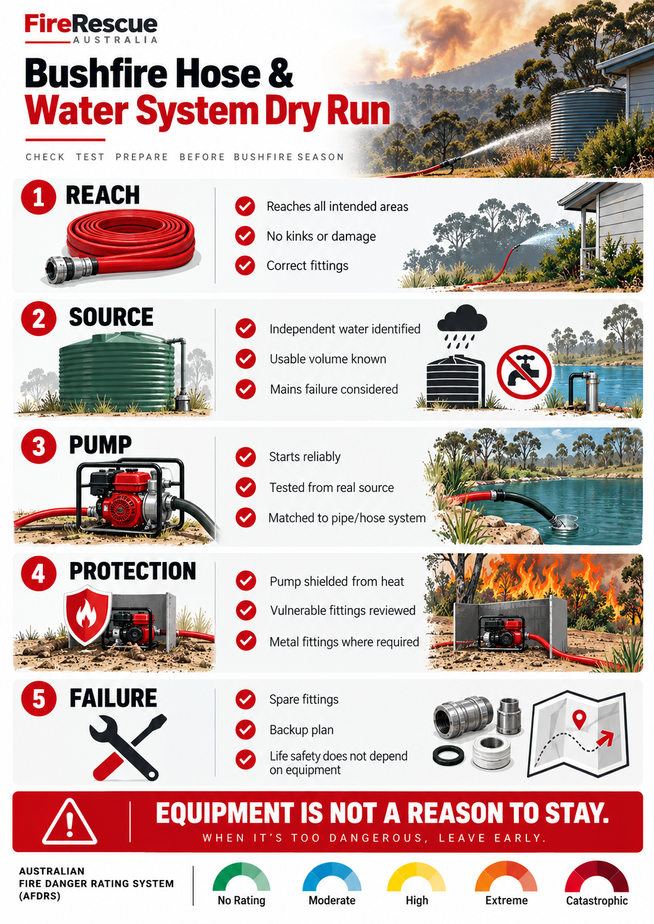
The FireRescue Hose & Water System Dry Run
Do this before the dangerous part of the season. The point is not to spray water around the property. It is to identify system failures while you still have time to fix them.
- REACH: Can the correct hose physically reach every area it is intended to serve without being stretched tight, kinked or routed through a likely heat-exposure point?
- SOURCE: What water source actually supplies the hose, and will that source still be available if mains water pressure drops or fails?
- PUMP: If the system requires a pump, can it start reliably, produce the required pressure and operate without depending on mains electricity?
- PROTECTION: Are the pump, pipes, fittings and controls protected from radiant heat and ember attack, and are vulnerable plastic components avoided where current agency guidance recommends metal?
- FAILURE: What will you do if the pump, hose, fitting, fuel supply or water source fails? Equipment failure must never remove your life-safety option.
The better question is: Can the complete system deliver water where it is needed, under the conditions I am planning for, without trapping me into relying on it?
1. Hose reach matters more than a universal diameter rule
The old version of this article recommended a minimum 19 mm (3/4 inch) hose diameter for everyone. That is too simplistic. The usable flow and pressure at the nozzle depend on the water source, pump, elevation, hose diameter, hose length, fittings and how many outlets are operating.
Current NSW RFS advice for general property preparation is simple: have a hose or hoses long enough to reach around the house. CFA goes further for active property defence and recommends purpose-suitable firefighting hoses. It notes that ordinary plastic garden hose can melt in fire conditions and recommends discussing hose selection with the supplier who is helping size the pump and system.
For a planned firefighting system, do not choose the hose independently from the pump. Treat pump, pipe, hose, nozzle and water source as one hydraulic system.
Pre-season hose inspection
- unroll or deploy the full hose run
- look for cuts, cracking, abrasion, heat damage or brittleness
- check couplings, washers and nozzles
- test the hose under its normal operating pressure
- confirm all planned areas can be reached
- remove blockages and check stored hoses for insect or rodent damage
- keep compatible spare fittings and repair items if the system is intended for active defence.
2. Do not rely on mains water for active defence
Mains water pressure may fall or fail during a major bushfire. Current CFA and Queensland guidance both tell people who are planning to defend not to depend on the reticulated mains supply.
CFA’s current Victorian guidance specifies at least 10,000 litres of independent water for people planning active property defence. Queensland Fire Department gives the same minimum figure for its stay-and-defend guidance. These are defence-planning requirements, not a guarantee that 10,000 litres will always be sufficient.
The usable volume depends on the size of the property, duration of use, pump flow, sprinkler demand and the number of outlets. Water reserved for firefighting also needs suitable plumbing and access.
3. Pump selection is a system-design question
CFA says a supplier can help size a firefighting pump by considering:
- where the water comes from and how far it must travel
- pipe size, pipe length and layout
- how many outlets or sprinklers will operate together
- hose size and hose length
- whether petrol, diesel or another arrangement best suits the system.
For active defence, the pump needs to remain usable if mains electricity fails. CFA calls for a non-electrical firefighting pump protected from radiant heat, while Queensland and South Australian guidance similarly emphasises independent pumping and heat protection.
Test the pump before each season and follow the manufacturer’s servicing, fuel-storage and operating instructions. A pump that starts in the shed but cannot prime from the actual tank, cannot overcome the pipe losses or overheats in its installed location is not a working fire-water system.

Optional pump example — affiliate link
The current My Generator affiliate feed supplied to FireRescue lists the Cromtech Honda 1.5″ Petrol Fire Fighting Water Pump. The feed describes a Honda GP160 engine, maximum flow up to 360 L/min and total head up to 60 m.
That makes it a useful example of the type of independent petrol pump available for a property system, but it is not automatically the right pump for your property. Pump selection must match the water source, suction conditions, pipework, hose length, elevation and simultaneous outlets.
Important: this is optional commercial equipment, not a survival guarantee and not a reason to remain during dangerous fire conditions. FireRescue may earn a commission if you purchase through the link, at no extra cost to you.
4. Protect the system from heat and ember attack
A fire-water system can fail because the components that support it fail first. Plastic pipes or fittings can soften or melt, pump fuel can vaporise, electrical power can disappear and exposed equipment can become unsafe to approach.
Current CFA guidance recommends metal hose fittings for active defence and protection of pumps from radiant heat. It also gives specific guidance for tank outlets and pipework where CFA appliance access is being provided. Queensland guidance similarly recommends protected pumps and fire-resistant hoses, while SA CFS says portable pumps should have suitable protection, ventilation and filtration.
Any dedicated system should be designed around the actual site rather than copied from a generic online diagram.
5. Test failure scenarios, not just normal operation
A pre-season test should deliberately ask what happens if something goes wrong. Consider:
- the usual pump will not start
- a hose coupling leaks or breaks
- one hose must be taken inside or moved
- mains power and mains water fail
- fuel is old or unavailable
- the pump location becomes too hot to approach safely
- the water source is lower than expected
- one of the adults expected to operate the system is unavailable.
If the system has no workable backup, that is a planning problem—not an invitation to improvise during the fire.
Property preparation matters before hose deployment
A hose should not be used as a substitute for fuel reduction and building maintenance. NSW RFS recommends clearing gutters, repairing roof damage and external gaps, keeping lawns and gardens maintained, removing leaves and debris, cutting back vegetation over buildings and ensuring hoses can reach around the home.
Queensland guidance similarly recommends clearing fine fuels, maintaining access and checking pumps, generators and water systems before the season.
Do not apply a single vegetation-clearing distance such as “20 metres” to every Australian property. Planning controls, vegetation types, environmental rules, BAL requirements and local bushfire provisions vary by jurisdiction and site.
Should you pre-wet the house and garden?
The answer depends on the survival plan and the guidance applying to your jurisdiction. Current Queensland stay-and-defend material includes wetting buildings and nearby vegetation before the fire front arrives, and CFA gives detailed tactical guidance for people who have deliberately planned and prepared to defend.
That does not make general pre-wetting a substitute for leaving early. Water can be limited, hoses can fail and the most important use of time may be getting people safely away. If your plan is to leave, follow the leave-early tasks issued by your local fire service rather than converting your property into an improvised firefighting operation.
Hoses and sprinklers: know the limitations
A hose can help extinguish small embers or spot fires only when conditions allow a trained or properly prepared person to work safely. It cannot protect someone from radiant heat, a fire front or rapidly changing conditions.
Sprinkler systems also depend on water supply, pipework, pump performance and heat-resistant components. Queensland Fire Department points readers to AS 5414:2012 for bushfire water-spray systems. Installation and design should be treated as a technical system, not simply a collection of sprinklers connected to a garden tap.
If sprinklers are important to your property strategy, use current technical guidance and suitably experienced designers or installers.
Do not depend on neighbours pooling firefighting gear
Good neighbours are valuable, but the old article’s suggestion that households pool hoses, tanks and first-aid resources can create a dangerous assumption that another person or another water system will be available during a fire.
Community preparation is better focused on sharing plans, identifying people who may need early assistance, attending fire-service information sessions and understanding official warning channels. A property-defence system should not depend on a neighbour arriving during the emergency.
First aid and smoke
Burns: cool the burn under cool running water for at least 20 minutes. Do not use ice, creams or lotions. Serious burns or breathing problems require urgent medical attention; call Triple Zero (000) when appropriate.
Smoke: moving away from smoke is more protective than relying on a face covering. A correctly fitted P2/N95 respirator can reduce exposure to fine smoke particles but it does not protect from radiant heat, flames or all gases and does not make an unsafe fire environment safe.
Five pre-season checks worth doing this weekend
- Deploy every hose: confirm reach, condition, fittings and nozzle operation.
- Run the pump: test it from the actual water source, not just dry in the shed.
- Check independence: identify what stops working if mains power and water fail.
- Inspect heat exposure: identify vulnerable pump, pipe, hose and fitting locations.
- Review the survival plan: make sure equipment has not quietly become the reason you plan to stay when leaving would be safer.
For firefighters and rural fire-unit operators
Household hose and pump guidance is not operational doctrine. Firefighters, brigade members and trained farm fire-unit operators should follow their service procedures, tasking, command arrangements, equipment standards and training.
From an operational perspective, clearly identified water supplies, accessible tank fittings, reliable property access and realistic information from occupants can all make a property easier to assess. But appliance crews must never assume a private pump, hose or tank will perform as claimed without checking the conditions and system.
Frequently asked questions
Is a normal garden hose enough for bushfire defence?
For active defence, CFA recommends purpose-suitable firefighting hose and notes that plastic garden hose can melt in fire conditions. If your plan is simply to leave early, a maintained garden hose may still be useful for ordinary property maintenance, but it should not become your survival strategy.
What size firefighting pump do I need?
There is no correct universal pump size. Pump choice depends on the water source, suction conditions, required flow and pressure, pipe and hose length, elevation and number of simultaneous outlets. Size the complete system, not just the pump.
Can I rely on town water?
Not for a planned active defence system. Current CFA and Queensland guidance warns that mains pressure or supply may fail during a fire.
Does owning a firefighting pump mean I can stay?
No. A pump is only one component. CFA says defending a home is extremely demanding and never recommends planning to defend on Catastrophic days. People, water, property preparation, protective clothing, equipment and backup plans all matter.
How often should hoses and pumps be tested?
At minimum, test them before each bushfire season and follow the manufacturer’s maintenance schedule. SA CFS also advises people planning to defend to run and check pumps during the Fire Danger Season.
Related FireRescue guides
- How to Prepare for a Bushfire: Practical Guide for Australians
- Bushfire Preparedness Checklist: Australian Readiness Audit
- Firefighting Pumps for Property Owners
Conclusion
A bushfire hose or pump is not a standalone piece of safety equipment. It is part of a system that includes water, plumbing, hose, fittings, access, heat protection, maintenance, people and backup plans.
If your plan is to leave early, keep the property and equipment maintained without allowing the equipment to delay your departure. If you are considering active property defence, use current fire-service guidance and have the entire system assessed, tested and practised well before the fire season.
Official and supporting sources checked
- CFA Victoria — Defending your property; equipment needed to defend; preparing to defend; hose, pump and water-supply guidance
- NSW Rural Fire Service — Prepare your home and water/hose preparation
- Queensland Fire Department — Prepare for bushfires; Stay and defend; pumps, water and hoses
- SA Country Fire Service — property preparation and pump-testing guidance
- Australian Fire Danger Rating System — current national rating terminology
- Healthdirect Australia — current burn first-aid guidance
- My Generator affiliate data feed supplied to FireRescue — Cromtech Honda 1.5″ Petrol Fire Fighting Water Pump product details and image
Ken Walker — former Station Officer and fire-service educator with career and volunteer firefighting experience.
This article provides general educational information for an Australian audience. It does not replace site-specific hydraulic or pump design, professional bushfire advice, agency procedures or current directions from emergency authorities. Firefighting equipment cannot guarantee survival or property protection. During an emergency, follow official warnings and directions.
Corrections and field experience: FireRescue Training Hub welcomes source-backed corrections and practical observations from firefighters, pump specialists, rural property owners and emergency-service personnel. Current agency guidance always takes priority.
FireRescue Training Hub
Access practical fire and emergency study support resources, downloads, checklists, audio guides, and member-only course content.
- Course library
- PDF downloads
- Audio guides
- Checklists
Study support only. Not accredited training or a replacement for workplace procedures.
About the author and safety review
Ken Walker
Former Station Officer and fire service educator
Former career firefighter with extensive career and volunteer fire service experience.
Qualifications: Associate Diploma of Applied Science in Fire Technology; Institute of Fire Engineers studies.
Author profilehttps://www.firerescue.com.au/about-us/