Urban vs Rural Firefighting: How Tactics, Resources and Risks Differ
Firefighting in a city street and firefighting across bushland or farmland can look completely different. The hazards, water supply, access, staffing and tactical priorities may change — yet modern incidents increasingly require urban and rural firefighters to work as one integrated emergency service.
Focus: Australia first
Audience: Public + firefighters
Want the original detailed report?
This web article is the shorter, updated guide. The original long-form report remains available for readers who want deeper case studies and background.
The original report was more than 20,000 words and contained repeated material. This version focuses on the most useful comparison for readers, updates the incident-management discussion for AIIMS 2025, uses current Australian fire-service information, and keeps the detailed eBook available separately.
Australia’s fire services work across one of the broadest operating environments in the world: high-rise buildings, dense suburban streets, industrial complexes, regional towns, farms, grasslands, forests and remote bush.
The old idea that “urban firefighters fight buildings while rural firefighters fight bushfires” is too simple. It still describes an important difference in primary operating environments, but modern fire services increasingly cross those boundaries — especially around expanding communities on the edge of bushland.
The practical question is therefore not which style of firefighting is better. It is what tactics, equipment and command arrangements best match the hazard in front of the crew.
Urban vs rural firefighting at a glance
| Operational factor | Urban / built environment | Rural / bushfire environment |
|---|---|---|
| Typical fuel | Buildings, furnishings, vehicles, industrial materials | Grass, forest, scrub, crops and structures within the landscape |
| Water supply | Often hydrant-based and relatively close | Tankers, static water, dams, relays or water shuttles may be required |
| Access | Roads generally good, but congestion and complex buildings create problems | Long distances, rough tracks, terrain and limited escape routes |
| Primary focus | Life rescue, confinement and structural fire suppression | Life safety, containment, fire spread, asset protection and community impact |
| Duration | Often intensive incidents measured in hours | Large bushfires may continue for days or weeks |
| Major variable | Building construction, occupancy, fire compartmentation and internal conditions | Weather, fuels, topography and fire behaviour |
Important:
These are broad operational patterns, not rigid rules. Rural crews attend structure fires. Career urban firefighters deploy to bushfires. Industrial fires can occur in remote areas, and grassfires can threaten metropolitan suburbs within minutes.
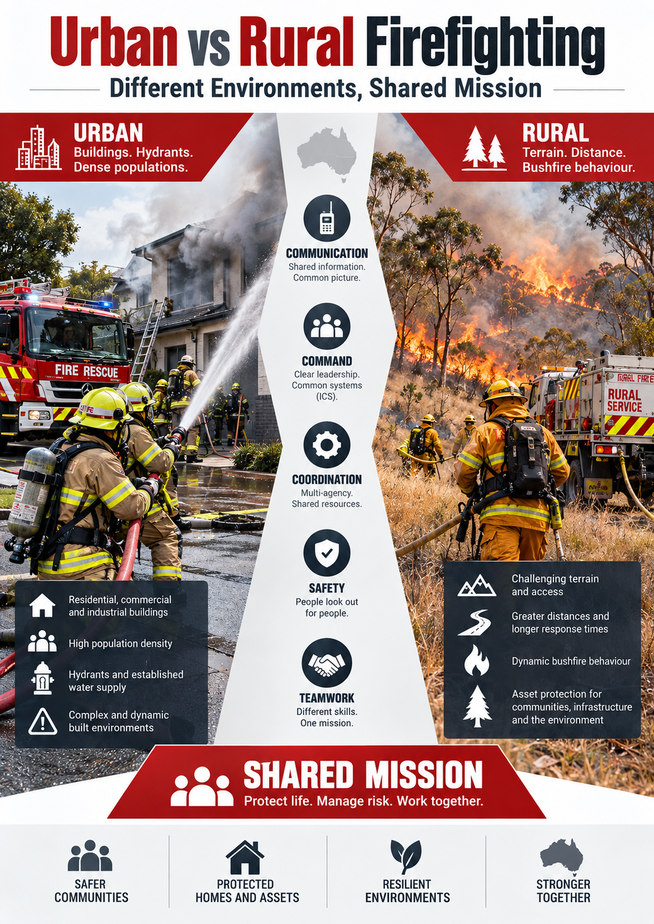
Urban firefighting: high consequence in a compact area
Urban firefighters commonly operate where people, buildings and infrastructure are concentrated. A relatively small fire can threaten many occupants, neighbouring properties and critical services.
The classic structural response may involve rapid size-up, rescue, breathing-apparatus operations, hose deployment, ventilation, exposure protection and establishing a reliable water supply. But a house fire is only one part of the urban workload. Modern metropolitan services also respond to road crashes, hazardous materials, technical rescue, alarm activations and other emergencies.
Buildings change the fireground
Buildings can contain a fire — but they can also conceal it. Crews may work in zero visibility with heat, smoke and toxic combustion products around them. Fire can travel through cavities, service shafts, ducts, façades and roof spaces. Structural stability may also deteriorate as the incident develops.
High-rise buildings add another dimension. Firefighters may need to move crews and equipment vertically while protecting stairs, managing building systems, maintaining communications and supporting large numbers of occupants.
The Grenfell Tower fire in London in 2017 remains an important international lesson. The final Grenfell Tower Inquiry report was published in September 2024. Its findings extend far beyond tactics alone and demonstrate how building design, regulation, materials, management and emergency response can combine to influence the outcome of a major structure fire.
Urban advantages — and limitations
Urban operations often benefit from dense station coverage, hydrants and relatively rapid access to additional crews and specialist appliances. This can support an early concentration of resources.
But “more resources” does not mean a simple incident. Traffic, high occupancy, hazardous materials, complex architecture, underground spaces and high-rise access can create problems that require specialist capability and strong incident command.
Rural firefighting: distance, landscape and changing fire behaviour
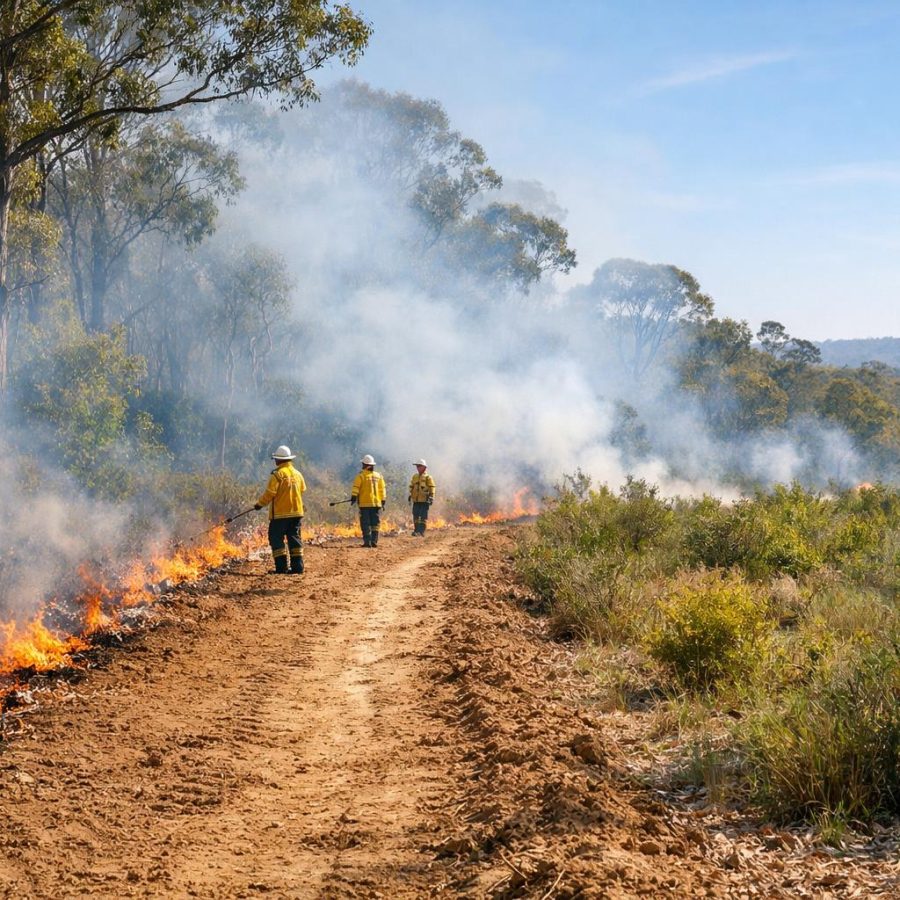
In bushland, grassland and agricultural areas, the fireground may extend for kilometres rather than metres. Weather and terrain can have an immediate effect on the direction and intensity of the fire.
Wind changes can rapidly alter which flank is dangerous. Slope can accelerate fire spread. Spotting can create new fires well ahead of the main front. Crews may also be separated from water, backup, medical support and reliable communications.
The tactical emphasis can therefore shift toward containment lines, flank attack, patrol, asset protection, use of heavy machinery, aerial support and strategic withdrawal when conditions exceed safe operating limits.
Water cannot be assumed
A rural appliance may arrive with only the water carried on board. That changes everything. Refill points, water tenders, dams, tanks and tanker shuttles become part of tactical planning.
Crews must understand what their water supply can realistically achieve. A limited tank cannot be treated like a hydrant that will continue flowing indefinitely.
Access and escape are tactical issues
A remote fire can require travel over narrow, steep or poorly maintained tracks. Heavy appliances may be unable to reach some areas. Falling trees, smoke, mud or fire can also cut a route that was usable when crews entered.
Safe rural operations therefore depend heavily on situational awareness, communications, escape routes, changing weather and maintaining enough margin to withdraw before conditions become untenable.
The wildland–urban interface is where the two worlds meet
The most demanding incidents are often not purely urban or purely rural. Around the wildland–urban interface (WUI), vegetation fires can enter streets and subdivisions, while burning structures generate additional heat and embers.
A crew may move from grassfire suppression to defending homes, supporting evacuation and dealing with burning vehicles or buildings within minutes. Hydrants may exist but lose pressure or become difficult to access. Roads intended for firefighting access may simultaneously fill with evacuating residents.
The 2018 Camp Fire in California is a powerful international example. Butte County’s official after-action report described a rapid transition from fire suppression to life-saving operations as evacuation plans were overwhelmed. The lesson is relevant in Australia: WUI incidents require fire suppression, evacuation, traffic management, warnings and community protection to operate as one system.
Career and volunteer firefighters: different models, shared operational purpose
Australia’s firefighting capability is built from both career and volunteer personnel. Treating one as “urban” and the other as “rural” is useful only at a broad level because the real system is more integrated.
Fire Rescue Victoria, for example, states that its career firefighters staff 85 fire and rescue stations across metropolitan Melbourne and major regional centres. Many regional stations are co-located with Country Fire Authority volunteer brigades. CFA says it has more than 1,200 brigades, including co-located stations shared with FRV career firefighters.
Career systems can provide
- 24-hour staffed stations
- high-frequency operational exposure
- specialist rescue, hazmat and structural capabilities
- predictable immediate staffing
Volunteer systems can provide
- large geographic coverage
- surge capacity during major events
- strong local knowledge
- deep connections with the communities they protect
The operational goal is not to make every firefighter identical. It is to ensure different crews understand one another’s capabilities, terminology, safety systems and command arrangements well enough to operate together when the incident crosses organisational boundaries.
AIIMS 2025: a common command framework
A major change since the original version of this article is the release of AIIMS 2025. AFAC published the latest Australasian Inter-service Incident Management System manual in October 2025, superseding AIIMS 2017.
AIIMS provides a scalable incident-management structure used across Australian fire, emergency service and land-management agencies. This common framework becomes especially valuable when an incident brings together metropolitan fire crews, rural brigades, land-management agencies, police, ambulance, aircraft and interstate personnel.
Why this matters operationally
A crew does not need identical vehicles, uniforms or day-to-day roles to work effectively with another agency. What matters is having compatible command, communications, safety and tasking arrangements — and knowing what each resource can safely do.
Technology is changing both environments
Technology is reducing some of the traditional separation between urban and rural operations. The same broad goal applies in both environments: improve information, reduce uncertainty and keep firefighters out of unnecessary danger.
Drones and remote sensing
Drones can provide aerial intelligence without immediately placing a crew in the hazard area. At a bushfire they may assist with mapping, hotspots and perimeter intelligence. At a large structural, industrial or hazardous-material incident they may provide roof, façade or site views that are difficult to obtain from ground level.
Predictive modelling and decision support
Bushfire modelling can help incident managers consider likely fire spread using information about weather, topography and fuels. These tools can help with planning, warnings and resource placement, but they remain decision-support systems. They do not replace experienced judgement, current observations or safety procedures.
Thermal imaging and situational awareness
Thermal imaging has become an established capability in structural firefighting and also has value in bushfire intelligence. Digital maps, vehicle tracking, aircraft tracking and shared operating pictures increasingly allow incident managers to see information that previously arrived only through radio reports.
Aerial firefighting
Aircraft can support suppression, mapping and asset protection across rural and peri-urban incidents. But aircraft do not remove the need for safe ground operations. Smoke, weather, terrain, airspace and aircraft availability can limit what aerial resources can achieve.
Climate and development are changing the operating environment
CSIRO and the Bureau of Meteorology’s State of the Climate 2024 reports an increase in extreme fire weather and longer fire seasons across large parts of Australia. That matters operationally because fire services may face longer periods of readiness, overlapping campaign incidents and fewer quiet windows for training, recovery and mitigation work.
At the same time, development continues around bushland and grassland edges. More people, homes and infrastructure at the interface increase the potential consequences when vegetation fires reach communities.
This strengthens the case for fire services to be involved not only in response, but also in prevention, planning, building safety, access, evacuation design and community education.
Seven practical lessons for modern fire services
- Match tactics to the hazard. Structural tactics, bushfire tactics and WUI tactics are related but not interchangeable.
- Plan water early. A strong tactical plan can fail if crews overestimate available water.
- Know the limits of access. Getting into an incident is only half the problem; crews also need a safe way out.
- Train across organisational boundaries. Major incidents will rarely respect agency boundaries.
- Use technology as support, not a substitute for judgement. Data is valuable only when crews understand its limitations.
- Protect the workforce. Fatigue, heat, smoke exposure and psychological stress can degrade operational performance.
- Build community resilience before the call. Planning, construction, warnings and public preparedness can reduce the task facing firefighters once a major fire begins.
What the public should understand
Firefighting capability is not unlimited. A metropolitan response may have rapid reinforcements, yet a major building fire can require enormous resources. A rural community may have highly experienced firefighters, yet extreme fire behaviour can make direct suppression impossible.
The public can help by understanding local warnings, preparing properties, maintaining access where appropriate, planning evacuation early and avoiding assumptions that a fire appliance will always be available to protect an individual property.
The shared mission
Whether firefighters are entering a smoke-filled building, protecting homes from ember attack or working along a containment line, the priorities remain grounded in protecting life, managing risk and achieving the safest effective outcome.
Conclusion
Urban and rural firefighting developed differently because the environments demanded different answers. Urban services evolved around dense populations, buildings, hydrants and rapid specialist response. Rural firefighting evolved around distance, landscape, changing weather, limited water and the need to cover enormous areas.
Neither operates in isolation anymore.
The expanding wildland–urban interface, longer periods of dangerous fire weather and increasingly complex emergencies mean modern firefighters need interoperability, flexible command and the ability to work with people and equipment from very different operational backgrounds.
The future is therefore less about choosing between “urban” and “rural” tactics and more about building fire services that can adapt quickly, share information and combine the right capability for the incident in front of them.
- AFAC — AIIMS 2025 Manual information
- Fire Rescue Victoria — About FRV
- CFA — Volunteer and co-located brigade information
- CSIRO & Bureau of Meteorology — State of the Climate 2024
- Royal Commission into National Natural Disaster Arrangements
- Grenfell Tower Inquiry — Final Phase 2 Report
- Butte County — Camp Fire Response After Action Report
Ken Walker — former Operation Officer, Station Officer and fire-service educator with career (25 years) and volunteer firefighting (15 Years) experience.
This article combines current public sources with operational firefighting context. Tactical decisions at an incident must always be made within the procedures, training, risk controls and command arrangements of the responsible agency.
Help improve this guide
FireRescue welcomes corrections and practical lessons from career firefighters, volunteers, land-management crews, emergency managers and community groups. Operational experience can add important context, but significant safety claims should be checked against current evidence and agency guidance before publication.
Safety disclaimer
This article is general educational information. It is not an operational procedure, training package or substitute for the policies, standard operating procedures, incident action plans or directions of a responsible fire or emergency-service authority. Firefighters should follow their agency training and command arrangements. Members of the public should follow current official emergency warnings and directions.
FireRescue Training Hub
Access practical fire and emergency study support resources, downloads, checklists, audio guides, and member-only course content.
- Course library
- PDF downloads
- Audio guides
- Checklists
Study support only. Not accredited training or a replacement for workplace procedures.
About the author and safety review
Ken Walker
Former Station Officer and fire service educator
Former career firefighter with extensive career and volunteer fire service experience.
Qualifications: Associate Diploma of Applied Science in Fire Technology; Institute of Fire Engineers studies.
Author profilehttps://www.firerescue.com.au/about-us/