The Australasian Inter-service Incident Management System (AIIMS) is a common incident management framework used across Australia’s fire, emergency service and land-management sector. It gives different agencies a shared way to organise people, objectives, information, resources and public communication during incidents that can change rapidly.
The current doctrine is AIIMS 2025. AFAC published the new edition in October 2025 and states that it supersedes AIIMS 2017. The update keeps the core system familiar while strengthening safety, recovery, information management, technology, community engagement and flexibility.
Custodian: AFAC
Reviewed: October 2026
Important
This article is an educational overview, not a substitute for the current AFAC AIIMS manual, agency doctrine, accredited training, role-specific competency or an organisation’s operational procedures. Personnel should work within their agency authority, training and incident arrangements.
What changed in AIIMS 2025?
AFAC describes the 2025 edition as an evolution rather than a wholesale replacement. Safety First is now an official principle. The manual gives stronger attention to recovery, information validation, digital tools and social media, community engagement, volunteers, continuous improvement and a number of specialist roles. It also provides greater clarity around Planning, Intelligence, Finance and Investigations.
What AIIMS is designed to do
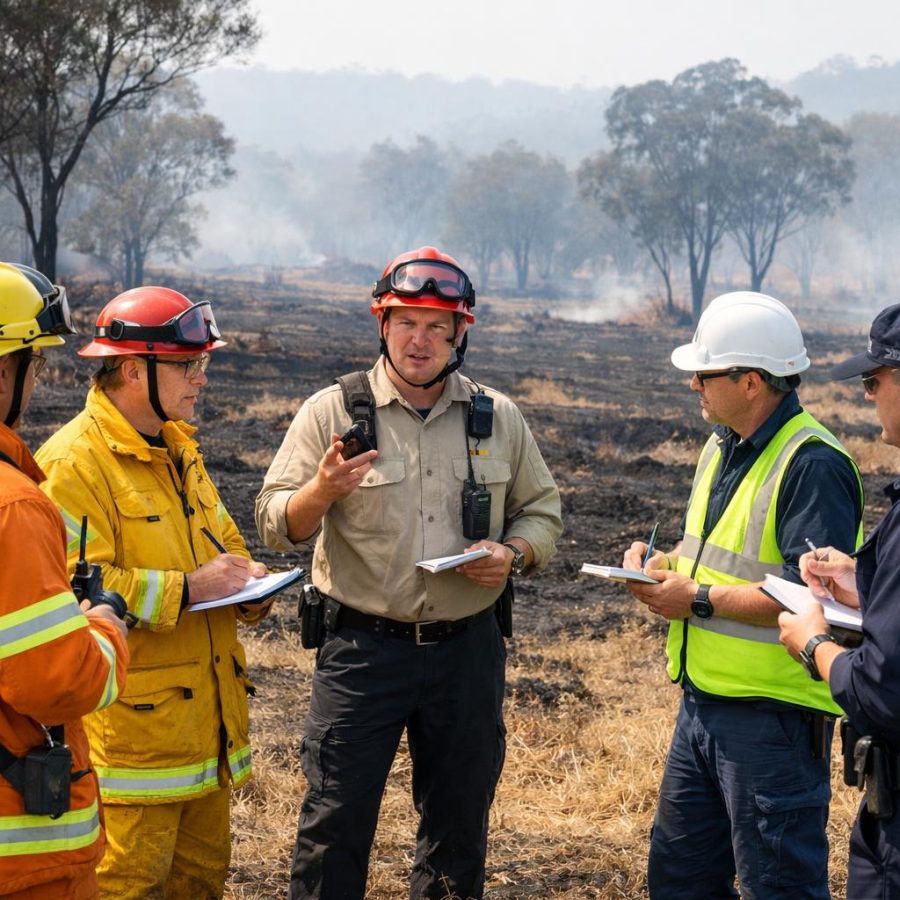
Large emergencies are difficult because many organisations may be working at the same time, often with incomplete information and competing demands. AIIMS provides a common management framework so those organisations can work toward agreed incident objectives rather than operating as separate groups.
The value is not limited to bushfire. AFAC describes AIIMS as an all-hazards, all-agencies system. The same underlying approach can support the management of fires, floods, storms, hazardous-material incidents and other complex emergencies, with the structure scaled to suit the incident.
A small incident does not need a large management team. As complexity grows, functions and specialist roles can be delegated. As the incident contracts, the structure can contract with it. That ability to expand and reduce is one of the reasons AIIMS is useful across very different types of emergencies.
AIIMS 2025 puts Safety First
One of the clearest changes in the current edition is that Safety First is now an official AIIMS principle. AFAC says this formalises safety as a foundational consideration in incident management rather than treating it as a separate task added later.
That matters operationally. Incident objectives, resource allocation, work periods, communications, intelligence and tactical decisions all have safety consequences. The system can provide structure, but it does not remove the need for judgement, dynamic risk assessment or people speaking up when conditions become unsafe.
Structure does not replace situational awareness
AIIMS is a management system, not a prediction engine. Fire behaviour, weather, access, communications and resource availability can change faster than a formal planning cycle. Current information from the field must continue to inform decisions.
Management by objectives
A central AIIMS idea is that an incident is managed against clear objectives. Those objectives describe what the incident management team is trying to achieve, and they guide strategies, tactics, resource priorities and information requirements.
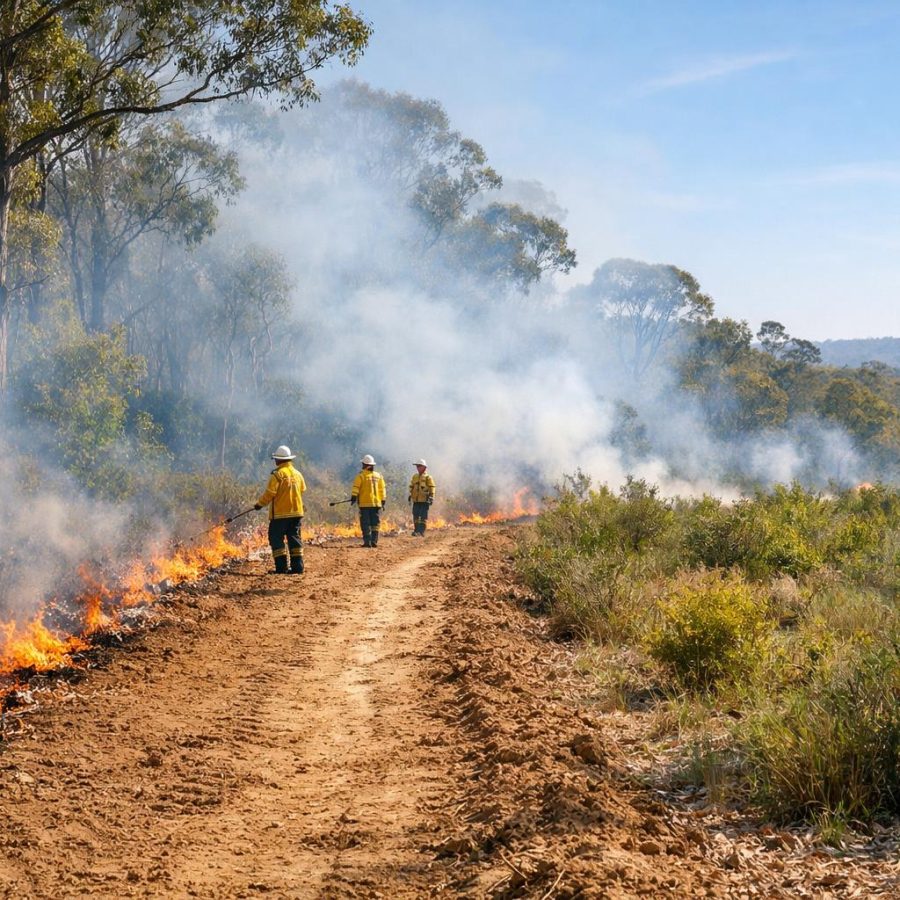
For a bushfire, objectives might address protection of life, firefighter safety, community warnings, containment priorities, critical infrastructure, environmental values and recovery needs. The exact objectives belong to the incident and the authorised controller; they should not be copied mechanically from another event.
The practical benefit is unity of effort. Crews, aircraft, public-information personnel, planners, logistics staff and partner agencies should understand the same priorities even though their individual tasks are different.
Functional management and delegation
AIIMS allows the Incident Controller to retain overall control while delegating functions as the incident becomes more complex. The structure is intended to support the controller, not bury them under every operational detail.
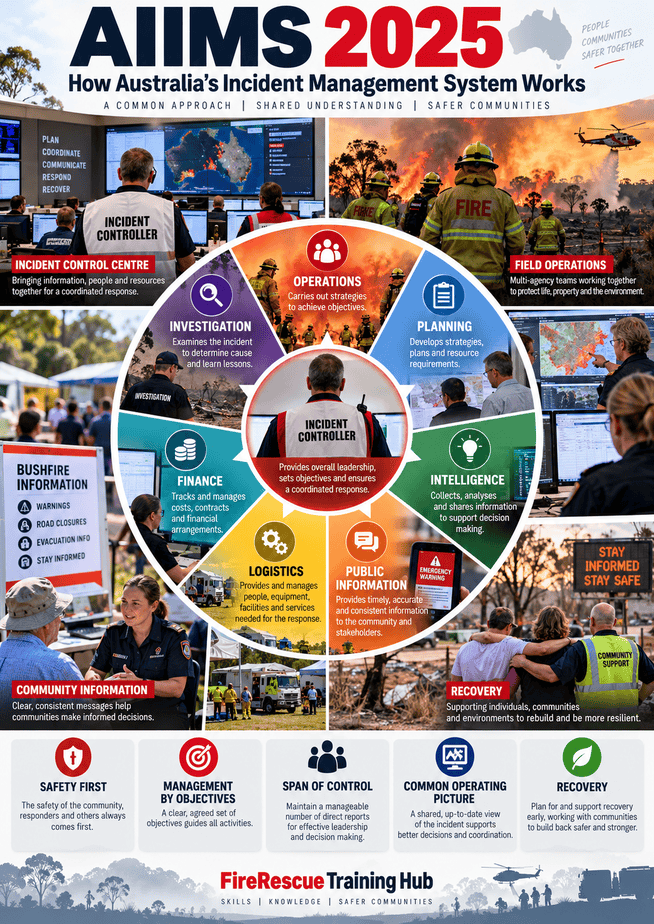
Current AFAC AIIMS 2025 aides-mémoire provide role descriptions, reporting relationships and task checklists across areas including Incident Control, Planning, Intelligence, Public Information, Operations, Investigation, Logistics and Finance. Not every incident requires every element to be activated as a separate position or unit.
| Area | Practical focus |
|---|---|
| Incident Control | Overall direction, priorities, objectives and control of the incident-management structure. |
| Operations | Implementation of strategies and management of operational resources and tasks. |
| Planning | Planning horizons, incident action planning, future needs and support for coordinated decision-making. |
| Intelligence | Collecting, validating, analysing and presenting information that supports situational awareness and decisions. |
| Public Information | Warnings, community information, media, accessible communication and social-media considerations. |
| Logistics | Resources, facilities, supplies, communications support and the practical needs that keep operations functioning. |
| Investigation | Investigation requirements where activated and appropriate to the incident. |
| Finance | Financial management and accountability requirements relevant to the incident. |
Span of control and scalable structure
Span of control is about keeping supervision manageable. When too many resources, teams or functions report directly to one person, clarity and safety can deteriorate. AIIMS provides a way to create additional supervisory layers when complexity grows and remove them when they are no longer needed.
The important idea is not to build the biggest possible organisation. It is to build the right-sized organisation for the incident. Over-structuring a small event can slow decisions; under-structuring a major event can overload individuals and create gaps.
Good implementation therefore depends on recognising when complexity has changed and adjusting the structure early enough to keep pace.
Information, intelligence and the common operating picture
AIIMS 2025 gives stronger attention to information flows, validation and technology. This reflects a basic incident-management problem: a team can have a clear structure and still make poor decisions if the information reaching it is late, incomplete or wrong.
A common operating picture is valuable because operational personnel, planners, controllers and partner agencies need a shared understanding of what is happening. In a bushfire this may include the fire edge, predicted spread, weather, threatened communities, crew locations, road access, warnings, critical infrastructure and resource status.
Technology can help, but it does not automatically create trustworthy intelligence. Information still needs to be checked, interpreted and communicated. AIIMS 2025’s stronger emphasis on validation and digital information recognises that modern incidents can produce more data than an IMT can use unless it is organised well.
Public information is an operational function
One of the enduring lessons from major Australian bushfires is that community information cannot be treated as an afterthought. People may need timely warnings and practical instructions while the incident is changing quickly.
The 2025 edition expands attention to community engagement, accessible communication and social media. AFAC also identifies the Social Media Officer as one of the roles given greater prominence in the current edition.
For incident managers, the challenge is not simply producing more messages. Information needs to be accurate enough to be trusted, fast enough to be useful and clear enough for the intended community to act on it.
Response and recovery are more closely connected
AFAC says AIIMS 2025 gives recovery its own dedicated chapter and strengthens the connection between operational response and recovery. This is significant because recovery does not start only after the last appliance leaves.
During an incident, decisions about access, utilities, public information, damaged infrastructure, displaced people, environmental impacts and handover arrangements can affect recovery for weeks or months.
A planned transition helps ensure information, responsibilities and community needs do not fall into a gap as the operational focus changes.
People, community values and volunteers
AIIMS is often drawn as an organisation chart, but its performance depends on people. AFAC’s description of the 2025 revision specifically refers to research on human psychology and social behaviour in teams managing incidents.
The current edition also gives greater prominence to the Values Officer, community engagement and the safe integration of spontaneous volunteers. These changes recognise that major incidents involve communities, cultural and environmental values, welfare issues and people who may want to help even though they are not part of the formal response organisation.
Good incident management therefore requires more than command. It requires listening, communication, inclusion, role clarity and the ability to use local knowledge without losing accountability or safety.
What Black Saturday taught incident management
The 2009 Victorian bushfires remain an important historical case study. The Victorian Bushfires Royal Commission identified serious shortcomings in incident and state-level emergency management, including leadership, information sharing, community warnings, integration, preparedness and Incident Controller training.
A peer-reviewed Australian Journal of Emergency Management analysis of command and control during the Kilmore East fire also highlighted how weak information flow can degrade coordination. Those lessons are useful because they show a recurring truth: an incident-management chart alone does not guarantee effective management. Qualified people, usable processes and enabling technology have to work together.
AIIMS has evolved since then. Historical findings should therefore be used to understand why doctrine changed, not presented as though the 2009 arrangements describe AIIMS 2025.
What Black Summer added to the picture
The 2019–20 Black Summer fires tested emergency arrangements over a vast area and over an extended period. The Royal Commission into National Natural Disaster Arrangements examined national coordination, information systems, preparedness, response and recovery following that season.
For AIIMS practitioners, Black Summer reinforced challenges around prolonged operations, interstate support, information sharing, resource prioritisation, communications resilience, public information and the transition into recovery.
Those lessons helped inform the environment in which the 2025 revision was developed. AFAC says the review considered major events, reviews, inquiries, research, technology changes and practitioner feedback rather than relying on one fire or one jurisdiction.
Why this article no longer gives AIIMS an “effectiveness percentage”
An earlier version of this FireRescue article assigned AIIMS an approximate percentage effectiveness score. That has been removed.
There is no credible single percentage that can measure the effectiveness of an incident management system across different hazards, jurisdictions, teams and events. Outcomes are influenced by fire behaviour, preparedness, staffing, communications, community exposure, infrastructure, leadership, timing and many other factors.
A better approach is to examine documented strengths and failures, identify the conditions under which the system works well, and use reviews and operational learning to improve implementation.
Operational perspective: AIIMS is only as strong as its implementation
From a fire-service operational perspective, the system is most useful when it creates clarity rather than paperwork. People at the incident need to understand the objectives, who they report to, what information is important, how safety issues are raised and what to do when conditions change.
The danger comes when the organisation chart looks correct but the information is stale, supervisors are overloaded, field intelligence is not reaching decision-makers or personnel are unsure who has authority. Those are human and implementation problems, but AIIMS must be flexible enough to help teams solve them rather than add friction.
That is why training, exercising, role competence, briefings, debriefings and continuous improvement matter just as much as knowing the names of the functions.
AIIMS training in 2026
AFAC’s current AIIMS Principles course reflects AIIMS 2025 and supports personnel who may work within a team-based AIIMS incident-management structure. AFAC states that role-specific positions such as Incident Controller require additional training and organisational approval beyond a general principles course.
This distinction is important. Understanding AIIMS is not the same as being authorised or competent to perform every Incident Management Team role. Agencies determine role requirements, currency, endorsement and operational authority.
For learners
Use this guide to understand the system. Use current AFAC resources and your organisation’s approved training to learn the doctrine and perform operational roles.
Practical questions for an Incident Management Team
- Are the incident objectives still appropriate for the conditions?
- Is the current structure the right size for the incident?
- Is any supervisor carrying an unmanageable span of control?
- What critical information is uncertain, outdated or unverified?
- Are field observations reaching Planning, Intelligence and Operations quickly enough?
- Are warnings and community information keeping pace with the threat?
- Are safety concerns being identified and acted on?
- What resource or communications failures could occur next?
- Are recovery consequences being considered during response decisions?
- What needs to change before the next operational period?
Historical FireRescue PDF
Archive note
FireRescue’s earlier detailed PDF was prepared before AIIMS 2025. It is retained as a historical analysis of major Australian bushfires, but it should not be used as current AIIMS doctrine or training material.
Key message
AIIMS remains Australia’s common incident-management framework for fire, emergency service and land-management agencies. The 2025 edition keeps the system recognisable while strengthening areas that modern incidents have shown to be critical.
Safety First, useful information, clear objectives, scalable structure, effective public communication, capable people and an early connection to recovery are central themes of contemporary AIIMS practice.
The system should not be judged by whether every incident runs perfectly. Its value lies in giving trained people a common framework for managing complexity — and in continuing to improve that framework as new lessons emerge.
- AFAC — Australasian Inter-service Incident Management System (AIIMS)
- AFAC — AIIMS 2025 Manual information
- AFAC — AIIMS Principles 2025 course update
- AFAC — Course in AIIMS Principles
- Royal Commission into National Natural Disaster Arrangements — Final Report
- Australian Disaster Resilience Knowledge Hub — Black Saturday command and control analysis
Ken Walker — former Station Officer and fire-service educator.
This article combines current AFAC public information with documented lessons from major Australian bushfires and an operational fire-service perspective. It does not reproduce or replace the proprietary AIIMS manual.
Training and operational disclaimer
This article provides general educational information only. AIIMS is formal incident-management doctrine and operational roles require current agency procedures, appropriate training, competency and authorisation. During an incident, follow the directions, doctrine and command arrangements of the responsible organisation.
FireRescue Training Hub
Access practical fire and emergency study support resources, downloads, checklists, audio guides, and member-only course content.
- Course library
- PDF downloads
- Audio guides
- Checklists
Study support only. Not accredited training or a replacement for workplace procedures.
About the author and safety review
Ken Walker
Former Station Officer and fire service educator
Former career firefighter with extensive career and volunteer fire service experience.
Qualifications: Associate Diploma of Applied Science in Fire Technology; Institute of Fire Engineers studies.
Author profilehttps://www.firerescue.com.au/about-us/