This final part of the learning series explains how authorised investigators determine wildfire origin and cause by analysing evidence, testing theories, reporting findings and securing records for later action. It is written as a study resource for learners and should be used alongside organisational procedures, approved methods and local requirements.
Introduction and study-support notice
This article covers Element 5 of PUAFIR603 Determine origin and cause of wildfire: analyse information to determine origin and cause of fire. It focuses on Performance Criteria 5.1 to 5.5 and explains the work that happens after information has been collected from the scene.
The material is designed for study and general learning. It is not a substitute for organisational policy, specialist instruction or legal advice. Actual investigation methods, report formats, evidence handling rules and approval pathways can vary across agencies, workplaces and jurisdictions. Always follow the procedures that apply to the incident and the role you hold.
In Australia, any immediate life-threatening emergency requires Triple Zero (000). Learners should also remember that wildfire investigations can involve risk, unstable terrain, damaged infrastructure and active suppression activity. Only authorised and trained personnel should enter or work in a scene.
This final stage is where careful thinking matters most. A scene may contain broken clues, conflicting accounts and disturbance from fire crews, weather and time. The investigator’s job is not to guess. The job is to examine the evidence methodically, test possible explanations and record a conclusion only when it is properly supported.
Learning outcomes
By the end of this article, learners should be able to describe how an authorised wildfire investigator can:
- organise collected information so it can be reviewed in a clear and logical way
- separate direct observation from interpretation, hypothesis and conclusion
- identify a likely area of origin and assess possible point of origin indicators
- develop and test origin-and-cause theories using approved scientific methods
- consider and eliminate alternative causes where the evidence allows
- report findings in a factual, neutral and structured way
- secure evidence and records for later examination or formal action
- complete the final wildfire investigation report and forward it through approved channels
These outcomes are closely linked. Good analysis supports good reporting. Good reporting depends on clear records. Good evidence security protects the final result from challenge, loss or confusion.
Organising collected information and evidence
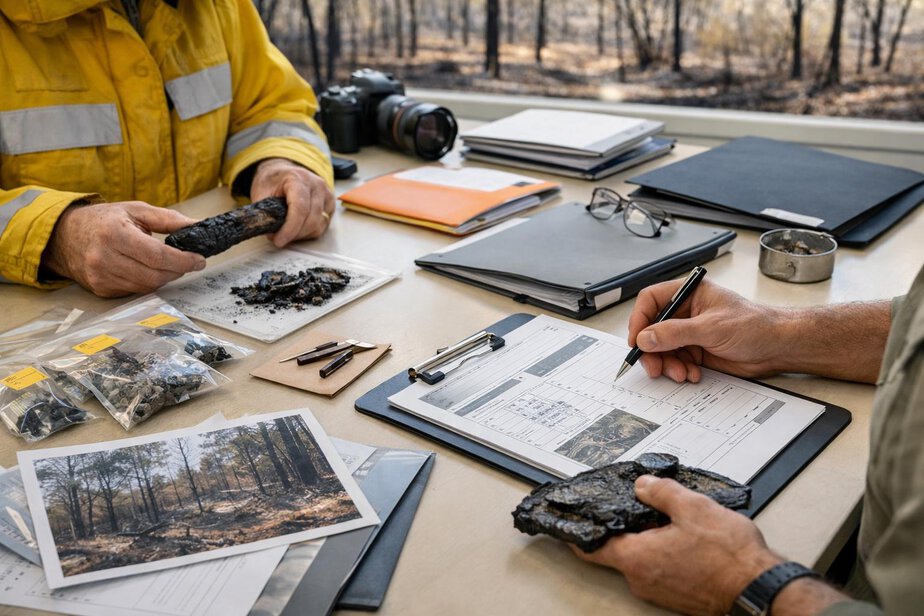
Before any theory is tested, the investigator needs to bring the collected material into a clear working order. A wildfire scene can produce many separate information streams. Some come from direct scene examination. Others come from people, records, devices or specialists. The investigator should review all available information, including:
- scene observations
- photographs and video
- maps and sketches
- fire-pattern indicators
- fuel, weather and topography
- witness accounts
- emergency calls
- first-arriving crew reports
- suppression activities
- damaged assets
- possible ignition sources
- laboratory or specialist findings
- evidence continuity records
These records are easier to use when they are organised by source, time, location and reliability. That means the investigator can see what came from where, when it was recorded, where it relates to the scene and how much confidence can be placed in it.
For example, a photograph taken before suppression activity may show fire-pattern indicators more clearly than a later image taken after machinery and hose lines have disturbed the area. A witness statement given soon after the event may be useful, but it still needs to be checked against the physical scene and other records.
Organising information also helps the investigator avoid being led too early by one piece of material. A single strong detail can appear convincing, but it may not tell the whole story. A scientific approach keeps the analysis open until all relevant evidence has been considered.
Helpful ways to organise the material
- group records into scene observations, witness material, operational records and specialist results
- compare entries against a simple time line
- mark where each item came from on the map or sketch
- note whether the source is direct, indirect, observed later or based on someone else’s account
- record missing information so it can be followed up if authorised
This stage is about discipline and clarity. It does not require a conclusion. It requires a working structure that allows the evidence to be reviewed fairly.
Separating observations, interpretations and conclusions
One of the most important skills in wildfire analysis is telling the difference between what was directly observed and what someone thinks it means. These are not the same thing.
Observation is what was directly seen, measured or recorded. For example, a patch of grass may be blackened in one direction, a tree trunk may be more deeply charred on one side, or a photograph may show a damaged fence near a roadway.
Information is material supplied by another source. This may include witness accounts, weather data, radio logs or a first-arriving crew report. It may be useful, but it is still second-hand unless the investigator has directly confirmed the detail.
Interpretation is what the evidence may mean. For example, a V-pattern in grass may suggest fire movement, but it does not on its own prove where ignition started.
Hypothesis is a possible explanation to be tested. For example, “The fire may have started near the machinery work area” is a hypothesis, not a fact.
Finding is a supported result of the investigation. It is a result that fits the reliable evidence and survives testing.
Conclusion is the final determination supported by the evidence as a whole. It should only be made when the collected material adequately supports it.
These differences matter because reports must not mix fact with opinion. A note that says “the fire definitely started at the machine” is too strong if the evidence only suggests that the machine is one possible source. Good investigators use careful language and explain why they reached their view.
Do not present assumptions as facts. If the evidence does not support a claim, the report should not pretend that it does.
The same rule applies to witness accounts. A person may describe what they thought they saw or heard. That account is useful, but it is not the same as direct physical confirmation.
Analysing the area of origin and point of origin
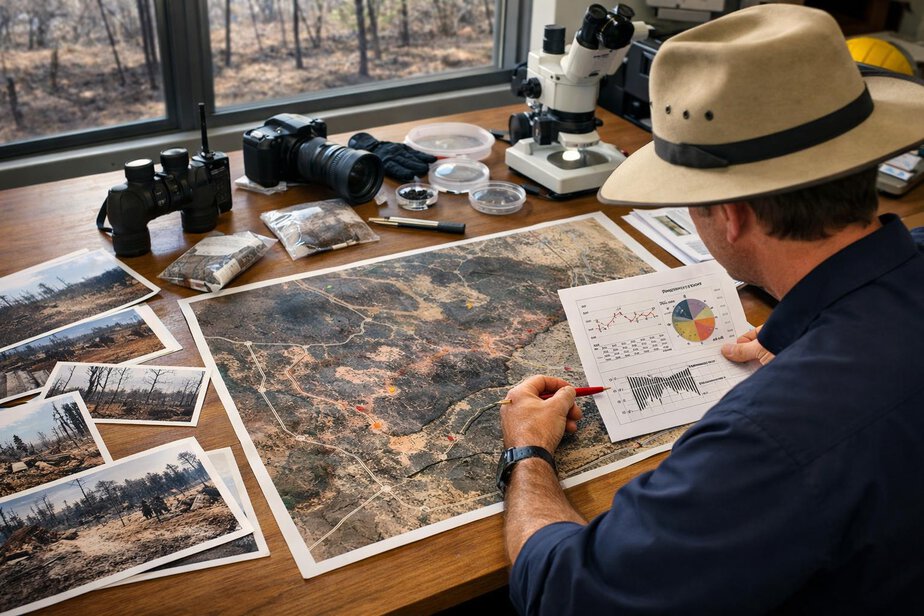
Origin analysis begins with the broad question of where the fire is most likely to have started. Investigators usually work from the larger area of origin towards a more specific point of origin if the evidence allows.
The area of origin is the general location where the evidence suggests the fire began. The point of origin is the more specific place within that area where ignition is supported by detailed examination.
Investigators may consider a range of indicators, including:
- advancing, backing and flanking fire indicators
- angle and depth of char
- ash, cupping and curling
- damage differentials
- die-out patterns
- foliage or leaf freeze
- grass stem indicators
- protection indicators
- sooting and staining
- transition zones
- V-pattern indicators
- fuel changes
- weather and wind
- slope and topography
- suppression disturbance
These indicators can help build a picture, but no single indicator should be treated as conclusive. Fire behaviour can change quickly. Wind, slope, fuel load, spotting and suppression actions can all affect what remains after the fire passes.
For example, a deep char pattern might seem to point to the first ignition point, but it may also reflect longer burning in that place, sheltered fuel, or later disturbance. A V-pattern may appear clear in one section and misleading in another because of wind shift or changes in fuel continuity.
It is also important to consider the effect of suppression. Firefighting vehicles, hoses, bulldozers, trail breaking, backburning, mopping up and access routes can all alter the scene. An investigator must recognise disturbance and avoid building a theory on evidence that has been changed after the fire.
Useful origin-analysis questions
- Where do multiple indicators begin to point in the same direction?
- Which parts of the scene are least disturbed?
- Do the indicators fit the known wind and slope?
- Do the patterns remain consistent when viewed from different angles?
- Is there a plausible ignition source nearby?
Origin analysis is about the weight of the whole scene, not the strength of one item. The investigator should keep asking whether the evidence keeps pointing to the same place, or whether it tells a different story when reviewed more carefully.
Developing possible origin-and-cause theories
Once the likely origin area has been identified, the investigator can develop possible theories about how ignition may have occurred. This is part of the scientific method. A theory in this context is not a guess. It is a reasoned explanation that can be tested against the evidence.
A simple approved investigation process may look like this:
- Recognise the need for investigation.
- Define the investigation question.
- Collect reliable information and evidence.
- Analyse the available material.
- Develop possible explanations.
- Test each explanation against the evidence.
- Consider alternative causes.
- Reject explanations that conflict with reliable evidence.
- Identify limitations and missing information.
- Form a conclusion only when adequately supported.
Actual methods must follow organisational procedures. The aim here is to show the logic of the process, not to replace formal training.
Possible cause categories may include:
- accidental
- negligent
- deliberate
- natural
- undetermined
Possible ignition sources may include:
- campfires
- debris burning
- electrical equipment
- machinery
- power lines
- rail activity
- smoking materials
- vehicles
- lightning
- deliberate fire lighting
- miscellaneous sources
The investigator must not assign criminal responsibility. The task is to determine what the evidence supports about origin and cause, not to make a legal finding beyond the evidence.
A good theory is specific enough to test. For example, “a machinery spark started the fire near the work area” is more useful than “something in the area caused the fire”. The first version can be checked against timing, fuel, weather and scene indicators. The second version is too broad to test well.
It is also acceptable for the final finding to remain undetermined if the evidence does not support one cause over another. That is not a failure. It is a responsible conclusion when the available information is incomplete or conflicting.
Testing theories using approved scientific methods
After several theories have been developed, each one should be tested against the full body of evidence. The investigator should ask clear questions for every proposed explanation:
- Does it fit the identified origin area?
- Does it match the fire-spread indicators?
- Is it consistent with the weather?
- Is it consistent with fuels and topography?
- Does witness information support or conflict with it?
- Was the possible ignition source capable of operating?
- Was it present at the relevant time?
- Could firefighting activity have changed the evidence?
- Is there another reasonable explanation?
- What evidence would disprove the theory?
This is where confirmation bias becomes a serious risk. Confirmation bias is the habit of focusing only on evidence that supports an early belief. An investigator may be tempted to settle on a familiar cause too quickly, especially if a witness mentions it first or if one item of physical evidence seems persuasive.
Good practice is to do the opposite. The investigator should actively look for evidence that challenges the preferred theory. If a theory cannot survive testing, it should be rejected or weakened. If several theories remain possible, the report should say so clearly.
Approved scientific methods usually involve comparison, reconstruction, elimination and reasoned judgement. They do not rely on one piece of information in isolation. A laboratory result, for example, may help, but it still has to fit the scene context. A residue may suggest a fuel or contaminant, yet it may also have come from another source, from equipment, or from movement across the site after ignition. The result must be interpreted with the complete scene evidence.
Investigators should also consider whether a theory still works after accounting for suppression disturbance. If the area was driven over by vehicles, watered, cut, scraped or bulldozed, some visible clues may no longer represent the original fire conditions. That does not make the evidence useless. It means the evidence must be weighed with care.
One indicator does not prove a cause. A witness statement does not prove a cause. A laboratory result does not prove a cause on its own. The conclusion must be based on the combined evidence.
Checks that strengthen theory testing
- compare the theory with multiple independent evidence sources
- note all conflicts, not just the supportive points
- record why some causes were excluded
- identify any unknowns that limit confidence
- avoid using words stronger than the evidence allows
Reporting findings and uncertainty
When the analysis stage is complete, the investigator must report and document findings according to organisational procedures and policies. The report should be clear, factual and neutral. It should separate facts from professional opinion and should not exaggerate certainty.
Useful report content commonly includes:
- investigator identity and authority
- date, time and location
- investigation purpose
- scene description
- safety and access arrangements
- information sources
- examination methods
- evidence collected
- continuity records
- witness information
- weather, fuel and topography
- firefighting disturbance
- analysis of origin
- analysis of possible causes
- alternative theories considered
- findings
- limitations
- recommendations or further action where authorised
- attachments and supporting records
The report should be written so another authorised person can follow the reasoning. If the report says the cause is supported, it should explain why. If the report says the cause is undetermined, it should explain what prevented a firmer finding.
Limitations matter. A limitation might be incomplete timing information, a witness who saw only part of the event, a disturbed scene, or a laboratory result that needs context. Good reporting acknowledges these issues instead of hiding them.
Clear language also matters. Words such as “possible”, “probable”, “supported”, “not supported” and “undetermined” should only be used according to approved organisational requirements. The investigator should not use strong language to sound more certain than the evidence allows.
Reports must be consistent with the notes, photographs, sketches, evidence registers and continuity records. If those records do not align, the report will be harder to trust.
Securing evidence for later action
Evidence may need to be kept for later examination or formal action. This can include further testing, specialist review, legal proceedings, coronial investigation, insurance enquiries, organisational review, product-safety action or later comparison. The exact retention process depends on organisational and jurisdictional rules, so no fixed period should be assumed in general training material.
Evidence should be secured using approved:
- packaging
- labels
- seals
- storage
- access controls
- transfer records
- electronic record systems
- continuity procedures
Good continuity means the investigator can show where the evidence came from, who handled it, when it changed hands and how it was protected. If evidence is moved, examined or transferred, the record should reflect that clearly.
This step matters because a strong conclusion can be weakened if evidence cannot be traced or authenticated. Even if the analysis is sound, poor evidence handling can create doubt. Secure storage also helps protect material from loss, damage, contamination or unauthorised access.
Information records should be protected too. Digital photographs, sketches, interview notes, laboratory reports and time lines may all become part of the final record. They should be stored and shared only through approved systems.
When evidence is being held for later action, the investigator should confirm that it remains accessible to authorised people and protected from unauthorised use. This is part of professional practice, not a separate extra task.
Completing and forwarding the investigation report
The final stage is to complete the wildfire investigation report and forward it to relevant authorities and stakeholders. This should happen through approved channels only. Do not send confidential reports through unapproved email, public platforms or casual messaging services.
The completed report should usually be:
- reviewed where required
- signed or authorised
- stored securely
- forwarded through approved channels
- provided only to authorised recipients
- supported by relevant attachments
- corrected through approved processes if an error is found
Relevant recipients may include authorised organisational managers, investigating authorities, legal personnel or other approved stakeholders. The exact recipient list depends on the incident, the agency and the rules that apply.
If an error is found after the report has been completed, it should not be quietly changed without process. Corrections should follow approved procedures so the record stays accurate and traceable.
This stage brings the whole investigation together. The work is not finished until the findings are properly recorded, safeguarded and delivered to the people who are allowed to use them.
FireRescue Training membership advertisement
Practical scenario: rural grass and scrub wildfire
Imagine a wildfire near a rural road where dry grass and scrub burned beside a machinery work area and damaged electrical infrastructure. The incident occurs on a warm, windy afternoon after a period of dry weather. The scene is partly disturbed by firefighting vehicles and later access by support crews.
The investigator arrives to find several possible ignition sources in or near the likely origin area:
- a machine that had been operating in the work area
- damaged electrical infrastructure near the roadside
- smoking material reported by one witness
- a roadside area where debris had previously been collected
- an unknown gap in the timing information between first smoke and first flame reports
Different witnesses give different accounts. One person says they saw smoke near the machinery first. Another says the fire seemed to begin closer to the road and electrical infrastructure. A third says they heard a pop but did not see the start point. None of the accounts gives the full picture.
Physical indicators suggest a likely area of origin near the boundary between the work area and the roadside verge. There are fire-pattern indicators in the grass, a transition in fuel type, and some signs that the fire spread with the wind. However, the investigator also notes that vehicles have driven through the area during suppression and that some ground cover is disturbed.
A laboratory result identifies fuel residue on a sample collected from the scene. That result is important, but it is not proof by itself. The residue may have come from machinery, contamination or another source. It must be interpreted alongside the complete scene evidence, not treated as the answer on its own.
The investigator then organises the information by time, source and location. The first-arriving report is compared with witness accounts, scene photos, the map, weather records, the fuel condition and the suppression notes. The investigator separates direct observation from interpretation and notes which details are uncertain because timing is incomplete.
Several theories are developed and tested:
- the fire started from machinery activity
- the fire started from damaged electrical infrastructure
- the fire started from a discarded smoking material
- the fire started from another accidental source not yet identified
Each theory is checked against the indicators. The investigator asks whether the source was present, whether it could have operated at the relevant time, whether the fire spread fits the wind and topography, and whether suppression activity may have changed the scene. The investigator also looks for evidence that would disprove each theory.
If the machinery theory explains the origin area but the timing is unclear, the report should say so. If the electrical theory conflicts with the damage pattern or with the position of the first indicators, it may be rejected. If smoking materials cannot be linked to a credible location or timing, that theory may also be weak. If no theory is supported strongly enough, the cause may remain undetermined.
Finally, the investigator secures the evidence, notes the continuity records, completes the report and forwards it through approved channels. The report explains the reasoning, the limitations and the degree of certainty allowed by the evidence.
This example shows the real task of wildfire analysis: not forcing a quick answer, but following the evidence wherever it leads.
Common analysis and reporting errors
Even experienced people can make mistakes when pressure is high or the scene is messy. Some of the most common errors are:
- deciding the cause before analysing all evidence
- treating one indicator as proof
- ignoring evidence that conflicts with the preferred theory
- confusing witness opinion with direct observation
- failing to consider suppression disturbance
- overstating certainty
- leaving unexplained gaps in reasoning
- mixing facts and opinions in the report
- failing to document limitations
- sending evidence or reports through unapproved channels
These mistakes are avoidable when the investigator follows a steady process. Slow down, compare records, test the alternatives and write clearly. If the evidence is weak or incomplete, say so. A cautious and honest report is better than a confident but unsupported one.
Another common problem is assuming that a scene “looks obvious”. In wildfire work, the obvious answer is not always the correct one. Weather shifts, uneven fuel loads, prior disturbance and suppression actions can all change the picture. That is why evidence review must be methodical.
Performance Criteria 5.1 to 5.5 checklist
Use this checklist as a study aid when reviewing Element 5.
- 5.1 Analyse and interpret collected information and evidence — I can explain how to organise scene observations, witness accounts, photographs, maps, reports and specialist results, and how to separate observation from interpretation.
- 5.2 Develop and assess origin-and-cause theories using approved scientific methods — I can describe how theories are created, tested, compared, challenged and either supported or rejected.
- 5.3 Report and document findings according to procedures and policies — I can identify the parts of a factual, neutral report and explain why uncertainty and limitations must be recorded.
- 5.4 Secure evidence for subsequent action — I can describe the need for packaging, labels, seals, storage, access control and continuity records.
- 5.5 Complete the wildfire investigation report and forward it to relevant authorities and stakeholders — I can explain the need for review, authorisation, secure storage and approved distribution.
If you can discuss each point in your own words, you are building the right study foundation for the unit.
Five-question knowledge check
1. Multiple choice: Which approach best supports a reliable wildfire conclusion?
- A. Choose the first cause that seems likely
- B. Rely on one witness statement if it sounds confident
- C. Compare all available evidence before deciding
- D. Use the newest photograph only
Correct answer: C
2. True or false: A laboratory result by itself can prove the cause of a wildfire.
Correct answer: False
3. Workplace decision: You find fire-pattern indicators, but the area has also been disturbed by suppression vehicles. What should you do first?
- A. Ignore the disturbance and keep the original theory
- B. Consider whether suppression has altered the evidence before drawing conclusions
- C. Treat the most dramatic indicator as the point of origin
- D. Stop all analysis and write an undetermined report immediately
Correct answer: B
4. Multiple choice: What is the best description of an observation?
- A. A witness belief about what probably happened
- B. A direct sight, measurement or record made at the scene
- C. A final cause determination
- D. A guess based on one clue
Correct answer: B
5. True or false: It is acceptable to send a confidential investigation report through any convenient public channel if the recipient is busy.
Correct answer: False
Five key takeaways
- Wildfire conclusions must be based on all available evidence, not one clue on its own.
- Observation, interpretation, hypothesis, finding and conclusion are different and should not be mixed.
- The area of origin and point of origin are identified by looking at the whole pattern, not one indicator.
- Good investigators test several theories, look for conflicting evidence and document uncertainty honestly.
- Evidence and reports must be secured, authorised and forwarded only through approved channels.
This concludes the learning resource for Element 5. The core message is simple: analyse carefully, test fairly, record clearly and secure everything properly. Before publication or assessment use, verify the facts, the wording and the local procedures that apply in your organisation and jurisdiction.
Remember to verify facts and local procedures before publication.
FireRescue Training Hub
Access practical fire and emergency study support resources, downloads, checklists, audio guides, and member-only course content.
- Course library
- PDF downloads
- Audio guides
- Checklists
Study support only. Not accredited training or a replacement for workplace procedures.
About the author and safety review
Ken Walker
Former Station Officer and fire service educator
Former career firefighter with extensive career and volunteer fire service experience.
Qualifications: Associate Diploma of Applied Science in Fire Technology; Institute of Fire Engineers studies.
Author profilehttps://www.firerescue.com.au/about-us/