When a major Australian emergency stretches on for days or weeks, help may arrive from interstate, overseas or both. That support can be vital, but it only works well when people share a clear system, clear language and a strong understanding of local conditions.
Why outside assistance is requested
Large emergencies can quickly outgrow the capacity of local crews. A fast-moving bushfire, a cluster of fires, a long suppression campaign or a prolonged relief effort can demand more firefighters, more incident management staff, more aircraft, more heavy machinery and more logistical support than one jurisdiction can safely sustain on its own.
In those situations, outside assistance is not a sign that local services have failed. It is a normal part of good emergency management. Australia uses mutual aid because emergencies do not respect borders, and because fatigue, travel time, weather and geography can all make a long campaign harder to manage with local resources alone.
During the January 2026 Victorian bushfires, Emergency Management Victoria reported that more than 550 firefighters and incident management personnel were supporting operations. That support included 460 personnel from Australian states and territories, 22 arduous firefighters from New Zealand and 74 Canadian personnel scheduled to arrive on 27 January. More than 70 aircraft were supporting operations, six Victorian fires were active at the time of the announcement, and more than 413,000 hectares had been affected during the season to that point.
AFAC also reported that national coordination helped deploy approximately 500 resources and 47 tankers to Victoria over six days, with national aircraft support including a large air tanker and two Black Hawk helicopters. Those figures show the scale that can develop when a season becomes widespread and sustained.
How incoming crews are registered and accounted for
The first task for incoming personnel is not to fight fire. It is to be properly registered, checked in and matched to the incident system. This helps the incident management team know who is present, where they came from, what skills they have, what equipment they brought and where they can be safely used.
Registration also supports welfare and accountability. If a crew is delayed, redeployed, resting or moved between locations, the system needs to show that clearly. In major incidents, that visibility is essential for safety, aviation planning, accommodation, transport and crew rotation.
Depending on the deployment, visiting personnel may arrive as strike teams, task forces, single resources, incident management staff, specialist plant operators or aircraft support personnel. The precise terminology can vary by agency, which is why the receiving team does not rely on assumptions. People are identified, briefed and placed into the incident structure deliberately.
Registration usually links to the crew’s qualifications and current role. A firefighter with aviation experience is not necessarily assigned to aircraft operations. A firefighter with chainsaw experience is not automatically sent to the most hazardous line work. Incident managers match people to tasks based on currency, capability and the local need at that time.
Briefing before action: what crews must know first
A strong briefing is the bridge between outside help and local operations. It explains the situation, the plan, the risks and the expectations. Without it, experienced people can still make dangerous mistakes because they are working in an unfamiliar context.
A good briefing normally covers the incident objectives, current fire behaviour, weather outlook, access and egress routes, sector boundaries, communications arrangements, aircraft activity, refuge or safety zones, medical arrangements and any special local concerns. It should also explain who the crew reports to, what their task is, and when they are expected to check back in.
Clear language matters. Fireground talk can be fast and informal, but during a major multi-agency response everyone benefits from plain speech. That means using the words and terms agreed in the incident plan, avoiding slang where possible and confirming understanding rather than guessing.
Repeat-back communication is especially useful. If a crew is told to move to a location, complete a specific task or change a plan, asking them to repeat the instruction helps catch misunderstandings before they become safety problems. Written plans, sector maps and marked reference points add another layer of clarity, especially when radio traffic is busy.
One short fictional example shows the process. A visiting strike team arrives at a staging area after a long drive from another state. The crew leader is taken to the briefing point, where the liaison officer explains the local fire edge, the wind forecast, access tracks, known hazards and the radio call sign to use. The leader is shown a map, repeats the assignment back, checks the crew’s water and fuel status, and then takes the team to the sector supervisor for final tasking. Nothing dramatic has happened, but a lot of risk has been removed through a calm and structured handover.
Differences in vehicles, fittings, clothing and radios
One of the biggest traps in interstate or international deployments is assuming that equipment looks the same, behaves the same or connects the same way everywhere. Even when the task is identical, the hardware may not be.
Firefighting vehicles can differ in pump layout, tank size, hose storage, crew seating, tool placement and off-road capability. Hose fittings may not match without adapters. Protective clothing can differ in cut, weight, closures and expected layering. Radio systems may use different channels, procedures, terminology or coverage arrangements. Breathing apparatus, chainsaws, pumps and other tools may also vary in their setup or operating sequence.
Those differences are not a problem if they are recognised early. They become a problem when a person assumes a familiar-looking item works in the familiar way. A crew from another jurisdiction may be highly skilled, but skill does not replace local familiarity.
This is why the incident management team should not simply hand over equipment without explanation. A quick walk-through can prevent a mistake. Show the vehicle. Show the pump. Show the hose fittings. Show how the radio is expected to be used. Confirm what is standard on that incident and what is not.
| Topic | Why it matters | What to confirm |
|---|---|---|
| Vehicle setup | Controls and storage differ | Pump, tank, tools and seating layout |
| Hose fittings | Connections may not match | Compatible fittings and adapters |
| Protective clothing | Fit and function affect comfort and safety | Size, layering and local issue of PPE |
| Radio systems | Communication failures create risk | Call signs, channels and radio discipline |
| Terminology | Words may mean different things | Local task names and reporting terms |
The table above is not a technical checklist. It is a reminder that “similar” is not the same as “identical”. In a major incident, those differences must be acknowledged before work begins.
Why words, maps and call signs matter
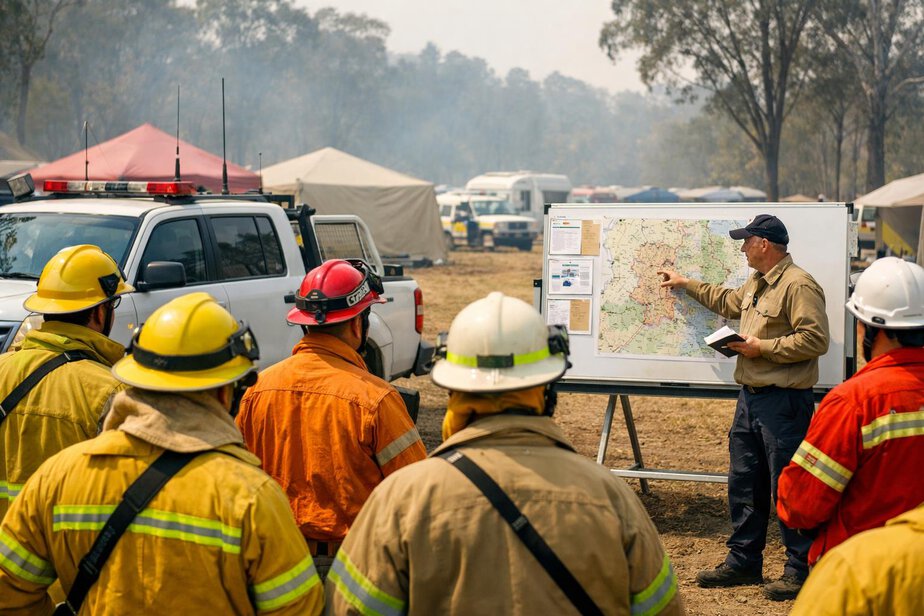
Good emergency operations depend on people knowing exactly who is speaking, where they are operating and what they are expected to do. Radio call signs and mapped sector boundaries help keep that clarity in place when many crews are working across a wide area.
Call signs are not just labels. They are part of the incident safety system. They help the controller, sector leaders and aircraft operators identify who is where, and they reduce the chance of confusion between similarly named places or resources.
Maps are just as important. In bushfire operations, road names may be long, unsealed tracks may change condition quickly, and landmarks can be unfamiliar to visiting crews. A paper map, a digital map or both may be used depending on the operation, but the key is that everyone is working from the same picture of the incident.
Clear language also protects against assumptions. Some words are used differently across agencies and countries. A simple term in one place can have a more specific meaning in another. That is why incident controllers and sector leaders should favour plain instructions and confirm that the receiver understands the local meaning before action starts.
For visiting personnel, this is not a test of intelligence or experience. It is a recognition that operational language is local. Even highly experienced firefighters need time to adapt when they arrive in a different system.
How AIIMS supports cooperation without forcing sameness
Australia’s incident management approach, AIIMS, is designed to help many agencies work together under one common structure. It does this through functional management, an appropriate span of control and unity of command. Those principles allow the incident to be organised in a way that is clear, scalable and flexible.
Functional management means tasks are grouped into core functions such as control, operations, planning, logistics and public information. Span of control means no supervisor is expected to manage too many people directly. Unity of command means each person has one clear line of supervision for their task at that time.
That structure is especially useful during interstate and international deployments because it gives everyone a shared framework. A visiting crew may not use exactly the same local terminology or vehicle design, but they can still fit into the same management system if the roles, reporting lines and objectives are clear.
AIIMS does not erase agency identity. Fire services, land managers, aviation partners, emergency services and visiting crews all retain their own expertise and internal procedures. What AIIMS provides is a way to connect those differences safely so the incident can be managed as one operation rather than many disconnected ones.
This matters in a season like the January 2026 Victorian bushfires, where multiple fires, multiple jurisdictions and large numbers of personnel all had to be coordinated at once. A common structure reduces the chance of duplication, missed handovers and conflicting instructions.
Local hazard awareness is not optional
A crew arriving from another region may be expert in wildfire work, but the local hazards still need to be explained in detail. Road access can be narrow, steep, soft, washed out or obstructed. Terrain can create blind corners and trap crews in dead ends. Fuels can burn differently across forest, grassland and mixed landscapes. Weather can change rapidly and drive unexpected fire behaviour. Powerlines, fences, farm infrastructure and water points can all create added risk.
Community risks matter too. Homes, sheds, livestock, tourists, volunteers and traffic all shape how an incident is managed. Local people may know which roads are usually passable, which tracks flood after rain, where fuel breaks are weak, or which communities need extra warning because of access constraints or vulnerable residents.
That local knowledge is often best captured through landholders, local firefighters, community leaders and liaison staff who know the area well. Their information should be treated seriously, checked where possible and folded into the incident plan. A visiting crew can be highly capable, but it will not know the small clues that locals recognise instantly unless someone points them out.
Weather and terrain briefings are especially important for overseas crews because they may be encountering different fuel types, different heat patterns or different response distances. The receiving agency should not assume that “bushfire” means the same operating environment in every country.
At the same time, local knowledge should never override formal safety systems. If a local resident says a track is usually fine, that still needs to be assessed against current conditions, the fire plan and the controller’s directions. Local insight is valuable because it informs the plan; it does not replace the plan.
Support needs: fatigue, accommodation, meals and transport
Major incidents are not sustained by fireline action alone. Crews need somewhere to sleep, food to eat, water to drink, clean clothing where possible, transport between base and tasking areas, and access to medical support when required. If those needs are not managed well, performance drops and safety risk rises.
Fatigue management is particularly important for visiting crews. Travel itself is tiring. Time zone changes, different meal patterns and unfamiliar accommodation can all reduce alertness. A strong deployment system will plan for rest, rotation and realistic task duration rather than pushing people to the edge of exhaustion.
Incident management teams also need to think about practical details such as crew tracking, vehicle servicing, refuelling, communications charging, interpreter support where needed and the safe movement of people to and from the work area. A crew cannot operate effectively if it spends half the day solving transport and welfare problems.
Medical needs must be handled through the correct channels. That does not mean every small issue becomes an emergency, but it does mean the system should know how to respond if a firefighter is dehydrated, injured or unwell. Visiting personnel should be told how to access help, what information they need to provide and who they report to if their condition changes.
Accommodation and meal arrangements may look ordinary, but they are an operational issue. Good welfare support helps people stay focused, remain compliant with safety directions and recover enough to work another shift.
Liaison officers, strike-team leaders and incident management teams
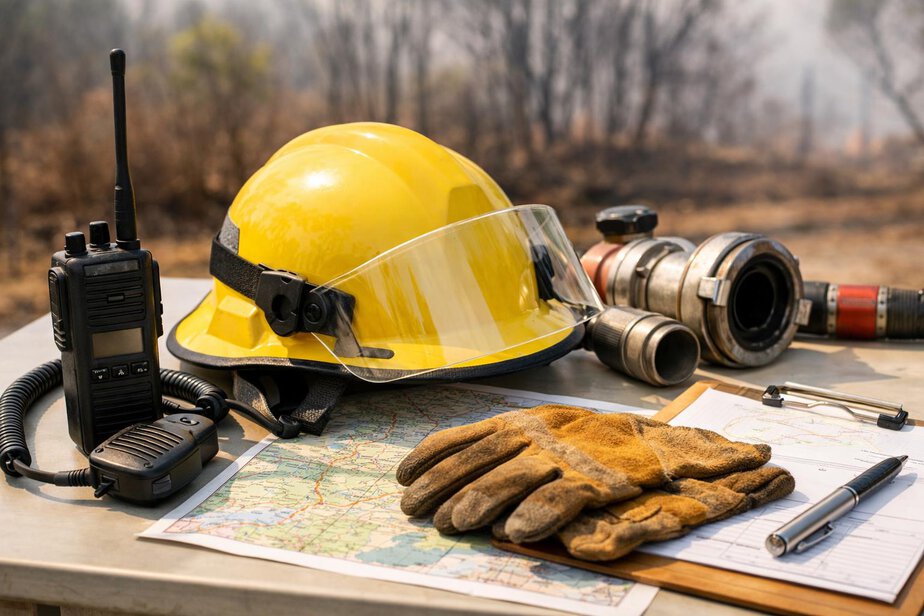
When many agencies and many crews are involved, the people who translate between groups are just as important as the people on the line. Liaison officers, strike-team leaders and incident management teams reduce confusion by turning broad objectives into practical, local action.
Liaison officers help visiting crews understand the local system and help the local system understand the visiting crews. They can answer questions about terminology, reporting lines, welfare arrangements, access to maps and any unique features of the incident structure.
Strike-team leaders and task force leaders act as the immediate connection between the incident controller or sector leader and the crews carrying out the work. They carry instructions, check understanding, report progress and raise issues early. That role is especially important when crews arrive with different backgrounds or equipment.
Incident management teams provide the framework that holds all of this together. They set the objectives, allocate resources, maintain the common operating picture and update the plan as the incident changes. They also make sure that outside assistance is used where it is most needed, rather than simply where it is easiest to place.
Good coordination does not mean endless meetings. It means the right people are talking at the right time, and the crew on the ground knows exactly who to report to and what the current objective is.
What a visiting crew learns in the first few hours
The first hours after arrival are usually a concentrated learning period. A visiting crew may already be tired from travel, but they still need enough time to absorb the local picture before they are put into the field.
They will normally receive a situation update, safety briefing, map review and task assignment. They may also be shown the staging area, the communications plan, the water and fuel points, the refreshment area and the process for checking back in after deployment. If aircraft are active, they need to know where aviation operations are happening and how ground crews should keep clear.
Depending on the incident, the crew may be told about smoke movement, falling tree risks, damaged roads, livestock, public access restrictions or the presence of overhead hazards. They may also be advised how the local community is being supported and where the boundaries are for public information.
At this point, the crew’s own experience becomes most useful when combined with the local plan. Good responders do not try to reinvent the response. They fit their skills into the operation they have been briefed on.
If something is unclear, it should be raised immediately. A short delay to clarify a task is far safer than a long delay caused by misunderstanding.
Why deployments build long-term capability
Interstate and international deployments are not only about meeting the current fire demand. They also build future capability. Crews learn from each other, leaders strengthen working relationships and agencies gain a deeper understanding of how different systems operate under pressure.
That experience is valuable because the next emergency may require the same people to work together again. A successful deployment builds trust. It helps people know who to call, how to ask for help, what information is most useful and how to integrate quickly when the pressure is high.
For visiting personnel, the deployment can broaden practical skills. They may work in different terrain, encounter different fuels, adapt to different equipment or observe different command practices. For local crews, the value lies in seeing how others solve problems and in gaining extra capacity when their own resources are stretched.
These exchanges also strengthen resilience at a national and international level. When relationships already exist, coordination is faster the next time assistance is needed. That is one reason mutual aid arrangements matter so much during large fire seasons.
Respect is central to that process. No agency or country should be treated as a guest without value. Each brings experience, and each must be integrated in a way that keeps the operation safe and effective.
Practical lessons from the January 2026 Victorian fires
The January 2026 Victorian bushfires showed how quickly a major season can require broad support. More than 550 firefighters and incident management personnel were involved, supported by large numbers of aircraft and coordinated national resource deployment. That scale makes one lesson very clear: the system must be ready to absorb help as soon as it arrives.
The main lessons are not complicated, but they are easy to overlook when people are tired. First, registration and accountability must happen early. Second, briefings must be clear and repeated where needed. Third, equipment differences must be checked rather than assumed away. Fourth, local hazards must be explained in plain language. Fifth, welfare and fatigue management must be treated as part of the operation, not as an afterthought.
The same lessons apply whether the support comes from another Australian state, New Zealand, Canada or elsewhere. The goal is always the same: use every person safely, make the best use of local knowledge and keep the incident under a single coherent plan.
In a major emergency, the strongest team is not the one with the most familiar equipment. It is the one that can quickly work together, speak clearly and follow one shared incident structure.
Five practical lessons for successful multi-agency cooperation
- Register every incoming crew, resource and leader before tasking them, so accountability and welfare are clear from the start.
- Use a briefing, a map and repeat-back communication for every new assignment, especially when crews are unfamiliar with local roads, terrain or terminology.
- Check differences in vehicles, hose fittings, protective clothing, radios and operating procedures before deployment, not after a mistake occurs.
- Use liaison officers, strike-team leaders and incident management teams to connect local knowledge with visiting capability and keep unity of command intact.
- Manage fatigue, accommodation, transport, meals and medical support as part of the incident plan, because strong welfare support is operational support.
Interstate and overseas deployments can be demanding, but they are also one of the clearest examples of how emergency services cooperate under pressure. The visiting crews bring additional hands, experience and specialist skills. Local crews bring place knowledge, incident context and direct understanding of the community. AIIMS provides the common framework that allows both sides to work together safely.
This article is general educational information only. Personnel must follow their own agency procedures, the local incident plan and the directions of the incident controller. Before publication, verify facts, local terminology and any current operational arrangements with the relevant agencies and procedures.
FireRescue Training Hub
Access practical fire and emergency study support resources, downloads, checklists, audio guides, and member-only course content.
- Course library
- PDF downloads
- Audio guides
- Checklists
Study support only. Not accredited training or a replacement for workplace procedures.
About the author and safety review
Ken Walker
Former Station Officer and fire service educator
Former career firefighter with extensive career and volunteer fire service experience.
Qualifications: Associate Diploma of Applied Science in Fire Technology; Institute of Fire Engineers studies.
Author profilehttps://www.firerescue.com.au/about-us/