Designing a rural firefighting tanker for Australian conditions is not just a matter of fitting a big tank to a truck. The best design balances water capacity, mobility, stability, crew protection and pump performance so the vehicle can work safely on roads, fire trails, paddocks and rough country. This guide explains how to think through a 2,000 to 5,000 litre tanker design and why the right answer depends on where the vehicle will operate.
Start with the job the tanker must do
Australian rural firefighting tankers are used in very different environments. Some spend most of their time on narrow farm tracks and quick attack jobs. Others need to support extended operations where refill points are far apart. A good design starts by matching the vehicle to the terrain, the likely fire behaviour and the crew tasks it must perform.
The first question is simple: what is the tanker meant to achieve most often? If the vehicle must move quickly through tight access, carry a small crew and provide fast initial attack, the design should favour mobility and lower mass. If the vehicle must stay on the fireground for longer periods without frequent refilling, water endurance becomes more important. If the work area includes rough hills, soft shoulders, creek crossings or unsealed roads, stability and axle loading become critical.
This is why tank size cannot be chosen in isolation. A larger tank increases endurance, but it also increases weight, raises the engineering demands on the chassis and can reduce access to difficult terrain. In practice, the tank size, chassis, pump, crew protection and equipment storage all need to be designed as one integrated system.
Why diesel power is the baseline choice
For a practical rural tanker, both the truck engine and any separate firefighting pump engine should use diesel fuel. Diesel is the preferred baseline because it suits long operating hours, heavy loads and remote-area refuelling arrangements. It also aligns well with a tanker that may need to sit idle for periods, then start reliably and work under sustained demand.
The propulsion engine should be a turbocharged diesel truck engine with enough torque for off-road work and hill climbing. In most general-purpose designs, an output in the range of about 180 to 220 kW is a sensible target for a medium rural tanker, although the final requirement depends on the chassis, gross vehicle mass and the terrain it must cover.
If the tanker uses a separate main firefighting pump engine, that pump should also be diesel powered. Secondary pump arrangements may be diesel, hydraulic or power-take-off driven. Petrol-powered pumps are not a good fit for this class of vehicle because the tanker is already a heavy-duty diesel platform, and fuel commonality, reliability and operating discipline are important in emergency service use.
Diesel also simplifies logistics for brigades and landholders operating in remote settings. That said, the exact fuel system, storage and refuelling arrangement should be designed to suit the vehicle’s operating profile, local policies and engineering constraints.
How tank size changes mobility, endurance and safety
Water weighs approximately one kilogram per litre. That simple fact drives much of the tanker design process. A 2,000 litre tank carries about 2,000 kilograms of water. A 3,000 litre tank carries about 3,000 kilograms. A 4,000 litre tank carries about 4,000 kilograms. A 5,000 litre tank carries about 5,000 kilograms.
Those figures do not include the truck, tank structure, pump, crew, diesel fuel, foam, hoses, tools or other equipment. Once all of those are added, the gross vehicle mass rises quickly. That is why a tanker that seems manageable in theory can become difficult to control if the chassis is too light or the water tank is positioned too high.
Increasing water capacity improves endurance. The vehicle can stay on task longer, protect more property before refilling and maintain a reserve for crew protection. But there are trade-offs. A larger tanker needs stronger brakes, better suspension, higher axle capacities and more careful stability management. It may also need a wider turning circle, more space to manoeuvre and stronger recovery planning if it becomes bogged or trapped.
There is also a clear access issue. A compact tanker is more likely to fit through narrow gates, around trees and along uneven fire trails. A larger tanker may still be suitable in rural districts, but only if the roads, bridges and tracks can safely support it. This is why the design must be matched to the local operating area rather than selected by tank size alone.
| Tank size | Approximate water weight | Main design effect |
|---|---|---|
| 2,000 litres | 2,000 kg | High mobility, shorter endurance |
| 3,000 litres | 3,000 kg | Balanced mobility and endurance |
| 4,000 litres | 4,000 kg | Better remote-area endurance |
| 5,000 litres | 5,000 kg | Heavy-duty chassis and stability demands |
Selecting the right chassis, drivetrain and braking package
For Australian rural firefighting use, the chassis must be a true heavy-duty diesel truck platform. A four-wheel-drive chassis is the best general choice for most tanker roles because it improves traction on dirt roads, loose shoulders, slopes and wet ground. Low-range gearing and differential locks are valuable because they help the vehicle move slowly and steadily in difficult terrain.
Every tanker should include heavy-duty suspension and brakes, high ground clearance, protected fuel, electrical and air systems, a full-size spare wheel and safe recovery points. An exhaust brake or retarder is also valuable because it helps manage speed on descents without relying only on service brakes. That matters when the vehicle is heavily loaded and may be working in hilly country.
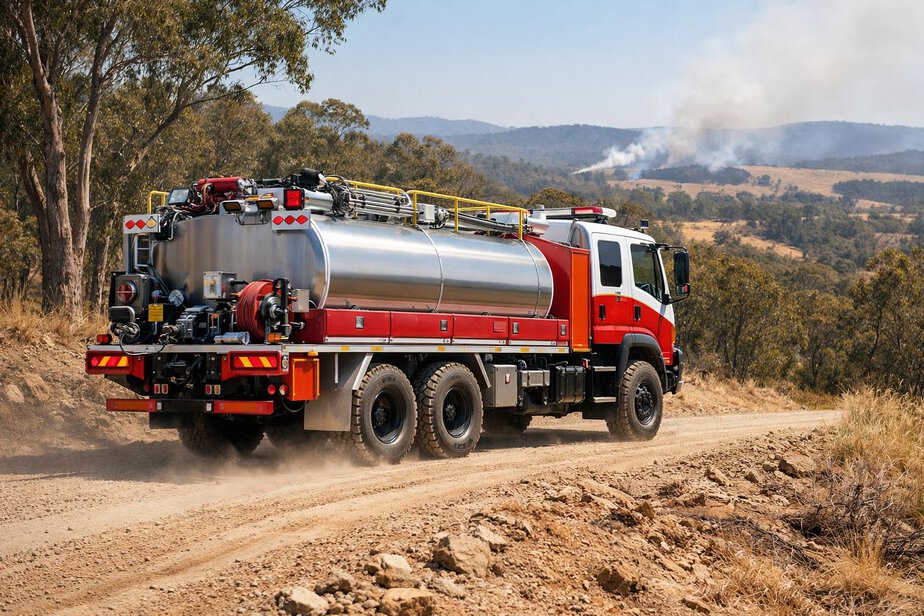
For a recommended general-purpose tanker, a 3,000 litre 4×4 diesel truck on an approximately 14.5 to 15 tonne chassis is a strong baseline. That size can usually carry a practical equipment load, provide crew protection and still remain nimble enough for rural tracks. It is a sensible compromise between capacity and access.
For a 4,000 litre tanker, the chassis needs to be rated for the higher mass and the vehicle should be planned for more remote operations where refill points are further apart. This option gives more endurance while still remaining within a relatively manageable range if the chassis and suspension are properly selected.
A 5,000 litre tanker is a different class again. It requires a heavier chassis, stronger brakes and much more attention to axle loading and body mounting. In many cases, a 6×6 configuration may be needed to support the weight, improve stability and spread the load more effectively. A medium truck should not simply be fitted with a larger tank and expected to cope.
Tank construction, baffling and centre of gravity
The tank should be mounted low and close to the centre of the vehicle. This helps reduce rollover risk and keeps the mass where the chassis can handle it most effectively. A high-mounted tank increases the centre of gravity and makes the vehicle less stable on side slopes, during braking and when cornering with a partial load.
Good internal baffling is essential. The tank should have properly designed longitudinal and transverse baffles to reduce water surge. Without baffles, water moves forcefully from side to side and front to rear when the tanker brakes, turns or drives across slopes. That movement can unsettle the vehicle and make steering and braking less predictable.
Possible tank materials include heavy-duty polyethylene, galvanised steel, stainless steel and aluminium. There is no single perfect material for every build. The final choice should consider weight, heat exposure, fatigue, corrosion, repair requirements and the way the tanker will be used. A lighter tank can help with mass management, but it still needs to withstand heat, vibration and rough terrain.
The tank should also include inspection access, drainage from the lowest point, overflow protection, water-level indicators, an in-cab water-level display, a pump-panel display and low-water alarms. These are not minor extras. They help the crew manage the water supply, protect the vehicle from accidental emptying of the reserve and reduce the chance of operational surprises.
Part of the water supply should be reserved for emergency crew and vehicle protection. That reserve must not be accidentally used during normal firefighting. As a practical planning guide, a 2,000 litre tanker might protect about 300 to 400 litres, a 3,000 litre tanker about 450 to 600 litres, a 4,000 litre tanker about 600 to 750 litres and a 5,000 litre tanker about 750 to 1,000 litres. The exact reserve policy should be engineered and controlled so it is not lost through poor gauge design or pump settings.
Water reserve management is one of the simplest ways to improve crew safety. A tanker that always retains enough water for self-protection is far more useful than one that can empty itself completely and leave the crew exposed.
Pump design, pump-and-roll and water delivery
A rural tanker should be able to pump effectively while moving slowly along the fire edge. This is known as pump-and-roll operation, and it is essential for grassfire work in Australia. It allows the tanker to advance along a fireline while the crew applies water to the edge, spot fires or exposed fuels without stopping for every short attack.
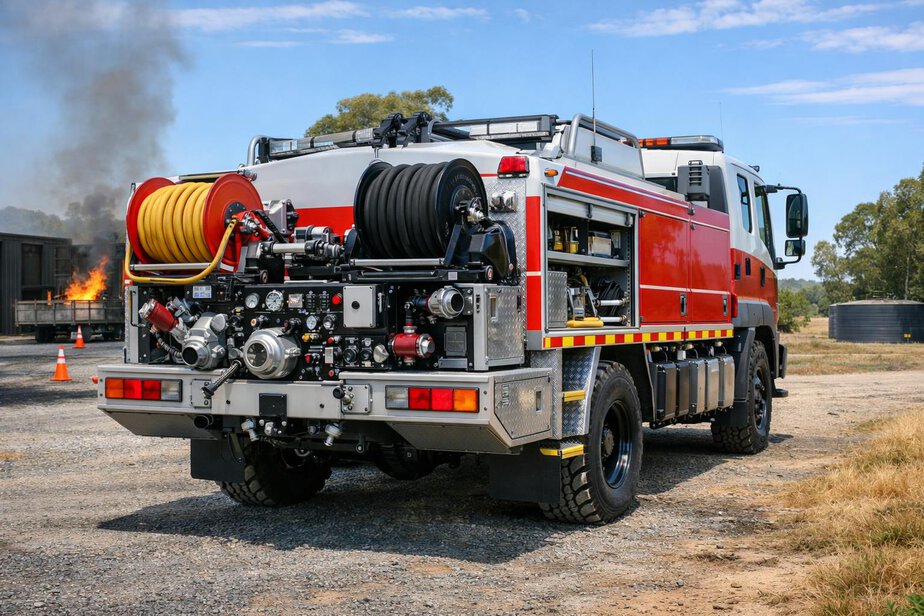
Pump-and-roll controls should be available inside the cabin, at the pump panel and at the protected rear crew position if one is fitted. The system should include pressure control, low-water protection, emergency stops and pump-temperature monitoring. These features help the crew stay focused on the fireground instead of constantly managing the mechanics of the pump.
Suggested main pump performance varies with tank size. A 2,000 litre tanker may use a pump in the range of about 900 to 1,200 litres per minute. A 3,000 litre tanker may be around 1,200 to 1,400 litres per minute. A 4,000 to 5,000 litre tanker may need about 1,400 to 1,700 litres per minute. Those figures are useful planning guides, but they must be matched to the available water supply and the vehicle’s ability to support the pump load.
A high-capacity pump should not normally run at full output from the onboard tank alone. High flow is most useful when the tanker is connected to a hydrant, dam, water tank or relay supply. If the system is designed only around maximum pump output and not around sustainable tank supply, the vehicle may exhaust its water too quickly and lose operational value.
Hose equipment should be practical and easy to access. Two rear-mounted electric hose reels with about 60 metres of hose on each reel are a strong option. Adjustable jet and fog nozzles give the crew more control over water application. A separate high-pressure hose for mop-up, a large-bore suction connection, a fast-fill connection and multiple rear and side deliveries all add flexibility.
A remote-controlled front monitor is useful for quick attack and exposure protection. It should allow in-cab operation, jet and fog patterns, a flow range of about 100 to 450 litres per minute, manual emergency override and a safe automatic stow position. The monitor should be positioned and protected so it can be used without exposing the crew to avoidable risk.
Foam systems and rapid refill capability
A Class A foam system can improve water penetration and flame knockdown when used correctly. It may also help the crew achieve better results with less water in some fuel types and weather conditions. For rural tankers, a practical foam system usually includes about 30 to 50 litres of concentrate, adjustable proportioning, isolation and flushing controls, ground-level filling and spill protection.
The foam system must be compatible with approved Australian firefighting foam and it should be used carefully near waterways, dams, organic farms, catchments and environmentally sensitive areas. Foam can be useful, but it is not a substitute for sound fireground judgement or proper environmental precautions.
Rapid water refill capability is just as important as the onboard tank. A tanker with good refill arrangements can remain useful for much longer than a tanker that must return to base too often. Fast-fill connections, suitable suction points and easy access to draft water from a dam, tanker support point or static supply can make a major difference in the field.
Where local practice allows, the vehicle should support efficient filling from multiple sources. That includes suction from open water and fast-fill from a suitable pressure supply. The tank design should also allow quick drainage from the lowest point so maintenance and contamination control are simpler.
Crew protection, burnover sprays and rear crew decks
Firefighter protection is a core design requirement, not an optional extra. A tanker should include five properly engineered seatbelt positions where a five-person crew cab is used, rollover protection, a strengthened cabin structure, fire-resistant curtains, fire blankets for every crew member, cabin and vehicle spray protection, air conditioning, rear and side cameras, heat-resistant wiring and hoses, and emergency activation controls.
The burnover protection system should spray the cabin roof and windows, doors and steps, the rear crew deck, the water tank, the pump area, tyres and wheel arches, the fuel tank, and critical hoses and wiring. The purpose is not to make the tanker invulnerable. It is to improve survivability if the vehicle is caught in extreme radiant heat, embers or flame exposure.
Where firefighters operate from a rear crew deck, that deck must be professionally designed and protected. It should include strong guardrails, anti-slip flooring, crew restraints where required, heat shielding, spray protection, radiant heat protection, emergency-stop controls, communication with the driver, secure hose controls and safe access and exit. A poorly designed crew deck can create more risk than it solves.
Equipment storage, access and the right size for the task
Every kilogram of equipment matters. Heavy items should be stored low, close to the centreline and between the axles where possible. That approach helps keep the tanker stable and reduces the chance of unhelpful weight transfer on rough ground. Light items can be placed higher if necessary, but the overall layout should still favour balance and access.
Typical equipment may include a portable diesel quick-fill pump, suction hose and strainer, hose branches and adaptors, rake hoes and hand tools, chainsaw and protective equipment, first-aid equipment, drinking water, fire blankets, recovery equipment, wheel chocks and basic repair equipment. All tools and equipment must be securely restrained so they do not move during braking, cornering or a rollover.
Accessibility is just as important as storage. The crew must be able to reach the most useful items quickly, even while wearing gloves and other PPE. A tanker that carries excellent equipment but hides it behind awkward doors, poor mounting or cluttered compartments will slow the crew down at exactly the wrong time.
Matching tanker size to the operating area is the final design decision. Here is a practical comparison of the common capacity bands.
2,000 litre tanker
This is a compact, highly mobile option. It suits quick attack roles, narrow tracks and properties where access is tight. It can be very effective when speed and agility matter more than long endurance. The trade-off is that it carries less water and will need refilling sooner.
3,000 litre tanker
This is the best general-purpose choice for many Australian rural settings. It offers a strong balance of mobility, water capacity, equipment space and crew protection. A 3,000 litre 4×4 diesel tanker with a five-person crew cab, separate diesel pump, pump-and-roll capability and remote front monitor is a very practical all-round solution.
4,000 litre tanker
This is the preferred option when water supplies are more distant and the vehicle must stay on task longer between refills. It is well suited to remote areas, provided the chassis, brakes and suspension are designed for the weight. It is less nimble than a 2,000 or 3,000 litre vehicle, but the extra endurance can be valuable.
5,000 litre tanker
This is a heavy tanker for demanding rural operations where roads, bridges and tracks can safely support a larger vehicle. It should not simply be built by placing a bigger tank on a medium truck. It needs stronger brakes, suitable axle capacities, improved baffling, stability calculations and extensive testing. In many cases, a 6×6 configuration may be the right answer because of the vehicle’s increased weight and higher centre of gravity.
Recommended designs and final engineering checks
For most Australian rural fire operations, the best general-purpose option is a 3,000 litre 4×4 diesel tanker on an approximately 14.5 to 15 tonne chassis with a five-person crew cab, a separate diesel pump, pump-and-roll capability, a remote front monitor and full burnover protection. That layout gives a strong balance of mobility, endurance and crew safety.
For remote areas where refill points are further apart, a 4,000 litre 4×4 diesel tanker on an approximately 15 to 18 tonne chassis is often the better choice. It carries more water without immediately moving into the heaviest class of vehicle, although it still needs careful attention to mass and stability.
For heavy rural operations, a 5,000 litre diesel tanker on an 18 tonne or larger 4×4 or 6×6 chassis may be appropriate. It has more endurance, but it also brings greater engineering complexity and a higher requirement for safe road and track conditions.
The final vehicle must be checked for total vehicle mass, individual axle loads, centre of gravity, braking performance, cornering stability, cross-slope stability, hill climbing, tank and body mounting, pump performance, pump-and-roll operation, crew-protection spray coverage, water reserve endurance, heat exposure, electrical reliability, turning circle, reversing visibility, off-road operation, Australian Design Rule compliance and heavy-vehicle modification certification.
That last point is essential. The completed tanker must be designed, constructed, tested and certified by qualified vehicle engineers and firefighting equipment specialists. A concept that looks good on paper can fail in service if it has poor load distribution, inadequate brakes or unstable handling. Professional engineering is not a formality; it is part of safe firefighting design.
In practical terms, the best tanker is the one that suits the terrain, protects the crew, carries enough water to do the job and remains controllable when the ground, heat and workload are at their worst. A careful design process, realistic testing and proper certification are the difference between a capable rural firefighting tanker and an expensive vehicle that is hard to use safely. Before publication or procurement, verify the facts, local requirements and current procedures with qualified professionals and the relevant authorities.
FireRescue Training Hub
Access practical fire and emergency study support resources, downloads, checklists, audio guides, and member-only course content.
- Course library
- PDF downloads
- Audio guides
- Checklists
Study support only. Not accredited training or a replacement for workplace procedures.
About the author and safety review
Ken Walker
Former Station Officer and fire service educator
Former career firefighter with extensive career and volunteer fire service experience.
Qualifications: Associate Diploma of Applied Science in Fire Technology; Institute of Fire Engineers studies.
Author profilehttps://www.firerescue.com.au/about-us/