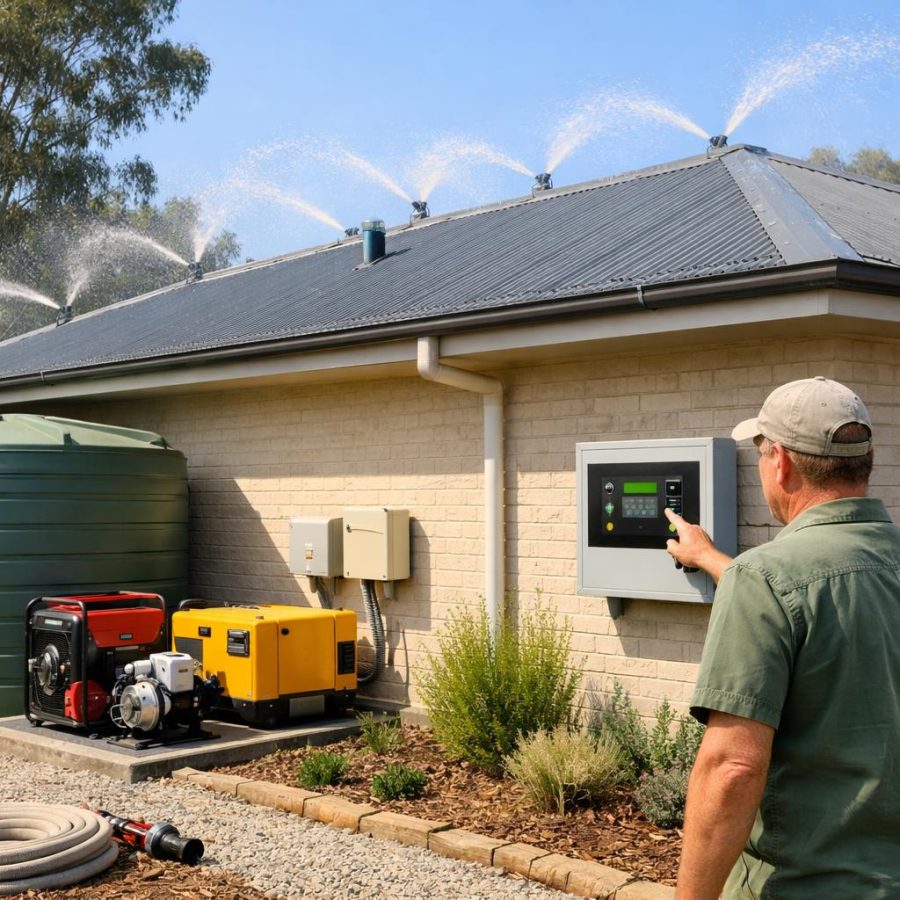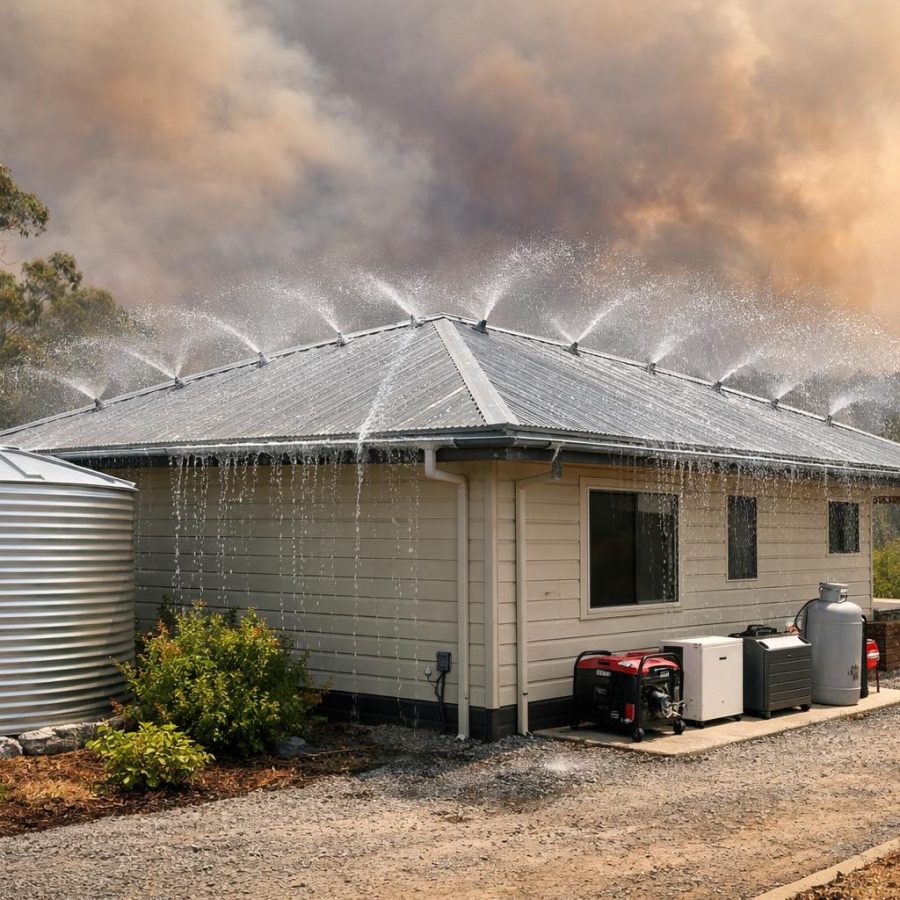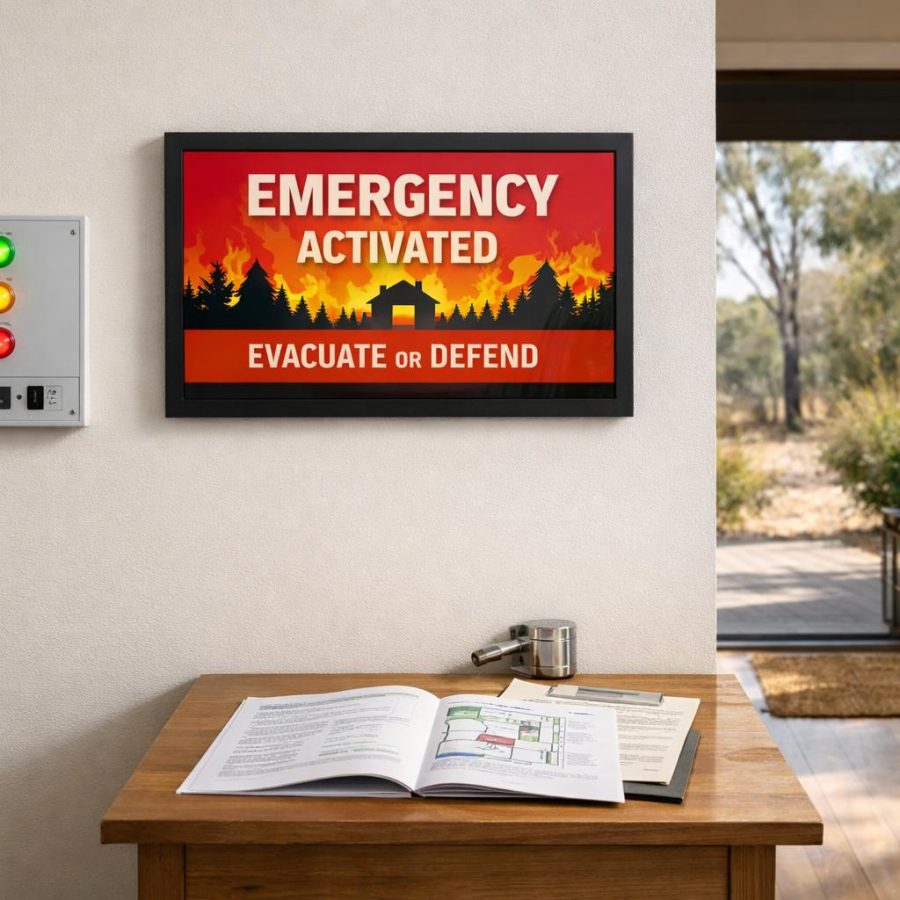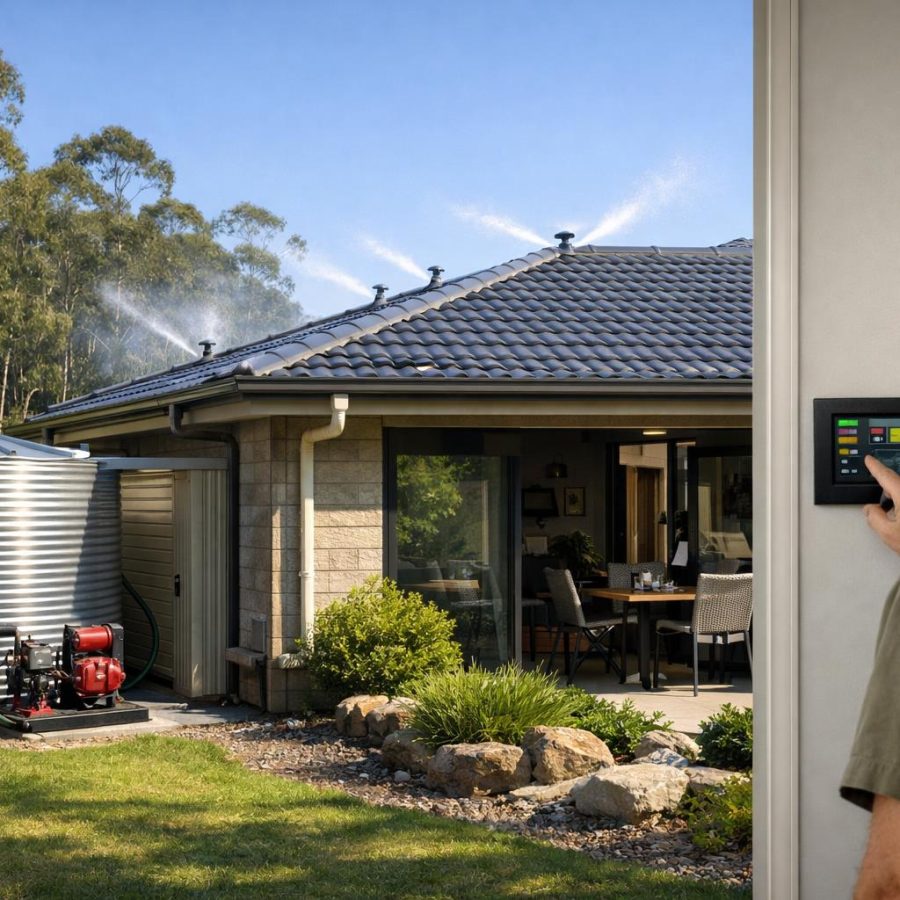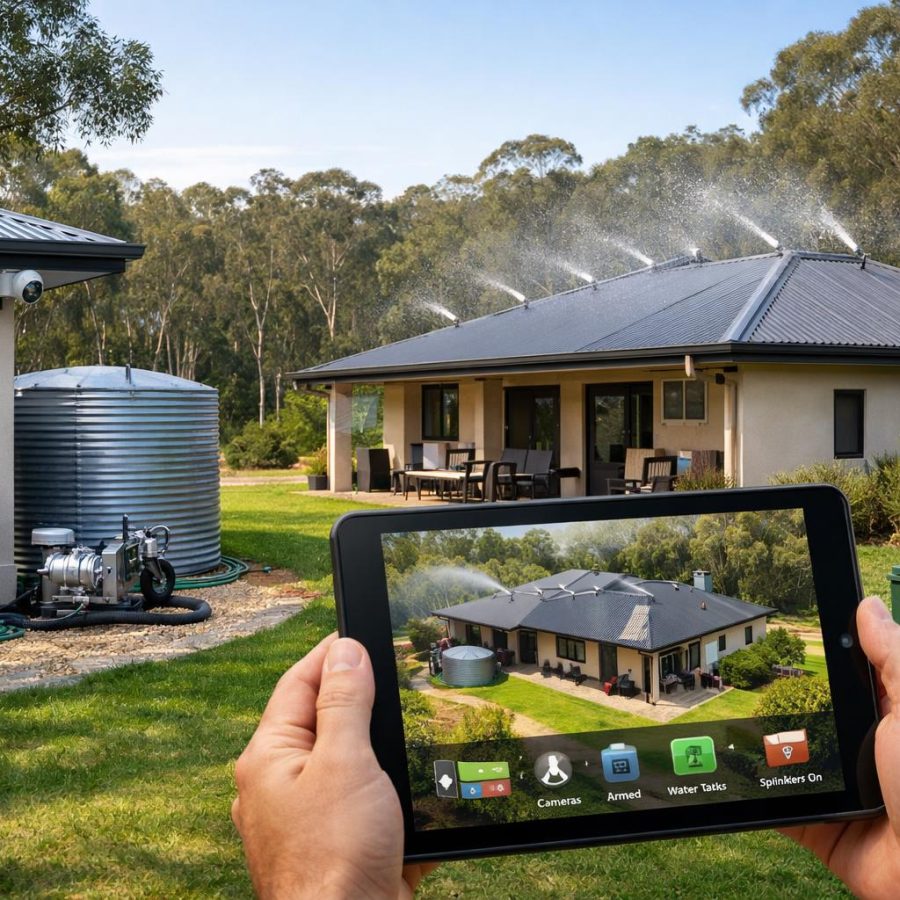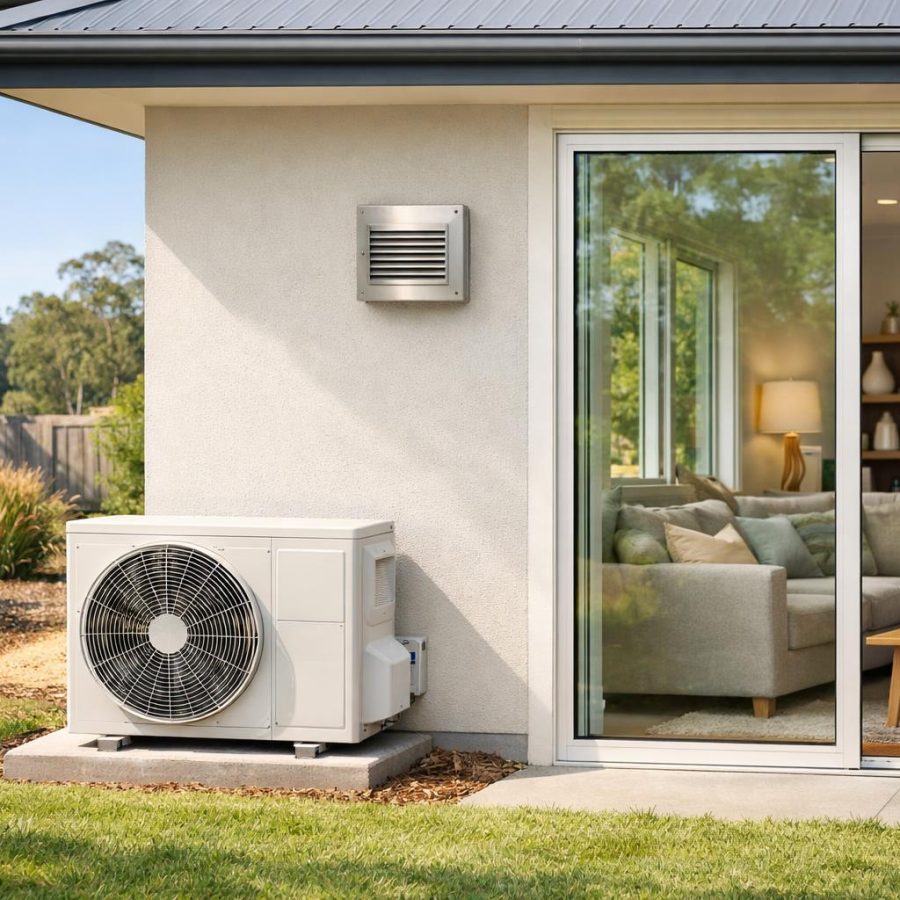
Extreme Fire Mode is the part of the Integrated Residential Bushfire Protection System that deals with the hardest question a household can face during a bushfire: if the property is under heavy attack, when is it still reasonable to remain inside, and when is it time to treat the house as no longer able to protect the people in it? This article explains that decision in simple terms for ordinary homeowners, using a clear GREEN, AMBER and RED status model that stays focused on occupant safety rather than wishful thinking.
What Extreme Fire Mode is for
Extreme Fire Mode is the sheltering phase of the system. It is not the same as normal day-to-day preparedness, and it is not the same as post-fire recovery. It is the period when the surrounding fire conditions may be severe, the property may be under direct threat, and the household is relying on the building and its critical protection systems to keep occupants safer for as long as those systems remain within their engineered design limits.
The central idea is simple: the house can be a protective place, but only while it is still capable of doing the job it was designed to do. Once the property starts exceeding those limits, the system must stop pretending that shelter inside is automatically the safer choice.
For that reason, Extreme Fire Mode is built around a continuous occupant-protection status. It asks a practical question at all times: does the house still have enough functioning protection, with enough margin, to keep occupants safer than being outside or moving through immediate danger?
This is a much narrower goal than full property defence. The system is mainly concerned with whether residents can shelter inside while the house remains structurally and operationally able to provide protection. It is also deliberately conservative. Official emergency warnings and directions always take priority over any local system logic.
The three occupant protection states: GREEN, AMBER and RED
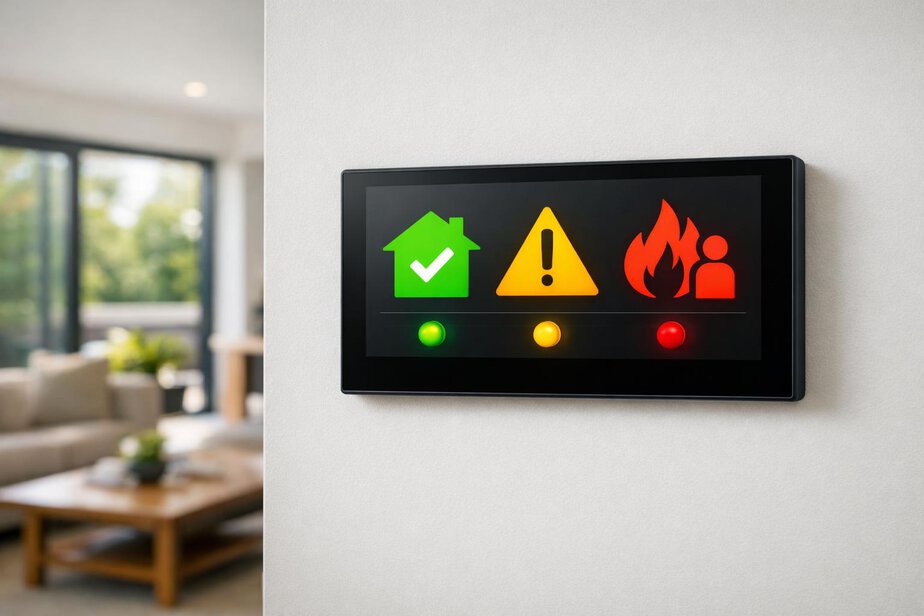
The simplest way to manage sheltering is with a status model that everyone in the household can understand quickly. The Integrated Residential Bushfire Protection System uses three states.
GREEN — REMAIN INSIDE
GREEN means the critical protection systems are operating and conditions are still within acceptable limits. The house is still considered capable of providing the intended level of occupant protection. Residents remain inside and keep monitoring conditions. This does not mean the situation is safe in an ordinary sense. It means the building is still doing its protective job within the design assumptions.
AMBER — PREPARE TO LEAVE
AMBER means protection is degrading, or conditions are approaching design limits. The house may still be usable for shelter, but the margin is shrinking. The household should begin preparing for a possible move, including gathering the emergency kit, checking exit options, confirming who is inside, and watching for changes that could push the status to RED.
RED — OCCUPANT PROTECTION COMPROMISED
RED means the house can no longer reasonably maintain the intended level of occupant protection. This is not simply a count of failed equipment. A single fault may be minor, while several problems together may still leave the house serviceable. The decision must be based on the overall ability of the building to protect occupants under the current conditions.
That distinction matters. A property can have one broken component and still remain in GREEN. It can also have many working components and still be in RED if fire intensity, radiant heat, wind, smoke, structural damage or internal conditions have overwhelmed the system’s ability to keep the occupants safer inside.
How the system should decide between GREEN, AMBER and RED
The status should be calculated from the combined condition of the house, its support systems and the fire environment. The system should not flip to AMBER or RED because of one minor fault in isolation. Instead, it should consider the whole picture.
Key inputs include water supply, pump performance, backup power, controller and sensor health, indoor air quality, structural exposure and the severity and direction of the fire conditions outside. The aim is to recognise when several small problems are starting to erode safety, or when one major problem is enough to push the house beyond its limit.
For example, falling water reserves may be acceptable if the fire is still distant and the pumps are stable. A pump fault may be manageable if backup power remains available and the exposure is low. But the same fault may become serious when radiant heat is increasing, smoke is building, and the household has no reliable way to sustain critical protection.
Similarly, controller or sensor faults do not automatically mean failure. A cautious system should still weigh whether the house can continue to protect occupants based on other available information. But if critical information becomes unreliable at the same time as conditions worsen outside, confidence in continued shelter should drop quickly.
The practical rule is this: status should reflect the real protective capability of the house, not the number of alarms on a dashboard. A system that is technically noisy but still effective may remain GREEN. A system that is quiet but overwhelmed by fire may be RED.
| Status | What it means | Typical household response |
|---|---|---|
| GREEN | Critical protection is functioning and conditions remain within design limits. | Remain inside, keep monitoring, do not become complacent. |
| AMBER | Protection is weakening or exposure is nearing limits. | Prepare to leave, stage the kit, confirm exits and stay alert. |
| RED | Occupant protection is compromised and the house is no longer a reliable shelter. | Use the best available information to judge whether to leave or move to the safest internal area. |
The table is intentionally simple. In an actual design, the underlying logic can be more detailed, but the household-facing result should remain easy to understand under stress.
What pushes a house from GREEN to AMBER
AMBER is the warning stage. It does not mean the house has failed. It means the reserve margin is shrinking and the household should act as if a move may soon be necessary.
The most useful triggers are the combined ones, because bushfire failure often arrives as a cascade rather than a single event. A property may first lose some water reserve, then experience a pump irregularity, then see backup power fall away, then start to admit smoke, and only then become truly unsafe for continued sheltering. The system should notice this gradual loss of margin early enough to give people time to prepare.
Typical AMBER triggers
- Water reserves are falling faster than expected and the estimated remaining supply is becoming tight.
- A pump is performing poorly, cycling unexpectedly, or showing signs of fault.
- Backup power is weak, unstable or uncertain.
- Indoor air quality is worsening, even if the house is still broadly habitable.
- Sensors or controllers are giving inconsistent information.
- Glazing, shading, seals or exterior elements are being stressed by heat or wind.
- The fire front, ember attack or radiant heat is becoming more intense or more erratic.
AMBER is where good habits matter most. If the household waits until RED before starting to prepare, it may lose valuable time. In contrast, a family that uses AMBER properly can check the kit, confirm routes, make sensible clothing choices, and avoid rushed decisions if conditions deteriorate further.
It is also the right time to reduce avoidable strain on the system. Unnecessary opening and closing of doors, repeated movements through smoke, or casual checking outside can create extra risk and should be avoided. Shelter mode is about conserving protection, not testing it.
What RED really means
RED is the critical point. It means the house can no longer reasonably maintain the intended occupant-protection level. That conclusion should be based on the overall protective capability of the building, not just on whether one component has failed.
This is important because bushfire safety can become dangerous if the system gives a false sense of certainty. A house may still have some functioning equipment, but if severe radiant heat is overwhelming exposed surfaces, strong wind is driving embers into vulnerable gaps, glazing is failing, structural damage is appearing, smoke is entering in a meaningful way, or the internal environment is becoming hazardous, the house may no longer be a dependable shelter.
Indicators that the engineered limit may be exceeded
- Severe radiant heat affecting external surfaces or parts of the building envelope.
- Strong wind increasing ember attack or making the structure harder to protect.
- Glazing failure or repeated glazing stress.
- Visible structural damage or signs that parts of the building are no longer reliable.
- Rapidly rising internal temperature.
- Smoke ingress or carbon monoxide concerns.
- Loss of critical external protection such as water, power, pump function or key controls.
These are not purely theoretical indicators. They are the kinds of things that should tell a system the building may no longer be offering the level of protection it was designed to provide. When several of them appear together, the case for RED becomes much stronger.
At RED, the house is no longer a place to simply sit and wait without further assessment. The system must now consider the best available information to advise the household on the least dangerous next step. That is not the same as promising safety. It is only the least bad option among difficult choices.
The system cannot guarantee an evacuation route is safe. At RED, conditions may still make moving outside dangerous, but remaining inside may also be unsafe if the house has lost its protective capacity.
This is why RED should trigger a choice framework rather than a rigid instruction. The system should review fire direction, heat, smoke, wind and the status of exits, then advise whether leaving appears to be reasonably safer or whether the safest available internal area may be less hazardous than moving outside.
What to do when RED occurs
When the status reaches RED, the first step is to avoid over-reacting and under-reacting at the same time. Panic can cause people to run into worse conditions, but delay can also remove the last usable margin. The system’s purpose is to give simple, calm, conservative guidance based on the best information available at that moment.
If a reasonably safer route appears available, the system may advise leaving. If leaving would likely expose occupants to greater danger because of heat, smoke, wind, blocked access or uncertain conditions, the system may instead advise moving to the safest available internal area while awaiting the next clear opportunity or official instruction. That distinction must remain advisory, because conditions can change quickly and no local system can assess every hazard.
Two things should be stated clearly to occupants at RED. First, no evacuation route can be guaranteed safe. Second, the final decision must still follow official warnings and directions, which always take priority over house-based logic.
The system should also avoid making people feel trapped by its own language. Even if it says remain inside, that does not mean remain anywhere in the building regardless of conditions. It means move to the safest available internal area identified by the design, away from direct heat, smoke pathways and obvious structural hazards, while continuing to monitor for change.
In practical terms, a RED message should be short, clear and unambiguous. It should not bury the main issue in technical detail. The household needs to know three things at once: the house is no longer a reliable shelter, leaving may or may not be safer, and the decision must be matched to the current conditions and official directions.
Planning two external exit options
Where practical, the system should plan two external exit options on different sides of the house. The reason is simple: fire, wind, fallen trees, embers or blocked access may make one side unusable while another remains marginally better.
Planning two exits does not mean both will be safe. It means the household has more than one possible way to respond if the preferred path becomes compromised. This is especially useful when the fire direction changes or when smoke and radiant heat create uneven conditions around the structure.
The system may suggest a preferred exit based on the direction of fire, heat and smoke, but that advice must be treated as advisory only. A route that looks best from one side of the property can quickly become worse if wind shifts, visibility drops or debris blocks the way.
Practical exit-planning points
- Choose exit options that are as separate as possible.
- Keep paths clear of clutter, parked vehicles and garden items.
- Identify where smoke, radiant heat and embers are likely to affect each side.
- Make sure the household knows which side is preferred in different weather conditions.
- Plan for the possibility that both exits could become compromised.
It is wise to rehearse the concept mentally rather than turning it into a complicated drill under stress. The household should know which door or route is normally first choice, what would make it unsuitable, and what the backup option is if the preferred side is blocked or too dangerous.
Because bushfire conditions can change very quickly, the chosen exit should not be treated as permanent. The purpose of the two-route approach is to reduce decision delay, not to create false confidence.
The emergency kit near the exit
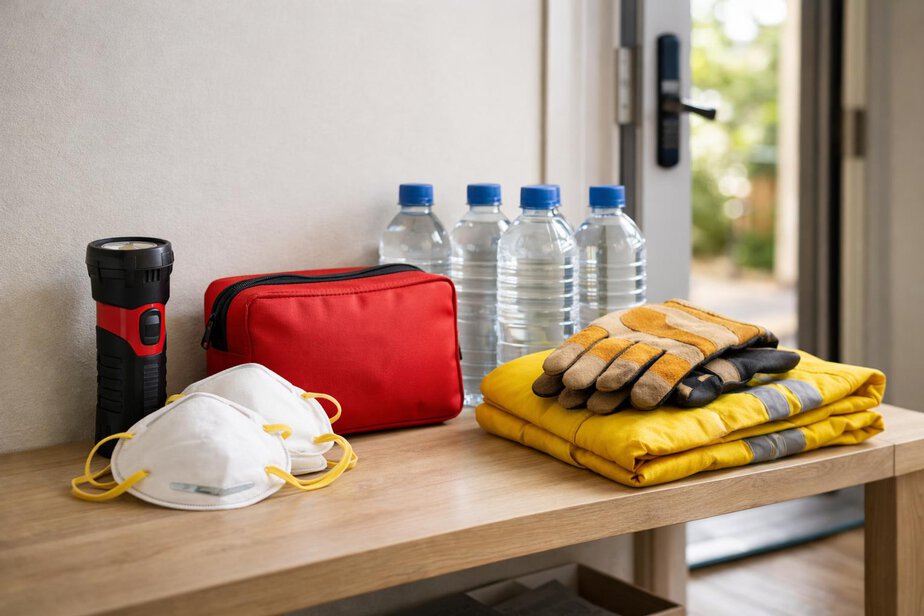
A simple emergency kit should be staged near a planned exit so that people do not have to search for essentials when time is short. The kit should be basic, easy to lift and easy to understand. It does not need to be large, complicated or expensive.
Recommended items
- A torch with spare batteries or a charged backup light source.
- P2 or N95 masks.
- A compact first-aid kit.
- Drinking water.
- Basic protective clothing such as long sleeves, long pants and sturdy enclosed shoes.
- Printed emergency instructions for the household.
The kit should be ready before fire season, not assembled during a warning. It should be placed where people can reach it quickly without crossing the area most likely to become crowded or blocked. If there are children, older adults or visitors in the home, everyone should know the kit exists and where it is kept.
Some households may also choose to keep small items such as glasses, essential medications or mobile chargers with the kit. However, the system should stay simple. The purpose is not to build a mobile command centre. The purpose is to ensure the most useful basics are available quickly.
Dedicated emergency lighting can be included as an optional upgrade, but it should remain optional so the base system stays simple and affordable. A household should not need a complex lighting installation just to understand the main protective logic.
In any serious bushfire event, printed instructions can be surprisingly useful. Smoke, stress and power loss make it harder to think clearly, and a simple one-page reminder can help people avoid hesitation.
Showing endurance for water, battery and fuel
One of the most useful features of Extreme Fire Mode is a plain estimate of how long the critical support systems may continue. These estimates are not guarantees. They are decision aids. They should always be labelled clearly as estimates because actual endurance can change depending on demand, faults and fire conditions.
The system should show the remaining water supply, estimated battery endurance and estimated generator fuel or runtime if a generator is part of the design. The household does not need engineering detail in the middle of a fire. It needs simple information that helps answer whether the shelter can keep working long enough to matter.
Estimated endurance should be interpreted with caution. High pump demand, prolonged filtration, controller faults, unexpected leaks, repeated door operation, smoke filtration loads or power fluctuations can all shorten actual runtime. The displayed estimate is useful because it reminds occupants that reserves are limited and that AMBER or RED may be approaching even if the house still feels orderly.
| Resource | What to display | How to treat the figure |
|---|---|---|
| Water | Estimated remaining supply and whether reserve levels are falling quickly. | Use as an estimate only; demand and leaks can change it fast. |
| Battery | Estimated endurance for critical controls and pumps. | Assume actual runtime may be shorter under heavy use. |
| Generator fuel | Estimated runtime or remaining fuel for supporting systems. | Consider load, maintenance status and starting reliability. |
A good display should make the trend obvious, not just the number. Falling reserves matter as much as the current figure. If the system shows that endurance is shrinking quickly, that is often an early sign that the shelter margin is reducing and that AMBER action should begin.
The goal is not to encourage people to stay longer than they should. The goal is to provide enough clarity to avoid both premature panic and dangerous delay.
Catastrophic Fire Danger and Unattended Protection Mode
Catastrophic Fire Danger sits outside the intended occupant-shelter design target. This is a crucial boundary. On catastrophic days, the correct response is to leave early, well before conditions reach the point where the house has to prove its occupant-protection capability.
That means Extreme Fire Mode is not the end stage for every severe fire day. It is only for the period when sheltering inside still remains within the design envelope. If the forecast, official warning or local conditions indicate catastrophic severity, the strategy changes. The household should not plan to remain inside and “see how it goes”.
Once residents have left early, the property may shift to Unattended Protection Mode if such a mode exists in the overall system. That mode may continue automatic property protection where practical, but it is no longer about people sheltering inside. The safety objective changes from occupant protection to remote property defence and damage limitation.
This distinction matters because catastrophic conditions can involve more than just flame front exposure. Extreme wind, falling trees, flying debris, blocked roads, loss of power and infrastructure failure can make both sheltering and late evacuation extremely dangerous. A leave-early approach avoids forcing the house to do a job beyond its limits.
In plain language, catastrophic days are not for testing the house. They are for leaving early, while roads are still open and while the household still has time to move calmly and safely under official guidance.
Keeping the system simple, usable and realistic
One of the strongest design principles in this part of the series is restraint. The base system should not become overloaded with unnecessary features. The more complicated the occupant-protection logic becomes, the harder it is for ordinary people to trust it under stress.
A simple GREEN, AMBER and RED model is useful because it compresses a lot of technical information into a form that can be understood quickly. The household still needs the underlying engineering, but the day-of-decision interface should stay uncomplicated. People under pressure do not need a long menu of possibilities. They need clear status and clear next steps.
That simplicity also helps reduce cost. Not every household needs every advanced feature. Dedicated emergency lighting, highly detailed dashboards or elaborate control interfaces may be useful in some installations, but they should not be treated as essential to the basic concept. The foundation of the system is robust protection logic, not gadgetry.
At the same time, simplicity should never become oversimplification. The system must still consider multiple inputs together: fire behaviour, water, power, control health, indoor air, structure and access. A simplified interface can still sit on top of a more thoughtful internal model.
Another key point is that the system must remain property-specific. A house on steep land with heavy vegetation exposure will not behave the same as a more sheltered suburban property. Construction type, BAL rating, openings, roof design, surrounding fuel loads and local wind patterns all matter. The concept needs to be adapted to the site.
That is why final design, installation, commissioning and maintenance should involve appropriately qualified professionals. A concept is useful, but a real system must be engineered for the individual building and its environment.
Practical household actions before publication and use
For ordinary homeowners, the most helpful practical step is to treat Extreme Fire Mode as a decision-ready household plan, not as a technical theory. Every adult in the home should know what GREEN, AMBER and RED mean, where the kit is, which exit is preferred, and what the backup exit would be if the preferred path is compromised.
Households should also be realistic about limitations. No system can make a house fireproof. No system can guarantee property survival. No system can guarantee occupant survival. No system can eliminate all bushfire risk. And no system can promise that a route out will remain safe for long enough to use.
The best outcome is one where the house gives residents a sensible protective option for as long as it safely can, while also telling them clearly when that option is no longer good enough. That is the real value of the Extreme Fire Mode logic: it reduces hesitation, discourages dangerous heroics, and keeps the focus on staying within the building’s true limits.
Used properly, the system does not encourage people to stay too long, and it does not push them out blindly. It gives a structured way to judge whether the building is still protecting them, or whether the situation has become too severe for sheltering to remain the right choice.
The final rule is the simplest one: shelter only while the house remains capable of providing the protection it was designed to provide. If the conditions move beyond that point, the household must fall back on official warnings, early evacuation planning and the safest practical decision available at the time. Before publication or implementation, always verify the facts, the local procedures and the site-specific design requirements for the property in question.
FireRescue Training Hub
Access practical fire and emergency study support resources, downloads, checklists, audio guides, and member-only course content.
- Course library
- PDF downloads
- Audio guides
- Checklists
Study support only. Not accredited training or a replacement for workplace procedures.
About the author and safety review
Ken Walker
Former Station Officer and fire service educator
Former career firefighter with extensive career and volunteer fire service experience.
Qualifications: Associate Diploma of Applied Science in Fire Technology; Institute of Fire Engineers studies.
Author profilehttps://www.firerescue.com.au/about-us/