New online course · Australian public safety
Bushfire risk is not limited to people who live deep in the bush. Grassfires can threaten rural communities, fires can affect suburban fringes, and holiday travel can put people on unfamiliar roads when conditions change.
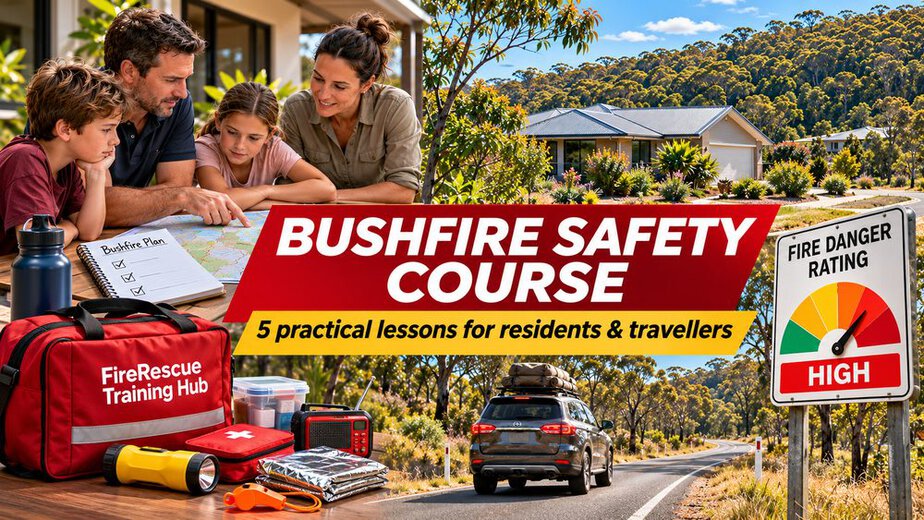
The new FireRescue Training Hub bushfire safety course offers five structured lessons to help everyday Australians understand the risk, read warnings, plan ahead and make safer travel decisions.
In brief
FireRescue Training Hub · FRT-COM-BUSH-01
Start with the basics, check your understanding and build a practical approach to fire danger, planning and travel.
Start Bushfire Safety Course →
5 lessons · Self-paced · 80% needed to unlock each next lesson
Study support only — not accredited training.
Why take a bushfire safety course?
It is easy to think of bushfire preparation as a job for emergency services or people who own rural land. Yet the choices people make before a fire matter just as much. A family may need to leave an at-risk home early. A visitor may need to change a campsite booking. A driver may need to choose another route rather than enter a fire-affected area.
The course does not try to turn learners into firefighters. Instead, it builds everyday awareness: how fires start, what official information means, and what practical decisions can reduce exposure to danger.
FireRescue already provides detailed articles on preparing properties and households. This course adds something different: a guided learning pathway with structured topics and knowledge checks, rather than another long list of things to do.
Who is this course designed for?
The course is written for Australian residents and visitors. You do not need emergency-service experience to begin. It is especially relevant to:
- Families and households that want a simple way to talk about fire danger, plans and early decisions.
- People living near bushland or grassland, including suburban-fringe and regional communities.
- Farm and rural property owners who want stronger awareness of fire risks and prevention responsibilities.
- Campers, caravanners and bushwalkers who visit locations where warnings, restrictions and road access may change.
- Motorists and motorcyclists who cross fire-prone regions and may have limited shelter or alternative routes.
- Seasonal visitors and new residents who are still learning Australian fire danger terminology.
A family with children, an older person, or someone who needs help to travel may require extra planning and an earlier departure decision. The course encourages learners to consider those individual needs rather than assume every household can respond in the same way.
Inside the course: five practical lessons
The five parts build on one another. Begin with the reasons fires become dangerous, then learn how to read official information. Later lessons bring that knowledge into household preparation, holidays and early action.
Know Your Bushfire Risk
Understand why fire risk exists in Australian forests, grasslands, rural districts and the urban fringe. Learn the basic ingredients of fire, and why an ignition near dry vegetation can develop into a serious problem.
- Identify common bushfire and grassfire risk settings, including roadsides and travel areas.
- Understand the roles of heat, fuel and oxygen.
- Recognise potential ignition sources such as lightning, campfires, machinery, powerlines and vehicles.
Try this: Think about one place you live in or visit. What vegetation, weather conditions or activities could change its fire risk?
Fire Danger Ratings, Warnings & Decisions
Fire Danger Ratings describe how dangerous a fire could be if one starts. Emergency warnings tell you about a particular incident and the actions you should take. This lesson helps you understand both, without confusing one for the other.
- Know the four national rating levels and what No Rating means.
- Distinguish a forecast Fire Danger Rating from an incident warning.
- Use official information to support decisions before an emergency becomes immediate.
Try this: Find your state or territory emergency information service. Check where it publishes today’s ratings, current incidents and action advice.
Prevent Fires & Prepare Your Home
Good prevention and early planning reduce avoidable risks. This lesson covers common ignition sources, household decisions and the need to check local restrictions before activities that produce flame, heat or sparks.
- Identify preventable ignition risks around homes, farms, campgrounds and outdoor work.
- Plan where to go, when to leave and what to take.
- Check the precise rules for the location, day and activity before using fire or machinery.
Try this: Choose an easy first action: check your household contacts, identify a safer destination, or review local fire restrictions.
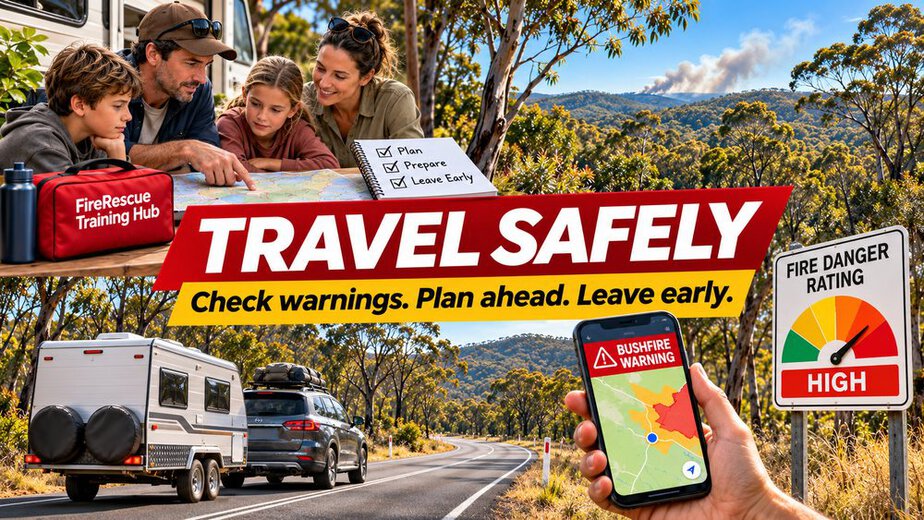
Travel Safely Through Fire-Prone Areas
People on holidays may not know local terrain or road options. A campsite, caravan park, walking trail or rural highway can become unsafe when fire danger rises. This lesson focuses on decisions made before and during travel.
- Recognise risks for drivers, riders, campers, caravanners and bushwalkers.
- Check both the journey and destination for fire danger, incidents and closures.
- Reconsider or change plans when forecasts and warnings make a route unsafe.
Try this: Before the next trip, check ratings and warnings for every region on your route—not only your destination.
Act Early, Stay Informed & Recover Safely
The final lesson brings the course together. It focuses on recognising a worsening situation, acting while safer choices remain, following the action in official warnings and recognising post-fire hazards.
- Notice rising risk and new information that should trigger a plan change.
- Explain why leaving early is safer than waiting until fire or smoke is close.
- Understand that recovery begins with checking whether authorities say it is safe to return.
Try this: Talk with your household or travel group about one clear trigger for leaving or changing plans, and who will check the warnings.
A key safety principle
Fire Danger Ratings are not the same as emergency warnings
Understanding this difference is one of the most useful skills in the course. Australia uses four Fire Danger Rating levels. They describe the potential danger of a fire under forecast conditions, rather than confirming that a fire is already burning near you.
No Rating appears when no proactive community action is called for under the national rating system. However, it does not mean that a fire cannot start. These national messages come from the Australian Fire Danger Rating System.
What about Advice, Watch and Act, and Emergency Warning?
These are incident warning levels, not daily Fire Danger Ratings. In Victoria, Advice tells you to stay informed about an incident. Watch and Act means the threat has increased and you must act now. An Emergency Warning signals imminent danger and the need for immediate action. Always follow the location-specific action statement. Warnings can be issued at a high level without passing through lower levels first.
The Victorian emergency warning guidance explains these messages. Other states and territories use their official warning channels, so check the information for the area where you are. Never wait for a warning to begin a well-planned early departure.
Fire bans and restrictions are a separate check
A daily danger rating is not permission to light a fire. Fire restrictions and Total Fire Bans have separate legal rules. They may differ by state, region, activity and date. Before lighting a campfire, burning off, operating spark-producing equipment or using outdoor cooking equipment, check the responsible authority.
For example, CFA explains the difference between a Fire Danger Period and a Total Fire Ban. Rules for your own location may be different.
A course for travellers as well as residents
A bushfire safety course for Australians should include road travel. Someone driving through unfamiliar country may not realise how quickly conditions and access can change. The same issue affects a camper away from phone coverage or a motorcyclist with limited storage and little protection from radiant heat.
CFA recommends checking conditions for both the places you will pass through and the final destination. It also advises against travelling through high-risk areas on Catastrophic days and recommends changing plans when Extreme conditions make a journey unsafe. Read the CFA travel safety guidance.
A simple pre-trip fire check
- The day before: check the forecast rating for each fire weather district along your route and at your destination.
- Before departure: review incident warnings, park or campground notices, road closures and local fire restrictions.
- Make a backup: choose a safer alternative destination or postpone a trip when conditions are concerning.
- During the journey: keep monitoring official information and signs. Do not drive towards smoke, flames or a closed road.
- Tell someone: share your intended route and expected arrival, especially when travelling through remote areas.
If you encounter an active fire, follow the instructions of emergency authorities. Call Triple Zero (000) to report a new fire or an immediate emergency in Australia. Do not drive into a fire-affected area to investigate or take photographs.
How the online course works
The learning pathway is straightforward. It is designed for people who want to work through one topic at a time and check what they have understood.
- Start with Part 1: Know Your Bushfire Risk.
- Study the two resources listed for that part.
- Complete the knowledge check. You need at least 80% to unlock the next lesson.
- Continue in order through all five parts, returning to earlier learning when you want a refresher.
- Review the official guidance for your location when putting the course lessons into practice.
You can study at your own pace. Course access or sign-in requirements depend on the current course settings; the starting page will guide you. FireRescue also has a directory of online courses if you want to explore other topics.
About certificates and recognition
A practical approach shaped by fire-service learning
People often focus on what to do once flames appear. However, effective community education starts much earlier: recognising risk, understanding the warning, making a clear plan and acting while options remain. These are familiar priorities in emergency-service training and community preparedness.
The FireRescue Training Hub course presents those principles for the public. It does not teach offensive firefighting techniques or suggest that a person should stay and defend property. Instead, learners practise the thinking behind safer decisions.
For households, that means discussing who needs help, where to go, how to communicate and what happens if the usual route is unavailable. For travellers, it means checking conditions before entering a risky area and being willing to postpone a journey.
Frequently asked questions
Is this bushfire safety course suitable for beginners?
Yes. The course is intended for residents, families and travellers, including people with no firefighting background. It introduces the topics in a structured order.
How many lessons are included?
There are five lessons. Each has two learning resources and a knowledge check. Learners need at least 80% in each check to unlock the next lesson.
Can I complete the course at my own pace?
Yes. It is designed for self-paced study. You can return to lessons and refresh your understanding when needed.
Does the course teach me to fight a bushfire?
No. It focuses on recognising risk, preventing ignitions, making plans, using warnings and travelling more safely. It does not qualify anyone to undertake firefighting.
Are Fire Danger Ratings the same as bushfire warnings?
No. Ratings describe expected fire danger if a fire starts. Warnings describe an actual or developing incident and give instructions for affected locations.
Is the course an accredited qualification?
No. This is non-accredited study support. Any course-completion certificate is not a nationally recognised qualification or replacement for formal training.
Will the advice apply everywhere in Australia?
The course uses national fire danger concepts and Australian safety principles. However, fire restrictions, emergency messages and local procedures must always be checked with the relevant state or territory authority.
Official sources and related FireRescue guides
This introduction draws on public information from Australian authorities. Use these links to check current conditions and rules; the information that applies to you can change quickly.
- Australian Fire Danger Rating System — national ratings and actions
- VicEmergency — understanding incident warnings
- CFA — when to leave a high-risk area
- CFA — staying safe while travelling
- CFA — fire restrictions and Total Fire Bans
- NSW Government — returning home safely after bushfire
Continue reading on FireRescue
- How to Prepare for a Bushfire — detailed household planning
- Bushfire Preparedness — practical steps that make a real difference
- FireRescue Training Hub online course directory
Start before you need the knowledge
A bushfire safety plan works best when you make it ahead of time. The same applies to a holiday route, family contact list or decision about leaving a high-risk area. Small steps taken early give people more choices than last-minute action.
If you are new to bushfire awareness, start with the first lesson. If you already know the basics, the course offers a structured way to check your understanding and identify gaps before summer travel or the next period of increased risk.
FireRescue Training Hub · FRT-COM-BUSH-01
Open Part 1 and follow the five lessons at your own pace.
Start Bushfire Safety Course →
5 lessons · Self-paced · 80% needed to unlock each next lesson
Study support only — not accredited training.
Important safety information
Prepared for FireRescue Training Hub. Official online references checked 3 November 2026. Please notify FireRescue if you spot an outdated source or a correction that could improve public safety.
FireRescue Training Hub
Access practical fire and emergency study support resources, downloads, checklists, audio guides, and member-only course content.
- Course library
- PDF downloads
- Audio guides
- Checklists
Study support only. Not accredited training or a replacement for workplace procedures.
About the author and safety review
Ken Walker
Former Station Officer and fire service educator
Former career firefighter with extensive career and volunteer fire service experience.
Qualifications: Associate Diploma of Applied Science in Fire Technology; Institute of Fire Engineers studies.
Author profilehttps://www.firerescue.com.au/about-us/