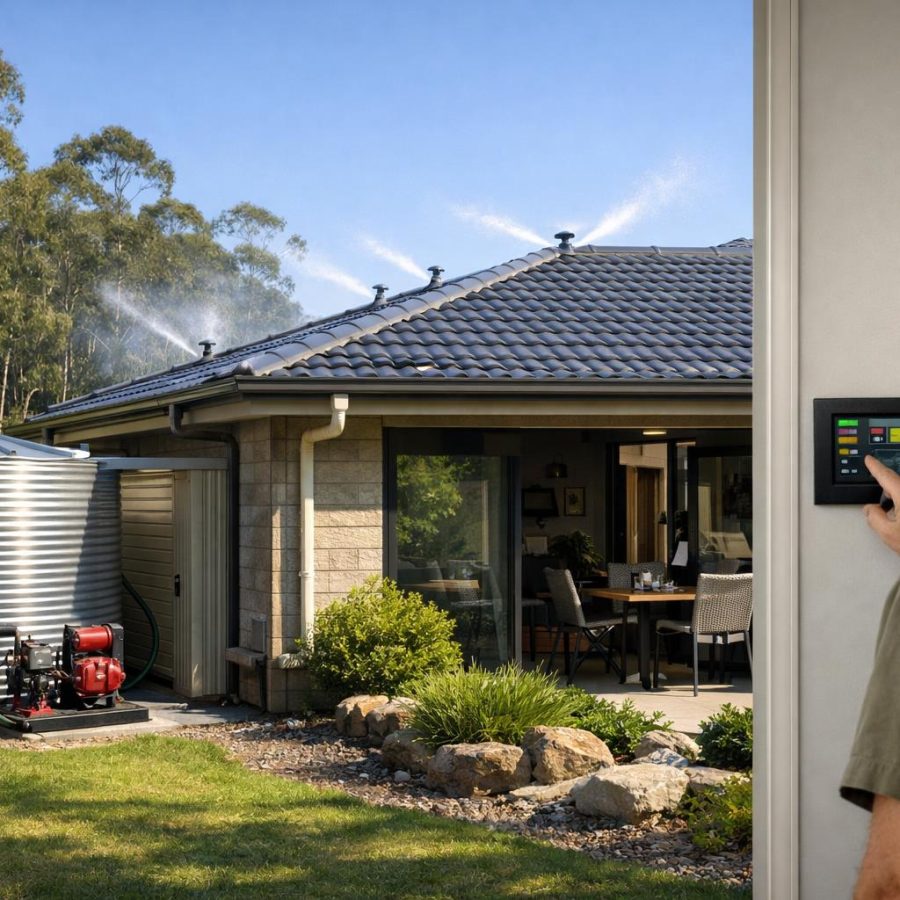
Roof and gutter protection is one of the most practical parts of an integrated bushfire protection system because it focuses on the places where embers are most likely to settle and start trouble. The aim is not to drench the whole roof just because fire is in the area; it is to place water where it is most useful, confirm that the water is actually getting there, and preserve supply for when conditions become worse.
Why roof and gutter protection matters
In a bushfire, embers and burning debris can travel well ahead of the main fire front. They can land on roofs, collect in gutters, sit in roof valleys, and lodge around roof edges and building junctions. These are predictable places where fine fuel can build up and where ignition can begin if heat and embers persist.
That is why roof and gutter protection is not just an add-on. It is a specific layer in the broader house protection system. In the proposed integrated model, it contributes a modest but real part of overall readiness, because it helps deal with a common ignition pathway rather than trying to solve every bushfire problem on its own.
For ordinary homeowners, the practical message is simple. A roof protection system should help stop embers from finding a dry, debris-filled ledge or corner to work on. It should not depend on luck, and it should not assume that water falling anywhere nearby is enough.
Design out debris traps where practical
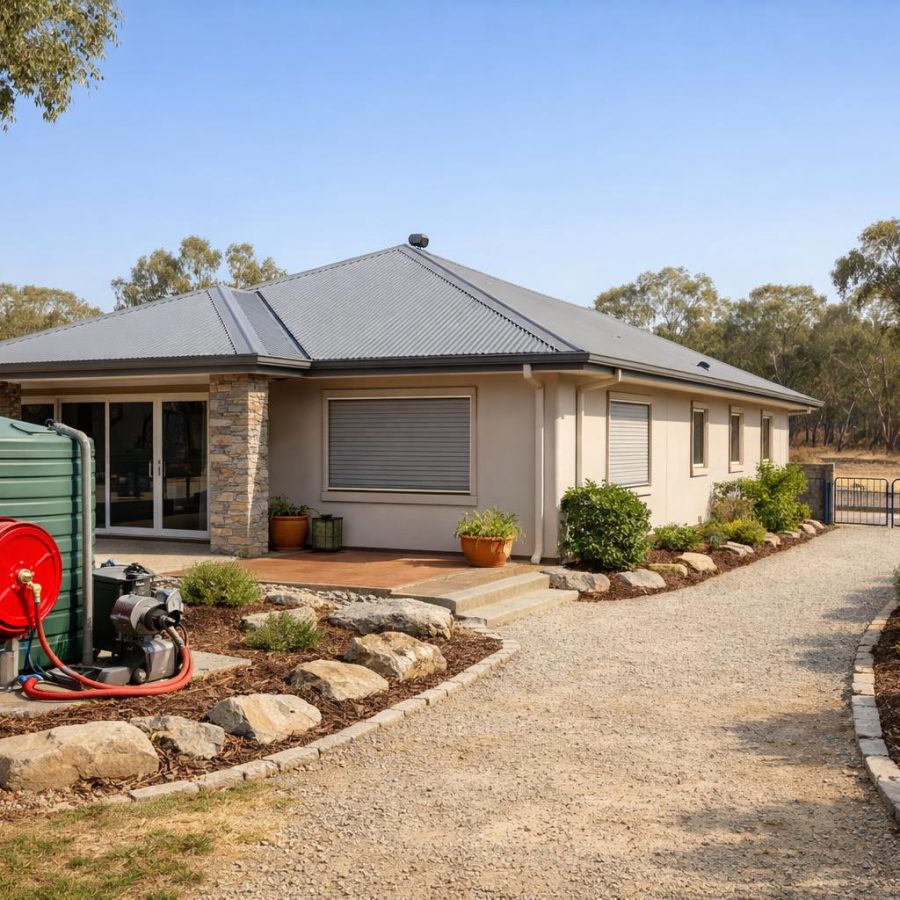
The best roof protection starts with good design. If a roof shape or gutter detail creates a place where leaves, bark and fine debris naturally collect, then that location becomes a problem long before a bushfire arrives. The preferred approach is to design out those traps wherever practical.
For new homes, that means keeping roof forms as simple as possible. Simple roof profiles are easier to maintain, easier to inspect and less likely to create hidden fuel pockets. Roof junctions, awkward returns and unnecessary changes in level can all increase the number of places where ember material accumulates.
It also means paying attention to access. If gutters and roof edges cannot be reached safely for inspection and cleaning, they are more likely to be neglected. Easy access does not mean every homeowner needs to walk the roof. It means the design should support safe maintenance by suitable people, using sensible methods.
Designing out debris traps is not a replacement for active protection. It is the first step. The less fine fuel that builds up, the less the system must do later.
Where a roof geometry or architectural feature creates an unavoidable debris trap, that area should be treated as a higher-risk location and protected accordingly. The design should not pretend that all roof sections behave the same.
Gutter design should support cleaning and inspection
Gutters are a major point of attention because they can collect leaves, bark and fine debris from day-to-day weather, then become a ready-made ignition pathway during bushfire conditions. Good gutter design reduces these risks by keeping the profile simple and the cleaning path obvious.
The preferred approach is straightforward:
- Keep gutter profiles simple.
- Avoid shapes that trap debris in corners or ledges.
- Make inspection and cleaning practical.
- Reduce hidden sections that are hard to see from ground level.
- Design guttering so water and debris have a clear path to move away.
Simple gutter systems are often easier to protect because the sprinkler layout can be more predictable. If the gutter is shaped to collect water evenly and shed debris cleanly, the roof protection system has a better chance of doing its job.
Homeowners should think about gutters as maintenance items, not just plumbing accessories. A gutter that is hard to clean becomes a fuel store. Even if a roof sprinkler system is installed, that fuel store is still there unless the design helps reduce it.
For existing homes, the opportunity may not be to redesign the roof, but it can still be to improve access, simplify details during renovations and reduce the number of places where debris can sit undisturbed.
| Design goal | Why it matters | Practical result |
|---|---|---|
| Simple gutter profile | Fewer places for debris to lodge | Easier cleaning and more reliable water flow |
| Good access | Allows inspection and maintenance | Less chance of hidden fuel buildup |
| Clear drainage path | Supports both stormwater and bushfire wetting | Lower risk of backup and overflow problems |
In bushfire-prone areas, the design standard should be more demanding than a typical suburban roof. If a roof detail is difficult to keep clean, it should be questioned early in the design process.
Use gutter guards carefully and only as an additional layer
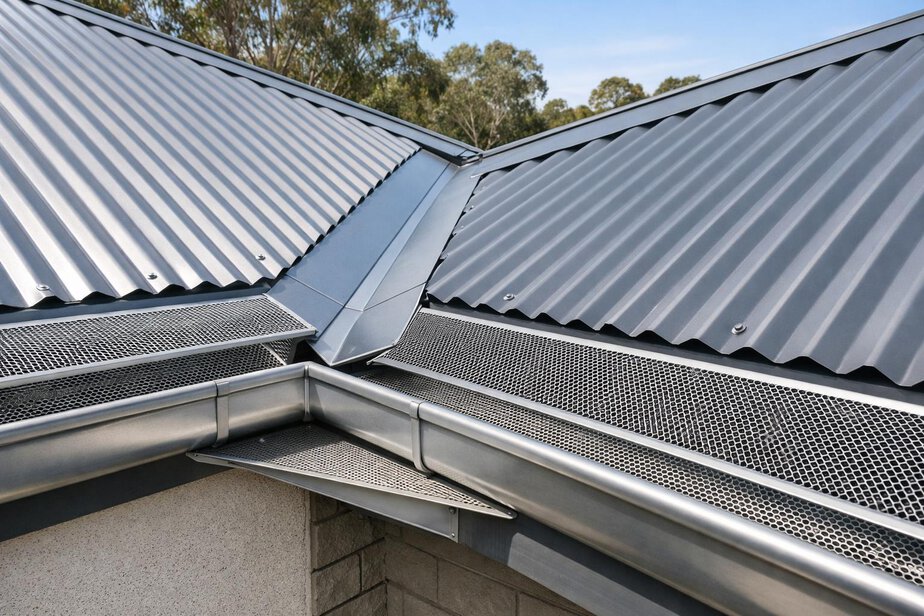
Gutter guards are often discussed as if they automatically solve the bushfire problem. They do not. A gutter guard can help keep out larger debris, but it can also create new places for fine material to collect. If that material is dry and combustible, the guard may end up adding risk instead of reducing it.
For that reason, gutter guards should only be used as an additional protection layer, not as the primary strategy. They should be made from metal or another suitably non-combustible material and be appropriate for bushfire exposure. The guard itself should not become a fuel source or a heat-sensitive failure point.
Just as important, the guard design should not create extra ledges, gaps or pockets where fine debris can accumulate. If a guard is so fine that it catches dust and bark but is difficult to clean, it may be counterproductive. If it is installed over a gutter that still collects debris underneath, the underlying problem has not gone away.
Homeowners should also remember that the best gutter guard still needs periodic inspection. Bushfire protection systems work best when the building remains maintainable. If a product makes cleaning harder or hides buildup from view, it deserves careful scrutiny.
Where possible, the safest outcome is a roof and gutter arrangement that is already low in debris accumulation, with guards used only where they genuinely improve performance and do not introduce new traps.
Roof valleys need dedicated protection
Roof valleys deserve special attention because they are natural collection areas for embers, leaves and water. They also often sit at the intersection of roof planes, which means they can combine debris accumulation with difficult access and complex drainage.
In a bushfire, a valley can become one of the first places where burning material settles. If the valley is dry and lined with debris, it may become a persistent ignition point even if other roof areas are less exposed. That is why roof valleys should not be treated as just another part of the roof.
Where roof valleys exist, they should have dedicated wetting or protection rather than relying only on general roof sprinklers. The goal is to make sure the valley itself receives targeted attention. Water application should be directed to the location where the embers are likely to settle, not merely to nearby roof surfaces.
For new homes, the design discussion should include whether some valleys can be reduced or removed altogether. Fewer unnecessary valleys usually means fewer places to trap debris, fewer complex junctions and fewer special protection requirements. This is not always possible, but it should be considered early.
For existing homes, the valley may already be built in. In that case, the task is to protect it properly, keep it clean and make sure the protection system can actually reach it in windy conditions.
Target water where embers are most likely to collect
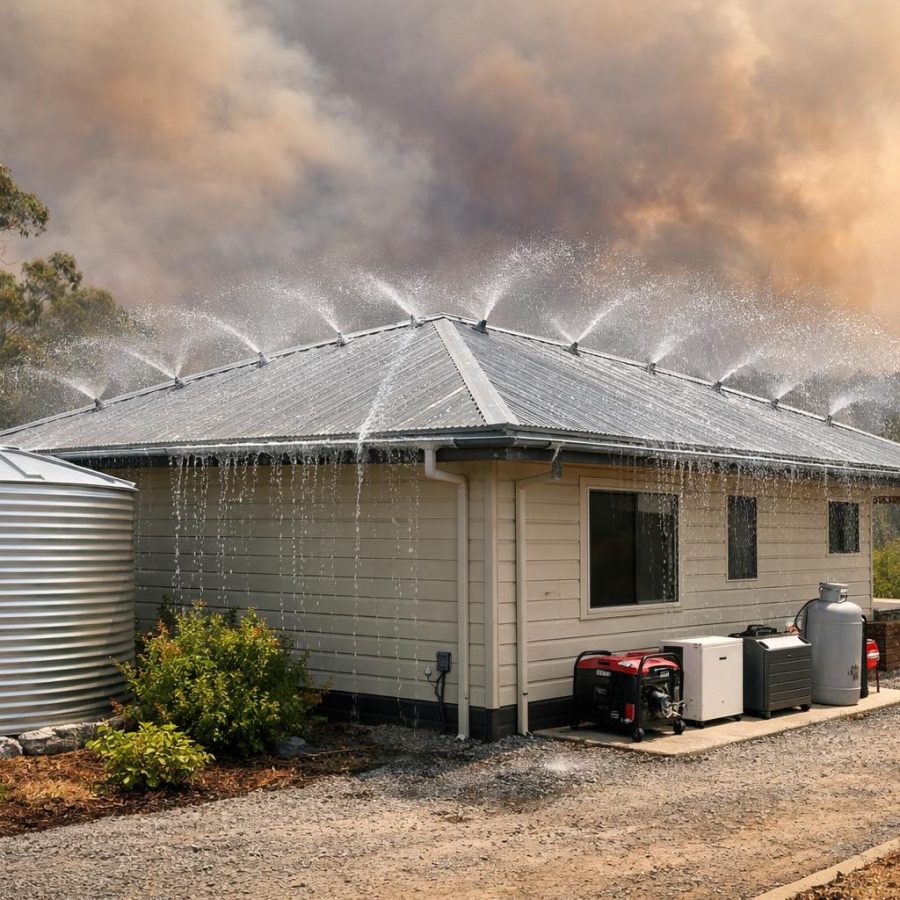
A well-designed roof sprinkler system should focus on the parts of the building most likely to receive ember attack or debris accumulation. That means gutters, roof edges, roof valleys, known ember collection points and vulnerable building junctions.
This targeted approach matters because it uses water more intelligently. If the system simply floods the entire roof, it may waste water where it is not needed while still missing the spots that matter most. In a bushfire, water supply is finite. The system should aim to stretch that supply while keeping the most exposed areas protected.
That does not mean roof-wide wetting is never useful. There may be times when broader application helps, especially as conditions worsen. But the starting point should be targeted protection. The system should be designed to place water where embers are likely to land, build up and persist.
This approach also makes it easier to align the sprinkler layout with the building form. A roof edge along a windward side may need stronger attention than a sheltered section. A junction where different roof planes meet may need more than a flat section with low debris risk. The system should reflect those differences rather than treating the roof as one uniform surface.
For ordinary homeowners, the key question is not “How much of the roof gets wet?” It is “Are the right parts getting enough water when they need it?”
Automatic water control should respond to conditions
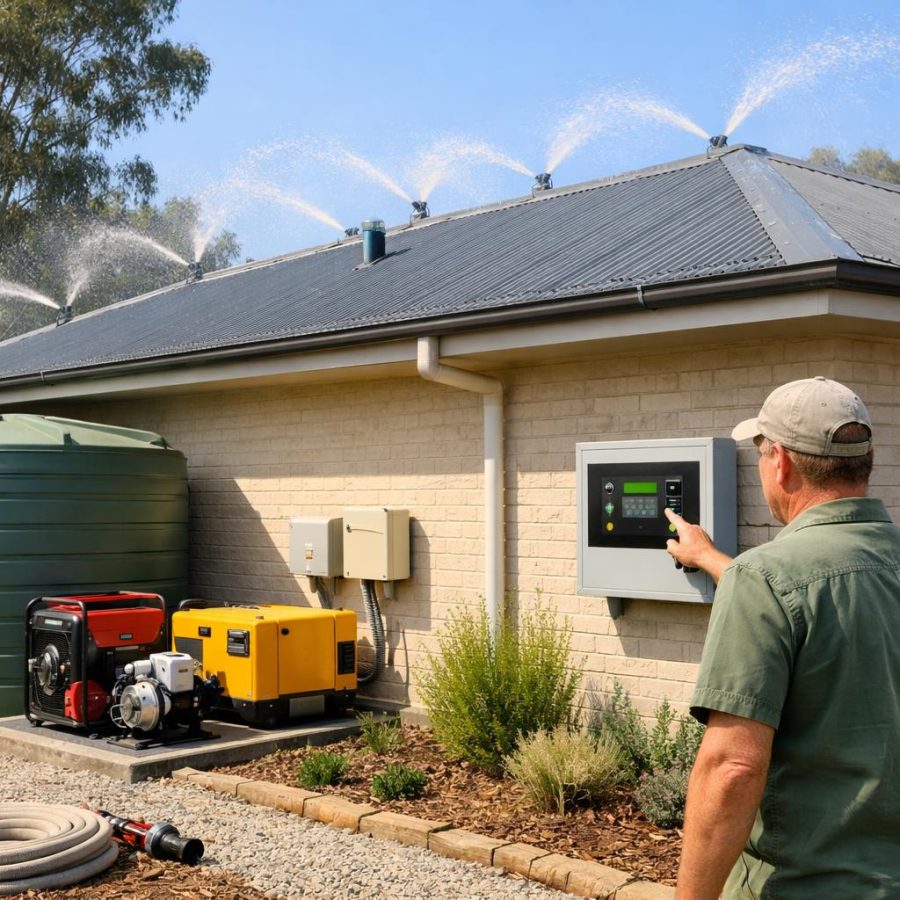
Roof and gutter protection should not operate as a simple on-off spray hose. It should automatically determine how much water is needed by using information from smoke detection, heat detection, wind speed and direction, tank water level and any active fire zones that are relevant to the property.
This matters because bushfire conditions change. Early in an event, short repeated wetting cycles may be enough to keep key surfaces damp and reduce ember ignition risk. As heat rises, ember attack intensifies or the threat becomes more sustained, the system may need to move to continuous water application.
The ability to switch between these modes is important for conservation. A dedicated bushfire tank is a valuable but limited resource. Using a little water early, in a controlled way, may preserve enough supply for the more severe stage of the event. At the same time, the system must be ready to increase protection quickly when conditions demand it.
Because mains water may be available only as a top-up source, the roof and gutter protection system should not depend directly on mains pressure. It should be designed to work as part of the dedicated bushfire water supply arrangement. That way, a failure or drop in mains performance does not leave the roof unprotected.
The homeowner does not need to manage this manually in the middle of a fire threat. The system should make sensible decisions automatically within the limits of its design.
Short cycles versus continuous application
Short wetting cycles are useful when the risk is present but not yet extreme. They can refresh wet areas and reduce drying without spending water too quickly. Continuous application is more appropriate when the threat is more severe, when embers are persistent or when conditions suggest the roof is likely to keep receiving attack.
The system should be able to make that transition without requiring the resident to understand pump curves, valve timing or sprinkler patterns. It should be an intelligent safety function, not a manual puzzle.
Wind can change roof sprinkler performance quickly
Wind is one of the biggest variables in roof and gutter protection. Strong bushfire winds can push embers in one direction, alter spray patterns and reduce the effectiveness of water that would otherwise fall neatly onto the target area. A sprinkler layout that looks adequate in calm air may perform very differently in real fire weather.
For that reason, roof and gutter sprinkler locations should be designed and tested under realistic windy conditions rather than assuming water will fall vertically. The system should reflect the fact that spray can be distorted, blown off target or concentrated in unexpected places.
When ember attack is predominantly coming from one direction, the system should give additional priority to the windward side while still maintaining some protection on other sides. That is important because wind direction can shift and because embers do not always behave in a perfectly predictable way.
If wind direction changes and the change remains consistent for a short confirmation period, the system should automatically reprioritise protection zones. The confirmation period matters because it helps avoid unnecessary switching caused by short gusts. A brief gust should not trigger a complete reallocation of water if the overall wind pattern has not really changed.
In practical terms, this means the roof protection system should be capable of adjusting to the fire weather it is facing, not just the weather it hoped for during installation.
Flow, pressure and blockage monitoring are essential
It is not enough to install roof sprinklers and assume they are working. Roof and gutter protection should include flow or pressure monitoring as a standard feature so the system can identify when a zone is not performing as intended.
The system should be able to detect blocked sprinkler heads, failed valves, damaged pipework, loss of pressure and any zone that has been commanded to operate but is not receiving sufficient water. These are the failures that matter because they reduce protection exactly when the building needs it most.
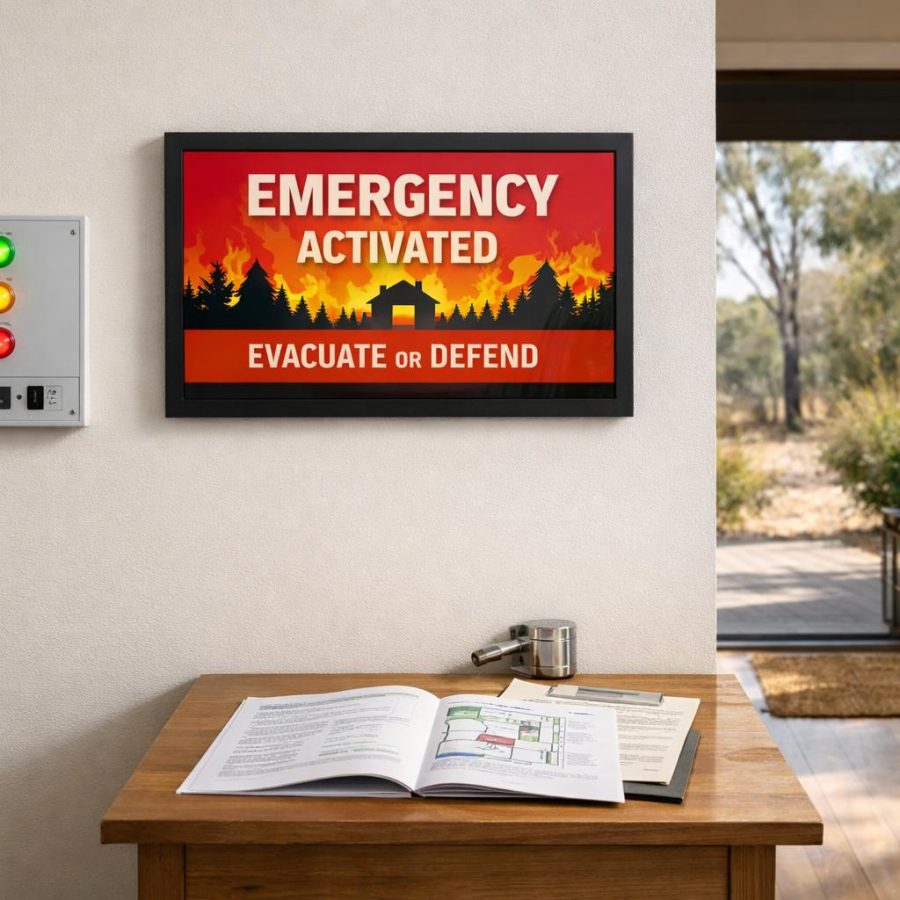
Monitoring should not be hidden from the homeowner. A failed roof protection zone should generate an appropriate Green, Amber or Red system warning so the resident receives a simple and clear status message. The warning should help them understand whether the system is operating normally, has a fault that needs attention, or has a serious problem that may reduce readiness.
Ordinary homeowners should not be expected to diagnose pump faults or trace pipework under pressure. The system needs to tell them, in plain language, when something is wrong. During maintenance, a qualified installer or technician can investigate the cause. During an emergency, the homeowner needs fast, simple information.
Monitoring is also useful before bushfire season. If a valve is slow, a sprinkler head is blocked or pressure is lower than expected, the fault can be corrected early rather than discovered during a threat.
Plan safe gutter overflow and drainage
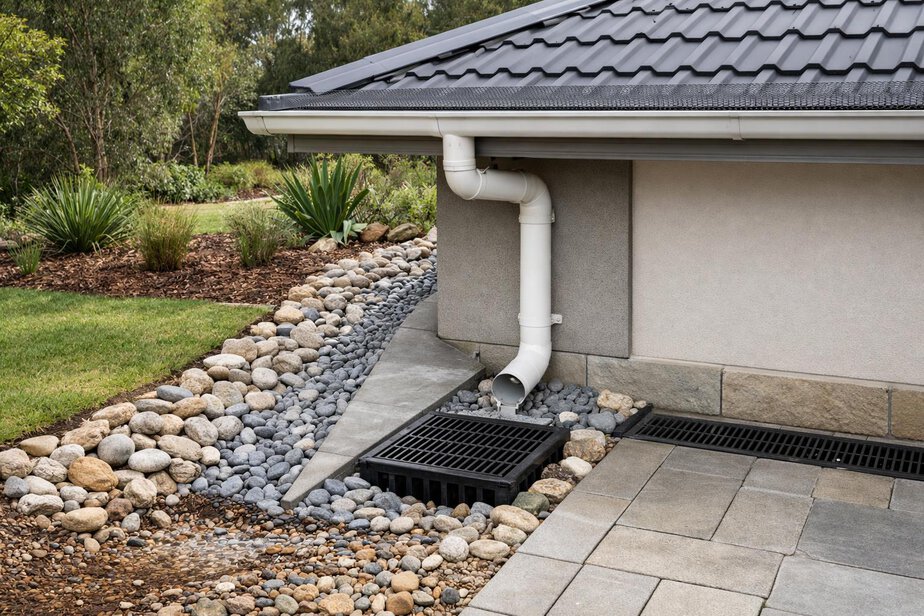
Roof and gutter protection deliberately adds water to areas that normally only receive rainfall. That means overflow has to be planned from the start. If gutters fill and water cannot escape safely, the system may create a new hazard while trying to reduce bushfire risk.
Gutters should have planned overflow paths that prevent water from entering the roof space, backing up beneath roof edges, damaging walls, creating flooding around entrances or affecting electrical equipment. The way water leaves the gutter is just as important as the way it enters.
Downpipes and overflow arrangements must suit the individual property. Some homes may be able to discharge water through the normal stormwater system. Others may need a different arrangement or a suitable discharge area depending on site conditions, building layout and local drainage behaviour.
It is not safe to assume that a one-size-fits-all solution will work. Roof shape, gutter volume, downpipe capacity, site slope and nearby infrastructure all influence how the water should be managed. A proper design should take those property-specific factors into account.
The aim is to ensure the protection system does not trade one emergency risk for another. Controlled water application should support the building, not introduce avoidable damage.
Automatic testing should cover roof protection zones
Roof and gutter protection should be part of the system’s automatic self-test. This is important because the system may sit unused for long periods, yet still be expected to work when a bushfire threat appears.
Automatic testing should confirm valve operation, water flow, pressure, individual zone operation, relevant sensors and controls. If a zone does not respond as expected, the system should flag it clearly so the homeowner knows a roof protection problem exists.
The test does not need to be complicated for the resident. In fact, it should be simple. The purpose of automation is to reduce uncertainty, not create more work. The homeowner should receive a clear warning if a roof protection zone is not operating correctly and should not have to work through technical fault-finding on their own.
Testing is especially important because some faults are hidden. A valve may open but not flow properly. A sprinkler head may appear intact but be blocked. A pressure reading may look acceptable until several zones are opened together. Routine self-testing helps catch these problems before the system is relied on in an emergency.
For a homeowner, this means the roof protection layer should quietly check itself and report clearly. If the system is healthy, that is reassuring. If it is not, the warning should be unambiguous.
How roof protection fits into the wider home system
Roof and gutter protection is only one layer in a complete bushfire preparedness system. It works best when combined with ember-resistant construction, defendable space, a dedicated bushfire water supply, pumps, sensors, backup power and other protection measures.
By itself, roof wetting does not make a house fireproof. It can help reduce ember ignition risk at specific collection points, but it does not replace maintenance, building design, site preparation or sensible emergency planning. The value of this layer is that it focuses on a likely ignition pathway and helps manage it in a controlled way.
Homeowners should also understand the difference between public actions and trained actions. A resident can usually inspect gutters from a safe place, keep the area clean, check for visible faults and make sure the system status is understood. More detailed design, installation, pressure balancing, flow testing and compliance decisions belong with qualified and authorised people.
That separation matters because effective bushfire protection depends on systems working together. The roof and gutter layer is strongest when it is designed as part of the whole house approach, not as an isolated gadget.
Practical checklist for homeowners and designers
Before a roof and gutter protection system is finalised, it is worth checking the following practical points:
- Have debris traps been reduced wherever practical?
- Are gutters simple enough to clean and inspect?
- Are gutter guards non-combustible and suitable for bushfire exposure?
- Do roof valleys have dedicated protection?
- Are roof edges and vulnerable junctions covered by targeted wetting?
- Does the system conserve water in lower-risk conditions?
- Can it increase to continuous application when conditions worsen?
- Has coverage been considered under windy conditions?
- Is there monitoring for pressure, flow and blocked or failed zones?
- Are overflow paths planned so water cannot back up into the roof or damage the building?
- Does automatic testing confirm the roof zones are working properly?
If the answer to any of these is unclear, the design should be reviewed before the system is relied on. Roof and gutter protection does not need to be complicated, but it does need to be deliberate.
Good bushfire design is usually about removing weak points before the fire arrives. In this layer, that means giving embers fewer places to settle, giving water a better chance of reaching those places, and confirming the system is actually doing what it was built to do.
Conclusion: Roof and gutter protection works best when it targets predictable ember collection points, responds to wind and water availability, and includes monitoring and safe overflow from the start. Used properly, it is a practical and important part of an integrated residential bushfire protection system, but it should always be checked against current guidance, local conditions and qualified advice before publication or installation.
Before using this information in a real project, verify facts, current standards and local procedures with the relevant authorities, qualified professionals and the latest applicable guidance.
FireRescue Training Hub
Access practical fire and emergency study support resources, downloads, checklists, audio guides, and member-only course content.
- Course library
- PDF downloads
- Audio guides
- Checklists
Study support only. Not accredited training or a replacement for workplace procedures.
About the author and safety review
Ken Walker
Former Station Officer and fire service educator
Former career firefighter with extensive career and volunteer fire service experience.
Qualifications: Associate Diploma of Applied Science in Fire Technology; Institute of Fire Engineers studies.
Author profilehttps://www.firerescue.com.au/about-us/