A practical Australian guide to briefing people, rehearsing safer decisions and using FireRescue’s eight-part farm fire safety course.
The missing step in farm fire safety: practise the plan
A farm can have a carefully written bushfire plan and still lose valuable time when people need to act. A contractor may not know which gate to use. A family member may assume somebody else has called for help. The person who normally makes decisions may be away from the property.
That is why farm fire safety training matters. It helps the people who live and work on a farm understand their roles, practise decisions and recognise when to stop a task or leave early. The aim is not to turn farm workers into firefighters. Instead, the aim is to make everyday safety decisions clearer before conditions become dangerous.
This article takes a different approach from our comprehensive farm fire safety guide. That guide explains property preparation, machinery hazards, livestock planning and equipment. Here, we focus on how to teach, brief and rehearse those arrangements with the people who need to use them.
The examples are fictional learning exercises, not instructions to enter a fireground. For any immediate threat to life in Australia, call Triple Zero (000). Follow official warnings, current local restrictions and the direction of emergency services.
At a glance: five training habits that make a difference
- Give everyone a role: decide who checks warnings, who accounts for people and who can stop work.
- Use one clear property map: mark gates, exit routes, water points, hazards and stock areas.
- Practise with a short scenario: use a discussion exercise instead of waiting for a real emergency.
- Record problems and fix them: a missed contact number or locked gate is a training finding, not a failure to hide.
- Refresh when things change: new contractors, crops, stock movements and machinery can change the plan.
Agriculture Victoria’s Fire Preparedness Toolkit supports farm maps, action plans, emergency contacts and family or staff briefings. Its message is practical: everyone who may need to act should understand the plan and their responsibilities.
Why a written plan is not the same as a ready team
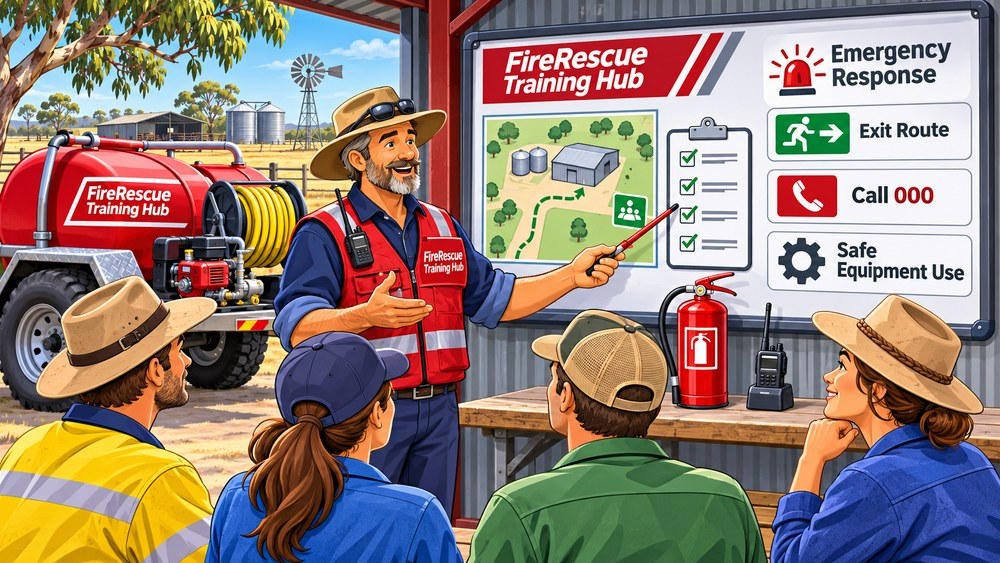
A written plan captures decisions. Training checks whether people can use them. Both matter, but they solve different problems.
Consider a simple example. A farm plan says that workers should leave through the north gate. However, a new contractor has only entered through the southern driveway. During a calm briefing, someone discovers that the contractor cannot identify the north gate on the map. Fixing that confusion now is much easier than explaining the route while smoke reduces visibility.
Likewise, people may recognise the words Fire Danger Rating yet not know what those ratings change on their particular property. Training connects the warning to a pre-agreed action. For instance, a farm may have a documented decision to postpone particular work or move livestock early when the relevant conditions arise. The exact action must follow local guidance and the farm’s own plan.
Train decisions, not heroic responses
A good briefing should build confidence in safe choices: identify danger, communicate early, protect people and withdraw when needed. It should never encourage someone to approach uncontrolled flames or stay behind to save machinery.
Farmers, family members and employees bring valuable local knowledge. However, local knowledge alone cannot make an unsafe situation safe. This is particularly important when dry vegetation, wind changes, smoke, hot machinery or damaged electrical equipment create fast-moving hazards.
Who should be involved in farm fire training?
The training group is often wider than the people who own the land. A farm may include seasonal workers, machinery operators, family members, visitors, contractors, delivery drivers and people living in separate dwellings.
Not everyone needs the same technical detail. Instead, everyone needs the information relevant to their role. A visitor may only need to know the emergency contact, safe departure directions and who to follow. A machinery operator needs the same information, plus task-specific fire controls and stop-work rules.
Use three simple levels of briefing
- Visitor orientation: how to report danger, where to go and who is responsible for the visit.
- Worker or contractor briefing: daily risks, warning checks, stop-work authority, property location and how to account for everyone.
- Plan-holder refresher: decision triggers, alternatives, communication failures, livestock arrangements and actions after the immediate danger has passed.
Where someone needs assistance to receive warnings or leave safely, discuss their arrangements respectfully before a dangerous day. Consider accessibility, transport and backup support. Keep private details with authorised people rather than broadcasting them to the whole workforce.
Start training with a shared farm map
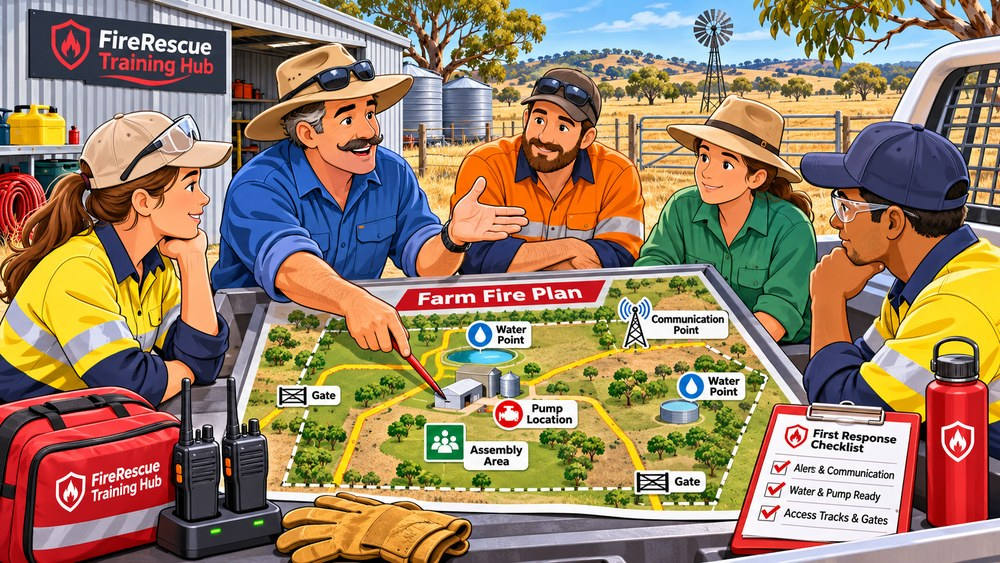
A shared map gives people a common picture. It also reduces the chance of relying on informal directions such as “the back gate near the old shed”.
Use a current farm map or an annotated aerial view. Keep it understandable and available offline. Agriculture Victoria recommends showing key assets, water sources, exit points, assembly or evacuation locations and livestock refuge areas.
Seven items to locate during a map briefing
- The correct property address, coordinates and clearly named access gates.
- Main and alternative departure routes, including known restrictions.
- Places where people may be working alone or out of mobile range.
- Fuel, chemicals, power infrastructure and other hazards to report to crews.
- Pumps, tanks and water points that responding agencies may need to know about.
- Livestock areas, movement routes and any pre-identified lower-risk holding areas.
- The location of printed contacts and the current version of the farm plan.
Ask each person to point to the gate they would use from their normal work area. If several people choose different gates, clarify the plan. Also check that the actual route is suitable for the vehicles concerned and that property access is maintained.
This is a map discussion, not a direction to drive around the property during a fire warning. Do not enter closed roads or fire-affected areas to test a route.
Run a 20-minute farm fire tabletop exercise
A tabletop exercise is a guided conversation using an imagined event. Nobody lights a fire, produces smoke or acts out a hazardous rescue. The group simply talks through what it would do, using the real property map and current plan.
Set aside about 20 minutes during a normal team meeting. Choose someone to read the scenario, someone to record gaps and someone to confirm follow-up actions. Keep the pace calm. The purpose is to learn, not to catch people out.
Minutes 0–5: agree on the starting situation
Tell the group: “It is a hot, windy afternoon during the fire season. A contractor is working away from the main house. A nearby grassfire has been reported, but nobody has seen flames on the property.”
Ask: Who checks the official warning? What is the farm’s agreed action trigger? Who can stop work? How will the contractor receive directions?
Minutes 5–10: introduce a communication problem
Now say: “One worker cannot be reached by mobile phone. A vehicle is parked near the usual departure gate.”
Ask: Is there an approved backup contact method? Who knows the worker’s last reported location? How is the obstructed exit handled without sending people toward a hazard?
Minutes 10–15: test an early-leaving decision
Add: “The official warning changes, and the farm’s documented trigger to leave has been reached.”
Ask: Who confirms the action? How will the group account for people? What was decided earlier about pets and livestock? What if the preferred road is unavailable? Emphasise leaving early according to the plan, not last-minute action through smoke or flame.
Minutes 15–20: record three improvements
Finish by asking: What worked? What was confusing? What must change before the next high-risk day?
Write down up to three actions, allocate an owner and set a realistic completion date. Then update the map or briefing sheet and share the changes with everyone affected.
Exercise boundary: this example is for discussion only. It is not firefighting training, an evacuation order or a substitute for advice from your local fire authority.
A one-minute worker briefing you can adapt
A simple briefing helps seasonal crews and contractors understand what to do. It should sound like normal workplace instructions, not a long lecture.
“Before we start, the farm address and gate names are on this map. Tell the supervisor straight away if you notice smoke, unsafe machinery or a blocked route. We check official warnings and local restrictions before work and again if conditions change. If we stop work or leave, follow the instructions in our farm plan. Do not try to fight a spreading fire. If there is immediate danger, call Triple Zero (000) and move to safety. Let us know if you need help receiving instructions or leaving.”
Adapt this wording to your site, activities and current procedures. A printed card can help, but a card does not replace an actual conversation. Ask the person to repeat the key contact and identify the correct exit on the map.
Practise clear reporting and a useful handover
During an emergency, vague messages can waste time. “There’s smoke near the top paddock” may mean something to a long-term worker but very little to someone arriving for the first time.
Practise a message that answers five questions: Who is calling? Where is the issue? What has happened? Are people safe? What help is required?
For example, a fictional report might say: “This is the farm manager at the eastern workshop, access through Gate 3 on Smiths Road. We have smoke coming from machinery. All three workers have moved away. We are calling 000 and will meet crews at the entrance.”
That is a training example, not a substitute for the emergency call handler’s questions. In a real emergency, give the operator accurate information and follow their instructions. Never delay a Triple Zero call while trying to perfect a message.
Test the backup communications plan
Mobile coverage is not reliable on every farm. During a normal workday, check the communication methods the property already uses, such as a suitable radio system, working phone or agreed check-in schedule. Confirm what happens if a device fails or a worker misses a check-in.
Do not assume that a handheld radio will connect with emergency-service channels. Any communication with responding agencies must follow their approved arrangements.
Train for the decisions that matter on dangerous days
Not all learning scenarios should be about an active fire. In fact, some of the most useful questions concern the decision not to start a job.
Try these prompts at a staff meeting. Ask people to state where they would find the applicable rule or procedure, rather than guessing.
Scenario A: harvest conditions change
The morning starts calmly, but the wind increases and the forecast deteriorates. Who checks the current Fire Danger Rating and applicable harvesting rules? Who has authority to stop the job? How will contractors find out?
For detailed machinery prevention advice, refer to our harvest machinery fire guide. This training exercise should focus on decision-making and communication, not repeat every machinery inspection step.
Scenario B: a hay storage warning sign
Someone reports unusual warmth, steam or a burning smell around stored fodder. Who reports the concern? How does the farm keep others away from a possible hazard? Who seeks specialist or emergency advice?
Do not treat this as a reason to enter or disturb a potentially unstable, heating stack. The exercise is about recognising an abnormal condition, keeping people clear and getting appropriate help.
Scenario C: livestock are still in the wrong paddock
A high-risk day is forecast for tomorrow. The agreed low-risk livestock area is not ready, and transport is limited. Who makes the call early enough to avoid dangerous last-minute movement? What safer alternatives are already in the plan?
CFA advises planning livestock protection well before bushfire season and moving stock early on Extreme or Catastrophic days. Importantly, people’s safety comes before animals. See CFA livestock and bushfire guidance.
Scenario D: the regular decision-maker is absent
The person who normally holds the farm plan is interstate. Who takes over? Can that person find the current contacts, warning sources and property map? Is the backup authority clear to all workers?
This is a good test of whether your plan belongs to the farm as a team or only to one person’s memory.
Measure what the team learned, not just who attended
A signed attendance sheet shows who was present. It does not show whether they understood the plan. A few practical questions give a better picture.
After a briefing, ask people to identify their nearest appropriate exit, the person they report to, the method for checking official warnings and the action required if they cannot safely continue work. Keep the questions within their actual responsibilities.
A simple training record
| Training item | Evidence of understanding | Follow-up |
|---|---|---|
| Property map | Person identifies correct gate and contact | Correct map if unclear |
| Stop-work decision | Worker knows who can stop a task and why | Repeat briefing if needed |
| Communication | Worker can give a clear location report | Check radios or contact list |
| Early action | Team knows its agreed warning triggers | Review the written fire plan |
| Livestock responsibility | Responsible people know the early movement plan | Confirm transport and backup roles |
Keep notes brief and proportionate. Avoid recording unnecessary sensitive information about an individual. Where training reveals a missing control, assign someone to fix it and confirm completion.
Turn one briefing into an ongoing seasonal routine
A single training session is helpful, but farms change. New workers arrive, paddocks change use, gates are altered and equipment moves between sheds. Therefore, training needs a simple refresh cycle.
A practical approach is to revisit the farm plan before the fire season, brief new workers before they begin, repeat key messages when conditions change and review what happened after drills or incidents. Agriculture Victoria’s toolkit includes family and staff briefing templates, checklists and action plans for this purpose.
Five moments to repeat the message
- Before the season: review the map, contacts, warning triggers and roles.
- Before high-risk work: brief the team on that day’s conditions and stop-work rules.
- When staff change: orient new workers, contractors and relief operators.
- After a near miss or exercise: identify improvements and update the plan.
- After property changes: revise the map if gates, water points, livestock arrangements or access routes change.
Also test whether your plan is available without power or internet access. A current printed copy at the appropriate locations can be valuable when a phone, modem or computer is unavailable.
What FireRescue’s eight-part Farm Fire Safety course covers
If you want a structured way to build knowledge beyond a short team briefing, FireRescue Training Hub has developed Farm Fire Safety: Prevention, Preparedness and Safe Response. Its internal reference is FRCB-C2877. The course is a custom, non-accredited learning pathway designed for Australian farmers, farm workers, contractors, hobby farmers and rural property owners.
The eight-part structure brings related subjects together. That lets learners work through the wider picture and return to the topics they need to revise.
The eight learning parts
- Understanding Farm Fire Risks and Responsibilities — recognising farm-specific fire hazards and responsibilities.
- Farm Fire Planning and Pre-Season Preparation — preparing the farm plan and acting before dangerous conditions.
- Firebreaks, Property Protection and Emergency Access — considering property layout, access and protection measures.
- Machinery, Harvesting and Fire-Safe Farm Work — identifying ignition risks and knowing when work must stop.
- Haystack, Fodder and Farm Storage Fire Prevention — recognising storage risks and warning signs.
- Electric Fences, Powerlines and Farm Infrastructure — understanding electrical hazards and safe reporting.
- Protecting Livestock, Horses and Farm Workers — planning early action for animals and people.
- Farm Fire Equipment, Safe Response and Final Capstone — reviewing equipment limits, communication, withdrawal and the whole learning pathway.
These topics are a study framework, not a substitute for a property-specific fire plan or practical firefighting instruction. Course access, lesson availability and any membership requirements should be checked on the current course page.
View the FRCB-C2877 Farm Fire Safety course
Explore FireRescue Training Hub membership
What learners should take back to the farm
Choose one small action after each part. For example, check whether all workers know the warning source, whether the property map is current or whether a contractor has been shown the relevant gate. That turns independent study into a useful discussion at the next farm meeting.
Remember that an online course cannot assess a farm’s individual hazards, give legal authorisation, qualify somebody to fight fires or guarantee safety. Formal training, applicable laws, workplace procedures and emergency-service directions remain separate.
How this article fits with the other FireRescue farm guides
We already have detailed public articles about farm fire planning, harvest machinery and firefighting equipment. Rather than repeat their technical content, use them as reference material when a training discussion identifies a knowledge gap.
- Read the main farm fire safety guide for whole-property prevention and preparedness.
- Read the harvest machinery guide for servicing, chaff, hot components and harvesting risks.
- Read the farm firefighting equipment guide for equipment considerations and operating limits.
- Use Agriculture Victoria’s official toolkit for property-specific maps, plans and checklists.
This way, the present article has a clear job: help people use the information together. The existing technical articles remain the places to explore each topic in depth.
Frequently asked questions
Is farm fire safety training legally required everywhere in Australia?
Requirements depend on the jurisdiction, activities, employment arrangements and hazards involved. This article does not offer a national legal checklist. Check relevant work health and safety duties, fire restrictions, land-management requirements, equipment instructions and local fire-authority guidance. Do not assume rules are identical across Australia.
Can a farm’s own fire briefing replace formal firefighting training?
No. A farm briefing supports awareness and shared procedures. It does not authorise someone to fight fires, enter closed roads, operate on an emergency fireground or perform tasks beyond their training and authority.
How long should a farm fire tabletop exercise take?
A short discussion can be useful in roughly 20 minutes, as shown here. The exact time is less important than testing a few meaningful decisions and assigning follow-up actions. Larger properties may need separate sessions for different teams.
Should visitors and contractors join the full course?
Not necessarily. Visitors need relevant local instructions, while regular workers may benefit from deeper study. The course can support independent learning, but the property owner or manager still needs to provide site-specific information to people working on the farm.
Is the FireRescue FRCB-C2877 course accredited?
No. FRCB-C2877 is an internal reference for a custom, non-accredited FireRescue Training Hub study course. It is not a nationally recognised training unit, a statement of attainment or a practical qualification.
What should a farm do when its practice exercise finds a problem?
Record the issue, assign a responsible person, set a date and update the plan. Then tell everyone affected. The purpose of an exercise is to expose gaps while there is still time to fix them.
Final thought: make the next conversation count
Farm fire safety does not improve merely because a document exists. It improves when the people on the property understand the risks, know their roles and make safer decisions together.
Start with one 20-minute tabletop discussion. Use your own map, your own procedures and the warning sources that apply in your area. Fix the first few gaps you identify, then repeat the discussion when the farm or team changes.
For broader learning, the FireRescue Farm Fire Safety course offers an eight-part, non-accredited study pathway. For official planning, use your relevant fire authority and Agriculture Victoria’s resources as applicable.
If fire threatens life or property, protect people, leave early in line with your plan and official advice, and call Triple Zero (000) when emergency assistance is needed. No study course or exercise should encourage anyone to take unnecessary fireground risks.
Official guidance and further reading
- Agriculture Victoria — Farm Fire Preparedness Toolkit — maps, contacts, checklists, action plans and staff briefings.
- Agriculture Victoria — Preparing Your Farm for Bushfire — property planning and livestock considerations.
- CFA — Pre-fire Season Checklist — farm-specific preparation and refresher training.
- CFA — Livestock and Bushfire — early livestock arrangements and people’s safety.
- NSW Rural Fire Service — Preparing Your Farm for Grass Fires — farm grassfire preparedness and safe planning.
Reviewed against published official guidance on 7 November 2026. General educational information only. State and territory rules, current warnings and farm-specific conditions take priority.
FireRescue Training Hub
Access practical fire and emergency study support resources, downloads, checklists, audio guides, and member-only course content.
- Course library
- PDF downloads
- Audio guides
- Checklists
Study support only. Not accredited training or a replacement for workplace procedures.
About the author and safety review
Ken Walker
Former Station Officer and fire service educator
Former career firefighter with extensive career and volunteer fire service experience.
Qualifications: Associate Diploma of Applied Science in Fire Technology; Institute of Fire Engineers studies.
Author profilehttps://www.firerescue.com.au/about-us/