Harvesting puts machinery into some of the most fire-prone conditions on the farm. Dry crop material, dust, chaff, oil and fuel can build up quickly around hot engines, exhausts and moving parts, so a small fault can become a serious fire in minutes. The safest approach is simple: service before harvest, clean often, watch for warning signs, stop early when conditions deteriorate, and put people ahead of machinery every time.
Why harvest machinery fires happen so fast
Headers, balers, tractors, chaser bins and grain-handling equipment often work in dry paddocks at the hottest and windiest time of year. That means they are surrounded by combustible material from the moment they start moving. Fine dust, straw, chaff and grain residue can sit on engines and under guards, where heat builds up unseen.
Several common machinery faults can provide the ignition source. Hot exhaust manifolds, turbochargers and mufflers can ignite crop material that has collected nearby. Worn bearings can overheat and start to fail. Slipping belts and chains can generate heat and friction. Damaged wiring can spark. Fuel, oil or hydraulic leaks can soak into dust and make that material easier to ignite.
What makes harvest fires especially dangerous is the speed of spread. Once a fire starts inside guards, under panels or around the engine bay, it can be hard to see, hard to reach and difficult to suppress. By the time smoke appears in the cab, the fire may already be well established.
Dry crop residue also helps fire travel beyond the machine. Burning chaff can blow into standing crop, stubble, roadside grass or nearby equipment. That is why prevention matters more than trying to fight a fire after it has taken hold.
Start with pre-harvest servicing and inspection
The best time to prevent a harvest fire is before the machine enters the paddock. Every header, baler, tractor, chaser bin and grain-handling unit should be serviced according to the manufacturer’s instructions, with special attention given to fire-related faults.
Do not treat servicing as a paperwork exercise. A careful inspection should cover the parts most likely to create heat, sparks or leaks.
Check these areas before harvest begins
- Bearings and bearing housings.
- Drive belts and chains.
- Exhaust systems and turbochargers.
- Electrical wiring, battery cables and connectors.
- Fuel lines and tanks.
- Hydraulic hoses and fittings.
- Brakes and rotating components.
- Areas where metal parts, wires or hoses may rub together.
- Spark arresters where they are required.
- Guards and covers where dust can collect unseen.
Repair fuel, oil and hydraulic leaks before operating the machinery in dry vegetation. A small leak may not look urgent, but once it soaks into dust or chaff it can become a much greater ignition hazard.
Electrical faults deserve particular attention. Do not replace a blown fuse with one of a higher rating. A blown fuse may be warning you about an overloaded circuit, damaged wiring or another fault that needs investigation. Likewise, rodents can damage insulation while machinery is parked. Inspect wiring carefully before the season begins, including inside less visible spaces.
It is also sensible to use the battery isolation switch when a harvester is parked, where the machine is designed for that practice and the manufacturer’s guidance allows it. That can reduce the chance of unintended electrical problems while the machine is idle.
Clean dust, straw and chaff before they become fuel
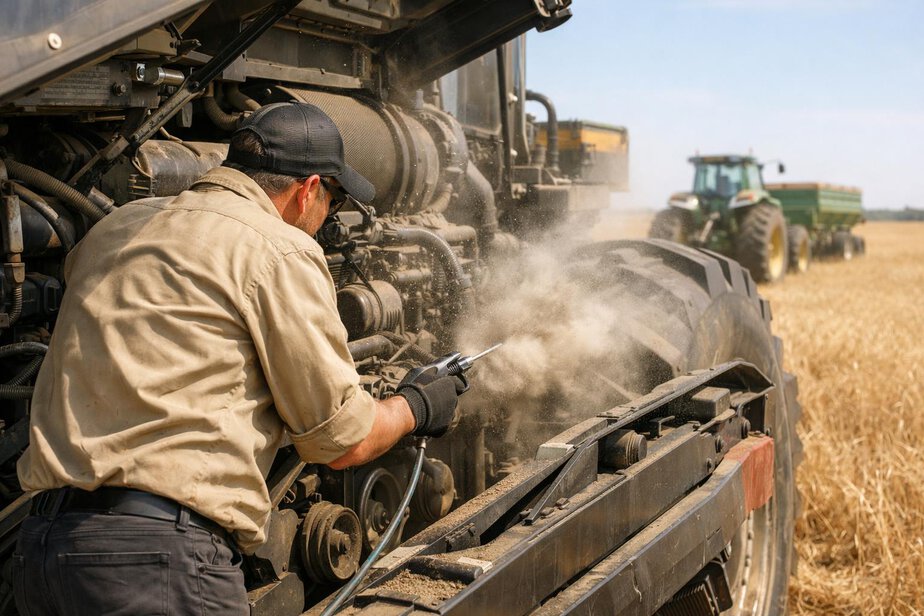
Regular cleaning is one of the simplest and most effective fire-prevention tasks during harvest. Crop residue should be removed often, not just at the end of the day. The drier the crop and the hotter, windier and dustier the weather, the more often cleaning may be needed.
Pay close attention to places where residue tends to build up and stay hidden. These include exhaust manifolds, turbochargers, engine bays, radiators and cooling systems, bearings and belt areas, battery compartments, hydraulic components, the rear and underside of the machine, weed-seed impact mills and the areas underneath guards.
Cleaning should generally be done from the top down so material is not blown back onto parts already cleaned. That sounds obvious, but it is easy to miss when people are trying to save time. A rushed clean can spread dust into hot or hard-to-see areas and leave the real hazard untouched.
Only clean, inspect or repair machinery after it has been shut down, isolated and made safe. Never reach into guarded or moving areas while the machine is running. If a raised front, header or hydraulic component must be accessed, it should be properly supported before anyone works underneath it.
Machinery fitted with weed-seed impact mills can produce more fine dust and may need more frequent cleaning. Fine dust can move easily with airflow and settle into spaces that look clean at first glance. That means the machine may appear tidy while still holding enough combustible material to create a serious fire hazard.
A good habit is to build short cleaning checks into the day rather than waiting for a major problem. That may mean stopping at scheduled breaks to clear residue before it accumulates around hot parts.
Watch bearings, belts, exhausts and wiring for early warning signs
Many machinery fires begin as a small mechanical problem long before any flames appear. The early warning signs are often subtle, but they matter. A bearing that is running hotter than the same bearing on the other side of the machine may be starting to fail. A belt that is rubbing, slipping or misaligned may be creating enough heat to ignite dust. A burnt smell, squeal, vibration or unusual noise should never be ignored.
An infrared heat gun is a useful tool for checking bearing temperatures during scheduled breaks. Compare temperatures across similar bearings so you can spot one that is noticeably hotter than the rest. A rising temperature is a warning that the bearing may be wearing, poorly lubricated or failing.
Do not keep harvesting and hope the problem will disappear. If a bearing becomes overheated, or if you notice unusual heat, vibration, noise or burning smells, stop and investigate. GRDC guidance notes the importance of checking bearings throughout the day and replacing bearings that become overheated.
It is also worth checking around fuel lines, battery cables, wiring, tyres and belts for rubbing or chafing. Any place where metal parts, wires or hoses contact each other can wear through over time and create a fault. Small damage may not seem serious until heat, vibration and dust combine in the field.
Exhaust systems and turbochargers need close inspection because they can remain very hot and sit near dry crop material. If dust or chaff accumulates there, ignition can happen quickly. That is why cleaning around exhausts, manifolds, turbochargers and guarded areas should be part of normal routine, not a once-a-week job.
Signs that should trigger an immediate stop
- Smoke or a burning smell.
- Unusual heat around a bearing, belt or exhaust.
- Vibration, rattling, squealing or scraping.
- Grease, oil, fuel or hydraulic fluid leaking onto dust.
- Repeated blown fuses or electrical faults.
- Visible chaff buildup around hot or moving parts.
Carry the right extinguishers and farm firefighting equipment
Fire extinguishers are important, but they are only one part of the response. They are most useful for a very small, early-stage fire where the operator has a clear escape route and can act without moving into danger. They are not a reason to stay too long or take risks.
CFA guidance recommends carrying at least two fire extinguishers on a harvester. They should be securely mounted, easy to reach and regularly serviced. A sensible arrangement is to place them where they can be accessed without moving toward flames, smoke or leaking fuel. That may include one near the operator’s cab and another at a safe external access point near the rear of the machine.
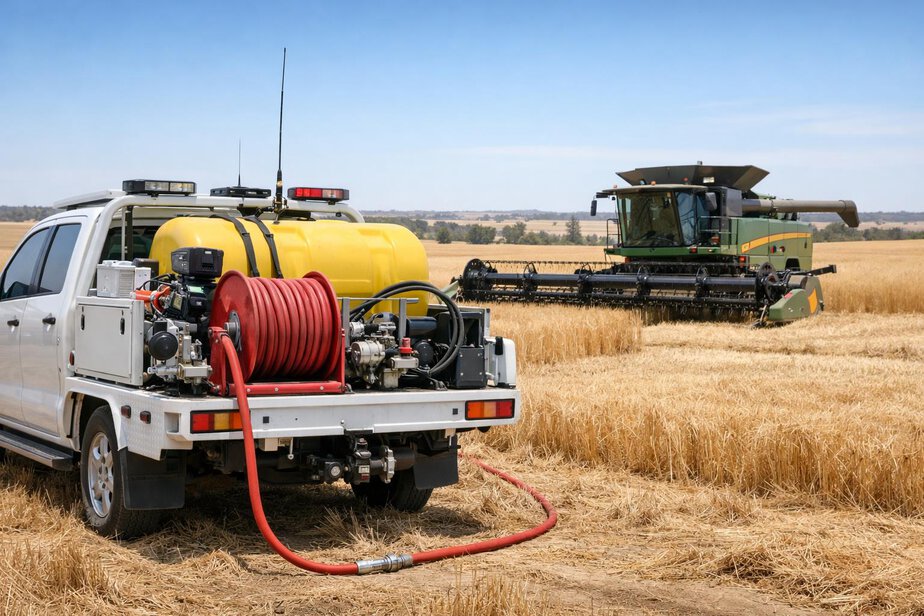
The same thinking applies to the farm firefighting unit. A farm unit should be operational and positioned close to harvesting activities. It should have an adequate water supply, a reliable pump, sufficient hose, a suitable nozzle, a clear escape route and radio or mobile-phone communication. The operator also needs to understand the equipment and know how to use it safely.
Firefighting equipment is there to support early intervention when conditions are safe. It must not create a false sense of security. If the fire is growing, if smoke is reducing visibility, if fuel is leaking, or if there is any risk to people, the safer action is to withdraw and call Triple Zero (000).
State and local guidance may vary. For example, South Australia’s CFS guidance calls for a maintained farm firefighting unit carrying at least 400 litres of water in the paddock where grain harvesting or grain handling occurs. That is not a universal national rule, so readers should check the requirements that apply in their own location.
| Equipment | Purpose | Good practice |
|---|---|---|
| Handheld extinguishers | Initial knock-down of a very small fire | Mount securely, service regularly and keep them easy to reach |
| Farm firefighting unit | Early support for safe, limited response | Keep it fuelled, tested, communicated and close to the work |
| Two-way radio or mobile phone | Coordination and emergency calling | Test before starting and maintain contact throughout the day |
Check weather, fire danger ratings and harvest restrictions every day
Fire risk is not fixed for the whole day. Conditions can change quickly as temperature rises, wind increases and humidity falls. A morning forecast is useful, but it is not enough on its own. Before starting work, check the current Fire Danger Rating, forecast temperature and wind, relative humidity, Total Fire Ban declarations, state fire-service warnings, local council or shire restrictions, any applicable grain-harvesting code, and any Harvest and Vehicle Movement Bans that may apply.
Some Australian requirements are location-specific. Laws, harvesting codes and fire restrictions differ between states, territories and local council areas, so operators must check the rules that apply to their property and the day’s conditions. Do not rely on what a neighbour does or on last season’s routine.
Operators should stop harvesting when the applicable state code, local restriction or farm safety plan requires it. There is no single numerical stopping point that suits all of Australia. A threshold that is acceptable in one jurisdiction may not be lawful or safe in another.
In Western Australia, local governments may issue Harvest and Vehicle Movement Bans when machinery operation presents an unacceptable fire risk. Operators are responsible for checking whether restrictions are in place before harvesting or operating machinery.
In Victoria, machinery operating during the Fire Danger Period may need to be mechanically sound, fitted with an approved spark arrester and accompanied by working water-based fire-suppression equipment with a minimum nine-litre capacity. Exact requirements depend on the machinery and activity, so local rules must be checked before work begins.
If conditions become unsafe, stop. That may be frustrating when a crop is ready, but a fire can destroy far more than one day’s work.
Plan communication before the first paddock is harvested
Good communication can save valuable time during an incident. Before harvest starts, prepare a written harvest fire plan that everyone can understand. It should not be left in one person’s head or buried in a phone note that others never see.
The plan should identify who will call Triple Zero (000), the property address and access points, paddock names or numbers, GPS coordinates where available, gates suitable for fire appliances, water-supply locations, machinery shutdown procedures, the location of firefighting units, nearby hazards such as fuel tanks, gas cylinders and powerlines, where workers should meet after evacuating, and who will warn neighbours.
Maintain two-way radio or mobile-phone contact between operators, chaser-bin drivers, the farm base and other workers. GRDC recommends a pre-harvest team meeting, a fire-management plan and reliable communication between workers. Those steps help make sure contractors and casual workers understand the plan before they enter the paddock.
The goal is not only to share information, but to make decisions faster. If a machine starts smoking, the person in the cab should know exactly who to call, where to move people, where the nearest exit point is and what information to give the fire service.
Neighbours may also need early warning, especially where smoke, flames or moving machinery could affect shared boundaries or access roads. The plan should say who is responsible for that task so it is not forgotten during a stressful moment.
What to do if machinery catches fire
If machinery catches fire, the first task is to protect people. Stop work immediately and warn everyone nearby. If the situation is life-threatening or the fire cannot be safely controlled, call Triple Zero (000) early.
Give the property address, the paddock location, the access gate and any known hazards. Clear, calm information helps emergency services find the right place faster. If there are multiple machines in the area, say which one is burning and whether anyone is injured or trapped.
Shut down the machine only when this can be done safely. Leave the cab using the exit furthest from the fire. Move upwind and away from flames, smoke, fuel and tyres. Do not return to the cab for personal belongings. Those items can be replaced; people cannot.
Use an extinguisher only on a small, early-stage fire and only if there is a clear escape route. Never position yourself downhill or downwind of the fire. Do not stand near fuel tanks, hydraulic accumulators, tyres or pressurised components exposed to heat. If the fire is growing or you are unsure, withdraw.
Burning machinery should not be driven toward sheds, fuel stores, haystacks, homes or groups of people. It is also unsafe to drive through unburnt crop if burning material may fall from the machine and create additional fires. If the machine can be left in a safer place without creating more risk, do that and move away.
People come before machinery, crops and buildings. That principle should guide every choice during an incident.
After the flames appear out, keep watching
A fire that looks extinguished may not be finished. Heat can remain inside guards, under panels, in bearings or in crop residue trapped near the machine. Reignition is a real risk, especially when wind shifts or hidden material keeps smouldering.
After the flames appear extinguished, continue to watch the machinery and nearby crop for smoke, glowing material, hot bearings, burning material inside guards, and fire beneath the machine. Tyres, belts, wiring and residues around the engine bay may still be hot enough to flare up again.
Do not restart the machinery until it has been inspected, repaired and declared safe. If the cause is not known, treat the machine as potentially hazardous until it is checked properly. That is especially important after an electrical fault, bearing failure or fuel leak.
Where practical, preserve the scene so the cause can be investigated. Record relevant information such as weather conditions, where the fire began, warning signs noticed beforehand and maintenance recently completed. Good notes can help explain what happened and may reduce the chance of a repeat incident later in the season.
Even when the fire seems minor, review the event with the crew. Ask what was seen first, how quickly the fire changed, whether communication worked and whether the response plan needs to be improved.
Practical checklists for pre-harvest, daily start-up and emergency response
Short checklists make it easier to stay consistent when the season gets busy. They also help new staff, contractors and relief operators follow the same standard.
Pre-harvest checklist
- Service machinery according to manufacturer instructions.
- Inspect bearings, belts, chains, exhausts, turbochargers, wiring, fuel lines and hydraulic hoses.
- Repair leaks before operating in dry crop or stubble.
- Check for rodent damage and chafing.
- Make sure guards and covers are fitted and clean.
- Confirm fire extinguishers are mounted, charged and serviced.
- Check the farm firefighting unit, pump, water supply, hose and nozzle.
- Prepare the written harvest fire plan and share it with the crew.
- Confirm local fire restrictions, bans and weather conditions for the area.
Daily start-up checklist
- Remove visible chaff, dust and straw from hot and hidden areas.
- Check around exhausts, manifolds, turbochargers and battery compartments.
- Look for leaks, loose belts, hot bearings or damaged wiring.
- Use an infrared heat gun to compare bearing temperatures during breaks.
- Test communications between operators, the farm base and the fire unit.
- Re-check Fire Danger Rating, wind, humidity and any restrictions before starting.
- Stop work if conditions worsen or a ban or code requires it.
Emergency response checklist
- Stop work and warn everyone nearby.
- Call Triple Zero (000) early if there is any risk to life or the fire is beyond immediate safe control.
- Give the address, paddock location, access gate and hazards.
- Shut down only if it is safe to do so.
- Leave via the exit furthest from the fire.
- Move upwind and away from smoke, fuel and tyres.
- Use an extinguisher only on a small fire with a clear escape route.
- Keep watching for smoke or reignition after flames are out.
- Do not restart until the machine is inspected and declared safe.
Practical conclusion for the harvest season
Harvest machinery fires are preventable more often than not, but only if fire safety is part of the daily routine. The important habits are straightforward: service the machine before the season starts, remove dust and chaff regularly, check bearings and hot components, keep extinguishers and a farm firefighting unit ready, monitor weather and restrictions, and stop early when conditions turn unsafe.
Just as important, never let the machine take priority over the people working around it. If a fire starts, get everyone to safety, call Triple Zero (000) early when needed, and avoid any action that puts you closer to flames, smoke, fuel or tyres.
Before publishing or relying on any local procedure, verify the current requirements for your state, territory and council area, and check your farm’s own fire plan and machinery instructions. Local rules and conditions can change, and the right response always depends on the situation in front of you.
FireRescue Training Hub
Access practical fire and emergency study support resources, downloads, checklists, audio guides, and member-only course content.
- Course library
- PDF downloads
- Audio guides
- Checklists
Study support only. Not accredited training or a replacement for workplace procedures.
About the author and safety review
Ken Walker
Former Station Officer and fire service educator
Former career firefighter with extensive career and volunteer fire service experience.
Qualifications: Associate Diploma of Applied Science in Fire Technology; Institute of Fire Engineers studies.
Author profilehttps://www.firerescue.com.au/about-us/