When investigators collect wildfire evidence, they are not just picking up debris. They are preserving a chain of facts that may help explain how a fire began, what it burned, and what happened at the scene. This study resource explains Element 4 of PUAFIR603 in plain language, with a focus on safe, authorised practice in Australia.
This article is for learning support only. It is not accredited training and it does not replace legislation, organisational procedures, specialist advice, authorised instruction or workplace assessment. Immediate life-threatening emergencies in Australia require Triple Zero (000). Only trained and authorised personnel should handle, collect, package, transfer or examine evidence.
Study support notice and learning outcomes
This part of the learning guide covers how authorised investigators identify and collect evidence to investigate a wildfire. It focuses on the work that happens after scene control and before final reporting. The goal is to support a careful, methodical approach that protects evidence and helps build a reliable explanation of the fire.
By the end of this section, you should be able to explain:
- the difference between control, comparison and residual samples
- how to protect samples from contamination
- how continuity of evidence is maintained
- why evidence should be recorded before collection
- how approved scene records support the investigation
- how forensic and physical evidence are interpreted with care
- how organisational and legal reports are completed from accurate notes
What Element 4 requires
Element 4 of PUAFIR603 is about identifying and collecting evidence to investigate a wildfire. In simple terms, this means the authorised investigator must recognise what may be useful, decide what should be sampled, record it properly, package it safely, and keep a clear history of each item from the scene to final storage or examination.
The performance criteria covered here are:
- 4.1 Identify and extract control, comparison and residual samples according to organisational procedures.
- 4.2 Protect samples from contamination and maintain continuity of evidence.
- 4.3 Record, collect, package and secure samples according to continuity procedures.
- 4.4 Apply approved procedures for capturing fire-scene records.
- 4.5 Interpret forensic and physical evidence.
- 4.6 Complete organisational and legal reports.
These tasks are connected. If any step is rushed or skipped, confidence in the evidence may drop. That is why professional wildfire investigation depends on discipline, patience and clear documentation.
Understanding control, comparison and residual samples
Sampling is only useful when the sample type is understood. The words can sound technical, but the idea is simple: investigators collect materials that help them compare one area or item with another, or check whether a residue or material may be linked to the fire.
Control sample
A control sample is material known not to contain the suspected substance. It can help show background conditions. For example, if a residue is found on a burned item, a control sample from a nearby unaffected area may help show what was already present in the environment.
Comparison sample
A comparison sample is similar material collected from an unaffected or known location for comparison. It may be used to compare fuel, soil, vegetation or other material with the item or area under investigation.
Residual sample
A residual sample is remaining material or residue that may relate to an ignition source, fuel, chemical or burned item. It could be a small amount of liquid, ash, soot, melted material or other trace matter. The meaning of a residual sample depends on context and expert assessment.
These definitions are only simple learning descriptions. They do not replace organisational, laboratory or specialist procedures. Only trained and authorised personnel should identify or extract samples.
How authorised investigators identify evidence and decide what to collect
Before anything is collected, the investigator must first decide whether the item is relevant to the investigation plan. This means looking for possible ignition sources, burn patterns, disturbed areas, residues, damaged equipment, fuel containers, smoking materials and other items that may help explain the fire.
Good evidence identification starts with scene awareness. The investigator should think about the fire behaviour, weather, fuel type, slope, access paths and any disturbance caused by suppression or later activity. An item is not automatically evidence just because it is burnt or unusual. It must be assessed in context.
Public members should not remove items from a wildfire scene. They may disturb important evidence, create a safety risk or destroy the location information that makes the item useful. Only trained and authorised personnel should decide what to collect.
Useful questions for the investigator include:
- Is the item related to a possible ignition source?
- Is it in a location that matches the fire spread indicators?
- Has it been disturbed by fire suppression, vehicles or weather?
- Would collection improve the investigation, or should the item remain in place?
- Does the item need specialist handling or laboratory examination?
Not every interesting item should be collected. Sometimes the best action is to document it thoroughly and leave it in place if that is required by procedure or safety.
Preventing contamination and protecting continuity of evidence
Contamination means unwanted material or handling changes the item in a way that reduces confidence in it. In wildfire work, contamination may happen through hands, gloves, clothing, reused tools, boots, vehicles, packaging, smoke, dust, water or soil. It can also happen if different items are placed together or if an item is moved before being properly documented.
Controls may include using clean approved equipment, changing gloves when required, separating items, working in a controlled area and limiting access to authorised people only. Personal safety always comes first. If the scene is unsafe, evidence work must wait until the risk is managed.
Continuity of evidence is the documented history of an item from collection to final storage, examination or authorised transfer. It shows where the item came from, who handled it, when it moved, how it was sealed and where it is kept. This history helps others trust that the item is the same one collected from the scene.
A continuity record may include:
- evidence number
- item description
- exact location
- date and time
- collector’s name
- photograph or sketch reference
- packaging and seal details
- each transfer
- storage location
- reason for examination or movement
- signatures or approved electronic records
An unexplained gap in continuity can weaken confidence in the evidence. That does not always make an item useless, but it may affect how strongly it can be relied on.
Recording evidence before it is moved
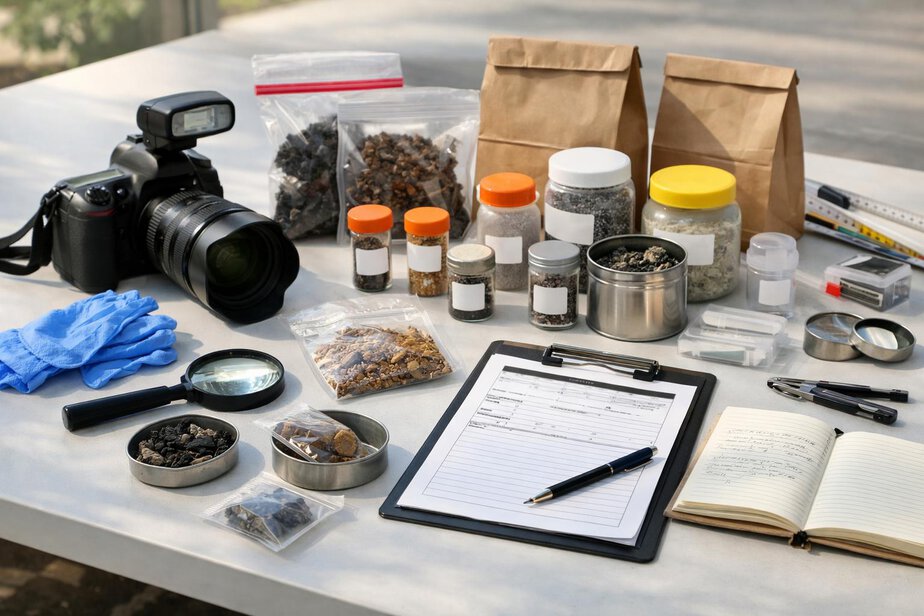
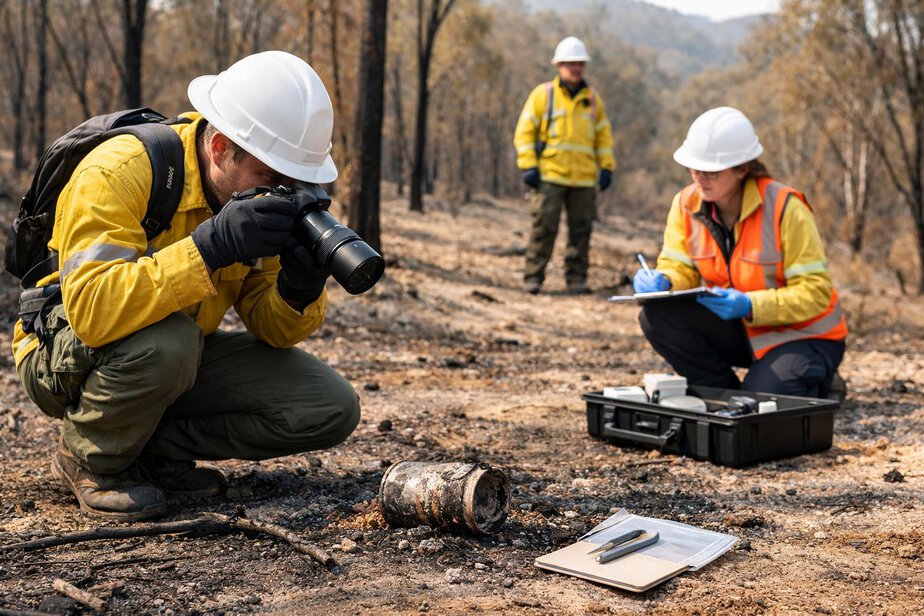
Evidence should normally be recorded before it is moved. Once an item is picked up, some of its original context is gone. A clear record of the scene before collection helps others understand where the item was found and what was around it.
Approved records may include photographs, close-up photographs, measurements where authorised, sketches, maps, notes, coordinates, item descriptions, surrounding conditions, nearby fire indicators and any known disturbance. If the item has already been altered by suppression or weather, that also needs to be recorded.
Useful recording habits
- start with the broad scene and then move closer
- take factual notes while the scene is fresh
- record north point, distances and landmarks where useful
- show the item in context before close-up images
- note signs of disturbance, such as hose lines, vehicle tracks or foot movement
Recording is not decoration. It is the foundation for later interpretation and reporting. A well-recorded scene can support the investigation even when some items cannot be recovered.
Packaging, labelling and securing samples
Packaging must suit the item and the intended examination. There is no one container that suits every sample. Wet, hot, sharp, fragile, chemical, electrical and biological items may need different controls. The investigator should follow organisational procedures, specialist advice and laboratory requirements.
For example, a damp item may need packaging that reduces further change, while a fragile item may need protection from crushing. A sharp component may need secure wrapping so it does not injure handlers or damage other items. A chemical residue may require a container chosen for that type of examination. The correct container depends on the item and approved procedure.
Basic packaging principles
- package each item separately when required
- do not mix unrelated samples unless procedure allows it
- label clearly and completely
- seal items in a way that shows if they have been opened
- store items in a secure place with restricted access
The label and seal are part of the evidence story. If a label is incomplete or a seal is missing, later users may not know whether the item has remained unchanged. For this reason, packaging and security are as important as the collection itself.
Capturing fire-scene records
Fire-scene records give structure to the investigation. They show what the scene looked like, where items were found and what changes happened during the investigation. These records must be factual, accurate, dated, legible and stored securely.
A clear record should describe:
- the scene condition on arrival
- boundaries and access points
- hazards
- weather
- fuel and topography
- fire-spread indicators
- areas and points of interest
- firefighting disturbance
- evidence locations
- collection actions
- decisions and changes
- persons present
Approved tools may include notes, photographs, video, diagrams, maps and evidence logs. The important point is not the style of the record, but whether it is reliable and complete enough to support the investigation later.
Observation versus interpretation
Observation is what is seen or measured. Interpretation is what the evidence may mean when compared with other reliable information. For example, an investigator may observe a darkened area and a damaged machine part. That is observation. Saying the machine caused the fire is interpretation, and it must be supported by more evidence.
Good records keep these two things separate. This protects the quality of the final report.
Interpreting forensic and physical evidence
Forensic and physical evidence in a wildfire scene can include electrical components, machinery or vehicle parts, fuel containers, smoking materials, matches or ignition devices, fire debris, ash or soil samples, vegetation, tyre or tool marks, burn patterns, photographs, digital records and witness information.
One item alone should not be treated as proof of origin or cause. Evidence must be assessed with fire behaviour, weather, fuels, topography, witness accounts and suppression activity. This is where careful comparison matters. The investigator asks whether the item fits the fire spread pattern and whether any other explanation is possible.
It is also important to remember that the presence of fuel, oil or smoking material does not by itself prove cause. A fuel container near a burned area may be relevant, but it may also be unrelated. A discarded smoking item may be important, but it still needs context. A damaged machine may be involved, but it may also be damaged by the fire rather than the cause of it.
Interpretation should be cautious and evidence-based. Where specialist laboratory examination is needed, the investigator should preserve the item properly and seek expert input rather than guessing.
Observation tells you what is there. Interpretation asks what it may mean, and only after it is compared with other reliable information.
Completing organisational and legal reports
Reports turn field work into a formal record. Organisational and legal reports should identify the investigator and authority, explain the scene and task, record the methods used, describe evidence factually, show continuity, separate facts from opinions, explain limitations, and record conclusions supported by the evidence.
They should also identify any further examination required and follow the approved format and review process. Do not invent forms or assume that one workplace report suits every service or jurisdiction.
Good report habits
- write from notes, not memory
- keep facts separate from opinions
- use clear and plain language
- refer to photo numbers, maps and evidence numbers
- include any limits caused by weather, access or disturbance
- record recommendations for further examination where needed
A report is strongest when it explains how the investigator reached the conclusion. That means readers can see the evidence path instead of simply seeing the final answer.
FireRescue Training learning support
Continue Your Fire and Emergency Services Learning
Build your knowledge with practical study resources, learner checklists, presentations and guided course materials from FireRescue Training.
www.firerescue.com.au/members/
Visit the FireRescue Training Section
FireRescue resources provide general study support and are not accredited training.
Practical scenario: a wildfire near machinery and roadside vegetation
A fictional wildfire begins near a machinery work area beside roadside vegetation in rural Australia. The scene includes a damaged machine, burned fuel or oil residue, a discarded smoking item, suppression water, tyre tracks from response vehicles, several possible ignition sources, and recorded weather with strong wind on the day of the fire. A specialist laboratory is later asked to examine selected items.
The authorised investigator arrives after the area has been made safe. The first task is to confirm authority and scene safety. The second task is to document items in place before anything is moved. The investigator notes that the roadside grass is heavily burned, the machine is damaged, and the suppression water has changed some of the ground surface. Vehicle movement has also disturbed parts of the area.
Possible evidence includes the machine itself, nearby residue, the discarded smoking item, soil or ash from relevant places, and comparison material from nearby unaffected areas. The investigator identifies which items may need control, comparison or residual samples, following organisational procedures.
Separate approved tools are used for different items to reduce contamination. Each item is packaged, labelled and sealed on its own where required. The investigator records every transfer and preserves photographs, notes and maps. Weather and wind records are attached to the file because they help explain fire spread and potential ignition direction.
The damaged machine is not assumed to be the cause. The fuel or oil residue is not treated as proof on its own. The smoking item is also not treated as automatic proof. Instead, the investigator compares all of these with the burn patterns, weather, fire spread indicators, suppression disturbance and specialist laboratory advice. Alternative causes remain open until the evidence supports a stronger conclusion.
In the end, the investigator completes the required reports, explains the scene conditions, records what was collected, notes any limitations caused by suppression disturbance, and identifies items that need further examination. This is a careful, professional approach to collect wildfire evidence without overstating what any single item means.
Common evidence-collection errors
Even trained people can make mistakes if they move too quickly or fail to follow the procedure. Common errors include collecting before photographing, using unsuitable or dirty tools, placing separate items in one package, using incomplete labels, failing to record transfers, leaving evidence unsecured, treating laboratory results as proof without context, mixing observations with assumptions, ignoring suppression disturbance, and completing reports from memory instead of notes.
These errors matter because they can damage confidence in the evidence. A scene may still produce useful information, but poor handling can make it harder to support a conclusion.
How to reduce mistakes
- work from the investigation plan
- pause before moving anything
- use approved equipment only
- check labels and seals before transport
- record each step as you go
- review notes before final reporting
The best protection against mistakes is a steady process. Rushing is one of the biggest risks in evidence work.
Five-question knowledge check
Practice only — not a formal assessment.
- Which sample is material known not to contain the suspected substance?
Correct answer: Control sample.
Explanation: It helps show background conditions or provide a comparison point. - True or false: A clean pair of gloves can still help prevent contamination if they are changed when required.
Correct answer: True.
Explanation: Changing gloves can reduce cross-contamination between items and locations. - Which record best supports continuity of evidence?
Correct answer: A log that shows the item number, who handled it, when it moved and where it was stored.
Explanation: Continuity depends on a documented history of the item. - What should usually happen before a suspected item is collected?
Correct answer: It should be photographed, noted and recorded in place first.
Explanation: Recording the context before movement helps support later interpretation. - Which statement is best?
Correct answer: A laboratory result is important, but it must be interpreted with scene facts, fire behaviour and other evidence.
Explanation: One result alone does not prove origin or cause.
Performance Criteria 4.1 to 4.6 checklist
- 4.1 Identify and extract control, comparison and residual samples according to organisational procedures.
- 4.2 Protect samples from contamination and maintain continuity of evidence.
- 4.3 Record, collect, package and secure samples according to continuity procedures.
- 4.4 Apply approved procedures for capturing fire-scene records.
- 4.5 Interpret forensic and physical evidence.
- 4.6 Complete organisational and legal reports.
Five key takeaways
- Only trained and authorised personnel should handle, collect, package, transfer or examine evidence.
- Control, comparison and residual samples have different purposes, so the investigator must choose the right one for the question being asked.
- Contamination control and continuity records are essential because they protect confidence in the evidence.
- Evidence should be recorded before collection, using factual scene notes, photographs, sketches and maps where authorised.
- Interpretation must stay cautious: no single item, photo or laboratory result proves origin or cause by itself.
For wildfire investigations, careful evidence work is a discipline. The best outcome comes from safe scene practice, accurate records, and respectful limits on what the evidence can actually show. Before publication or workplace use, verify local procedures, organisational requirements and current Australian guidance relevant to your setting.
FireRescue Training Hub
Access practical fire and emergency study support resources, downloads, checklists, audio guides, and member-only course content.
- Course library
- PDF downloads
- Audio guides
- Checklists
Study support only. Not accredited training or a replacement for workplace procedures.
About the author and safety review
Ken Walker
Former Station Officer and fire service educator
Former career firefighter with extensive career and volunteer fire service experience.
Qualifications: Associate Diploma of Applied Science in Fire Technology; Institute of Fire Engineers studies.
Author profilehttps://www.firerescue.com.au/about-us/