To coordinate a wildfire investigation well, the investigator must do more than walk a burnt site and look for clues. They must confirm who is involved, work within their authority, gather the right information, manage safety, and keep the investigation aligned with current incident management arrangements.
This article is a general study support resource for PUAFIR603 Determine origin and cause of wildfire, Element 1. It focuses only on how to coordinate a wildfire investigation. It is not accredited training and does not replace current legislation, organisational procedures, authorised instruction or workplace assessment.
Immediate life-threatening emergencies in Australia require Triple Zero (000).
What learners will learn
By the end of this resource, you should have a clear picture of how a wildfire investigator supports a safe and orderly investigation from the very beginning. The focus is on the coordination work that happens before and during the first stages of scene examination.
You will learn how to:
- confirm the roles and responsibilities of agencies, organisations and support personnel
- build cooperation between people from different agencies
- identify, request and receive information needed for the investigation
- coordinate investigation activities so work is efficient and does not disturb the scene more than necessary
- select and use PPE according to organisational procedures and the risk assessment
- follow WHS/OHS requirements that apply to the incident
This unit is about determining the origin and cause of wildfire. That wider task may involve fire behaviour, weather, topography, fuel load, physical evidence, witness information, incident records and firefighting actions. In this article, however, the emphasis stays on Element 1: coordinate wildfire investigation.
The role of the wildfire investigator
A wildfire investigator helps answer key questions about where a fire started, how it developed and what may have caused it. But before any detailed scene examination begins, the investigator must set up a safe and controlled approach.
In practical terms, the investigator is not there to take over every part of the incident. Active firefighting operations remain under incident management arrangements. That means suppression crews, the Incident Controller and other operational personnel continue to manage the fire response while it is still active. The investigator must work within their authority and follow current organisational procedures.
The coordination role usually includes:
- checking who has authority to allow investigation activity
- finding out which people are already involved
- understanding what the scene looks like now and what has changed
- arranging the right information, access and safety briefings
- making sure the investigation does not interfere with firefighting or other emergency work
The investigator also needs to separate fact from assumption. A burnt area may look simple at first glance, but the scene can be altered by fire behaviour, suppression activity, weather changes, vehicle movements and later clean-up. Careful coordination helps the investigator understand what has happened and what evidence may still be reliable.
In wildfire investigation, the safest first step is not entry. It is confirmation: who is in charge, what is safe, what is authorised and what information is already available.
Confirming agency and personnel responsibilities
Performance Criterion 1.1 requires the investigator to confirm the roles and responsibilities of agencies, organisations and support personnel involved in the wildfire investigation. This is an essential step because responsibility can vary between jurisdictions, incidents and organisational arrangements.
The investigator should identify:
- who has authority for the investigation
- who is responsible for incident control
- who is responsible for scene security
- who may collect or handle evidence
- which specialists are available
- how agencies will communicate
- the limits of each person’s role
This does not mean the investigator assumes every role personally. It means they understand the structure around the incident and know who can do what. A clear role picture reduces confusion and helps people stay within their authority.
For example, one person may control the fire response, another may secure the scene, and another may support mapping or technical assessment. Some personnel may only provide advice or access support. Others may be authorised to collect samples, record observations or photograph evidence. The exact arrangement depends on local procedures.
A useful way to think about this is:
- Authority: who can approve actions
- Responsibility: who must carry out the task
- Support: who can provide advice, transport, equipment or specialist knowledge
- Limits: what each person must not do without permission
The investigator should not guess. They should confirm roles directly through approved channels and record the result.
Building cooperation between agencies
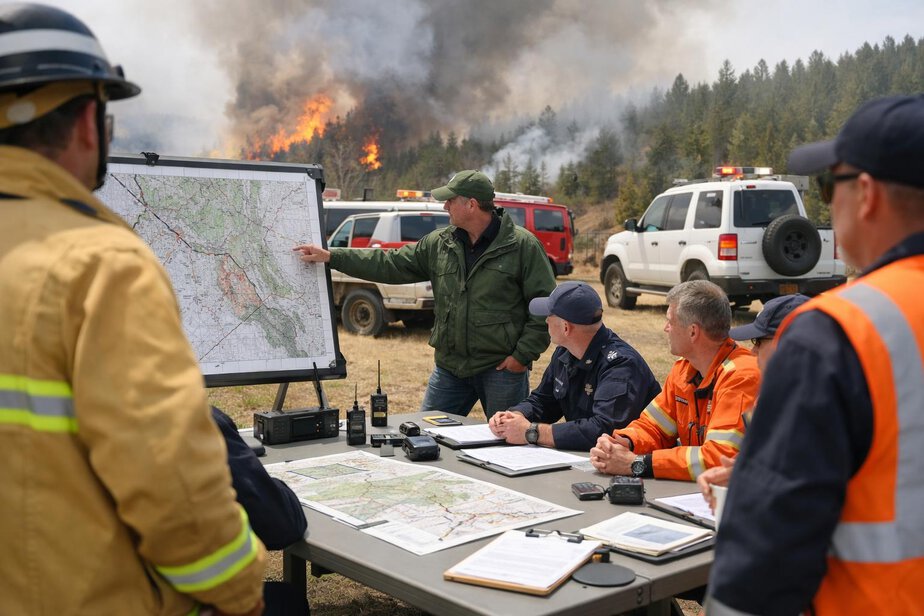
Performance Criterion 1.2 focuses on cooperation. Wildfire investigations often involve people from more than one agency or organisation. These may include firefighters, police, land managers, forensic specialists, technical experts and other authorised personnel.
Cooperation does not happen by chance. It must be actively built through respectful communication, clear briefings and agreed goals. Everyone involved should understand that the aim is not to prove a personal opinion. The aim is to gather reliable information without creating extra risk or damage to the scene.
Useful cooperation practices include:
- starting with a short, respectful introduction
- explaining the immediate purpose of the investigation
- sharing only the information needed for the task
- using agreed communication channels
- clarifying uncertainties early
- avoiding duplicated tasks
- keeping people within their designated role
- recording important decisions and changes
Good cooperation is especially important when a scene is still active. Firefighters may be operating nearby, traffic management may be in place, and other emergency tasks may still be underway. The investigator must not create extra pressure on those teams. Instead, they should work in step with them.
Respectful communication matters because people from different agencies may use different language, work patterns and priorities. The investigator should listen carefully, ask clear questions and avoid making assumptions. A short briefing can often prevent a long delay later.
When uncertainty appears, it should be resolved early. For example, if two personnel believe different areas are under their control, the investigator should not try to decide alone. The matter must be clarified through the correct authority and noted in the records.
In practice, cooperation also means keeping records of who said what, what was agreed, and when the decision was made. That record can help later if the scene changes or if a question arises about why a particular action was taken.
Identifying and requesting information
Performance Criterion 1.3 requires the investigator to identify what information is needed from other agencies or organisations, then request and receive it through approved channels.
Wildfire investigations often depend on information that the investigator did not see personally. That information may come from call centres, first-arriving crews, incident management, land managers, technical staff or witnesses. The key is to request the right information, record it accurately and understand what it means.
Common information sources may include:
- the time the fire was first observed
- initial emergency calls
- first-arriving crew observations
- weather information
- maps and property information
- suppression activity
- aircraft or vehicle movements
- photographs or video
- witness details
- reports from the Incident Controller
- known hazards
- changes made to the scene
- possible ignition sources
Some of this information will be factual, some will be observations, and some may be witness accounts. These are not all the same. The investigator should separate them carefully.
| Type of information | What it means | Why it matters |
|---|---|---|
| Confirmed fact | Something directly observed or recorded | Can support later analysis |
| Witness account | What a person says they saw, heard or did | May need checking against other evidence |
| Assumption | A guess or untested idea | Should not be treated as proof |
| Interpretation | A view about what the facts may mean | Must be supported by evidence |
| Conclusion | The final finding reached after review | Should follow the investigation process |
Information should be requested through approved channels so it is traceable and accurate. Casual messages can be misunderstood. A proper request also helps the investigator know who supplied the information and whether it can be verified later.
When receiving information, the investigator should listen carefully, ask follow-up questions where needed and record the source. If the information is incomplete, that should also be recorded. It is better to note uncertainty than to create an unsupported claim.
Never confuse a fast explanation with a confirmed one. A person may offer an opinion about how a fire started, but the investigator still needs evidence, scene context and source checking before any conclusion can be made.
Coordinating investigation activities
Performance Criterion 1.4 focuses on making the investigation efficient and effective. Coordination matters because wildfire scenes are often busy, dynamic and partly damaged. Without good organisation, evidence can be missed or disturbed.
A simple coordination cycle can help:
- Confirm authority and objectives. Know what the investigation is allowed to do and what it is trying to achieve.
- Obtain an incident and safety briefing. Find out the current conditions, hazards and restrictions.
- Identify required personnel and resources. Work out who is needed and what equipment or support is required.
- Assign authorised tasks. Give clear work tasks only to people who are allowed and trained to do them.
- Set communication and reporting arrangements. Confirm how updates, warnings and decisions will be shared.
- Monitor safety and investigation progress. Check that the plan still fits the scene.
- Record decisions and significant changes. Keep a clear record of what changed and why.
- Review priorities as conditions change. Reassess if wind, weather, fire activity or scene access changes.
Coordination helps reduce confusion, duplicated work, unnecessary scene disturbance and missed evidence. For example, if one team is photographing an area while another team is about to move through it, the investigator should coordinate timing so that the first task is completed before the second begins.
Coordination also means working with the Incident Controller when active fire management operations are still continuing. The investigation cannot be treated as separate from the incident. Access, timing, exclusion areas and movement may all need to be adjusted to suit the fireground.
Clear briefings are important. A brief should cover the task, location, hazards, communication method, reporting line and any limits on movement or evidence handling. People should leave the briefing knowing exactly what they can and cannot do.
If a task starts to interfere with suppression activity, the investigator must pause, reassess and seek direction. Safety and operational priorities remain central. Rushing to inspect the suspected origin area can damage evidence, create conflict with crews and increase risk to everyone on scene.
Selecting and using PPE
Performance Criterion 1.5 requires personal protective clothing and equipment to be used according to organisational procedures. PPE is an important control measure, but it is not a replacement for safe planning.
The correct PPE depends on the hazards identified in the risk assessment and the organisation’s requirements. There is no single universal list that suits every wildfire scene. The investigator must follow local procedures and select equipment that is suitable for the actual task and conditions.
Possible hazards may include:
- heat
- smoke
- unstable trees
- ash pits
- rough ground
- sharp materials
- vehicles and machinery
- changing weather
- fatigue
- damaged infrastructure
- contaminated material
PPE should be inspected before use, worn correctly and maintained after use. Damaged or unsuitable PPE should be replaced according to organisational procedure. A quick check before entry can prevent a preventable injury later.
Important points about PPE:
- it must be suitable for the hazard
- it must be approved by the organisation
- it must be used with training and instruction
- it must be checked before entering the scene
- it must not be relied on to make an unsafe area safe
PPE also needs to match the activity. The demands of a roadside grass fire scene may be different from those of a burnt forest edge, a paddock boundary, or a site with vehicle access and damaged fencing. The investigator must not assume one setup will work for every task.
Remember: PPE reduces risk, but it does not remove it. If the scene is unsafe, uncontrolled or unauthorised, the answer is not better PPE. The answer is to stop, reassess and follow the correct control arrangements.
Following WHS/OHS procedures
Performance Criterion 1.6 requires the investigator to follow the WHS/OHS procedures that apply to the wildfire incident. These procedures are there to protect people from avoidable harm and to keep the investigation within safe limits.
WHS/OHS management in the wildfire setting should include:
- hazard identification
- risk assessment
- control measures
- safety briefings
- exclusion areas
- communication arrangements
- fatigue and hydration management
- monitoring changing fire and weather conditions
- emergency withdrawal arrangements
- reporting hazards, incidents and near misses
Safety arrangements should be practical and clear. Everyone should know how to report a new hazard, when to withdraw, and who to notify if the scene changes. A brief shift in wind can affect smoke, visibility, fire edge stability and access routes. The investigator must stay alert to those changes.
Personal safety comes before evidence recovery. No person should enter an unsafe, uncontrolled or unauthorised area to recover evidence. If there is any doubt about stability, access or fire activity, the investigator should pause and seek direction through the proper authority.
Fatigue and hydration also matter. Investigations can be mentally demanding, and burnt landscapes can be physically hard to move through. Long periods in heat, smoke or uneven terrain increase risk. Short breaks, water, and regular checks on personnel wellbeing are sensible control measures.
Emergency withdrawal arrangements should be understood before field work starts. If conditions change quickly, everyone needs a clear way to leave the area and report the issue. Confusion during withdrawal can put people in danger and interfere with emergency operations.
Good WHS/OHS practice also means reporting near misses. A near miss is a warning sign. It may show that a control measure is not strong enough or that the risk picture has changed. Reporting it early can prevent a later injury or scene loss.
Practical multi-agency scenario
The following fictional scenario shows how coordination might work in an Australian wildfire investigation. It is a study example only.
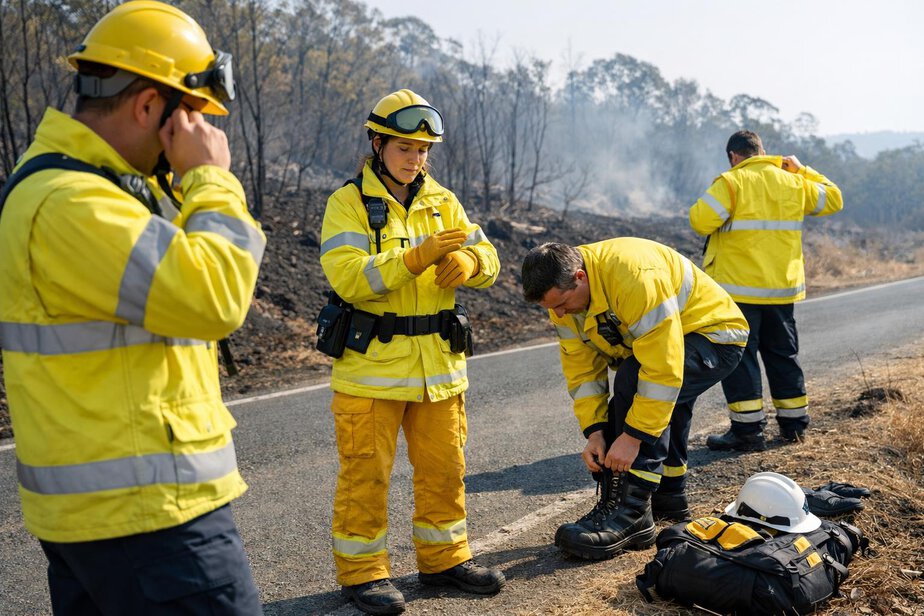
A wildfire has affected grassland and roadside vegetation near a rural road. Suppression crews are still working nearby, and the wind is changing during the afternoon. Several agencies hold useful information, including the people managing the incident, local land information, and those who first arrived at the fireground. There is also a concern that some firefighting vehicles may have disturbed parts of the roadside area that could be important to the investigation.
The investigator arrives and does not head straight into the suspected origin area. Instead, they first contact the Incident Controller through the approved process. They request a current safety briefing and ask who has authority over the investigation activity, who controls scene access, and what areas remain unsafe or restricted.
At the briefing, the investigator confirms the current roles and responsibilities. They identify which personnel may assist, which personnel must remain focused on suppression, and which tasks must wait. They also confirm how communication will occur and who needs updates before any move into the scene.
The investigator identifies the information needed from other agencies and personnel, such as:
- the time the fire was first reported or observed
- initial emergency call details
- first-arriving crew observations
- weather information
- records of suppression actions
- vehicle movement near the roadside
- photographs taken before the area changed
- any known hazards such as hot spots, damaged poles or unstable ground
The investigator requests this information through approved channels and records the source of each item. They do not treat one account as final proof. Instead, they keep facts, witness accounts and interpretations separate.
Before any scene entry, the investigator checks PPE and confirms the hazards. Wind is still shifting, smoke is moving across the area, and the shoulder of the road is uneven. Because conditions are not stable, the investigator delays entry until it is safer and authorised. This avoids unnecessary risk and helps protect the likely origin area from disturbance.
The investigator assigns only authorised tasks. One person may help with scene notes, another may manage records, and another may support mapping or perimeter checks if authorised. The investigator does not ask anyone to step outside their role.
As the scene develops, the investigator records decisions, information sources and any changes to access. When the wind increases and the suppression crew adjusts nearby operations, the investigator pauses again and checks whether the plan still fits the conditions.
This scenario shows why rushing is a mistake. If the investigator had entered quickly without authority, they could have disturbed footprints, vehicle marks, ash patterns or other evidence. They also could have entered a hazardous area while fire activity was still changing. Careful coordination protects both people and evidence.
Common coordination mistakes
Many investigation problems start with poor coordination rather than poor technical skill. The following mistakes can seriously weaken the investigation or create unnecessary danger.
- Entering the scene without authorisation. This can breach procedures and damage evidence.
- Failing to confirm who is in charge. If authority is unclear, work can become confused or duplicated.
- Relying on unverified information. Assumptions can lead the investigation in the wrong direction.
- Giving tasks to people outside their role. This can create safety and accountability problems.
- Poor communication between agencies. Missed messages can lead to delays and scene disturbance.
- Failing to record decisions. Later review becomes difficult if records are incomplete.
- Wearing unsuitable or damaged PPE. This increases the chance of injury.
- Continuing work when conditions become unsafe. Safety must be reviewed whenever the scene changes.
- Allowing investigation activity to interfere with firefighting operations. Active incident management remains the priority while the fire is still being controlled.
These mistakes are often preventable. Most can be reduced by slowing down at the start, confirming the incident structure, and using a clear coordination routine.
If there is pressure to hurry, the investigator should return to the basics: authority, safety, communication and task control. A careful start saves time later and improves the quality of the investigation.
Practice only — not a formal assessment
Five-question knowledge check
1. Why must a wildfire investigator confirm agency roles before beginning work?
Answer: To know who has authority, who controls the incident, who secures the scene, who may handle evidence and how people should communicate. This reduces confusion and keeps everyone within their role.
2. What is one good way to improve cooperation between agencies?
Answer: Use respectful communication and clear briefings. This helps people understand the shared objective and their own task limits.
3. Name two types of information a wildfire investigator may need from other agencies.
Answer: Examples include the time the fire was first observed, weather information, suppression activity, first-arriving crew observations, photos or witness details. These help build an accurate picture of the incident.
4. Why should investigation activities be coordinated with the Incident Controller during active fire operations?
Answer: Because active firefighting remains the priority while the fire is still being managed. Coordination helps avoid unsafe access, scene disturbance and conflict with suppression work.
5. Why is PPE not enough on its own?
Answer: PPE reduces risk, but it does not make an unsafe scene safe. The investigator still needs hazard checks, risk controls and authorisation before entry.
Performance Criteria 1.1 to 1.6 review checklist
Use this checklist to review whether you understand the coordination task in Element 1.
- 1.1 I can confirm the roles and responsibilities of agencies, organisations and support personnel.
- 1.2 I can explain how cooperation between different personnel is achieved through clear communication and shared objectives.
- 1.3 I can identify the information needed from other sources and request it through approved channels.
- 1.4 I can describe a simple coordination cycle for organising investigation activities safely and efficiently.
- 1.5 I can explain that PPE must suit the hazard, be approved, checked and used correctly.
- 1.6 I can identify the WHS/OHS controls that support safe investigation work, including hazard reporting and withdrawal procedures.
If you cannot tick all six points confidently, revisit the relevant section and practise again with examples from your workplace or training materials.
Five key takeaways
- Coordination begins before scene entry. Confirm authority, roles and current conditions first.
- Active firefighting stays under incident management arrangements. The investigator works within current control structures.
- Information must be requested and recorded properly. Do not confuse facts, witness accounts and assumptions.
- Safety always comes before evidence recovery. Use PPE, WHS/OHS controls and withdrawal arrangements.
- Good coordination protects both people and evidence. It reduces confusion, unnecessary disturbance and missed information.
To coordinate a wildfire investigation effectively, the investigator must work carefully with agencies, check authority, request information through approved channels, and keep safety at the centre of every decision. That approach supports a more reliable investigation and reduces the chance of avoidable mistakes.
This article provides general study support only. It is not accredited training and does not replace current legislation, organisational procedures, authorised instruction or workplace assessment. Before using any information in practice, verify the facts and confirm local procedures, responsibilities and approval pathways.
FireRescue Training
www.firerescue.com.au
FireRescue Training Hub
Access practical fire and emergency study support resources, downloads, checklists, audio guides, and member-only course content.
- Course library
- PDF downloads
- Audio guides
- Checklists
Study support only. Not accredited training or a replacement for workplace procedures.
About the author and safety review
Ken Walker
Former Station Officer and fire service educator
Former career firefighter with extensive career and volunteer fire service experience.
Qualifications: Associate Diploma of Applied Science in Fire Technology; Institute of Fire Engineers studies.
Author profilehttps://www.firerescue.com.au/about-us/