📄 Free Fire Rescue Resources for This Post
Download a printable checklist and a one-page quick guide for childcare centre fire safety.
FireRescue public safety guide
Childcare centre fire safety starts with one question: can staff help every child, including every baby, reach safety when the usual exit is blocked?
This Australian guide covers fire prevention, evacuation plans, practice drills, extra help for children, family updates and the information firefighters need.
IN A REAL FIRE: Raise the alarm, start the centre’s safe evacuation procedure and call Triple Zero (000) as soon as possible. Keep children together at a safe meeting point. Check who is missing and tell firefighters immediately. Do not re-enter a burning or smoke-affected building. Follow the centre’s approved procedures and the directions of emergency responders.
Why childcare centre fire safety needs a special plan
A childcare centre faces challenges that most offices do not. Older children may recognise an alarm and follow simple directions. However, babies cannot walk, some children may be asleep and loud noise can upset others. As a result, educators need a plan to help every child reach safety. In practice, they cannot assume that every child will stand up and walk to an exit.
During the day, children move between sleep rooms, bathrooms, playgrounds and learning spaces. Meanwhile, educators may settle babies, prepare food, help with toileting or greet families. As a result, the emergency plan must reflect the staff on duty, the children present and the real building layout. A neat drawing alone cannot show whether an evacuation will work.
This article helps approved providers, centre managers, educators, family day care providers and parents. It focuses on childcare centres, with extra notes on family day care and Victorian bushfire rules. However, each service must also check its own state or territory rules, approval conditions and building arrangements.
Five priorities for a safer childcare centre
At a glance — the five priorities
- Know the risks: identify credible fire, smoke and evacuation hazards at the premises.
- Plan for every child: include infants, sleeping children and anyone needing support.
- Practise every procedure: record rehearsals and fix any weaknesses discovered.
- Keep escape routes usable: check exits, gates, alarms, equipment and assembly areas.
- Account and communicate: know who is present and give accurate information to emergency services and families.
What to do if there is fire or smoke
Everyone needs simple actions they can remember. The steps below give a public safety overview, not a replacement for the centre’s own emergency and evacuation procedure. In a real incident, trained staff may need to raise the alarm, call 000 and move children at the same time.
Choose a meeting point away from fire, smoke, traffic and emergency vehicles. However, wind or an outdoor fire may make the usual location unsafe. Therefore, the written plan needs a second meeting point that staff know and practise using.
If smoke or fire blocks an exit, never take children through it. Instead, follow the centre’s planned alternative. If you cannot escape, call 000 and explain your exact location. Do not assume a lift is safe during a fire. Multi-storey centres need building-specific evacuation arrangements.
What Australian childcare fire safety rules require
Childcare services covered by Australia’s National Quality Framework (NQF) must plan for emergencies. Regulation 97 of the Education and Care Services National Regulations sets out emergency and evacuation duties. Regulation 168 covers required service policies and procedures. In addition, providers must meet the supervision, building, fire safety and workplace duties that apply in their location.
Core NQF points to check
- Risk assessment: assess the emergencies that could affect the service. For centre-based services, review the assessment at least every 12 months and promptly after a change that may affect safe evacuation.
- Site-specific procedures: write clear emergency instructions and include an emergency and evacuation floor plan.
- Exit diagrams: display the emergency and evacuation floor plan and instructions clearly near every exit.
- Regular rehearsals: practise the emergency and evacuation procedures every three months while the service operates, then keep records. Include the children and adults who must participate under the Regulations.
- Different emergencies: if the plan covers several emergency procedures, practise each one as required, not just the easiest exit route.
These are key national requirements, not a full legal checklist. For example, centres in shared multi-storey buildings may need extra arrangements under the building emergency plan. A childcare service on a school site must also coordinate with the school. However, it still remains responsible for the children in its care.
Victorian providers can consult the Victorian Early Childhood Regulatory Authority’s emergency management guidance. For the national framework, see ACECQA’s Guide to the NQF — Quality Area 2.
Common fire risks in childcare centres and how to reduce them
Good fire prevention starts with everyday checks. Staff can often find small faults before they cause serious trouble. Therefore, start by checking the actual hazards in your centre because buildings, equipment and routines differ.
Kitchens, food preparation and heating
Cooking equipment, grease, appliances, electrical faults and unattended heating can start fires. Keep paper, packaging and other materials away from heat. Also, supervise cooking, keep fire safety equipment accessible and teach staff the correct response to a cooking or appliance fire. If there is smoke or fire, evacuation and calling emergency services take priority over trying to save equipment.
Laundries and clothes dryers
Many services wash bedding, towels and clothing throughout the day. Lint, restricted airflow and poorly maintained dryers can increase fire risk. Follow the manufacturer’s instructions. Clean accessible lint filters, keep vents clear and arrange qualified inspections when equipment develops a fault. For additional background, see FireRescue’s clothes dryer fire safety guide.
Chargers, batteries and electrical equipment
Tablets, power banks, cleaning equipment and toys may contain rechargeable batteries. Use approved, compatible charging equipment, follow manufacturer instructions, inspect for damage and avoid charging on combustible surfaces or where equipment obstructs exits. If a device overheats, swells, smokes or looks damaged, stop using it and follow current safety advice. Never put used batteries in ordinary kerbside bins. Read FireRescue’s battery disposal and rubbish-fire guide.
Storage, escape paths and controlled gates
Prams, cots, deliveries, bins and play equipment should not reduce the usable width of an escape route or block emergency doors. Secure gates must prevent unauthorised child access without preventing lawful emergency egress. If a gate or door needs a special unlocking method, check it against building and fire rules. Then test it during drills.
Smoke detection and maintenance
The building needs suitable fire alarms, emergency lighting, fire doors and other required systems. Qualified people must maintain them as applicable rules require. Staff should know what an alarm means and what action it requires. Never wedge a fire door open or cover an alarm because it is inconvenient. Report faults straight away. In the meantime, follow the approved safety precautions until a competent person fixes the problem.
How should a childcare centre evacuate babies and toddlers?
Infants and children who cannot walk need special attention. The plan must work when the centre is busy, not just when an extra educator happens to be available. Start with the number and ages of children, their mobility needs, the staff on duty and the available exits.
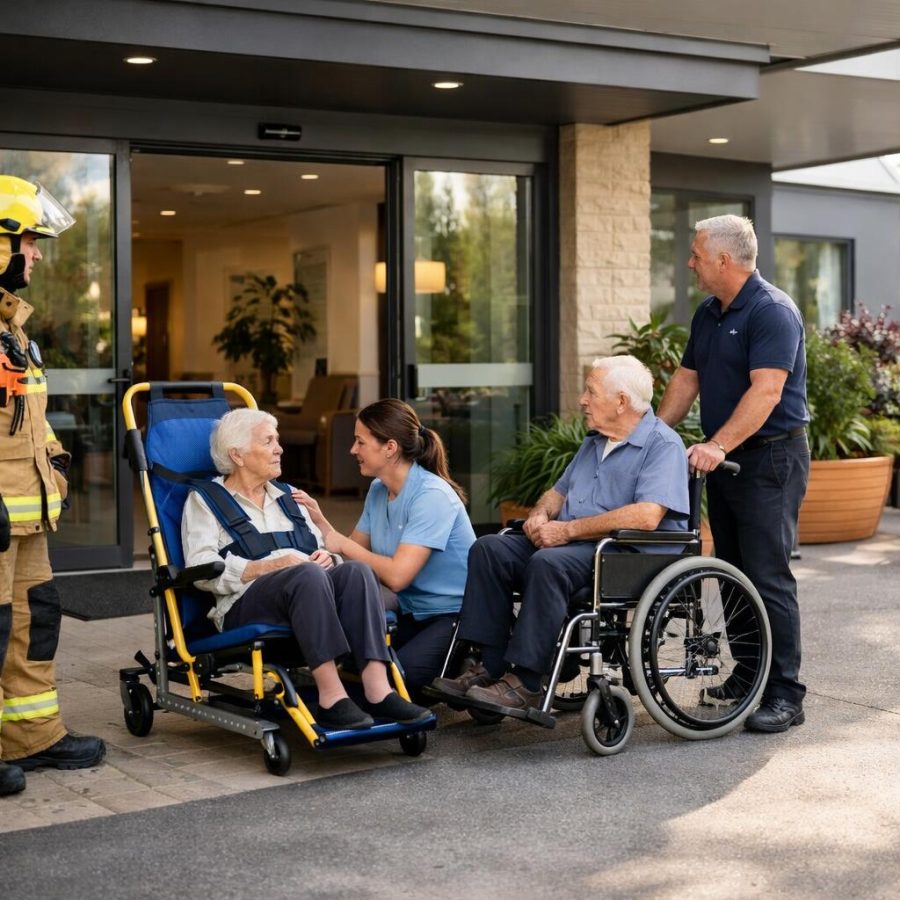
A suitable plan may use an evacuation cot, multi-child evacuation device or other purpose-designed equipment. However, buying equipment is only the first step. Check its rated load, the children it can carry, door widths, surfaces, staff availability and the building layout. In addition, staff must learn to use it and practise according to the product instructions and the centre’s risk assessment. Never exceed its rated capacity or improvise restraints.
Check nursery equipment and exit routes
Test the nursery evacuation plan against real conditions
- How many babies could be asleep at once, and which adults are responsible for each group?
- Can the equipment pass safely through the normal and alternative exits?
- Are there ramps, steps, slopes, gates or changes in surface that affect movement?
- Can staff move and supervise children without leaving others unattended?
- What happens if the usual educator, exit or evacuation device is unavailable?
- How are children kept safely together once outside?
Helping toddlers and children who can walk
Toddlers may walk, but they can freeze, turn back, become upset or follow the wrong adult. Therefore, practise short, calm instructions that suit their age. Do not expect a perfect line during a real emergency. Plan enough capable adults for the children present, including suitable backup arrangements for relief staff and placement students.
Multi-storey centres face extra challenges. For example, ordinary cots and trolleys may not suit stairs, and staff must not assume they can use lifts during a fire. The centre may need a specialist plan, suitable exit arrangements and advice from qualified experts or relevant authorities. For this reason, nurseries above ground level need particular care.
Children with disability, sensory needs or communication differences
A procedure that works for most children can still fail a child who cannot hear the alarm, cannot walk the route, is overwhelmed by noise or does not understand a shouted instruction. Rather than treating every child the same, plan for each child’s needs. Where appropriate, involve families and relevant support professionals.
Useful arrangements may include an individual evacuation assistance plan, accessible routes, suitable mobility support, alternative ways to recognise an alarm, visual prompts, a familiar adult and calm language. For privacy, share personal details only with people who need them to keep the child safe. Follow the service’s privacy policy and legal duties.
A practical question for staff
If a child cannot walk, becomes distressed by alarms or needs specialised communication, who will assist, how will they do it, and what is the backup if that educator is absent?
Practise safely and sensitively. A rehearsal should build familiarity, not unnecessarily frighten children. Introduce alarms and safety instructions in ways that suit each child’s age and needs. Discuss any reasonable accommodations with the family beforehand.
Assigning roles without losing supervision
Clear roles help staff act quickly. However, role titles cannot replace enough educators or proper supervision. Use the following tasks when planning staff roles. They do not set a fixed staffing model. One person may hold more than one role only if that is safe and practicable for the number and needs of children present.
If the designated person is away, the procedure must still work. Consider breaks, staff changes, early starts, late pickups and smaller teams. Room checks must only be carried out when safe, as part of the preplanned process, and must not delay evacuation or require re-entry into a dangerous area.
Fire drills and evacuation rehearsals: what good practice looks like
Under the NQF, services must rehearse emergency and evacuation procedures every three months while operating and keep a record of each rehearsal. If a service has several responses, such as evacuation and lockdown, it must practise each as required. Some providers require more frequent practice through their own policies. These extra rules are different from the NQF minimum.
A useful drill tests something that could happen in real life. Change the scenario and time of day. At the same time, keep each practice safe and suitable for the children:
- The normal exit is unavailable; can staff use the documented alternative?
- A fire starts during sleep time; can babies be moved safely?
- A staff member assigned an important role is absent; who takes over?
- Some children are outside and some indoors; how are both groups accounted for?
- A child needs mobility or sensory assistance; does the planned support work?
- One assembly area is affected by traffic or smoke; is the alternative usable?
After each drill, record the date, scenario, participants, steps practised, problems and follow-up actions. Next, assign someone to fix each problem. For example, if the evacuation cot cannot pass through a doorway, the conclusion is not simply “try harder next time”. That is a design or planning problem requiring prompt correction and potentially qualified advice.
Also review the plan after a real emergency, a near miss, major building work or a change in a child’s support needs. For centre-based services, Regulation 97 also requires a risk-assessment review at least every 12 months. Above all, a signed document only helps if educators can use it in their rooms.
Bushfire and grassfire: a different planning problem
A building fire may require immediate movement out of the premises. A bushfire or grassfire approaching a childcare service creates additional dangers: radiant heat, smoke, blocked roads, late family pickups and uncertainty about safe travel. Early decisions help protect children. Therefore, plan and act before a fire threatens the centre rather than relying on a late evacuation.
Australia uses four Fire Danger Ratings: Moderate, High, Extreme and Catastrophic. When no rating applies, the forecast may show No Rating. Ratings are about how dangerous a fire could be if one starts. They are different from incident warnings, which tell people about an actual event. A centre should monitor both, using its own approved procedures and official warning services.
Check your service’s bushfire closure conditions
Victoria: additional closure obligations
In Victoria, services on the Bushfire At-Risk Register (BARR) or Category 4 list must follow extra approval conditions. For example, they must close in advance when the forecast reaches Catastrophic for their fire weather district. Co-located school arrangements can add practical complications. Check the service’s current approval conditions and the official lists; do not assume every Victorian childcare service has the same closure triggers.
See the Victorian regulator’s bushfire and grassfire requirements and the BARR register.
In Victoria, family day care services have their own bushfire duties. Although individual family day care sites are not listed on the BARR, providers must assess fire risk, monitor summer ratings and arrange closure for days forecast as Catastrophic in the relevant fire weather district. Other states and territories have their own service requirements, warnings and closure arrangements. Nevertheless, every centre should answer the same questions. Who monitors official warnings? Who decides to close? When do families hear about a closure? What if children are already there? How will the centre avoid sending families onto unsafe roads?
Smoke nearby does not prove that a road is safe. Likewise, the absence of a warning does not guarantee safe travel. For broader family preparedness, see FireRescue’s Australian bushfire preparation guide.
Firefighter perspective: what arriving crews need to know
From an operational firefighting and emergency-management perspective, a childcare centre can present a difficult combination of unfamiliar layouts, multiple rooms, young occupants, controlled access and rapidly changing information. These points reflect general firefighting principles and official evacuation guidance. They are not a claim that the author attended a specific childcare incident.
Information that helps the first arriving crew
- Exact incident location: which building, room or wing is involved and where crews can enter.
- Occupancy: the best confirmed count of children, educators and visitors on site.
- Accountability: who is accounted for and the last known location of anyone missing.
- Building access: locked gates, stairs, internal doors, alternate entries and any difficult routes.
- Hazards: gas cylinders, plant rooms, electrical equipment, hazardous storage or other known risks.
- Assembly location: where educators supervise evacuated children, away from fire trucks and smoke.
Choose one adult to brief firefighters, but keep enough educators supervising the children. In fact, firefighters need to know what staff have not yet confirmed as well as what they know. For example, “We can account for 42 children, but we have not checked the visitor register yet” gives firefighters a clearer picture than saying everyone is out without checking.
Public-facing emergency instructions should remain short and direct. Decisions on firefighting tactics, search, entry, isolation, rescue and fire suppression belong to trained emergency responders operating under their agency procedures and the actual incident conditions.
Keeping parents informed without creating more risk
Families need clear information about safe meeting points, reliable updates and any change to pickup plans. Explain these arrangements at enrolment. Then repeat the message whenever the emergency plan changes. Keep emergency contacts accurate, including alternative authorised contacts.
During an incident, avoid rumours, public names of children and live images from the meeting point. Never ask parents to drive towards an active fire scene. Communicate through the centre’s established channels and follow the advice of emergency services. Above all, the immediate priorities remain life safety, accurate attendance checks and supervision. As soon as it is safe, update families through the centre’s agreed communication channels.
Practical childcare centre fire safety checklist
Use this as a discussion and inspection aid, not as evidence of legal compliance by itself. Ask the responsible manager to assign each issue to someone and record when they fix it.
A useful five-minute question
Ask two educators to explain how they would safely move their current group of children if their nearest exit was blocked. If they give very different answers, or rely on an absent person or missing device, review the plan.
Frequently asked questions about childcare fire safety
How often must childcare centres practise fire evacuation?
Under the NQF, services must practise emergency and evacuation procedures every three months while operating. They must also keep rehearsal records. If the centre has several procedures, staff must practise each as required. Provider policies or additional service conditions may require more frequent practice.
Do babies have to participate in evacuation rehearsals?
The Regulations require the children and adults present on the day to take part as specified. Therefore, educators need a safe and age-appropriate way to include babies and test the nursery plan.
Does every childcare centre legally need an evacuation cot?
There is no one-size-fits-all equipment answer in this guide. The service must assess its children, layout, routes, staffing and applicable approvals, then provide a workable method for evacuating children unable to walk. A purpose-designed device may help, but the centre must check that it really suits the building and children.
What if a child is missing during an evacuation?
Tell the emergency coordinator and arriving firefighters immediately. Provide the child’s name or identifying details through appropriate secure channels, their last known location and any relevant mobility or assistance needs. Do not send staff back into a dangerous building.
Can staff fight a small fire instead of evacuating?
Evacuation, warning people and calling 000 must not be delayed. Only trained staff should consider using a fire extinguisher or blanket when the centre’s procedures and conditions allow it. Educators should not leave children without supervision or take risks attempting to control a developing fire.
Must Victorian childcare centres close on Catastrophic fire danger days?
Victorian services on the BARR or Category 4 list must follow the additional closure conditions, including pre-emptive closure when Catastrophic is forecast for their fire weather district. Other services must check their approval conditions and current government advice. Do not assume every centre follows the same closure trigger.
Does a childcare centre in a multi-storey building need special planning?
Yes. The evacuation of infants and children through stairs, shared building exits or controlled areas creates particular difficulties. The centre must match its procedures to the building emergency plan and seek qualified advice when needed.
What should parents ask a childcare centre about fire safety?
Ask how the service evacuates babies, how often staff practise, how they check attendance, what help children with additional needs receive and how staff will contact parents after an emergency. Look for a clear, current answer rather than a vague reference to a folder.
Conclusion: make the plan work for the child who needs the most help
A strong childcare centre fire safety plan does not need endless pages. Instead, it needs to work for real children, real staff, available exits and the problems that can arise during a normal day.
First, review the nursery and each child who needs individual help. Next, test another exit and check the attendance process. Speak with educators who open the centre, cover lunch breaks or supervise late pickups. Finally, record the gaps, fix them and practise again.
Related FireRescue guides
Official guidance and sources
The following Australian government, regulatory and fire-service resources informed this general guide. Because rules can change, check the latest information from your regulator and the conditions of your service approval.
- ACECQA — Guide to the National Quality Framework, Quality Area 2.
- Victorian Early Childhood Regulatory Authority — Emergency management in early childhood services.
- Early Learning Victoria — Emergency management and evacuation policy (includes additional provider-specific procedures).
- Queensland Government — Emergency and evacuation requirements (plain-English explanation of the NQF requirements).
- ACECQA — Multi-storey buildings: evacuations and approvals.
- Fire and Rescue NSW — Workplace evacuation.
- Victorian Early Childhood Regulatory Authority — Bushfire and grassfire risks.
- Victorian Government — Bushfire At-Risk Register.
About the author
Ken Walker — retired firefighter, fire-service leader and educator. This guide combines published official guidance with a general operational fire-safety perspective. It does not claim personal involvement in any particular childcare fire incident.
Official sources checked: 30 October 2026. Editorial status: This draft still needs a final safety review before publication. Do not call it independently approved unless that review has taken place.
Important: General education only. Not a centre-specific evacuation plan, legal opinion, fire engineering design, regulatory approval or substitute for training. Use current laws, service-approval conditions, building documentation, qualified advice and directions from emergency services.
Have a correction or a practical lesson from early childhood safety work? email FireRescue. Please avoid including identifying details about children or confidential incident information.
FireRescue Training Hub
Access practical fire and emergency study support resources, downloads, checklists, audio guides, and member-only course content.
- Course library
- PDF downloads
- Audio guides
- Checklists
Study support only. Not accredited training or a replacement for workplace procedures.
About the author and safety review
Ken Walker
Former Station Officer and fire service educator
Former career firefighter with extensive career and volunteer fire service experience.
Qualifications: Associate Diploma of Applied Science in Fire Technology; Institute of Fire Engineers studies.
Author profilehttps://www.firerescue.com.au/about-us/