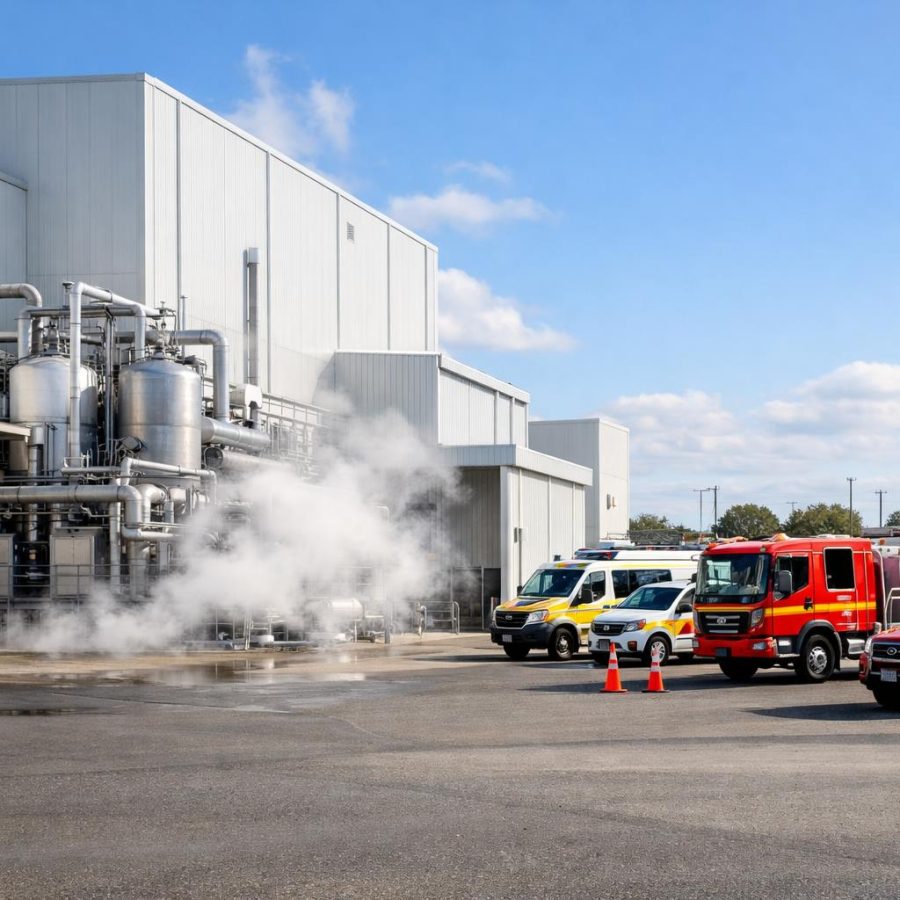
A fire in a residential aged-care facility is never routine. Residents may be frail, confused, bed-bound, dependent on medication or unable to understand instructions, while staff must balance life safety, smoke movement, building fire compartments and the limits of what can safely be moved at once. In Australia, the best response is not always a full evacuation; the safest decision depends on the immediate fire conditions, the building’s fire-safety systems, the vulnerability of residents and advice from emergency services.
Why aged-care facility fires are especially difficult
Residential aged-care fires are challenging because the people inside are often the least able to protect themselves. Many residents cannot quickly walk to an exit, cannot hear alarms clearly, cannot follow complex instructions or cannot tolerate the physical stress of moving in a hurry. Some live with dementia, delirium, cognitive impairment, frailty, chronic illness or reduced vision and hearing. Others rely on wheelchairs, walking frames, oxygen, suction, specialised beds or powered medical equipment.
That means a fire in aged care is not just a building emergency. It is also a care emergency. Staff must think about smoke, heat and flames, but they must also think about medication continuity, oxygen supply, skin integrity, falls risk, distress, wandering, communication barriers and the practical challenge of moving many vulnerable people at once.
Fires can also spread operational pressure across the whole site very quickly. A single alarm may trigger a full response from firefighters, ambulance and police, while staff are trying to account for residents, preserve calm, protect visitors and work with fire doors, smoke doors, lifts and compartmentation. In these settings, every minute matters, but rushed decisions can also create avoidable harm.
For families and the public, it is important to understand that a facility evacuation is not a simple movement exercise. It is a risk balance. Moving frail people can cause falls, hypothermia, oxygen interruption, disorientation, agitation and medical deterioration. In some incidents, keeping residents in protected compartments while firefighters attack the fire may be safer than trying to move everyone outside immediately.
Why early detection and rapid notification matter
The earlier smoke or fire is detected, the more options staff and firefighters usually have. A small incident identified quickly may be contained with a limited internal response, while a delayed discovery may force urgent evacuation through smoke-affected areas. For that reason, early detection systems, regular maintenance and prompt escalation of concerns are vital in aged care.
As soon as staff know about an emergency, they should notify emergency services. Australian Government guidance for aged care emphasises calling 000 as soon as the service becomes aware of an emergency event. That early call gives firefighters time to mobilise, gives ambulance and police services time to prepare and helps the facility access advice before conditions worsen.
Early notification matters for another reason: a facility’s internal response may need reinforcement. Staff may need assistance with relocating residents, controlling smoke spread, managing lifts, checking rooms, carrying equipment, or directing emergency crews through the building. A prompt 000 call helps ensure that professional support is on the way while the situation is still manageable.
Alarm systems and fire indicator panels can provide critical information, but they are not a substitute for immediate action. If a staff member sees smoke, smells burning or discovers a fire, the first priorities are raising the alarm, calling 000, protecting residents from smoke and following the facility’s emergency plan.
Immediate staff actions when fire or smoke is discovered
When fire or smoke is found in an aged-care facility, the first actions should be calm, clear and organised. Staff should activate the alarm, call 000, notify the appropriate internal supervisor and begin the response set out in the emergency plan. The exact sequence will vary by site, but the principles are the same: warn, report, protect and account.
Immediate staff actions commonly include the following:
- Raise the alarm and alert nearby staff without creating panic.
- Call 000 and provide the facility address, fire location and access details.
- Move residents away from smoke or fire if it can be done safely.
- Close doors behind the fire area to slow smoke movement.
- Check whether the building’s fire systems have activated and whether any compartments remain protected.
- Assign staff to account for residents, visitors and colleagues.
- Gather essential records, medications and mobility aids where time and safety allow.
- Prepare to brief firefighters on the number and location of residents.
The immediate aim is not to do everything at once. It is to reduce the most urgent risks first. In many fires, smoke is a greater immediate threat than flame. Moving residents away from smoke and keeping doors closed can buy time and support a more controlled response.
Staff should avoid opening doors into smoke-filled areas unless they have a clear reason and a safe plan. Opening the wrong door can feed air to the fire, spread smoke into other parts of the building and undermine compartmentation. When in doubt, the facility emergency plan and emergency service advice should guide the next step.
Keep supervision and communication tight
Residents who are moved from one area to another should remain under supervision. Confused residents may wander, try to return to their rooms or become distressed if left without clear reassurance. Staff must communicate in simple language, use calm direction and keep residents together where possible.
Progressive evacuation and sheltering in place
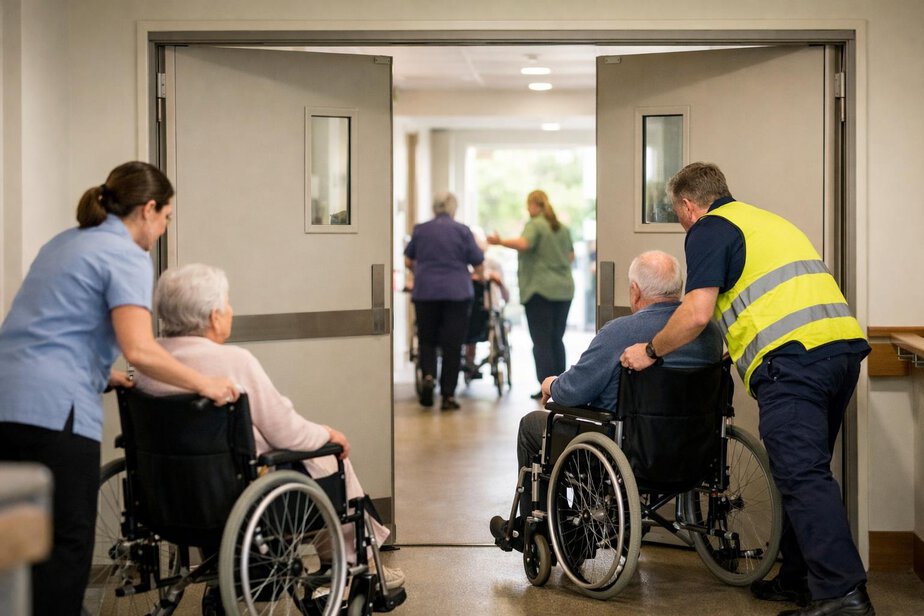
One of the most important concepts in residential aged care is that evacuation does not always mean taking everyone out of the building. In many cases, the safer option is progressive evacuation: moving people step by step to a protected area rather than attempting a full external evacuation immediately.
Victorian Department of Health guidance recognises two broad options in an emergency: shelter in place or evacuation and relocation. That practical distinction is useful across Australia. Shelter in place means residents remain within the facility where staying inside is safer or more appropriate. Evacuation or relocation means residents are moved because remaining in the affected area presents a greater risk.
Progressive evacuation may include:
- Horizontal movement to another fire compartment or safer part of the building.
- Vertical movement between floors where required and if safe.
- Movement outside the building when internal protection is no longer enough.
- Relocation to another aged-care facility or another safe location if the emergency extends beyond the site.
Horizontal movement is often valuable because it can reduce the physical strain on residents and staff. If the building is designed with fire compartments and protected areas, staff may be able to move residents across a fire-rated boundary while firefighters deal with the affected section. This can reduce immediate exposure to smoke and heat without forcing vulnerable people into the open air too soon.
Evacuation decisions should be based on the actual conditions at the time, not on a fixed assumption that everyone must leave immediately. The safest option may be to keep residents in a protected area until emergency services confirm a further move is necessary.
A full external evacuation can introduce major risks. Residents may become cold, dehydrated or frightened. Wheelchair users may struggle on uneven ground. Bed-bound residents may need complex transfer arrangements. Oxygen-dependent residents may need continuous supply. For many incidents, progressive movement is safer, faster and more humane.
When sheltering in place may be appropriate
Sheltering in place may be appropriate when the fire is contained, the compartmentation is holding, smoke movement is limited and firefighters or facility management advise that residents can remain safely inside a protected area. It is not a passive option. It requires active monitoring, closed doors, resident supervision and readiness to move if conditions change.
Special risks for residents with mobility, cognitive or medical needs
Residents in aged care may have very different evacuation needs. Some can walk with minimal assistance. Others need two staff members, a wheelchair, a hoist or a stretcher. Some have dementia and may not understand why they must move. Others may be confused by alarms, crowds, smoke or unfamiliar uniforms. Facilities must plan for these differences before an emergency occurs.
Residents with limited mobility may be unable to use stairs or may only manage them with substantial assistance. A person using a walking frame may move slowly and become exhausted quickly. A wheelchair user may need assistance through narrow corridors, thresholds or ramps. Someone who is bed-bound may need careful planning, extra staff and the right equipment to move without injury.
Residents with dementia or cognitive impairment may resist evacuation, try to leave the safe area, search for family or become distressed by the change in routine. Some may wander into unsafe areas if not closely supervised. Staff should use familiar voices, clear reassurance, simple direction and close observation. It is often better to guide rather than argue.
Medical dependence adds another layer of risk. Residents may rely on:
- oxygen cylinders or medical oxygen systems
- powered beds, pressure-relief equipment or mobility aids
- nebulisers, suction equipment or battery-powered devices
- medications stored in refrigeration
- regular timed medicines that should not be delayed
Where possible, keep essential medications, relevant health information and mobility equipment with the resident during evacuation or relocation. That may not always be possible in a fast-moving incident, but it should be a clear priority in the emergency plan.
Residents who rely on oxygen deserve special attention. Oxygen itself does not burn, but it can make a fire burn more fiercely and can create additional hazards around cylinders, tubing and concentrators. Staff should isolate and move oxygen equipment only in line with training, site procedures and emergency service direction. If a fire involves oxygen systems, firefighters need to know immediately.
How firefighters, ambulance and police work with aged-care staff
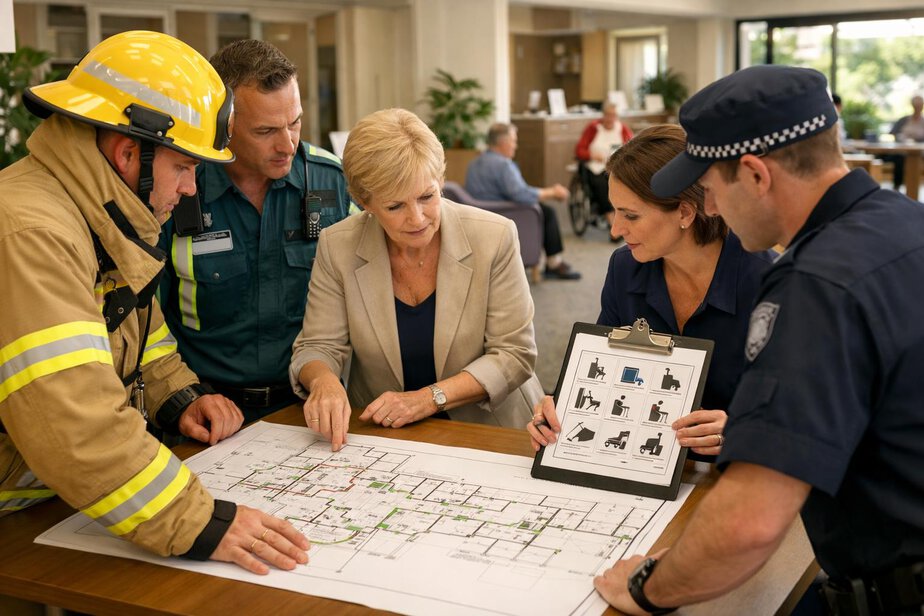
Effective response depends on good information sharing. Firefighters arriving at an aged-care facility need to know where the fire started, how much smoke is present, which compartments are affected and how many residents may still be inside. They also need to know which residents cannot walk independently, which residents require two-person assistance and whether anyone is confined to bed.
Useful information for emergency crews includes:
- number of residents, staff and visitors on site
- any residents who are missing or unaccounted for
- locations of residents who need wheelchair, hoist or bed assistance
- where oxygen users are located
- the layout of the building and its fire compartments
- information from the fire indicator panel where available
- known hazards such as stored oxygen, batteries or combustible materials
Staff should hand over clearly and avoid overload. If one person is coordinating with emergency services, they should use concise, practical language. Firefighters need accurate information, not assumptions. If a resident is known to have moved from one wing to another, or if a room is empty, that should be stated so crews do not waste time searching the wrong area.
Police may assist with perimeter control, traffic management, family liaison or crowd control, depending on the incident. Ambulance services may assist with assessment, treatment and selected transport, but planning should not assume enough ambulances will be available for a large-scale resident move. During major fires, bushfires or other disasters, ambulance resources may already be heavily committed.
For that reason, aged-care providers should consider multiple transport options in advance for frail residents who may need relocation. These options may include a mix of ambulance, patient transport, accessible vehicles and pre-arranged arrangements with other facilities, subject to local planning and emergency conditions.
Accounting for everyone
Accounting for every resident, staff member and visitor is critical. A missing person in aged care may be a resident who cannot self-evacuate, a visitor who was not recorded at arrival or a staff member in a remote part of the facility. Clear accounting helps emergency services decide where to search and whether additional rescue action is required.
Night-time evacuation, identification and resident tracking
Fires at night are especially difficult because staffing levels are often lower, residents are asleep and lighting conditions may be poor. Some residents may not be wearing glasses, hearing aids or mobility devices. Others may be confused on waking and may not understand why staff are asking them to move.
At night, the time needed to wake residents, communicate clearly and support movement can be substantial. Facilities should plan for this reality rather than assuming daytime staffing patterns will always be available. Night drills and realistic scenario planning are important because the pace and coordination of a night incident can be very different from a daytime one.
Resident identification is another key issue. After movement or evacuation, staff must know who has been moved, where they are and which care needs still apply. Identification can be maintained through records, care boards, wristbands or other facility-approved systems. The exact method matters less than the consistency of the process.
Where practical, residents should keep:
- their key medications
- essential personal and health information
- mobility aids they rely on
- hearing aids, glasses and other support items
Not every item can be moved in every emergency, but the plan should identify what is essential and how it will be gathered quickly.
Confused residents may refuse to move. In those cases, staff should use calm explanation, familiar routines and close supervision rather than force where that is unsafe or inappropriate. If a resident is at immediate risk from fire or smoke, trained staff and emergency services will need to act decisively in line with the emergency plan and the situation on the ground. The goal is always to reduce harm while respecting dignity as far as possible.
Essential services, backup power and oxygen hazards
Residential aged-care emergencies often involve more than the fire itself. A serious incident may disrupt electricity, water, heating or cooling, communications, medication refrigeration and access to electronic records. These failures can continue after flames are controlled, especially if the building has been partly evacuated or physically damaged.
Backup power is therefore an important part of emergency planning. Facilities should know what is supported by emergency power, how long it can run and which systems are considered essential. This may include lighting, call systems, refrigeration for medications, communication devices and some clinical equipment. Staff should not assume all equipment will keep running during a prolonged emergency.
Oxygen cylinders and medical oxygen systems require careful planning because they may create additional hazards if exposed to heat, damaged during movement or left in an unsafe area. Staff should know where oxygen is stored, which residents are using it and how to communicate that information to firefighters immediately. If there are large quantities of oxygen on site, that can affect firefighting tactics and safety zones.
Medical equipment charging can also become an issue. Residents may rely on powered beds, communication aids, hearing devices or other battery-supported equipment. If power is lost, a facility should know which residents need urgent prioritisation and what portable alternatives are available.
| Emergency issue | Why it matters | Planning focus |
|---|---|---|
| Electricity loss | Affects lighting, lifts, charging and some clinical equipment | Backup power, battery checks, manual alternatives |
| Water loss | Impacts hygiene, hydration and fire support systems | Stored water, contingency supplies, resident needs |
| Medication refrigeration | Some medicines may need temperature control | Cold-chain planning and transfer procedures |
| Communications failure | Makes family contact and coordination harder | Redundant communication options and contact lists |
| Oxygen disruption | Can rapidly affect residents who depend on oxygen | Identify users, move supplies safely, inform crews early |
Planning, drills and pre-incident coordination
Aged-care emergency performance is shaped long before the fire starts. Providers are expected to have emergency and disaster management arrangements that allow safe care to continue during emergencies. That planning should include evacuation arrangements, transport, alternative accommodation, continuity of care, staffing, essential supplies, medical and mobility equipment, and communication with families and authorities.
Emergency plans should be realistic. They should not assume that an external evacuation will always be easy, or that ambulances will be available for large numbers of residents. They should also account for situations where residents cannot be moved quickly, where staff numbers are reduced and where fire doors and compartmentation may be the key to buying time.
Useful planning actions include:
- mapping residents by mobility, cognition and care needs
- keeping up-to-date room and roster information
- identifying residents who need two-person assistance
- testing progressive evacuation routes and protected areas
- checking access for firefighting and transport vehicles
- identifying assembly areas that protect residents from smoke, heat and weather
- preparing communication lists for families, authorities and receiving facilities
Drills matter because people under stress do not perform well if the first time they hear a procedure is during a real fire. Training should be role-specific. Nurses, carers, hospitality staff, managers and night staff may each have different responsibilities. Fire crews also benefit from pre-incident planning with local facilities so they understand entry points, resident profiles, compartments and likely hazards.
Pre-incident coordination can include site familiarisation visits, review of access keys or systems, understanding of alarm panels and identifying where residents who need help are usually located. That preparation can save minutes during an actual emergency.
Family communication and continuity of care
Families will often be anxious and may seek immediate information. Facilities should have communication processes that are calm, factual and consistent. Families need to know that resident safety is the priority, but they should not expect perfect information in the first moments of an incident. Accurate updates are better than rushed assumptions.
Transport, relocation and recovery after the fire
If residents must be moved out of the facility, transport planning becomes a major issue. Residents may need to go to another aged-care facility, a hospital, a temporary shelter or another safe location. The correct destination will depend on their medical needs, the scale of the incident, local availability and advice from emergency services and health authorities.
It is important not to assume that an ambulance will be available for every resident. In a major incident, ambulance services may be committed to life-threatening cases, transport of the injured or support across a wider disaster area. Providers should therefore prepare for multiple transport methods and have arrangements that suit frail people, not just mobile adults.
Once residents have been moved, the focus shifts to recovery and safe return. Recovery may involve temporary accommodation, medication replacement, documentation checks, family updates, psychological support and assessment of what parts of the facility remain usable. Returning residents too early can create risk if smoke damage, service failure or security issues remain unresolved.
Where a relocation or shelter-in-place decision is made, Victorian residential aged-care providers are advised to notify the Australian Government Department of Health, Disability and Ageing when it is safe to do so. More broadly, communication with government, families and care partners should continue until residents are settled and the situation is fully stabilised.
Recovery also means looking after staff. Fire response in aged care is physically and emotionally demanding. Staff may have been lifting residents, making urgent decisions, working with distressed people and responding under intense pressure. A good recovery plan includes debriefing, welfare support and review of what worked and what needs improvement.
The end of the fire is not the end of the emergency. Safe recovery includes resident reassessment, medication continuity, family communication, building checks and a careful return to normal care.
After any significant incident, the facility should review the response, update the emergency plan and address any equipment, training or communication gaps found during the event. That review should be practical and specific. The aim is not blame. The aim is better readiness next time.
Conclusion: protect life, preserve care and plan for the real conditions
Aged-care facility fires demand more than a standard evacuation script. Residents may be frail, medically dependent, confused or unable to move without assistance. Smoke may spread faster than staff expect, and the safest response may be to shelter in place or move progressively to a protected compartment rather than rush everyone outside. The right decision depends on the fire, the building, the resident mix and the direction of emergency services.
For firefighters, the priority is rapid assessment, containment, rescue and clear coordination with facility staff. For aged-care workers and managers, the priority is early alarm, early 000 notification, resident supervision, accurate accounting and practical planning for medications, mobility aids, oxygen, transport and recovery. For families and the public, the key message is that good planning saves lives, but real emergencies still need flexible judgement.
Before publication or operational use, verify facts, local procedures, building systems and state or territory requirements with the relevant authorities and the facility’s current emergency plan. In aged care, preparation is essential, but so is the ability to adapt to the incident in front of you.
FireRescue Training Hub
Access practical fire and emergency study support resources, downloads, checklists, audio guides, and member-only course content.
- Course library
- PDF downloads
- Audio guides
- Checklists
Study support only. Not accredited training or a replacement for workplace procedures.
About the author and safety review
Ken Walker
Former Station Officer and fire service educator
Former career firefighter with extensive career and volunteer fire service experience.
Qualifications: Associate Diploma of Applied Science in Fire Technology; Institute of Fire Engineers studies.
Author profilehttps://www.firerescue.com.au/about-us/