<p id="firefighting-essential-pre-incident-planning-strategies-for-firefighters-and-first-responders-🚒🔥”>🚒🔥When it comes to firefighting in Australia, preparation is everything. Bushfires, structural fires, car crashes—whatever the emergency, arriving unprepared can be a firefighter’s worst nightmare. That’s where pre-incident planning (PIP) kicks in. It’s like knowing the layout of a maze before you’re dropped in blindfolded.
Here, we’ll explore the must-know pre-incident planning strategies that keep firefighters and first responders a step ahead and ready to face the heat (literally).
1️⃣ Understanding the Terrain: Know Your Battlefield 🌏
Ever tried navigating a new city without a map? Now imagine running into a burning building that you’ve never been inside before. Sounds like a bad idea, right?
Firefighters carefully study their response areas before disaster strikes. This means scoping out everything from street layouts to potential hazards.
✅ Key considerations:
- Are there large open fields prone to bushfires?
- What’s the closest water source? (Because a bushfire with no water is just terrifying.)
- How accessible are buildings? Is there a fire hydrant nearby, or is it a kilometre down the road?
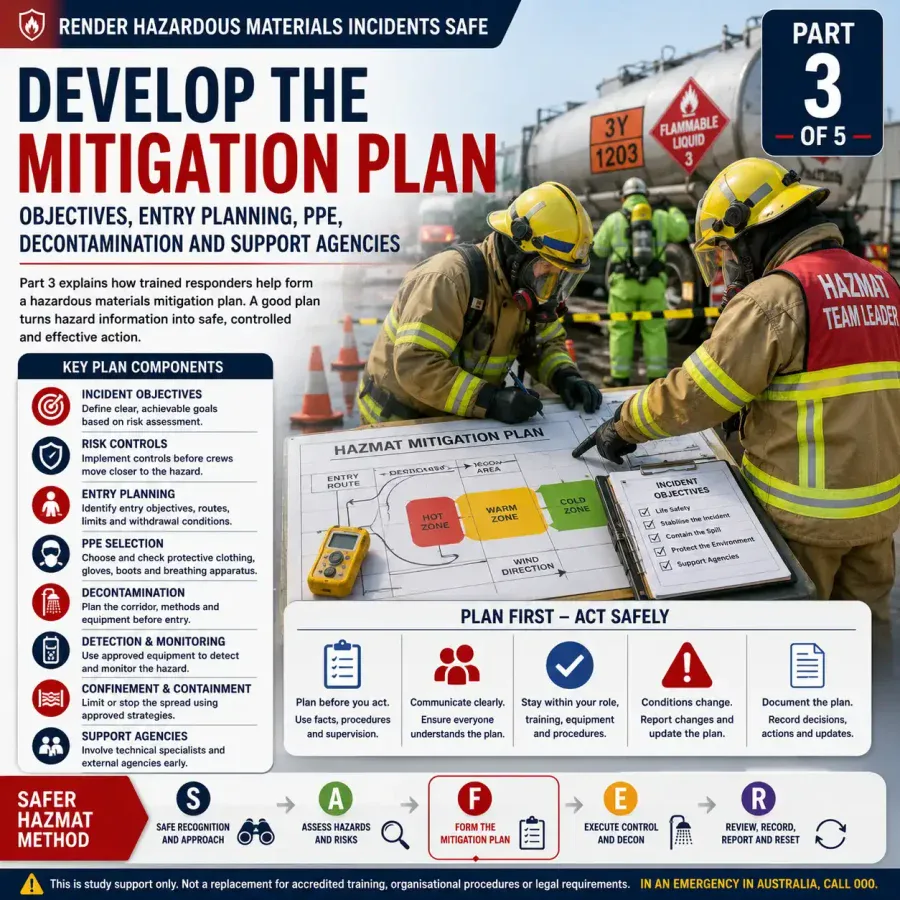
- Are there industrial sites storing hazardous materials?
Fire crews often conduct “familiarisation visits” to businesses, schools, hospitals, and industrial areas. They note fire exits, sprinkler systems, and structural vulnerabilities—because nothing says bad day like entering a burning building and realizing it’s a fire trap.
2️⃣ Water Supply: Because Firefighters Can’t Fight Fire with Good Intentions 💦
A fire truck without water is like a surfer without a board—completely useless. Knowing where and how to access water quickly is a non-negotiable part of firefighting.
🔥 Pre-planning water supply includes:
- Identifying local hydrants and testing their pressure (because a trickle won’t cut it).
- Locating alternative water sources like lakes, rivers, and tanks.
- Understanding if the area has reticulated or static water supplies.
- Arranging tanker deployments in bushfire-prone regions.
In rural Aussie towns, firefighters often need to be creative. Sometimes, a backyard swimming pool might be the best water source available. (Sorry, Kev, we’re about to drain your pool to save the town.)
3️⃣ Building Intelligence: Learn the Layout Before It’s on Fire 🏢🔥
Walking blindly into a burning building? That’s like playing a fiery version of hide-and-seek—except the building is collapsing, and your opponent is a raging inferno.
🔥 What firefighters track:
- Residential vs. commercial buildings—each burns differently.
- Hazardous materials storage (because surprise explosions are NOT fun!).
- Load-bearing walls—nobody wants to walk into a soon-to-collapse structure.
- Stairwells, lifts, and escape routes—because knowing how to get in is as crucial as knowing how to get out.
Many Australian fire brigades collect digital blueprints of major buildings in their area, ensuring firefighters have access to this information in an emergency. It’s like having the cheat codes to a game—except this game is deadly serious.
4️⃣ Emergency Contacts & Coordination: Knowing Who to Call 📞👮
Firefighters don’t work in a bubble. They rely on close coordination with police, paramedics, utility companies, and local councils. Imagine arriving at a fire and realizing the entire building is live with electricity. Yeah, not ideal.
🔥 Pre-incident planning ensures:
- Utility companies can shut off power and gas safely.
- Police assist with crowd control and road closures.
- Ambulance crews are ready for medical emergencies.
- A strategy is in place for large-scale evacuations.
In Australia, where bushfires can alter an entire region in hours, pre-planning community evacuations is crucial. Knowing when and how to move people before danger arrives is the difference between survival and disaster.
5️⃣ Communication & Incident Command: Who’s Running the Show? 🎙️
Imagine ten firefighters charging into a warehouse fire, each with their own plan. Chaos. Absolute chaos. This is why the Incident Command System (ICS) is Australia’s go-to strategy for managing fires and emergencies.
🔥 Key ICS components:
- Clear chain of command – Who’s in charge? Who reports to whom?
- Radio communication – Because yelling across a wildfire just doesn’t work.
- Pre-set emergency plans – Everyone knows exactly what to do, so there’s no last-minute decision-making when flames are licking at their boots.
Fireground communication can be the difference between flawless teamwork and confusion that leads to injuries. Firefighters don’t just train to put out fires; they train to talk, coordinate, and execute a plan under extreme pressure.
Why Pre-Incident Planning is a Firefighter’s Secret Weapon 🚀
Firefighting isn’t just about rushing into danger—it’s about preparing so well that when danger does arrive, the team already knows exactly what to do. Good pre-incident planning means fewer casualties, less property damage, and safer communities.
Australia’s unpredictable fire season, sprawling landscapes, and bushfire threats make pre-incident planning a non-negotiable part of firefighting strategy.
⚠️ Without solid pre-incident planning, firefighters are running into battle blind. With it, they are a well-oiled fire-smashing machine.
Got an epic firefighting story or want to learn more about Aussie emergency response strategies? 💬 Drop a comment below and let’s chat!
🚒🔥 Stay prepared. Stay safe. And always respect the power of fire. 🔥🚒
FireRescue Training Hub
Access practical fire and emergency study support resources, downloads, checklists, audio guides, and member-only course content.
- Course library
- PDF downloads
- Audio guides
- Checklists
Study support only. Not accredited training or a replacement for workplace procedures.
About the author and safety review
Ken Walker
Former Station Officer and fire service educator
Former career firefighter with extensive career and volunteer fire service experience.
Qualifications: Associate Diploma of Applied Science in Fire Technology; Institute of Fire Engineers studies.
Author profilehttps://www.firerescue.com.au/about-us/