Petrol, solvents, thinners, alcohols, oil-based paints and many other liquids can create a serious fire hazard well before a visible flame appears. The key danger is often the flammable vapour above or around the liquid. Vapour can move away from a spill, collect in low areas and ignite when it reaches a spark, flame, hot surface or other ignition source.
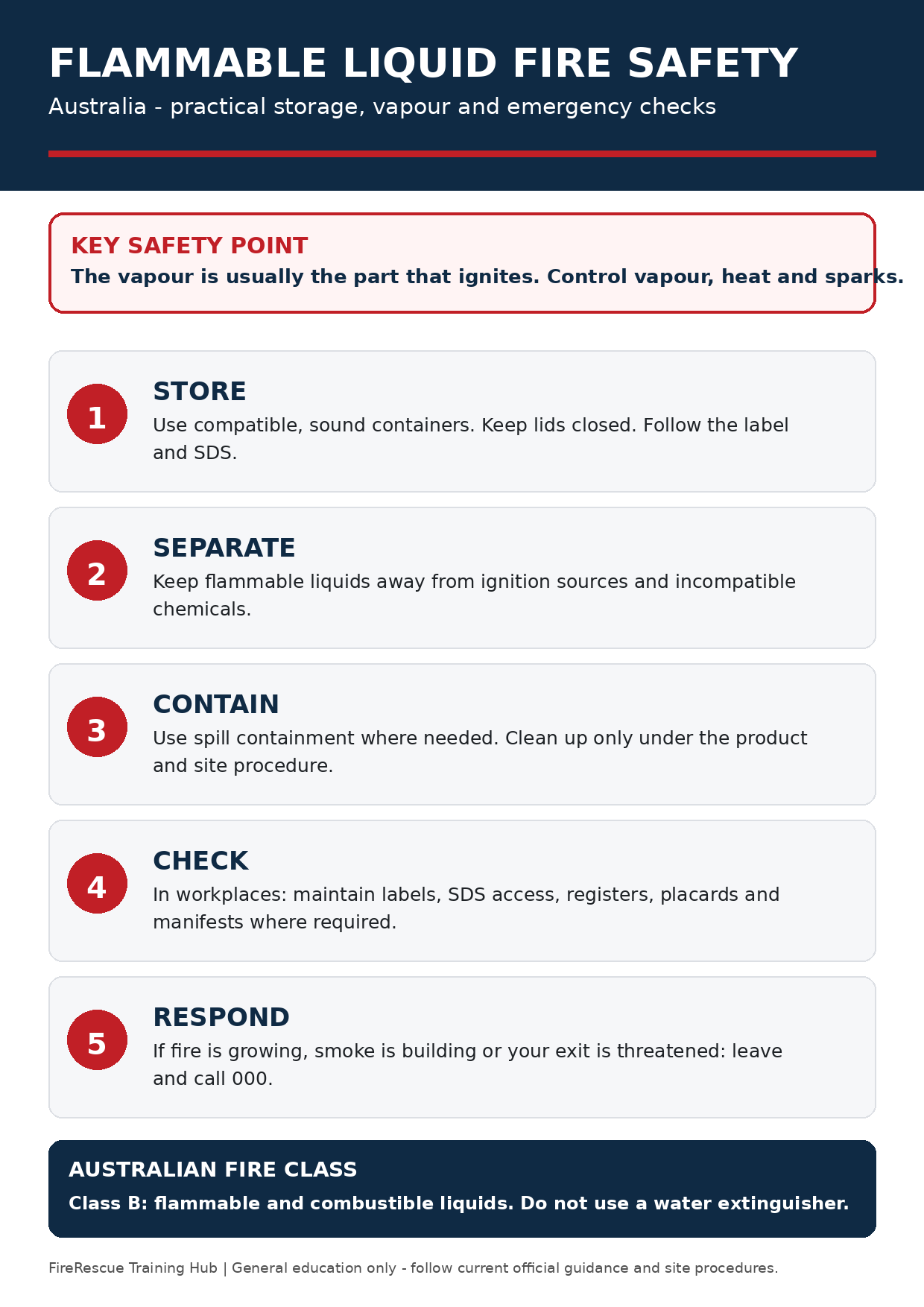
That makes flammable-liquid safety less about memorising a list of chemicals and more about controlling five things: the product, the vapour, ignition sources, containment and people. At home, that means sensible storage, closed containers and early evacuation. In workplaces, it also means following the product safety data sheet (SDS), applicable work health and safety or dangerous-goods laws, site procedures and relevant Australian Standards.
If a fire is growing, producing significant smoke, involving multiple containers, threatening your escape route or you are unsure what is burning, leave the area and call Triple Zero (000). A portable extinguisher is for a small, early-stage fire only when the correct extinguisher is available, you are able to use it and a safe exit remains behind you.
Key takeaways
- Flammable liquids usually burn through their vapours, not because the bulk liquid itself is somehow burning independently of vapour.
- Flash point helps indicate how readily a liquid can produce ignitable vapour, but it is only one part of the risk.
- In Australia, fires involving flammable and combustible liquids are Class B.
- Do not use a water extinguisher on a Class B liquid fire. Use only equipment that is clearly rated for the hazard and follow its label.
- Workplace controls should start with the SDS, correct labelling, suitable storage, ignition control, spill containment, training and emergency planning.
- For larger incidents, unknown chemicals, tank fires or heavy vapour, evacuation and professional emergency response are the correct public actions.
Contents
- What makes flammable liquids dangerous?
- Vapour, flash point and ignition
- Common liquids and everyday risks
- Safer storage and handling
- Australian workplace requirements
- What to do if fire starts
- What to do after a spill
- Burns and exposure
- Firefighter and professional considerations
- Frequently asked questions
What makes flammable liquids dangerous?
A flammable liquid can release vapour that mixes with air. When that mixture sits within an ignitable concentration range and reaches a sufficient ignition source, flame can travel rapidly through the vapour and back to the liquid surface. This is why a small spill can create a hazard larger than the visible wet area.
The risk changes with the chemical involved, temperature, ventilation, quantity, container, work activity and surrounding environment. A warm liquid may release vapour more rapidly. A leak in a confined or low-lying space may allow vapour to collect. Transfer, pumping or pouring can also introduce static-electricity risks for some products and processes.
Flash point is useful, but it is not the whole story
Flash point is the lowest temperature at which a liquid gives off enough vapour to form an ignitable mixture under the specified test conditions. A lower flash point generally means ignitable vapour can form at lower temperatures. However, real-world risk also depends on concentration, ventilation, ignition energy, temperature, container condition and how the product is being handled.
Australian workplace and transport systems use formal hazardous-chemical and dangerous-goods classifications. For a particular product, do not rely on a generic internet table: check the current Australian SDS and product label.
Vapour can travel to the ignition source
One of the most important practical lessons is that ignition does not need to occur directly above the spill. Many common fuel and solvent vapours are heavier than air and can move across floors, through drains or into lower spaces. An ignition source some distance away can ignite the vapour and allow flame to flash back toward the release.
Common flammable-liquid risks around Australian homes and workplaces
Common examples include petrol, some solvents and thinners, acetone, methylated spirits and other alcohol products, some adhesives, some paints and coatings, cleaning products and fuels. Diesel and other combustible liquids can also sustain serious fires even though their volatility differs from petrol.
Do not assume two products with similar everyday uses have the same fire behaviour. Alcohol-based products, hydrocarbon fuels and specialist solvents may require different extinguishing agents and spill controls. The SDS is the best starting point for a specific chemical.
Common ways incidents begin
- containers left open or damaged, allowing vapour release;
- fuel or solvent spills near engines, heaters or electrical equipment;
- refuelling hot or running equipment;
- hot work, grinding or welding near flammable products;
- poor control of static during transfer operations;
- incompatible chemicals stored together;
- unlabelled or unsuitable containers; and
- people attempting to clean up or transfer a product without checking its SDS.
Safer storage and handling: a practical public checklist
For ordinary household or small-workshop quantities, keep the approach simple and conservative.
- Keep products in suitable, compatible containers. Do not decant petrol, solvents or other hazardous chemicals into drink bottles or food containers.
- Keep containers closed when not in use. This reduces vapour release and spill risk.
- Keep them away from heat and ignition. Do not store or use flammable liquids beside open flames, pilot lights, hot equipment, smoking areas or uncontrolled electrical ignition sources.
- Read the label and SDS. Product-specific advice matters, especially for incompatible materials, ventilation, PPE, spill response and firefighting.
- Control spills early. Do not wash a flammable liquid into drains or spread it across a larger area.
- Limit unnecessary quantities. Do not accumulate old fuel, solvents or partly used containers without a genuine need.
- Keep children and unauthorised people away. Secure hazardous products appropriately.
If you store fuel for generators, pumps, boats, farm equipment or off-grid use, also see FireRescue’s fuel-container guide.
Australian workplace requirements: what matters most
Australian requirements are not simply the US OSHA/NFPA rules often repeated online. Work health and safety and dangerous-goods requirements vary by jurisdiction, so workplaces need to check the law that applies in their state or territory.
Safe Work Australia identifies core duties for hazardous chemicals including correct labelling, safe storage, access to current SDS information, hazardous-chemical registers, placards and manifests when threshold quantities are exceeded, worker information and training, and control of hazardous atmospheres. The exact legal effect and thresholds depend on jurisdiction.
Use the SDS as the product-specific anchor
A current SDS normally provides the chemical’s hazards, handling and storage precautions, exposure controls and PPE, first aid, accidental-release information and firefighting measures. If a workplace has hazardous chemicals, the register should include the current SDS for each chemical that must be listed.
AS 1940 and dangerous goods
AS 1940:2017, The storage and handling of flammable and combustible liquids, remains a key Australian technical standard for Class 3 flammable liquids and combustible liquids, including storage facilities, operating procedures, emergency planning and fire protection. How it applies to a particular premises should be determined through the relevant legislation, regulator requirements and competent advice.
For road and rail transport, the Australian Dangerous Goods Code Edition 7.9 is the current national code published by the National Transport Commission. Edition 7.9 became mandatory from 1 October 2025, subject to jurisdictional commencement arrangements.
In Victoria, for example, the Dangerous Goods (Storage and Handling) Regulations 2022 set duties for workplaces storing or handling dangerous goods. Other states and territories have their own regulatory frameworks.
For broader workplace-safety context, see FireRescue’s workplace safety guide.
If a flammable-liquid fire starts
Australia classifies flammable and combustible liquid fires as Class B. CFA guidance warns that water extinguishers should not be used on Class B fires because applying the wrong extinguisher can spread the burning liquid or worsen the situation.
For the public: the decision is about escape first
Raise the alarm, help people move away and call Triple Zero (000) when fire services are needed. Only consider a portable extinguisher when all of the following are true:
- the fire is small and still contained;
- you know what is burning;
- the extinguisher label clearly shows it is suitable for that fire;
- you can operate it safely; and
- you have a clear exit behind you.
In Australia, suitable equipment for some Class B risks can include correctly rated foam or dry chemical powder extinguishers. Carbon dioxide extinguishers have more limited Class B suitability and provide little cooling, so re-ignition can be a concern. Always use the rating and instructions on the actual extinguisher.
A fire blanket is not a general-purpose solution for a petrol or solvent spill fire. Fire blankets have important uses – especially for some small cooking incidents – but they should not be promoted as a substitute for correctly rated Class B equipment.
For a detailed Australian extinguisher guide, see Fire Extinguisher Types, Colours and Uses in Australia.
If there is a spill but no fire
A spill can create a dangerous vapour cloud before any flame appears. The safest response depends on the product, quantity and location.
- Keep people away from the area.
- Remove ignition sources only when this can be done safely and without creating a spark.
- Do not casually switch electrical equipment on or off in a potentially flammable atmosphere.
- Follow the SDS and workplace spill procedure.
- Use suitable PPE and spill-control materials only if you are trained and the task is within the site’s planned response.
- For a significant spill, unknown product, strong vapour, confined-space risk or any immediate danger, evacuate and contact emergency services.
Do not improvise ventilation. A normal fan, switch or motor may itself be an ignition source. Hazardous-area ventilation and electrical equipment require appropriate design and selection.
Burns and chemical exposure
For a thermal burn, Healthdirect advises cooling the burn under cool running water for at least 20 minutes as soon as possible. Do not use ice, creams or greasy substances. Seek urgent medical care for serious burns and call 000 when required.
If a hazardous chemical contacts skin or eyes, follow the product SDS and appropriate first-aid guidance. Healthdirect advises prolonged cool running water for chemical burns and recommends calling 000 for serious symptoms or emergencies. The Poisons Information Centre can be contacted on 13 11 26 in Australia.
For firefighters and emergency-service professionals
From a fire-service operational viewpoint, a flammable-liquid incident is rarely just a visible flame problem. Product identification, vapour movement, ignition control, containment, exposures and runoff can drive the risk just as much as the fire itself.
Professional response should be based on agency procedures, site information and dynamic risk assessment. Important considerations can include:
- identifying the product from SDS, labels, placards, manifests, UN numbers and site personnel;
- approaching with regard to wind, vapour travel and potential ignition zones;
- establishing appropriate exclusion zones and atmospheric monitoring where indicated;
- controlling ignition sources and product flow where this can be achieved safely;
- protecting exposures and considering tank or container heating, pressure and structural failure;
- selecting extinguishing media that is compatible with the fuel, equipment and incident objective;
- planning for re-ignition, vapour re-formation and contaminated runoff; and
- coordinating with specialist hazardous-materials, environmental and site resources when required.
Foam selection deserves particular care. Hydrocarbon fuels and polar solvents may need different foam capabilities, while environmental controls around fluorinated firefighting foams and PFAS vary by jurisdiction. Queensland Fire Department, for example, states that it stopped purchasing fluorinated firefighting foams in 2003 and uses non-fluorinated products. Firefighters and facilities should follow current agency policy, manufacturer specifications and jurisdictional environmental requirements rather than relying on legacy AFFF assumptions.
What firefighters want you to know
- If you can smell strong solvent or fuel vapour, do not assume the area is safe simply because there is no flame.
- Do not block appliance access with vehicles, drums or stored materials.
- When calling 000, tell the operator what product is involved if you know, the approximate quantity, whether anyone is injured and whether cylinders, tanks or other dangerous goods are nearby.
- Do not re-enter a building or spill area to collect property.
- Have SDS and site chemical information accessible to emergency crews at workplaces.
Frequently asked questions
Are petrol fires Class B in Australia?
Yes. Petrol and other flammable or combustible liquid fires are Class B under the Australian fire-class system.
Should I use water on a petrol or solvent fire?
No. A water extinguisher is not suitable for a Class B liquid fire and can spread burning liquid. Firefighters may use water for specific professional tactics such as exposure cooling, but that is different from directing a normal water stream onto a burning fuel spill.
Is diesel safe because it is less volatile than petrol?
No. Diesel generally presents a different vapour and flash-point profile, but it can still burn intensely, feed large fires and create serious smoke, heat and spill hazards.
Do all workplaces need a flammable-liquid cabinet?
Not automatically. Storage controls depend on the product, quantity, packaging, location, activity and applicable law. The SDS, risk assessment, relevant regulator guidance and standards such as AS 1940 help determine the appropriate controls.
Can I pour leftover petrol or solvent down a drain?
No. Flammable liquids can create fire, health and environmental hazards in drains and waste systems. Follow local hazardous-waste or council disposal guidance and the product SDS.
What should I do if one extinguisher does not control the fire?
Leave immediately. Do not continue an unsuccessful attack while conditions worsen. Close a door behind you if safe, stay out and wait for firefighters.
Conclusion
Flammable-liquid fire safety starts well before ignition. The most effective controls are good storage, closed and compatible containers, clear labels, access to SDS information, separation from ignition sources, spill containment, training and a realistic emergency plan.
For the public, the key message is simple: do not let firefighting equipment tempt you into staying in an unsafe situation. If a fire is growing, smoke is building, the product is unknown or your exit could be cut off, leave and call 000.
Practical next steps
- Check every fuel, solvent and flammable product you store.
- Dispose of unidentified or unnecessary chemicals through an appropriate service.
- Confirm containers are sound, labelled and closed.
- Read the SDS for workplace products.
- Check that extinguishers are suitable for the actual risks and are accessible near a safe exit.
- Review emergency procedures with everyone who may need to respond.
Related FireRescue guides
- Fire Extinguisher Types, Colours and Uses in Australia
- Fuel Containers: Heavy and Light Duty Safety
- Workplace Safety in Australia
Sources
- Safe Work Australia – Storage of flammable liquids
- Safe Work Australia – Storing hazardous chemicals
- Safe Work Australia – Managing risks of hazardous chemicals in the workplace
- CFA – Fire extinguishers
- WorkSafe Victoria – Dangerous goods safety basics
- National Transport Commission – Australian Dangerous Goods Code
- Healthdirect – Fire safety and burns first aid
- Queensland Fire Department – PFAS and firefighting foam
Written by Ken Walker – former Station Officer and fire-service educator with career and volunteer firefighting experience. Reviewed against current Australian official guidance in October 2026.
Help us improve this guide: Firefighters, emergency-service members, workplace safety professionals and community readers are welcome to submit corrections or useful field experience. Important claims will be checked before they are added.
FireRescue Training Hub
Access practical fire and emergency study support resources, downloads, checklists, audio guides, and member-only course content.
- Course library
- PDF downloads
- Audio guides
- Checklists
Study support only. Not accredited training or a replacement for workplace procedures.
About the author and safety review
Ken Walker
Former Station Officer and fire service educator
Former career firefighter with extensive career and volunteer fire service experience.
Qualifications: Associate Diploma of Applied Science in Fire Technology; Institute of Fire Engineers studies.
Author profilehttps://www.firerescue.com.au/about-us/