FireRescue Training • Part 4 of 5
Implement the Mitigation Plan
Control Zones, Entry Operations, Detection, Containment and Decontamination
Part 4 explains how trained responders help put the hazardous materials mitigation plan into action. It covers roles, control zones, entry operations, response equipment, PPE, decontamination, detection, containment and reporting.
0 of 11 sections refreshed
Move from planning to controlled action
Implementation means putting the plan into action without losing discipline.
Part 1 focused on recognition. Part 2 focused on hazard assessment. Part 3 focused on planning. Part 4 now moves into implementation. This is where the plan becomes controlled action at the incident scene.
Implementation must not be rushed. A hazardous materials response can look active and urgent. Yet safe action still depends on command, control and procedure. The team must know the task, the risk controls and the limits of the plan.
The fourth part of the SAFER HAZMAT Method is E. This means execute control and decontamination. It covers the practical work of isolating the scene, setting zones, entering under direction, using equipment and applying decontamination.
Execution also includes reporting. Every result matters. A reading, a leak change, a container condition, a contamination issue or a decontamination problem must be passed through command. This helps the plan stay current.
Good implementation is calm. It is planned. It uses the right people, equipment and protective systems. It also allows crews to stop if conditions change.
Follow roles within the Incident Action Plan
Each person must know their role, task and reporting line.
The Incident Action Plan gives structure to the response. It helps crews understand what needs to happen, who is responsible and how safety will be controlled. At a hazardous materials incident, this structure is vital.
Individual roles and responsibilities must be identified and followed. A responder may be part of an entry team, back-up team, decontamination team, equipment team, safety role or support role. Each task must connect to the plan.
Clear roles help prevent task drift. Task drift happens when a person starts doing extra work that was not planned. This can be dangerous. It may also affect decontamination, air management, exposure control and command awareness.
Responders should ask simple questions before action. What is my task? Who is my supervisor? What is my route? What equipment do I need? What do I report? When do I withdraw?
Good crews respect role discipline. They do not freelance. They do not enter another area without direction. They do not change the task without reporting. This traditional discipline saves lives.
Best practice
Confirm your task, supervisor, route, PPE, limits and reporting process before starting.
Common mistake
Starting extra tasks because they seem helpful, without command approval.
Isolate and secure the scene
Scene control helps stop exposure, confusion and contamination spread.
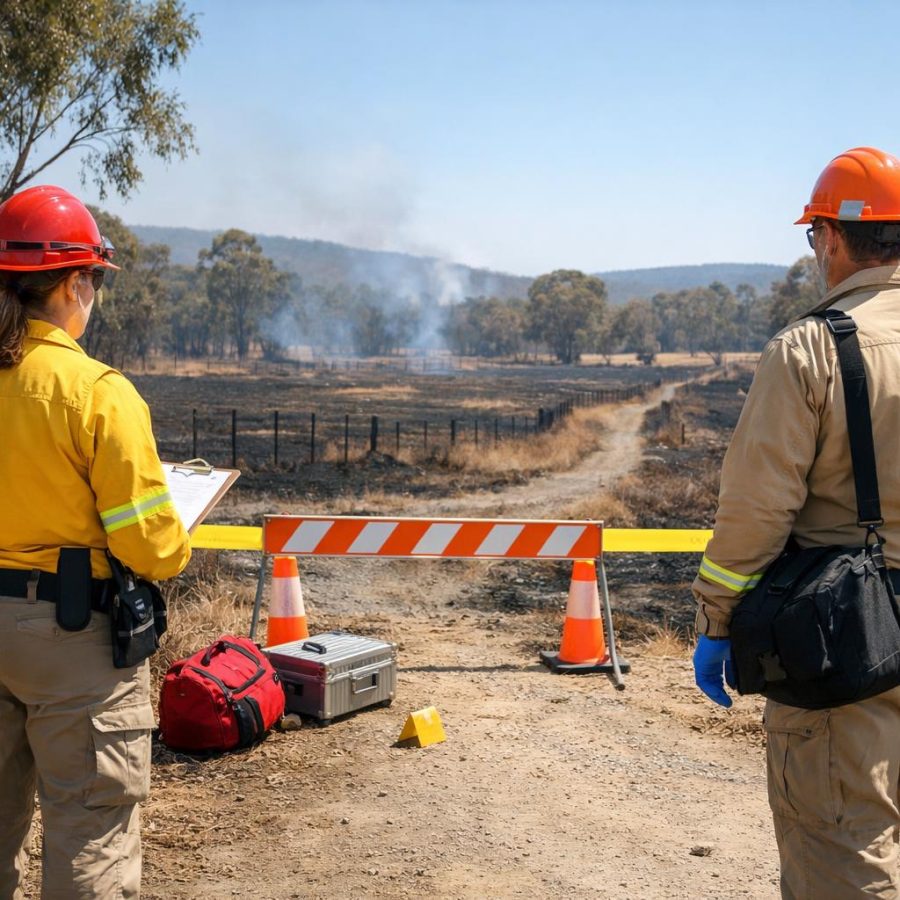
A hazardous materials scene must be isolated and secured. This helps protect responders, workers, bystanders and the public. It also helps command manage access and reduce uncontrolled movement.
Scene isolation may include barriers, cordons, vehicles, signage, traffic control or staff placed at safe access points. The method depends on the incident, the site and organisational procedures.
Securing the scene also protects evidence and information. It can stop people from moving containers, disturbing labels, spreading contamination or entering unsafe areas. This matters during both emergency operations and later review.
Isolation distance should reflect the hazard. A small contained spill may need one type of control. A vapour release, fire, gas cylinder or tanker leak may need wider control. Command may adjust isolation as new information arrives.
Responders should also watch for people already inside the area. Workers, drivers or bystanders may not understand the risk. They may need direction, evacuation or decontamination under approved procedures.
Establish hazard control zones
Zones separate contamination, operations and support areas.
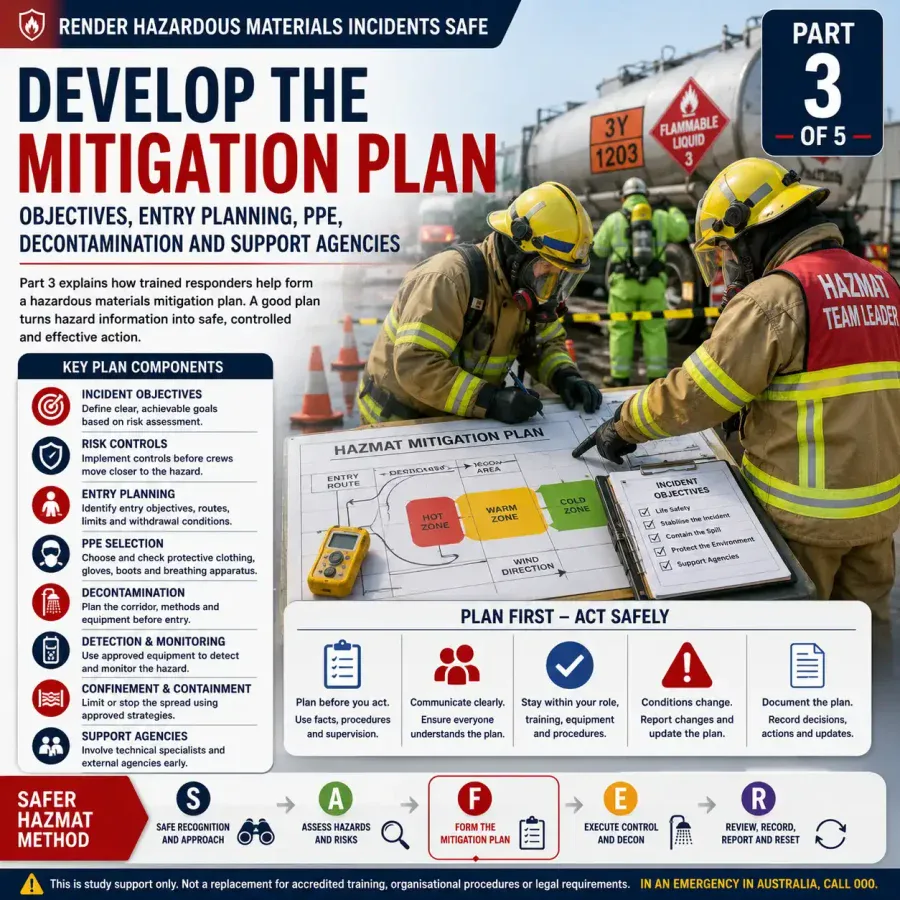
Hazard control zones help organise the incident scene. They help separate the area of likely contamination from the work area and the support area. This reduces exposure and controls movement.
The hot zone is the area of likely contamination. It is where the main hazard is present or expected. Entry into this area must be controlled. Crews need the right task, PPE, equipment, briefing and decontamination plan.
The warm zone is the area of operations. It often supports decontamination, entry control and movement between the hot and cold zones. It must be managed carefully because contamination may move into this area.
The cold zone is the support zone. It is used for command, staging, support and other functions that must stay away from contamination. This area should remain clean and controlled.
Zones may also include controlled exits, entrances, refuges and emergency exits. These must be clear. Crews need to know how to enter, how to leave and where to go if conditions change.
Zones are not decorations on a map. They guide behaviour. They tell people where they can go, what PPE is needed and how contamination is controlled.
Control zone checks
- Hot zone identified and controlled.
- Warm zone set for operations and decontamination.
- Cold zone protected for support and command.
- Entry and exit points controlled.
- Emergency exits and refuges considered.
- Zone changes reported through command.
Set up the decontamination corridor
Decontamination must support safe exit and prevent spread.
The decontamination corridor is a controlled path out of the hazard area. It helps remove or reduce contamination. It also helps stop contamination from spreading to clean areas.
The corridor should be established before entry where contamination may occur. It may include a holding area, wash area, disrobing area and rest area. The exact layout depends on the material, procedure and available equipment.
Decontamination may be emergency, emergency mass or technical. It may also involve wet, dry or alternative methods. The method must match the product, risk and organisational procedure.
The entry team must know where the corridor is. They must know how to move through it. They must also know who is managing the process. A confused exit can spread contamination.
Decontamination workers also need protection. They may handle contaminated people, tools, suits or breathing apparatus. Their safety must be planned as part of the system.
Contaminated equipment must also be managed. Tools, meters, gloves and suits may carry product. They should not be moved into clean areas without the correct process.
Implement the entry plan
Entry must follow the approved plan and stop if conditions change.
The entry plan should now guide the team. It sets the task, route, PPE, equipment, communication, time limits, decontamination process and withdrawal conditions.
Before entry, the team should confirm the objective. They should know what they are doing and what they are not doing. This prevents the team from taking on extra tasks in a dangerous area.
Entry should be monitored. This may include air management, control boards, communication checks, safety observers and back-up arrangements. The exact system must follow organisational procedures.
The team should move with care. They should avoid unnecessary contact with surfaces, liquid, vapour, damaged containers and unknown materials. They should also watch for signs that the risk is changing.
Conditions that may require withdrawal include loss of communication, PPE damage, breathing apparatus issue, unexpected product behaviour, rising risk, poor visibility, team member distress or a command order to withdraw.
When the team leaves, it should follow the decontamination process. It should also report results clearly. The plan can then be adjusted if needed.
Best practice
Enter only for the planned task. Report changes early and withdraw when directed.
Common mistake
Completing the planned task, then staying longer to do extra work without approval.
Apply response equipment safely
Equipment must match the task and be used under procedure.
Hazardous materials response equipment may support detection, confinement, containment, entry control, decontamination and communication. The equipment must match the hazard, the plan and the responder’s training.
Response equipment may include detection instruments, control boards, decontamination equipment, absorbent materials, booms, pads, plugs, patches, over-packing equipment, grounding and bonding equipment, ventilation tools or other approved resources.
Equipment should be checked before use. Faulty or unsuitable equipment can create new risk. Responders should report missing parts, damage, poor readings, battery issues or calibration concerns where relevant.
Using equipment safely also means knowing its limits. A detector may need correct operation and interpretation. A patch may not suit all leaks. Absorbent material may not suit every product. Ventilation may not suit every atmosphere.
The plan should state who will use the equipment and why. This helps avoid duplication and unsafe improvisation. It also helps command track what has been done.
After use, equipment may need decontamination, isolation, disposal or testing. This must follow organisational procedures.
Don and operate in PPE correctly
Protective clothing and equipment must be used with care.
Personal protective clothing and equipment are essential during many hazardous materials tasks. However, PPE must be selected, donned, used and removed correctly. It must also match the hazard and task.
Protective clothing may include gas-tight suits, splash suits, turnout clothing, gloves, biological protective clothing, disposable clothing, reusable clothing, radiological protective clothing or thermal protective clothing.
Personal protective equipment may include breathing apparatus, control boards and Distress Signal Units. Breathing apparatus is important where the atmosphere may be unsafe or unknown.
Before entry, crews should check fit, seals, gloves, boots, closures, visor, communications and breathing apparatus readiness. A small issue can become a serious problem inside the hazard area.
PPE also affects performance. It can increase heat stress. It can reduce movement. It can reduce vision and hearing. Therefore, work time, rest, monitoring and decontamination must be part of the plan.
Removing PPE can also create risk. Contamination may be on the outside of the suit or gloves. Removal must follow the decontamination process. It should not be rushed.
PPE reminders
- Select PPE to match the hazard and task.
- Check PPE before entry.
- Use breathing apparatus where required.
- Monitor heat, fatigue and air supply.
- Report damage or problems at once.
- Remove PPE through the approved decontamination process.
Apply detection and control strategies
Detection, confinement and containment must follow the plan.
Detection helps confirm the presence, level or movement of a hazard. It may support control zones, entry decisions, decontamination decisions and public safety actions.
Detection must use approved equipment and trained operators. Readings should be recorded and reported. Unclear readings should be treated carefully. They should not be used beyond the limits of the equipment or the operator’s training.
Confinement and containment strategies aim to limit movement. These strategies may be defensive or offensive. The choice depends on the risk, training, product behaviour, equipment and command direction.
Strategies may include damming, diking, diversion, absorbent material, plugging, patching, over-packing, vapour suppression, ventilation, grounding, bonding or product transfer. These are not do-it-yourself actions. They require training and approved procedures.
Control strategies can also create risk. A wrong action may spread product, create vapour, increase pressure or expose crews. Therefore, the plan must be followed. Changes must be approved through command.
Results must be reported. If a reading changes, if a leak slows, if containment fails or if conditions worsen, command needs the information quickly.
Record and report results
Reports help command review the plan and protect crews.
Recording and reporting are part of implementation. They are not paperwork for later. They help command understand what has happened and what must happen next.
Results may include detection readings, entry times, PPE issues, decontamination outcomes, containment actions, equipment used, product movement, casualties, environmental risks and any contamination incidents.
Reports should be clear and factual. They should avoid guesswork. They should separate confirmed results from uncertain observations. This helps command adjust the plan safely.
For example, a useful report may state that a leak point was confirmed, no valve was operated, a reading was taken at a named location and the team exited through decontamination without visible suit damage.
Good records also support later review. They help identify what worked, what failed and what needs follow-up. This is important for responder safety, legal requirements, environmental protection and organisational learning.
When in doubt, report early. A small detail may matter later. Clear reporting is one of the best safety tools at a hazardous materials incident.
Example implementation report
“Entry team completed the planned route and confirmed liquid leaking from the lower valve. No valve operation was attempted. Readings were taken at the marked point and reported to command. Team exited through decontamination with no visible suit damage.”
Part 4 practical checklist
Use this checklist to revise implementation before moving to review.
This checklist summarises Part 4. It is a study aid only. It does not replace accredited training, organisational procedures, supervisor direction, legislation or approved operational manuals.
Part 4 should leave the learner with one strong point. Implementation must stay controlled. Crews must follow the plan, use the right equipment, protect themselves, apply decontamination and report results.
The SAFER HAZMAT Method will continue in Part 5 with R. This means review, record, report and reset. Part 5 will bring the whole series together through review, safety monitoring and a final capstone scenario.
Scenario drill
An entry team is ready to confirm a leak point on a tanker. The team has PPE, breathing apparatus, communication, detection equipment and a decontamination corridor. Just before entry, wind begins to push vapour toward the planned route. What should happen next?
Quick knowledge check
Question: Why are hazard control zones used?
60-second refresher drill
- Follow your role within the Incident Action Plan.
- Isolate and secure the scene.
- Establish hot, warm and cold zones.
- Set up the decontamination corridor before entry.
- Implement the entry plan as briefed.
- Use response equipment only under training and direction.
- Wear and remove PPE through the correct process.
- Apply detection, confinement and containment strategies under procedure.
- Record and report results through command.
- Stop and report if conditions change.
Next in the series: Part 5 of 5 — Review, Report and Learn: Entry Team Safety, Contamination Incidents and Operational Effectiveness.
FireRescue Training Hub
Access practical fire and emergency study support resources, downloads, checklists, audio guides, and member-only course content.
- Course library
- PDF downloads
- Audio guides
- Checklists
Study support only. Not accredited training or a replacement for workplace procedures.
About the author and safety review
Ken Walker
Former Station Officer and fire service educator
Former career firefighter with extensive career and volunteer fire service experience.
Qualifications: Associate Diploma of Applied Science in Fire Technology; Institute of Fire Engineers studies.
Author profilehttps://www.firerescue.com.au/about-us/