FireRescue Training • Part 2 of 5
Identify and Assess Hazards
Materials, Containers, Exposure Risks and Information Sources
Part 2 explains how trained responders identify site hazards, recognise material and container risks, use trusted information sources and report risk through the chain of command.
0 of 9 sections refreshed
From recognition to assessment
Part 1 asked, “Could this be hazardous?” Part 2 asks, “What hazards and risks can we identify?”
Once a possible hazardous materials incident has been recognised, the next task is to identify and assess the hazards. This must be done carefully, from a safe position and under organisational procedures. The goal is to build a clear picture for the supervisor and command structure.
Assessment does not mean guessing. It means observing, checking, comparing and reporting. A responder may look at the scene, the material, the container, the weather, the people affected, the nearby exposures and the information sources available. Each clue helps the incident team understand what may happen next.
Part 2 of the SAFER HAZMAT Method focuses on A, which means assess hazards and exposure risks. This stage supports later planning. If hazards are poorly identified, the mitigation plan may be weak. If risks are not communicated clearly, crews may be sent into conditions that are not fully understood.
Good assessment starts with discipline. The responder stays within their role, training, equipment and command direction. They do not move closer simply to satisfy curiosity. They do not touch, smell, taste or handle unknown material. They gather information in a safe and structured way.
Hazard assessment is also a team process. One person may identify a label. Another may notice runoff. A site representative may provide a manifest. A supervisor may confirm wind direction or request technical advice. When this information is shared properly, command can make stronger decisions.
Identify site hazards first
The site itself may create danger before the product is even confirmed.
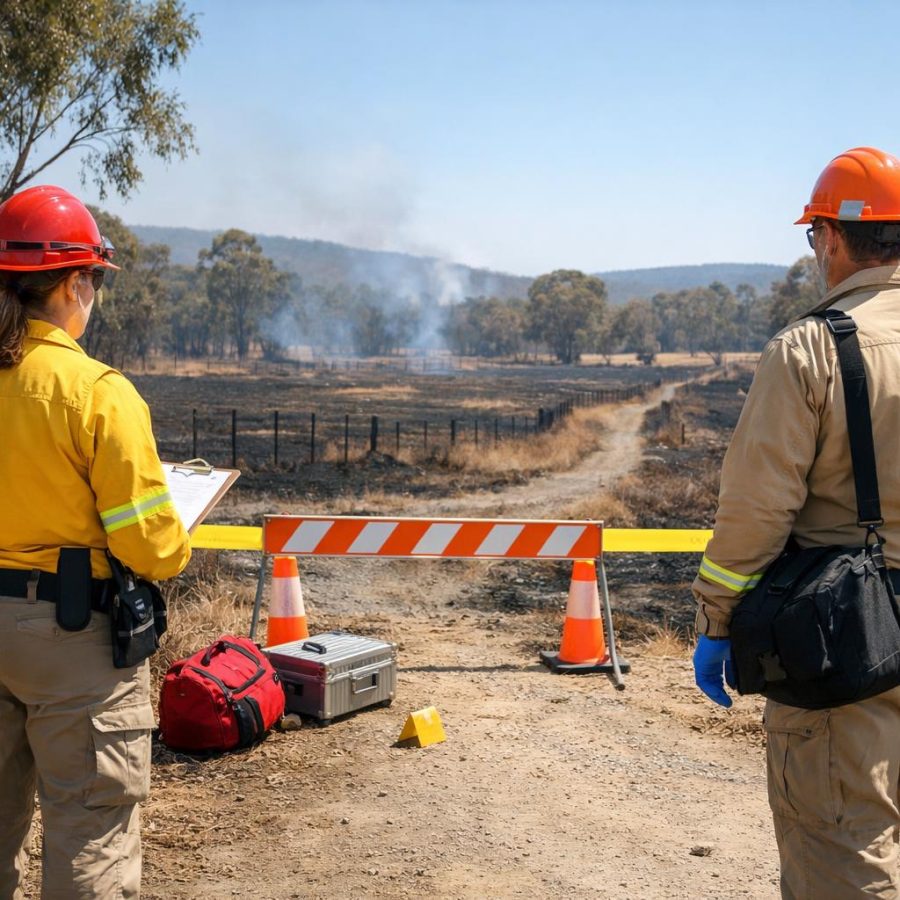
A hazardous materials scene can include many site hazards. These may include traffic, fire, smoke, unstable structures, damaged containers, poor access, confined spaces, drains, waterways, electrical hazards, trip hazards, weather changes, low-lying areas and moving machinery.
Therefore, responders should not focus only on the chemical name or placard. The site layout may be just as important. A small spill near a stormwater drain may create environmental risk. A vapour cloud near a road may create public exposure. A damaged cylinder in a fire area may create danger for crews and nearby people.
Site hazards should be identified according to organisational procedures. This means using approved observation methods, safe approach guidance, command reporting and local operational doctrine. The responder’s task is to notice and communicate hazards that may affect the incident plan.
Good responders scan the whole area. They look high, low, near and far. They look at where people are standing. They look at where the product may travel. They look for ignition sources, drains, slopes, weather effects and buildings that may trap vapour or smoke.
Also, site conditions can change. A wind shift may move vapour. Fire may weaken a container. Rain may spread contamination. Traffic may create access problems. For this reason, assessment is not a one-time action. It must continue as the incident develops.
Best practice
Assess the whole scene, not just the obvious container or spill.
Common mistake
Looking only at the product label and missing drains, vapour movement, access issues or nearby people.
Assess the material risk
The material may create fire, health, reaction, contamination or environmental risk.
Hazardous materials may affect people, property and the environment in different ways. Some materials are flammable. Some are toxic. Some are corrosive. Some may react with water, air, heat or other products. Some may create vapour, dust, smoke, contamination or delayed health effects.
Because of this, responders should avoid assuming that all spills behave the same way. A clear liquid may still be dangerous. A small container may contain a highly toxic product. A product that does not burn may still harm people or the environment. A product that smells mild may still require strict control.
Material risk should be assessed using recognised information sources. These sources may include Safety Data Sheets, HAZCHEM emergency action codes, CHEMDATA, emergency response guide books, product labels, transport documents, storage manifests, site plans and technical specialists.
Early assessment should consider the likely route of exposure. A material may enter the body through breathing, skin contact, eye contact, swallowing or contamination of clothing and equipment. Some effects may be local, such as burns to skin. Others may be systemic, meaning they affect the body more widely.
Material risk also includes the behaviour of the product. Is it spreading as liquid? Is it forming vapour? Is it burning? Is it reacting? Is it entering drains? Is it affecting casualties? Is it near heat, ignition or incompatible material? These questions support safer command decisions.
However, responders must stay within their training. The aim is not to conduct uncontrolled experiments or make unsupported decisions. The aim is to gather and report useful information so the incident plan can be formed with the best available evidence.
Assess containers and packages
The container can tell responders a great deal about risk, quantity and failure potential.
At a hazardous materials incident, the container matters. The same product may present different risks depending on whether it is in a small bottle, drum, cylinder, tanker, intermediate bulk container, pipework system, shipping container or fixed storage vessel.
Responders should look for the type, size, condition and position of the container. They should observe whether it is upright, damaged, leaking, bulging, burning, heat affected, corroded, overfilled or involved in impact. They should also observe whether the container is near drains, traffic, ignition sources, buildings or people.
Container markings may provide useful clues. These may include product names, proper shipping names, United Nations numbers, class labels, emergency information panels, HAZCHEM codes, packing groups, hazard diamonds, Global Harmonised System labels and other site or transport markings.
However, markings can be missing, damaged, hidden, outdated or wrong. A container may have been reused. A label may not match the contents. A mixed load may involve several products. Therefore, container information should be used with other sources, not in isolation.
The condition of the container may also affect urgency. A leaking drum may require different priorities from a heat affected gas cylinder. A tanker near fire may raise different concerns from a sealed package in a warehouse. A damaged pipe may require site isolation or specialist advice.
Safe container assessment should be done from a safe distance and through command. If closer inspection is required, it must be planned, authorised and supported by correct protective clothing, breathing apparatus, entry controls, monitoring and decontamination arrangements.
Container details worth reporting
- Container type, size and position.
- Visible damage, leakage, fire exposure or corrosion.
- Labels, placards, panels, product names or numbers.
- Direction of leak, vapour, smoke or runoff.
- Nearby drains, waterways, ignition sources or public exposures.
- Any uncertainty about the contents or markings.
Use information sources correctly
Good assessment depends on reliable information, not assumptions.
Information sources help responders identify products and understand safe handling concerns. These sources may include Safety Data Sheets, emergency response guide books, HAZCHEM emergency action codes, CHEMDATA, transport documents, storage manifests, safe storage cards, electronic chemical databases, technical specialists and site emergency plans.
Each source has a purpose. A Safety Data Sheet may provide information about hazards, exposure controls, first aid, firefighting measures, spill response and storage. A transport document may help identify the product being carried. A site manifest may show stored quantities. A technical specialist may help interpret product behaviour.
Information should be checked carefully. The responder should ask whether the source matches the scene. Does the product name match the container? Does the document match the vehicle or storage area? Is the information current? Are there multiple products involved? Has fire, heat or mixing changed the situation?
Information sources are not a replacement for command. They support command. A responder should pass relevant information through the chain of command, especially if the information affects safe distance, protective equipment, decontamination, evacuation, confinement, containment or specialist support.
It is also useful to separate confirmed facts from possible clues. For example, “The manifest lists sodium hydroxide” is stronger than “It might be a corrosive.” A clear statement helps command weigh the information properly.
Where technical language appears, responders should avoid overconfidence. Chemical names, abbreviations and hazard codes must be interpreted correctly. If uncertain, say so and seek advice through approved channels.
Understand labels, signs and identification systems
Visual markings can give early clues, but they must be confirmed where possible.
Hazard identification systems help responders recognise possible risks. These may include class labels, emergency information panels, HAZCHEM emergency action codes, United Nations numbers, Global Harmonised System labels, ADR hazard identification systems, NFPA marking systems and packing groups.
These systems are useful because they help responders build a first picture. A class label may indicate flammable liquid, toxic substance, corrosive material or another hazard class. A United Nations number may help identify a substance for further reference. A HAZCHEM code may support emergency action decisions under approved procedures.
However, visual signs are only one part of assessment. A label may be damaged. A placard may be hidden by smoke. A container may be incorrectly marked. A product may be mixed with other materials. Therefore, signs should be compared with documents, site information and technical advice where possible.
Responders should avoid treating labels as permission to act. Instead, labels are information for command. They help determine isolation, entry planning, protective clothing, breathing apparatus, detection needs, decontamination needs and mitigation options.
When reporting labels and markings, simple language helps. For example, a responder might say, “Visible red flammable liquid diamond, number three, on the tanker,” or “Emergency information panel visible, but full number not readable from current position.” This gives command useful information without overstating certainty.
Good reporting of labels can save time. It can also prevent unnecessary exposure. The key is to gather what can be observed safely and then pass it through the correct channel.
Best practice
Use binoculars, safe-distance observation, site documents and command channels where approved.
Common mistake
Moving closer just to read a marking when safer options may exist.
Assess exposure and spread
Risk depends on where the material can go and who or what it can affect.
Exposure assessment looks at who or what may be harmed. This may include responders, workers, bystanders, casualties, nearby residents, traffic, animals, buildings, drains, waterways, soil, vegetation and critical infrastructure.
Spread assessment looks at how the material may move. It may move as liquid, vapour, smoke, dust, contaminated runoff or contaminated clothing and equipment. It may move with wind, slope, water flow, ventilation systems, traffic movement or human movement.
This is why the scene should be viewed as a whole. A spill on flat concrete may behave differently from a spill on a sloping road. A vapour in open air may behave differently from vapour in a confined space. Smoke from burning material may travel far beyond the visible container.
Responders should also watch for signs of exposure. These may include people coughing, skin or eye irritation, dizziness, breathing difficulty, nausea, collapse, contamination on clothing or reports from workers. These signs must be reported through command and managed under procedures.
Environmental risk is also important. A product entering a drain, creek, soil area or stormwater system may create long-term harm. Early recognition of runoff direction can help command plan containment or request specialist support.
Exposure and spread assessment supports control zones. It helps decide where the hot, warm and cold areas may need to be placed. It also supports decisions about decontamination corridors, controlled exits, safe access, evacuation and public safety messaging.
Convey risk through the chain of command
Assessment only helps if it is reported clearly and quickly.
Risk information must be conveyed through the chain of command. This supports the Incident Action Plan, control zones, entry planning, protective equipment selection, decontamination planning and resource requests.
Good risk reports are factual. They state what has been seen, what has been confirmed and what remains uncertain. They avoid dramatic language and unsupported conclusions. They help the supervisor make decisions without confusion.
A useful report may include the location, product information, container type, visible hazard, leak direction, people affected, likely spread, weather influence, access concerns, environmental risks and available documents. It may also include what actions have not been taken, such as “No entry has been made.”
Command communication should be calm and repeatable. In busy incidents, short structured messages are better than long unclear descriptions. If a responder has several details, they should prioritise what affects safety first.
Risk reporting must also continue. As the incident changes, new information should be passed on. For example, if vapour movement changes, a leak increases, a container heats up, runoff enters a drain or a casualty appears, command needs that information promptly.
Clear reporting also protects crews. It reduces duplication, reduces unsafe movement and helps each team understand its role. In hazardous materials work, communication is not extra. It is part of the safety system.
Example risk report
“From the current safe position, we can see liquid leaking from the lower valve of a tanker. A flammable liquid placard is visible, but the product name is not confirmed. Runoff is moving toward a stormwater drain. No entry has been made. We are holding position and awaiting direction.”
Part 2 practical checklist
Use this as a learning refresher before moving to mitigation planning.
This checklist summarises the assessment stage. It is designed for study support and revision. It does not replace accredited training, organisational procedures, supervisor direction or approved workplace systems.
Part 2 should leave the learner with a clear habit. Assess the whole scene, not just the product. Look at the site, the material, the container, the information sources, the exposure pathways, the spread risks and the people or environment that may be affected.
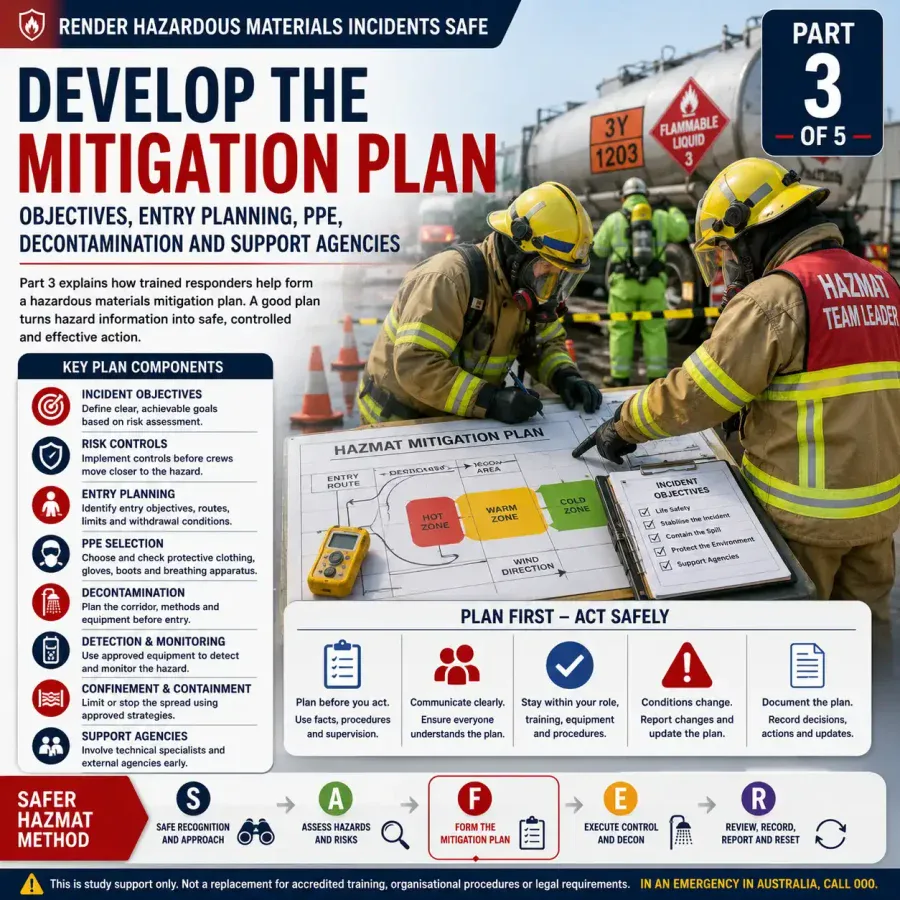
The SAFER HAZMAT Method will continue in Part 3 with F, which means form the mitigation plan. That next step will use the hazard and risk information gathered in Part 2 to support incident objectives, risk controls, entry planning, protective equipment and decontamination planning.
Scenario drill
You are positioned outside a warehouse after a reported chemical spill. A worker provides a product name, but the label on the leaking drum is partly damaged. Liquid is moving slowly toward a floor drain. What is the best assessment action?
Quick knowledge check
Question: What should responders assess at a hazardous materials incident?
60-second refresher drill
- Start with the whole scene, not only the product.
- Identify site hazards such as traffic, drains, fire, weather, access and nearby people.
- Assess material hazards using safe observations and reliable sources.
- Look at the container type, condition, markings and possible failure signs.
- Use Safety Data Sheets, emergency guides, HAZCHEM information, CHEMDATA, manifests, site plans and technical specialists where available.
- Assess exposure and spread risks to people, property and the environment.
- Report clear facts and uncertainty through the chain of command.
- Do not enter, touch or test unknown materials unless trained, equipped and directed under approved procedures.
Next in the series: Part 3 of 5 — Develop the Mitigation Plan: Objectives, Entry Planning, PPE, Decontamination and Support Agencies.
FireRescue Training Hub
Access practical fire and emergency study support resources, downloads, checklists, audio guides, and member-only course content.
- Course library
- PDF downloads
- Audio guides
- Checklists
Study support only. Not accredited training or a replacement for workplace procedures.
About the author and safety review
Ken Walker
Former Station Officer and fire service educator
Former career firefighter with extensive career and volunteer fire service experience.
Qualifications: Associate Diploma of Applied Science in Fire Technology; Institute of Fire Engineers studies.
Author profilehttps://www.firerescue.com.au/about-us/