FireRescue Training • Part 1 of 5
Recognise the Hazardous Materials Incident
Safe Approach, Initial Information and Command Communication
This first lesson explains how trained emergency service personnel recognise a possible hazardous materials incident, approach with care, gather early information from a safe distance and report clearly through the chain of command.
0 of 8 sections refreshed
Why recognition comes first
The safest first action is to recognise that the incident may involve hazardous materials.
Hazardous materials incidents can appear ordinary at first. A leaking drum, damaged tanker, unusual vapour, chemical smell, sick person near a container, spill at a workplace or fire involving stored products may all be signs that the incident needs a hazardous materials response mindset.
Recognition is not guessing. It is careful observation supported by procedures, supervisor direction, site information and reliable sources. The early goal is to avoid unnecessary exposure while protecting life, property and the environment.
In emergency response, the first minutes often shape the quality of the whole incident. If the first arriving personnel treat a hazardous materials incident as a simple spill, fire or rescue call, they may move too close, miss early warning signs or place other responders at risk. If they recognise the possibility early, they can slow the incident down, protect the crew and give command better information.
The first part of the SAFER HAZMAT Method is S, which means safe recognition and approach. Before responders assess hazards, form a plan, enter a site or apply control actions, they must first identify that hazardous materials may be involved and act with caution.
A safe recognition mindset respects the old fireground principle of looking before committing. Good responders gather clues before moving into danger. They notice labels, smoke, vapour, leaking product, damaged containers, affected people, unusual smells, wind direction, terrain and possible drains or waterways. They also understand that some hazards cannot be seen, smelled or felt safely.
Understand what hazardous materials may include
A hazardous materials incident can involve more than one type of risk.
A hazardous materials incident may involve dangerous goods, goods too dangerous to be transported or hazardous chemicals. It may involve materials with chemical, biological, radiological or physico-chemical properties that create unreasonable risk to life, property or the environment.
For a responder, this means the hazard may not be limited to what is burning, leaking or visible. The material may create toxic exposure, corrosive injury, flammable vapour, explosive atmosphere, oxygen displacement, contamination, reaction with water, environmental harm or delayed health effects. This is why early recognition must be careful and conservative.
Some hazardous materials are found in industrial sites, laboratories, transport vehicles, farms, warehouses, workshops, hospitals, swimming pool plant rooms, service stations and domestic locations. Others may be present during fires where stored products, batteries, aerosols, fuels, pesticides, cleaning products or industrial gases are involved.
It is also important to remember that the container can be as important as the product. A cylinder, tanker, drum, intermediate bulk container, shipping container, package, pipework system or storage vessel may give early clues about pressure, quantity, movement, stability and possible failure. Damage, heat exposure, bulging, leakage or missing labels all matter.
Part 1 does not train people to identify every product. Instead, it teaches the first discipline: recognise the possibility, hold a safe position, gather visible information and communicate clearly. Detailed product assessment and mitigation planning come later in the series.
Use plans and supervisor directives
Early action should be guided by pre-incident plans, site controls, containment plans and command direction.
Some sites have pre-incident plans, site control information, containment plans or emergency response arrangements. These may show stored products, access points, isolation points, drainage concerns, site contacts, hazards, likely exposures and emergency actions.
At a hazardous materials incident, these documents help responders avoid making blind decisions. They support the supervisor and command structure by giving early information about what may be present and what risks may need control.
Personnel should follow supervisor directives and organisational procedures. A responder may observe, collect information and report, but should not act outside role, training, equipment or command direction.
Pre-incident planning is valuable because it turns a confusing scene into a more structured problem. A site plan may show where chemicals are stored. A containment plan may show where runoff could travel. A community emergency response plan may identify nearby exposures. A site contact may provide a manifest or confirm the normal product held in a storage area.
However, plans must still be checked against what is happening now. A plan may be outdated, a container may have been moved, a product may have changed or the incident may have damaged normal access points. Good responders use plans as guidance, not as a substitute for observation, command assessment and current safety information.
Supervisor directives are critical because hazardous materials incidents require coordinated control. One person acting independently can create confusion, contamination or exposure. A disciplined response respects the chain of command and keeps every observation linked to the wider incident action process.
Best practice
Check available site information early and pass useful details to the supervisor.
Common mistake
Rushing forward before confirming the hazard, wind, product, container condition or safe access.
Approach with care and caution
Safe distance protects responders from unknown exposure.
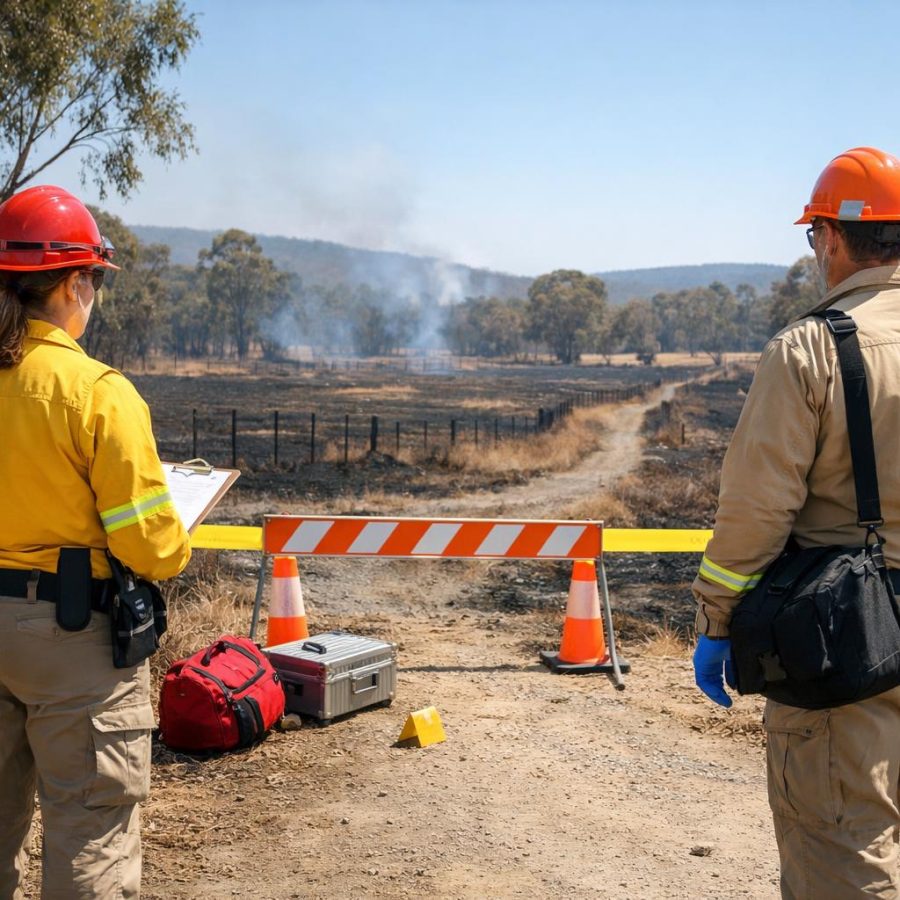
A hazardous materials incident should be approached carefully. The first arriving crew may not know the product, quantity, container condition, exposure route, reaction risk or spread pattern. A safe distance gives responders time to observe, communicate and decide the next step under command.
Safe approach means looking for clues before moving closer. These clues may include placards, class labels, shipping documents, emergency information panels, product names, container shapes, vapour clouds, dead vegetation, liquid movement, unusual fire behaviour or affected people and animals.
Approach decisions must align with organisational procedures and advice from appropriate authorities. The key principle is simple: do not become part of the incident.
Care and caution also mean thinking about route. A crew should avoid driving or walking into the path of vapour, runoff, smoke or contamination. Apparatus placement should support safety, communication, later control zones and possible withdrawal. Crews should avoid blocking access for specialist resources, decontamination set-up or evacuation movement.
Safe distance is not just about metres. It is about separation from the hazard, likely spread, wind movement, drainage, low areas, ignition sources, unstable containers and potential exposure routes. The safest initial position may change as more information is gathered or as conditions change.
Responders should avoid touching containers, walking through liquid, opening doors, lifting lids, moving packages or entering affected areas until the task is planned, authorised and supported by correct personal protective clothing, breathing apparatus, equipment and decontamination arrangements.
Traditional emergency service discipline still matters: slow is smooth, smooth is safe, and safe work supports the whole incident. Hazardous materials incidents reward patience, observation and command discipline far more than speed without information.
Identify hazardous materials from a safe distance
Early identification relies on signs, documents, sources and specialist advice.
Hazardous materials may be identified using several sources. These can include Safety Data Sheets, HAZCHEM information, emergency response guide books, CHEMDATA, transport documents, storage manifests, site plans, product labels, emergency information panels and technical specialists.
Responders may also use visible identification systems such as class labels, emergency action codes, United Nations numbers, Global Harmonised System labels, product names and container markings. These sources help build an early picture of the material and the risk it may present.
Early identification should be treated as information for command, not permission to act independently. Details should be conveyed clearly through the chain of command so the incident plan can be developed safely.
Safe-distance identification is a practical skill. A responder may be able to read a placard through binoculars, photograph a label from outside the hazard area, receive product information from a site representative or locate transport documents without entering the contaminated area. The aim is to gather information without increasing risk.
Product names can be helpful, but they should not be relied on alone. Trade names may not explain the actual hazard. A container may hold a different product from the label. A mixed load may involve several materials. A fire may change product behaviour. For these reasons, early information should be confirmed through reliable sources where possible.
Information sources can support decisions about isolation, protective equipment, exposure risks, firefighting approach, decontamination, confinement, containment and specialist support. In Part 1, the focus is simply to recognise which sources may exist and to report what is available.
Early information to report
- What you can see from a safe distance.
- Any visible labels, placards, panels or numbers.
- Type and condition of container or vehicle.
- Signs of leaks, vapour, smoke, fire or spread.
- People, property or environment at risk.
- Any site plan, document or specialist information available.
Recognise people, environment and exposure risks
Recognition includes what the material may affect, not just what the material is.
A hazardous materials incident is not only about the product. It is also about what the product may affect. People may be exposed by breathing, skin contact, eye contact, swallowing or contamination of clothing and equipment. Some effects may be immediate, while others may be delayed or difficult to recognise at first.
Responders should observe for affected workers, bystanders, casualties, animals, vegetation, waterways, drains, buildings, traffic, ignition sources and nearby populations. These observations help command understand the possible scale of the incident and the priorities for isolation, evacuation, sheltering, rescue, decontamination and environmental protection.
Exposure risk can be increased by weather, wind, slope, drains, confined spaces, low-lying areas, damaged packaging, heat, fire, water runoff and poor ventilation. A liquid spill may move downhill or enter drainage. Vapour may move with wind or collect in low areas. Smoke from burning hazardous materials may create risks beyond the immediate fire area.
The responder’s job in the recognition phase is not to solve all of these issues at once. The job is to notice the signs, stay safe, protect the crew from unnecessary exposure and pass useful information to the supervisor. Command can then build a safer picture of the incident.
Good early observations may include simple language such as “runoff is moving toward a drain,” “two workers are coughing outside the gate,” “vapour is drifting toward the road,” or “the container is heat affected.” These statements are useful because they are factual, visible and linked to safety decisions.
Communicate through the chain of command
Clear reporting helps command build the safest next action.
Communication is a safety control. A responder who identifies useful information must pass it through the correct chain of command. This supports supervisor decisions, incident objectives, risk assessment, control zones, protective equipment selection and later planning.
Good reports are short, calm and factual. They avoid assumptions and clearly separate confirmed information from observations. For example, saying “white vapour visible from the valve area” is better than guessing a product or reaction without evidence.
Reports should match organisational procedure. They may include location, product markings, container type, visible damage, people affected, wind or spread indicators, access concerns and immediate safety issues.
Clear command communication also prevents duplication and unsafe freelancing. If one crew has already identified a placard, another crew does not need to move closer to confirm the same thing unless directed. If a site worker has provided a manifest, that information can be passed to command and used with other sources.
Communication should include uncertainty. If information is not confirmed, say so. A useful report might state, “The label appears to show a corrosive class marking, but it has not been confirmed.” This helps command use the information carefully without treating it as certain.
In a hazardous materials incident, poor communication can lead to poor protective equipment choices, unsafe entry, delayed decontamination, incorrect isolation or avoidable exposure. Good communication supports safer planning and gives specialist resources a stronger starting point.
Example report style
“From a safe distance, we can see a damaged container with a visible hazard label and liquid leaking toward a drain. No entry has been made. We are holding position and awaiting direction.”
Part 1 practical checklist
Use this as a study refresher, not as a replacement for procedures.
This checklist summarises the recognition stage. It is designed for learning and revision. It does not replace organisational procedures, local response doctrine, supervisor direction, approved equipment, workplace instructions or accredited training.
Part 1 should leave the learner with one strong habit: do not rush the unknown. Recognition, distance, observation and communication are the foundation of safe hazardous materials response. The responder who pauses and reports well may prevent a small incident from becoming a larger responder safety problem.
The SAFER HAZMAT Method will continue in Part 2 with A, which means assess hazards and exposure risks. That next step builds on recognition by looking more closely at site hazards, material hazards, container risks and the information sources used to support safe assessment.
Scenario drill
You arrive near a small industrial site. A worker reports a strong smell near a storage area. You can see a damaged container from outside the gate, but the product is unknown. What is the best first action?
Quick knowledge check
Question: Why should hazardous materials be identified from a safe distance first?
60-second refresher drill
- Stop and recognise that hazardous materials may be involved.
- Approach with care and maintain a safe distance.
- Use pre-incident plans, site information and supervisor direction.
- Look for labels, placards, panels, documents and other safe-distance clues.
- Observe people, property, environment, drains, wind, access and spread indicators.
- Report clear observations through the chain of command.
- Do not enter, touch, move or control unknown materials unless trained, equipped and directed under approved procedures.
Next in the series: Part 2 of 5 — Identify and Assess Hazards: Materials, Containers, Exposure Risks and Information Sources.
FireRescue Training Hub
Access practical fire and emergency study support resources, downloads, checklists, audio guides, and member-only course content.
- Course library
- PDF downloads
- Audio guides
- Checklists
Study support only. Not accredited training or a replacement for workplace procedures.
About the author and safety review
Ken Walker
Former Station Officer and fire service educator
Former career firefighter with extensive career and volunteer fire service experience.
Qualifications: Associate Diploma of Applied Science in Fire Technology; Institute of Fire Engineers studies.
Author profilehttps://www.firerescue.com.au/about-us/