FireRescue.com.au | Historical analysis | 1990–2025
Victoria’s Fire Services: 35 Years of Leadership Challenges and Reform
A plain-English overview of CFA, Fire Rescue Victoria, industrial disputes, volunteer–career relations and the lessons for better emergency-service governance.
The big picture
Victoria’s fire services have repeatedly faced the same difficult question: how can governments, agency leaders, career firefighters and volunteers share responsibility for protecting the community without weakening operational independence or trust? The original historical paper argues that successive industrial disputes, leadership changes and structural reforms did not fully resolve this problem. The 2020 creation of Fire Rescue Victoria (FRV) changed who employs career firefighters, but it also created new coordination and staffing questions for the Country Fire Authority (CFA).
35 years
Historical scope: 1990–2025
Two services
CFA volunteers and FRV career firefighters
One public duty
Safe, accountable emergency response
Why this history matters
Fire services are different from many workplaces. Their decisions affect firefighter safety, community confidence and emergency response under extreme pressure. They also combine complex employment arrangements with strong traditions of service. In Victoria, the CFA developed as a volunteer-centred organisation supported by paid firefighters and employees. The former Metropolitan Fire Brigade (MFB) operated as a career service in metropolitan Melbourne. For decades these arrangements served communities, but the boundaries between employment conditions, command authority and volunteer rights became increasingly contested.
The supplied paper follows how the disagreements developed from the early 1990s through the establishment of FRV in 2020 and the challenges reported by 2025. It gives considerable attention to claims by volunteer representatives and findings from oversight bodies. Those perspectives are important, but they are not the only ones. Career firefighters and their union have argued that staffing, safe systems of work, training and appropriate equipment are essential protections. Governments have argued that structural change can modernise the system. A fair assessment needs to distinguish documented events, institutional findings and competing interpretations of motives.
The strongest lesson is not that one group alone caused every difficulty. It is that unresolved disputes over authority, consultation and resources can spread far beyond the negotiating table. When leaders lack a clear mandate, volunteers feel unheard, employees distrust management or public confidence weakens, the consequences can affect the entire emergency-services system.
🗓️ The key turning points
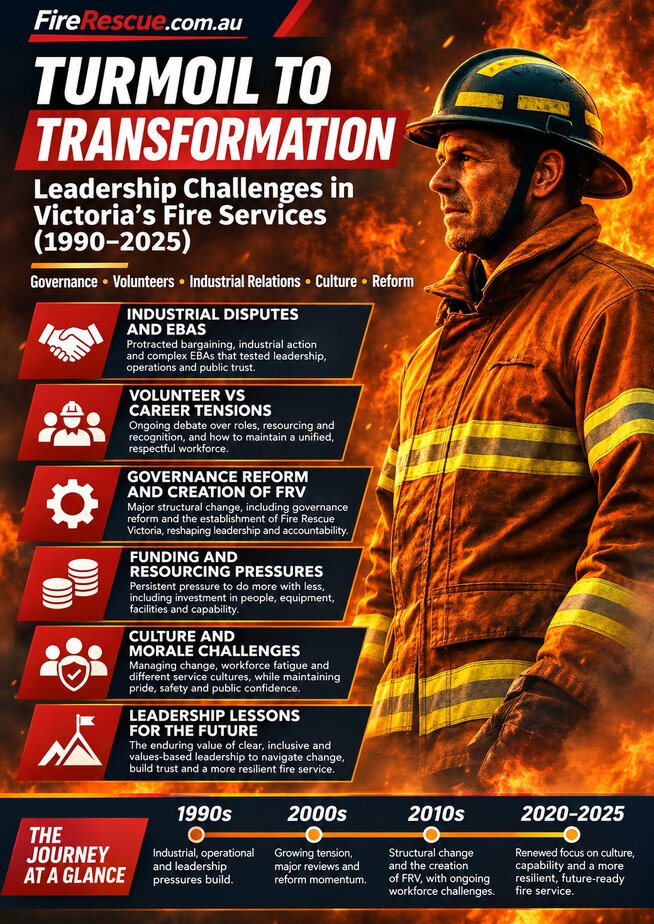
1990s: Enterprise bargaining changes the landscape
New public-sector bargaining arrangements gave paid firefighters a stronger mechanism for negotiating wages and working practices. The paper describes disputes about positions supporting volunteers, as well as the balance between workforce agreements and CFA management decisions. A prolonged 1999–2000 agreement dispute included work bans and disagreement over Community Support Facilitator roles. Volunteer leaders argued that some industrial claims affected functions beyond paid employment. The period also reinforced the need for improved firefighter training and safety following the 1998 Linton tragedy.
2000s: Major fires drive reform
The 2002–03 Alpine fires and the catastrophic 2009 Black Saturday bushfires tested emergency management and community warning systems. Black Saturday killed 173 people and led to a Royal Commission and substantial reform efforts. The original paper highlights greater statewide coordination, a Fire Services Commissioner and improved incident management as important outcomes. It also observes that new coordinating roles could complicate the relationship between agency executives and statewide emergency-management leadership.
2010–2014: Volunteer rights and consultation
The 2010 CFA enterprise agreement became controversial among volunteer representatives, who argued that provisions concerning staffing, training and decision-making could limit volunteer participation. The 2011 Jones Inquiry responded to concerns about arrangements affecting volunteers and called attention to consultation and support. Subsequent emphasis on the Volunteer Charter reflected a broader question: how should industrial agreements protect employees without determining matters that affect people who are not parties to those agreements?
2015–2016: A leadership and political crisis
A prolonged bargaining dispute escalated into one of the most consequential chapters of CFA history. The Victorian emergency-services minister resigned, the government dismissed the CFA board, and senior executives departed during the controversy. The paper identifies concerns over proposed staffing and operational clauses, competing legal interpretations, and the rights of volunteers. Supporters of the agreement emphasised career firefighter safety and conditions; opponents argued it threatened volunteer autonomy and management authority. The controversy also entered federal politics and contributed to legislation addressing volunteer emergency-service organisations.
2017–2020: A new model is designed
Reform proposals divided opinion. Parliamentary scrutiny raised questions about consultation, operational arrangements and the proposed separation of career and volunteer firefighters. The government nevertheless proceeded with legislation, and on 1 July 2020 FRV commenced, combining the former MFB workforce with career firefighters transferred from CFA. CFA continued as a volunteer firefighting service, supported by paid staff and FRV personnel under secondment arrangements. The change addressed one structural source of bargaining conflict but created another complex agency-to-agency relationship.
2020–2025: New structure, familiar pressures
The original paper describes greater separation between the career and volunteer employment models, alongside continuing concerns about seconded positions, cultural issues, consultation and resource allocation. Reports by the Fire Services Implementation Monitor and IBAC feature prominently. They point to difficulties in organisational accountability, integrity and management arrangements. The period also demonstrates that frontline cooperation can continue effectively even when the broader policy framework is contested.
The six leadership challenges
Looking across the decades, the same six themes repeatedly appear in the original analysis. They overlap: a disputed agreement can affect a chief officer’s authority; an unclear staffing arrangement can delay training; and weak consultation can make necessary reform harder to implement.
1. Industrial relations
Enterprise bargaining should protect lawful employment conditions and support safe work. Yet the paper argues that clauses governing operational change can become contentious when they overlap with statutory command and volunteer participation. Union representatives have legitimate interests in staffing, fatigue, training and equipment; agency leaders also require authority to make lawful operational decisions. Lasting agreements need clear boundaries and genuine negotiation rather than a permanent cycle of industrial confrontation.
2. Command and accountability
Emergency-service officers must understand who can direct staff, approve training and make operational decisions. The paper is particularly critical of situations in which CFA is responsible for outcomes but relies on personnel whose employment and some administrative arrangements sit within FRV. When authority and responsibility do not align, disputes can delay decisions and vacancies can become harder to resolve. Clear service agreements, reporting responsibilities and escalation paths are essential.
3. Volunteer–career relationships
Volunteers contribute local knowledge, community commitment and surge capacity. Career firefighters offer continuous availability and specialist capabilities. The paper shows how disagreements about incident command, access to training and recruitment pathways created perceptions of unequal treatment. Those perceptions can deepen even when personnel cooperate well on the fireground. Joint exercises, respectful supervision and fair recognition help prevent organisational divisions from becoming personal ones.
4. Funding and resources
Ambitious reforms need funding for appliances, infrastructure, training, staffing and administration. The original paper describes concerns about ageing equipment, operational vacancies and whether money is allocated fairly between metropolitan and regional needs. It also recognises strong career-firefighter arguments about safe staffing and protection. Resource choices must be transparent and tied to measurable risks rather than headlines or rivalry.
5. Culture and integrity
Workplace bullying, discrimination, misuse of confidential information and weak internal trust are serious management issues, not secondary distractions. The paper discusses controversial culture reviews and IBAC’s Operation Turton findings involving historical MFB/FRV conduct. It also notes disputes over the interpretation and public reporting of investigations. Organisations need safe reporting channels, procedural fairness, secure records and credible action when misconduct is established.
6. Politics and public trust
Governments fund fire services and remain accountable for policy. But emergency-service decisions become harder when political arguments, public campaigns and industrial disputes dominate discussion. The 2016 crisis and later reforms show the risks of abrupt changes without broad confidence in the process. Transparent consultation and independent scrutiny help communities judge whether reforms are genuinely improving public safety.
⚖️ The union’s role: benefits and controversy
The original paper places substantial emphasis on the United Firefighters Union (UFU) and its influence on management. Its argument is that some consultation-and-agreement arrangements created difficulties for operational flexibility and contributed to industrial conflict. The paper draws on reports and comments by volunteer bodies, former officers, oversight authorities and journalists. It is essential, however, not to treat every criticism or allegation recorded by those sources as an independently established finding.
Union representation is a legitimate feature of Australian workplaces. Firefighters need a collective voice in matters including staffing, health risks, training, protective equipment and conditions. The paper itself recognises that health and safety campaigns produced genuine benefits, including greater attention to occupational disease and hazardous exposures. The debate concerns the boundary between protecting employees and making operational decisions reserved for statutory leaders.
The 2024 IBAC material discussed in the original article is particularly significant because it concerns documented integrity and administration issues. Yet individual allegations about motives, influence or political relationships should still be attributed carefully. The UFU has disputed interpretations of its conduct and has argued that its interventions can expose management problems. An editorial summary should report that contest rather than decide every disputed claim by assertion.
Practical reform would mean meaningful employee consultation with clear timeframes, written decision records, lawful escalation paths and an explicit distinction between employment conditions and operational command. It would also mean leaders listening seriously to concerns raised by crews and responding with evidence, not dismissing safety arguments merely because they emerge in an industrial setting.
🚒 The CFA–FRV secondment question
One of the most important themes after 2020 is the secondment of FRV personnel to support CFA functions. The arrangement was designed to preserve access to career expertise while the services separated their employment models. The paper argues that the system can leave CFA dependent on staffing decisions made elsewhere and describes volunteer concerns about vacancies and the chief officer’s ability to direct available resources.
That does not mean every secondment arrangement is ineffective. Shared staffing can preserve specialist knowledge, reduce duplication and support interoperability when responsibilities are well defined. The real governance test is whether CFA can obtain the people and services it needs, whether vacancies are promptly filled, and whether responsibility for performance is unmistakable. Independent implementation reporting should be used to examine these questions with current evidence.
Potential improvements include joint workforce planning, agreed timelines for filling positions, clear selection and supervision processes, published measures of service delivery and a fair method for resolving disagreements. The original paper goes further by suggesting CFA could directly employ some critical operational support officers. That is a policy option rather than an established solution: costs, legislation, industrial implications and operational effects would require careful assessment.
Above all, staff arrangements should be judged by whether they help brigades prepare, train and respond safely. Governance that looks tidy on an organisation chart may still fail if a district cannot fill essential support positions or respond to local needs.
👥 Culture, morale and firefighter wellbeing
Emergency work requires trust under pressure. Firefighters depend on colleagues to follow procedures, communicate clearly and act professionally. Where workplace behaviour deteriorates into bullying, discrimination or entrenched factionalism, those relationships are weakened. The supplied paper argues that some fire-service culture problems were prolonged by weak accountability and resistance to external scrutiny.
The paper refers to the contested 2018 equal opportunity review and later IBAC reporting. These are not interchangeable sources: reviews, allegations, court proceedings and formal findings each have different evidentiary status. A responsible public article should name the source of a claim and explain when findings were disputed, restricted from publication or directed at historical conduct. It should not generalise that every firefighter or every brigade shares the failings reported in particular incidents.
Better culture requires leaders to model respectful behaviour, protect people who raise concerns, make fair investigations possible and communicate what changes follow. It also requires support for personnel exposed to trauma and organisational stress. Volunteers and career members should have confidence that safety, performance and misconduct concerns can be addressed without retaliation or favouritism.
That work is not separate from operational readiness. Teams with strong trust are better positioned to share warnings, question unsafe decisions and learn from near misses. A culture of genuine accountability can improve both workplace wellbeing and community outcomes.
🌏 What can Victoria learn elsewhere?
The original paper compares Victoria with New Zealand, the United Kingdom and other Australian jurisdictions. These comparisons are valuable precisely because there is no single organisational model that removes all tensions. Different systems make different trade-offs between volunteer autonomy, career staffing, central coordination and local decision-making.
New Zealand brought urban and rural fire services together under Fire and Emergency New Zealand in 2017. That is broadly the opposite direction to Victoria’s structural separation in 2020. Its experience illustrates the opportunities of unified planning and the continuing need to fund and consult both career and volunteer workforces. Integration alone cannot eliminate industrial disagreements or concerns that volunteer needs are overlooked.
The United Kingdom provides a different perspective. Fire services rely largely on employed wholetime and on-call firefighters rather than Victoria’s traditional volunteer model. Major industrial disputes over pay, staffing and modernisation show that conflict between unions and management can arise even without a substantial volunteer-career divide. The lesson is that fair negotiation and credible reform are necessary under any employment structure.
Other Australian states have maintained alternative combinations of metropolitan career agencies, rural volunteer services and statewide coordinating bodies. Their arrangements do not prove that one system is automatically superior, but they demonstrate that structural choices must fit local geography, population, hazards and workforce availability. Victoria should compare outcomes—training access, response readiness, support vacancies, cost and safety—rather than copying another jurisdiction’s organisational chart.
✅ Seven priorities for stronger leadership
The recommendations above are condensed from the original paper’s proposals and broader themes. They are options for public discussion, not a costed reform package. Implementing them would require consultation, legal and industrial review, evidence about current performance and careful assessment of unintended consequences.
Final assessment: one mission, shared responsibility
Across three and a half decades, Victorian fire services have faced major bushfires, painful public inquiries, industrial confrontation, government reform and difficult questions about culture. Their structures changed dramatically, but the underlying governance challenge remained: how to protect professional standards, volunteer contribution, public accountability and operational independence at the same time.
The historical paper is at its strongest when it connects individual controversies to these broader institutional questions. An enterprise agreement is more than a pay document when it affects how leaders make decisions. A secondment arrangement is more than an administrative mechanism when it determines whether brigades receive training and operational support. Culture is more than morale when it shapes integrity and the willingness to report danger.
The record also deserves balance. A disputed decision does not erase years of frontline service. Volunteer firefighters and career personnel repeatedly work together to protect lives and property, often with exceptional professionalism. The mistakes of particular leaders or institutions should be examined without diminishing that shared contribution.
A durable way forward would put operational effectiveness, firefighter wellbeing and community safety ahead of factional advantage. That requires transparent evidence, leaders who can lead, proper consultation and a willingness to change arrangements that are not delivering. Reform should be evaluated by what happens at stations, in training and on the incident ground—not merely by legislation, political messaging or organisational identity.
Further reading: IBAC · Parliament of Victoria · CFA · FRV. For the detailed footnotes and source-specific claims, see the original long-form paper.
FireRescue Training Hub
Access practical fire and emergency study support resources, downloads, checklists, audio guides, and member-only course content.
- Course library
- PDF downloads
- Audio guides
- Checklists
Study support only. Not accredited training or a replacement for workplace procedures.
About the author and safety review
Ken Walker
Former Station Officer and fire service educator
Former career firefighter with extensive career and volunteer fire service experience.
Qualifications: Associate Diploma of Applied Science in Fire Technology; Institute of Fire Engineers studies.
Author profilehttps://www.firerescue.com.au/about-us/