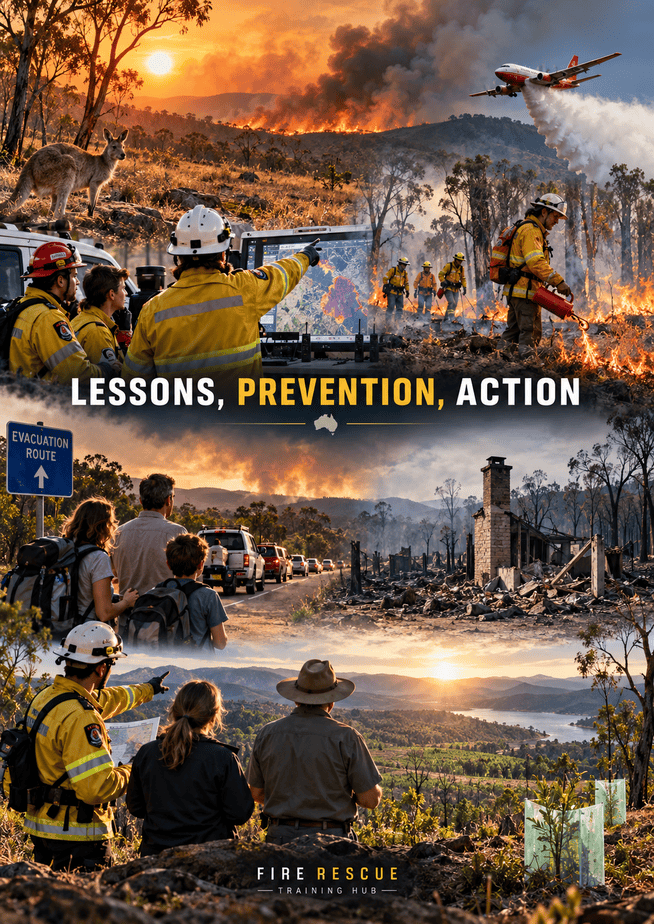
Australia cannot prevent every bushfire. What we can do is reduce the chance that a fire becomes a disaster by improving preparedness, land and fuel management, warnings, coordination, firefighter capability, community planning and recovery.
The strongest lesson from Black Summer and later research is that there is no single fix. Safer outcomes come from many systems working together before, during and after a fire.
Incident management: AIIMS 2025
Reviewed: October 2026
Do not wait for aircraft, firefighters or a warning message before acting if you are in immediate danger. Follow your state or territory fire authority, emergency warnings and evacuation directions. In a life-threatening emergency, call Triple Zero (000).
What Australia learned from Black Summer
The 2019–20 Black Summer fires exposed the scale of the challenge Australia can face when extreme weather, dry fuels, long-running incidents and widespread community exposure occur at the same time. The Royal Commission into National Natural Disaster Arrangements examined preparedness, response, recovery, national coordination and the role of the Australian Government.
The lesson was not that Australia lacked capable firefighters. It was that a disaster of national scale can place pressure on every layer of the system at once: local brigades, incident management teams, communications, warnings, aviation, logistics, interstate assistance, community evacuation and recovery.
Research undertaken after Black Summer has continued to examine fire prediction, cultural land management, community-centred disaster risk reduction, data, reconstruction and operational effectiveness. The value of that work is in turning a major disaster into measurable improvements rather than simply repeating the same lessons.
The risk is changing — but differently across Australia
CSIRO and the Bureau of Meteorology report that extreme fire weather has increased and fire seasons have lengthened across large parts of Australia. The drivers are not identical everywhere. Southern forest-fire risk is strongly influenced by heat, dryness and dangerous fire weather, while wet periods in northern and central Australia can produce large grass fuel loads that later dry and burn.
AFAC’s Spring 2026 Seasonal Bushfire Outlook identified increased fire potential across parts of several states and territories. Importantly, AFAC also stresses that a seasonal outlook is not a prediction of exactly where a fire will occur. Dangerous fires can still happen in areas shown as having normal seasonal risk.
That means prevention has to be local. A strategy suitable for a Victorian forest, a Queensland grassfire district, a Tasmanian wilderness area or remote northern Australia may be very different.
1. Reduce risk before the fire starts
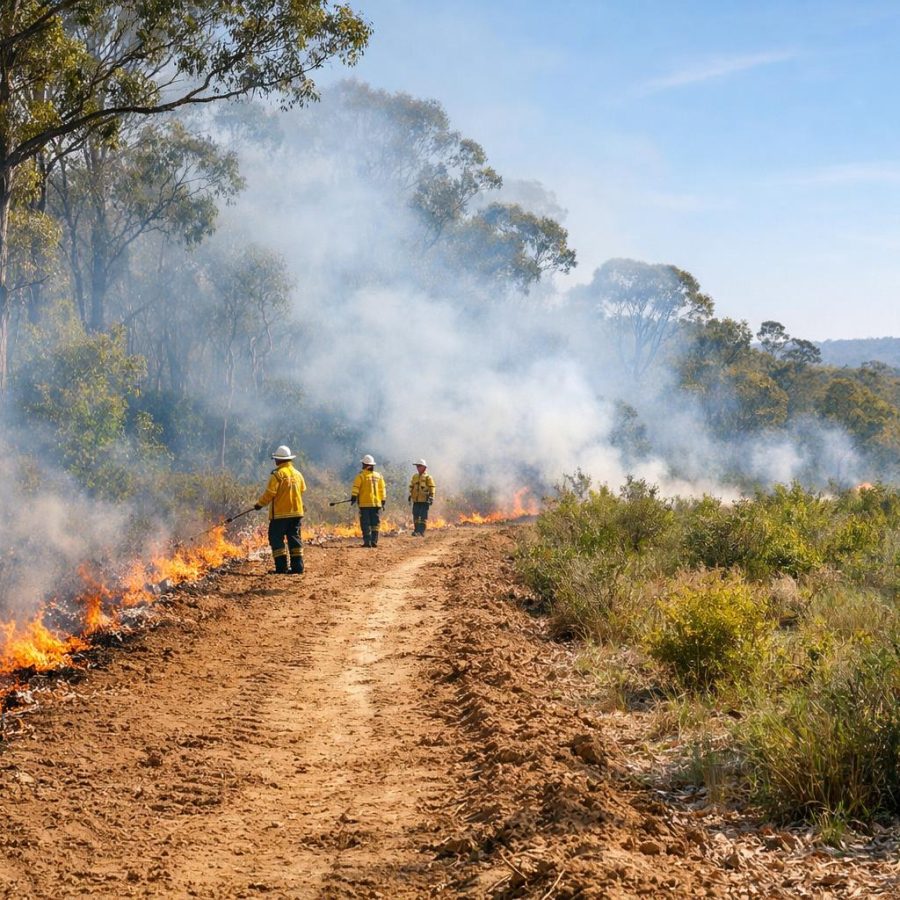
Fuel management remains an important part of bushfire risk reduction, but it is not a guarantee that a fire will be stopped. Planned burning, mechanical treatment, grazing, strategic breaks and vegetation management can all have a role depending on the landscape, ecology, weather window and local risk.
The strongest approach is risk based. Treatments should be considered alongside townships, critical infrastructure, access routes, ecological values, private land, public land and the likely behaviour of fire under severe conditions.
First Nations cultural fire knowledge can also contribute to land management where it is led by Traditional Owners and suited to Country. Cultural burning should not be reduced to a generic “fuel reduction technique”; it is connected to culture, ecology, knowledge and responsibility for Country.
Land-use planning matters too. New development in bushfire-prone areas needs to consider access, evacuation, vegetation, water, building exposure and the ability of emergency services to operate safely.
2. Make warnings fast, clear and actionable
A warning is useful only if people receive it, understand it and know what to do. Australia now uses nationally consistent warning principles through the Australian Warning System, while states and territories continue to deliver warnings through their own emergency platforms and channels.
A major new development is AusAlert, Australia’s cell-broadcast emergency warning system. Following community tests and a successful national test in July 2026, AusAlert is scheduled to be ready for use in October 2026. It is designed to send alerts directly through compatible mobile devices in a defined area, including when networks are heavily loaded.
No warning technology should be treated as the only source of information. People should continue to monitor official fire authority websites and apps, ABC emergency broadcasting, local radio and other authorised channels.
3. Coordinate nationally without losing local knowledge
States and territories retain primary operational responsibility for emergency response, but nationally significant events need mechanisms that can bring governments, agencies and key sectors together quickly.
NEMA’s National Coordination Mechanism is designed to bring together relevant stakeholders before, during and after major crises, provide a national picture and support coordination across sectors and jurisdictions.
At incident level, AIIMS 2025 remains the common incident-management framework used across Australian fire and emergency services. Its current principles include Safety First, management by objectives, functional management and span of control. Good coordination still depends on trained people, current information and clear authority.
National systems should strengthen local capability, not replace it. Local brigades, land managers, councils and communities often understand access, terrain, vulnerable residents, water sources and local fire behaviour in ways that cannot be recreated from a distant coordination centre.
4. Maintain enough firefighting capacity for long, complex seasons
Australia depends on a combination of career firefighters, volunteers, public-land firefighters, specialist teams, aircraft, incident-management personnel and interstate support. Long-duration seasons can stretch all of them.
The 2026–27 National Aviation Assets program includes nationally coordinated aircraft supporting state and territory agencies. NEMA also states that the Australian Government is funding national aerial firefighting capability and surge capacity, while states and territories remain responsible for maintaining their own jurisdictional capabilities.
Aircraft are valuable but they do not replace ground crews. Retardant and water drops can slow or support suppression, but fires are ultimately controlled through a wider system of ground operations, intelligence, weather, access, containment and mop-up.
People are the limiting resource in many emergencies. Recruitment, retention, training, fatigue management, leadership development, mental health support and safe equipment all contribute to whether a fire service can sustain operations for days or weeks.
5. Use technology to support decisions — not replace judgement
Fire agencies now have access to better satellite data, mapping, weather information, fire-spread modelling, aircraft tracking, cameras, drones and common operating pictures than were available to earlier generations of firefighters.
These tools can improve detection and situational awareness, but their value depends on the quality of the data and the way it is interpreted. A model can show a likely fire path; it cannot guarantee what a fire will do. A map can show a road; it cannot guarantee the road is still open or safe.
The best use of technology is to combine it with field intelligence, weather observations, local knowledge and experienced operational judgement.
6. Build community resilience before smoke is visible
Emergency services cannot place a fire truck at every property. Community preparedness remains essential, particularly in areas where roads are limited, warning time may be short or resources may already be committed elsewhere.
- Know your local bushfire risk and official warning channels.
- Have a written bushfire plan and decide your leave-early triggers.
- Plan for children, older people, disability, pets and livestock.
- Prepare the property before the fire season rather than during an emergency.
- Know more than one route if your area has limited road access.
- Keep phones charged and have alternatives for receiving information.
- Do not assume a fire truck or aircraft will be available to protect your home.
Prepared communities also look beyond individual households. Neighbours can identify people who may need help, share local information and plan how to communicate if power or mobile services fail.
7. Treat recovery as part of preparedness
Recovery starts earlier than many people expect. Decisions made during response can affect road access, utilities, temporary housing, public health, community information, environmental protection and long-term rebuilding.
AIIMS 2025 gives stronger attention to the link between response and recovery. That is important because a successful emergency operation is not only about containing the fire. It is also about handing over information and responsibilities in a way that helps communities recover safely.
Planning for recovery before a disaster also helps identify vulnerabilities that should be reduced beforehand.
Operational perspective: prevention is a system, not one program
From a fire-service perspective, major bushfires rarely expose only one weakness. A severe event can simultaneously test communications, staffing, weather intelligence, aircraft, road access, public warnings, fatigue, command and community preparedness.
That is why debates framed as a choice between “more burning”, “more aircraft”, “better warnings” or “more firefighters” miss the operational reality. Each control addresses a different part of the risk.
A resilient system has layers. If one layer fails, the next still has a chance to protect people.
A practical national checklist
| Area | Question to keep asking |
|---|---|
| Fuel and land | Are treatments targeted to the places where they reduce risk most effectively? |
| Planning | Are new communities being designed with bushfire exposure, access and evacuation in mind? |
| Warnings | Can people receive, understand and act on warnings quickly? |
| Firefighting | Are people, equipment, aircraft and leadership sustainable through a long season? |
| Coordination | Can agencies and governments share information and resources without unnecessary delay? |
| Community | Do people understand their own risk and know what they will do before conditions become dangerous? |
| Recovery | Are recovery needs being considered before and during the emergency? |
Historical FireRescue eBook
The original long-form FireRescue eBook is retained as historical background. Some organisations, policies, programs and statistics in that earlier document may have changed since publication, so use the current article and official agency sources for present-day guidance.
Key message
Australia will continue to experience bushfires. The practical goal is to stop as many fires as possible from becoming disasters.
That requires prevention, preparedness, warnings, capable emergency services, good coordination, informed communities and recovery planning to work together.
The most useful lesson from past disasters is not to search for one perfect solution. It is to keep improving every layer of the system before the next severe fire season tests it.
- Royal Commission into National Natural Disaster Arrangements — Final Report
- NEMA — National Coordination Mechanism
- NEMA — Disaster Risk Reduction
- NEMA — National aerial firefighting capability
- AFAC / NAFC — 2026–27 National Aviation Assets
- AFAC — AIIMS 2025
- AFAC — Seasonal Bushfire Outlook Spring 2026
- CSIRO and Bureau of Meteorology — State of the Climate 2024
- Natural Hazards Research Australia — Black Summer research
- AusAlert — About the national emergency warning system
Ken Walker — former Station Officer and fire-service educator.
This article combines current official Australian guidance and research with documented lessons from major bushfires and an operational fire-service perspective. It is intended to support public understanding and professional discussion, not replace official warnings, agency doctrine or local emergency advice.
Bushfire conditions can change rapidly. Follow your state or territory fire authority, emergency warnings and evacuation directions. This article provides general educational information only and does not guarantee safety, property protection or the availability of emergency services.
FireRescue Training Hub
Access practical fire and emergency study support resources, downloads, checklists, audio guides, and member-only course content.
- Course library
- PDF downloads
- Audio guides
- Checklists
Study support only. Not accredited training or a replacement for workplace procedures.
About the author and safety review
Ken Walker
Former Station Officer and fire service educator
Former career firefighter with extensive career and volunteer fire service experience.
Qualifications: Associate Diploma of Applied Science in Fire Technology; Institute of Fire Engineers studies.
Author profilehttps://www.firerescue.com.au/about-us/