BAL Rating Guide
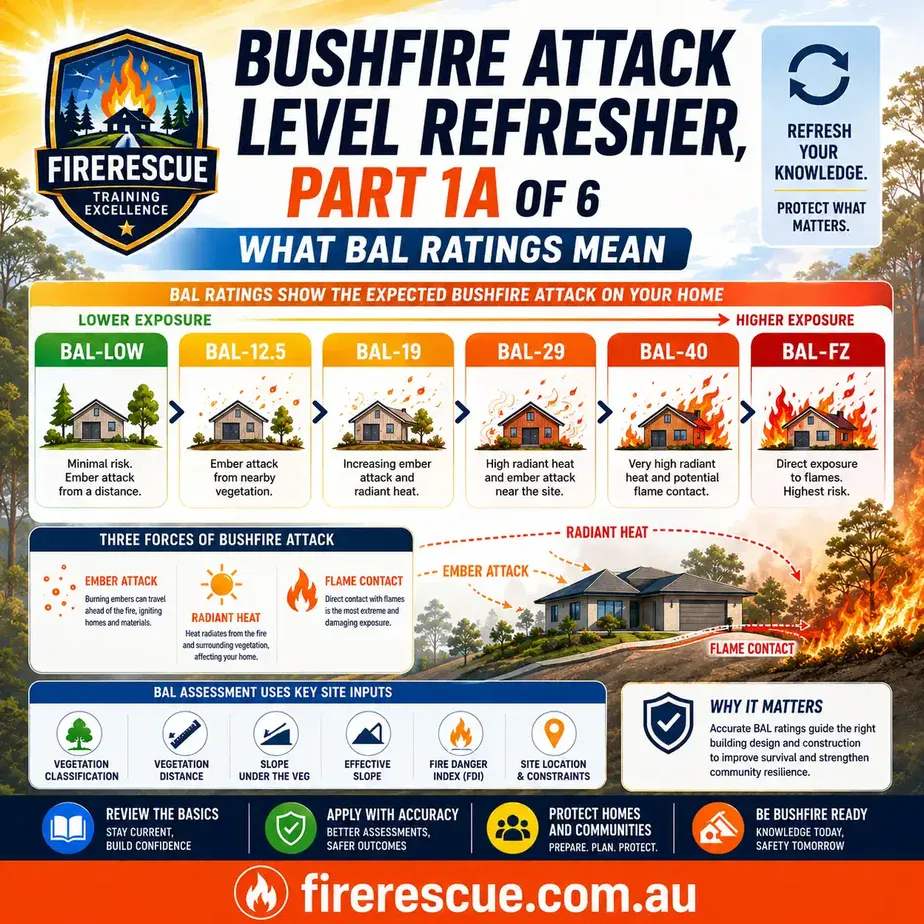
Quick refresher: BAL-LOW to BAL-FZ.
Conduct and record a Bushfire Attack Level (BAL) assessment
Part 1 of 6
BAL Assessment Foundations: Purpose, Standards and Safe Practice
BAL assessment foundations start with a simple idea. The assessor must understand why the assessment is needed, what rules guide the work, how bushfire can affect buildings, and how to approach the site safely and carefully.
Refresher progressMark each section as refreshed as you work through the article.
0% refreshed
01
Learning summary
This first lesson sets the ground rules for the full six-part course.
What you will learn
You will learn why BAL assessment matters, what the assessor must consider, and why good evidence must support every judgement.
What this is not
This article is not legal advice. It is a training and refresher guide based on the course requirements and should be used with current organisational procedures and jurisdictional requirements.
How to use it
Read each section, pause at the drills, then use the quiz to check your understanding before moving to Part 2.
02
What a BAL assessment is trying to achieve
A BAL assessment links site conditions with the likely level of bushfire attack on a building site.
A Bushfire Attack Level assessment helps identify the level of bushfire exposure that may affect a building site. It does this by looking at the site, the nearby vegetation, the distance between vegetation and the building site, the slope of the land, fire danger inputs and other relevant site factors.
At foundation level, the work is about careful observation and disciplined recording. The assessor does not guess. Instead, the assessor gathers site information, checks the relevant standards and procedures, and follows the required assessment pathway.
The purpose is also practical. Buildings in bushfire prone areas may face ember attack, radiant heat and flame contact. Therefore, the assessment process supports better decisions about building performance, construction requirements and site planning.
Good BAL assessment also helps communication. Site owners, builders, designers and other stakeholders may need clear information about what has been assessed and why it matters. As a result, the assessor must explain the purpose and process in plain language without overstating what the assessment can do.
Key point:A BAL assessment is not a casual site opinion. It is a structured process that must follow applicable standards, legislation, organisational procedures and safe work requirements.
03
BAL assessment foundations and the standards mindset
The assessor must know which rules and procedures apply before making site decisions.
BAL assessment foundations include a strong standards mindset. This means the assessor checks the required sources before applying judgement. The course points to planning and building legislation, industry standards, organisational procedures, WHS/OHS requirements and certification requirements where they apply.
Relevant standards and requirements may include AS 3959 Construction of Buildings in Bushfire Prone Areas or its successor, the NASH Standard for steel frame construction in bushfire areas, the National Construction Code including the Building Code of Australia, and relevant state or territory planning requirements.
These documents matter because BAL assessment sits between site conditions and building response. The assessor needs to understand the link between bushfire exposure and construction performance. However, the assessor must also stay within role, scope and authority.
In practice, this means a learner should build a habit early. First, identify the assessment purpose. Next, check the applicable jurisdiction and organisational procedure. Then, collect information using the required method. Finally, record and report the outcome clearly.
Standards mindset checklist
- Confirm the assessment task and site details before starting.
- Check the current standard, procedure and jurisdictional requirement.
- Use the required method for measuring and recording site information.
- Stay within organisational authority and certification requirements.
- Record evidence clearly so the assessment can be reviewed.
04
Safe practice comes before site assessment
WHS/OHS is not separate from BAL assessment. It shapes how the assessor enters, moves through and records a site.
A BAL assessment may involve walking a site, checking vegetation, measuring distance, considering slope and looking at nearby features. Therefore, the assessor must apply safe work practices before and during the assessment.
Safe practice starts before arrival. The assessor should understand the task, the site location, the expected terrain, access limits, weather conditions and any known hazards. In addition, the assessor should use required personal protective clothing and equipment when organisational procedures require it.
On site, safe practice continues through simple habits. Watch footing. Keep clear of unsafe structures. Maintain awareness of traffic, animals, uneven ground, heat, smoke, sharp vegetation, overhead hazards and restricted areas. Also, do not enter places where access is not authorised or safe.
Documentation supports safety as well. If the assessor records site constraints and limitations, the final assessment becomes clearer. For example, heavy vegetation, unsafe terrain, poor access, weather conditions or blocked measurement lines may affect how information is collected. These issues should be handled through organisational procedures.
Training caution:Do not treat a BAL assessment as a reason to take unsafe shortcuts. If conditions stop safe assessment, pause and follow organisational procedures.
05
How bushfire attack can affect buildings
The course requires the learner to analyse the cause and effect of bushfire attack on buildings.
To understand BAL assessment, the learner must understand how bushfire can attack a building. At foundation level, three main mechanisms are important: embers, radiant heat and flame contact. These mechanisms may occur separately, but they can also combine during a bushfire event.
Ember attack
Embers are burning pieces of material carried by wind and fire movement. They may travel ahead of the main fire front and settle in places where fine fuels or vulnerable features exist. For a BAL assessment learner, ember attack matters because small ignition points can affect the immediate environment around a building.
Radiant heat
Radiant heat is heat energy transferred from the fire to surrounding objects without direct flame contact. It can affect people, materials and building elements. Therefore, distance, slope, vegetation and fire intensity become important parts of assessment thinking.
Flame contact
Flame contact occurs when flames directly reach a building or nearby feature. It represents a serious exposure pathway. The assessor must consider vegetation, adjacent structures, flammable elements and other sources of combustion when thinking about potential fire impact.
Heat transfer basics
Heat may transfer through radiation, convection and conduction. Radiation moves heat energy across space. Convection moves heat through hot gases and air movement. Conduction moves heat through direct contact within materials. These ideas help the learner understand why building exposure is not based on flames alone.
06
Fuel, topography and weather work together
BAL assessment thinking must consider how landscape and conditions influence bushfire behaviour.
The course highlights the interaction between fuel, topography and weather. This interaction is central to bushfire behaviour. A site should never be considered in isolation from the land and vegetation around it.
Fuel includes vegetation and other combustible material. Important fuel factors include amount, arrangement and moisture status. Dry, continuous or elevated fuels may support different fire behaviour from sparse or interrupted fuels. However, the assessor must use the required classification and assessment method rather than personal opinion.
Topography affects how fire may move across land. Slope is especially important because fire can behave differently as it moves upslope or downslope. In later parts of this series, slope and effective slope will become a major focus.
Weather also shapes fire behaviour. Wind speed and direction, temperature, humidity, atmospheric stability and fire danger indices can influence fire movement and potential exposure. Therefore, Part 3 will look more closely at fire danger inputs and site information.
FuelWhat can burn, how much is present, how it is arranged and how dry it is.
TopographyThe shape and slope of land under vegetation and near the building site.
WeatherWind, temperature, humidity and fire danger inputs that affect likely fire behaviour.
07
The BAL READY Cycle
This six-part series uses one simple learning cycle to keep the assessment process clear.
The BAL READY Cycle helps learners remember the broad journey from bushfire attack knowledge through to final records and reports. It does not replace standards or procedures. Instead, it gives the learner a clear mental map for the course.
BBushfire attack understood
Know the role of embers, radiant heat, flame contact and heat transfer.
AApplicable standards checked
Confirm standards, legislation, organisational procedures and certification requirements.
LLocation confirmed
Identify the site and understand constraints before measuring.
RReview fuel, topography and weather
Think about the conditions that influence bushfire behaviour.
EExamine vegetation, distance and slope
Classify and measure key site inputs using required methods.
AAssess FDI and site inputs
Use fire danger inputs and site information correctly.
DDetermine and verify BAL
Apply the required method and verify outcomes under procedure.
YYour records are clear
Document, report and communicate the assessment clearly.
08
Practical scenario drill
Use this short scenario to practise foundation thinking before moving into detailed site inputs.
Scenario
You arrive to prepare for a BAL assessment on a proposed building site near unmanaged vegetation. The owner wants a quick answer. The weather is warm, the ground is uneven, and part of the vegetation edge is difficult to access.
Question: What is the best first response?
09
Common mistakes and better habits
Strong foundation habits reduce errors later in the assessment process.
Common mistake
Starting with a preferred answer before checking standards, procedures and site evidence.
Better habit
Start with the task, then check the required method, then collect and record site information.
Common mistake
Treating vegetation, weather and slope as separate details with no connection.
Better habit
Think about how fuel, topography and weather interact before making assessment decisions.
Common mistake
Explaining the result to a site owner without explaining the process or limitations.
Better habit
Use plain language, stay within scope and explain that the assessment follows required standards and procedures.
10
Knowledge check
Answer these quick questions before continuing to Part 2.
11
60-second refresher drill
Use this drill as a fast recap before teaching or revising this topic.
- Name the three main bushfire attack mechanisms: embers, radiant heat and flame contact.
- Say why standards and procedures must come before personal judgement.
- Explain how fuel, topography and weather interact at a site.
- List two WHS/OHS checks you would make before entering or moving through a site.
- Explain why clear records matter when the assessment is reviewed later.
FireRescue Training Hub
Access practical fire and emergency study support resources, downloads, checklists, audio guides, and member-only course content.
- Course library
- PDF downloads
- Audio guides
- Checklists
Study support only. Not accredited training or a replacement for workplace procedures.
About the author and safety review
Ken Walker
Former Station Officer and fire service educator
Former career firefighter with extensive career and volunteer fire service experience.
Qualifications: Associate Diploma of Applied Science in Fire Technology; Institute of Fire Engineers studies.
Author profilehttps://www.firerescue.com.au/about-us/