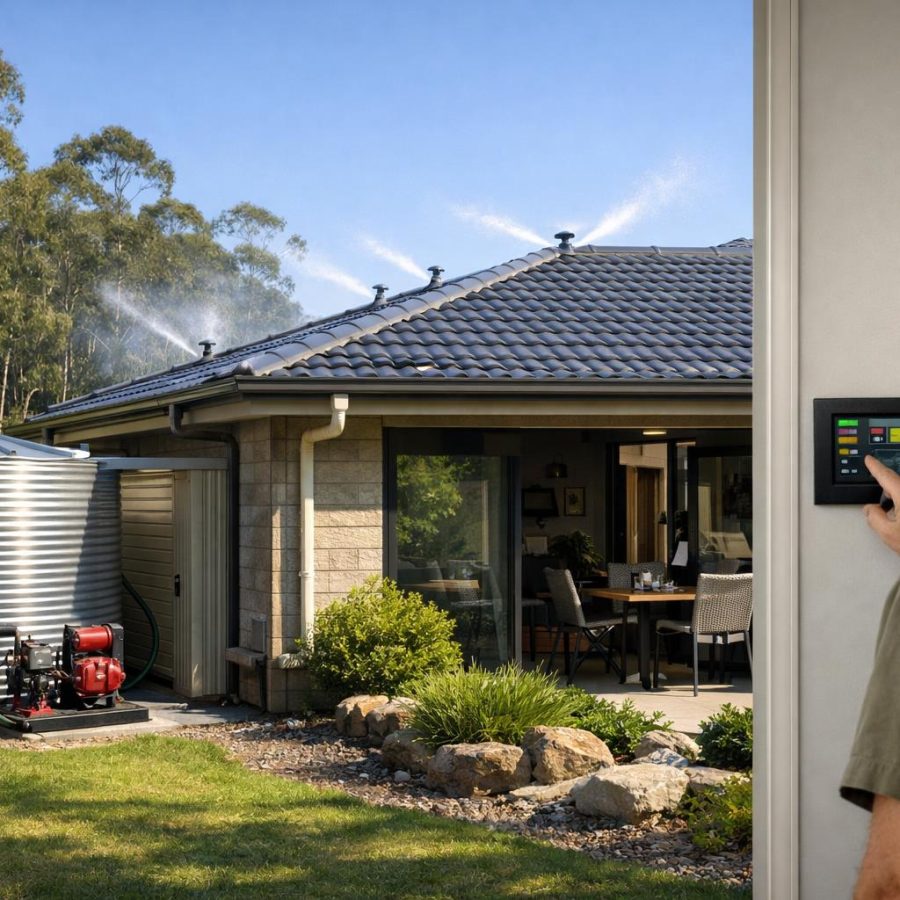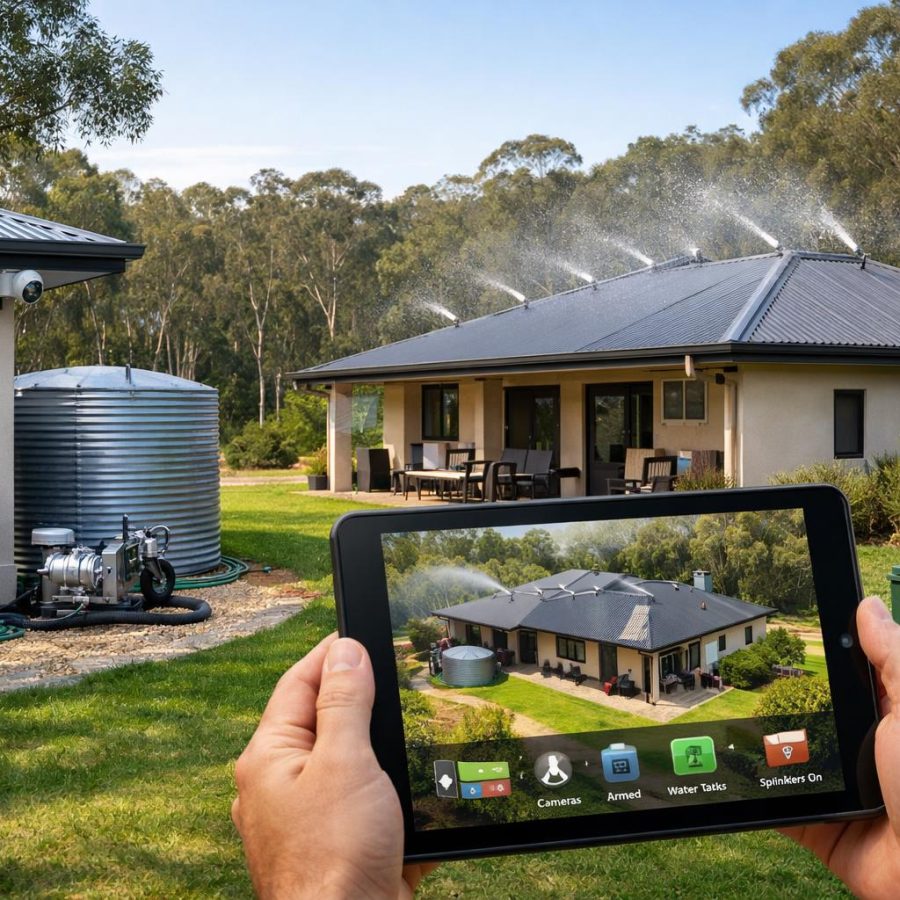
When a bushfire threatens a home, the usual message is familiar: prepare early, keep the property clear, and be ready to defend with hoses, pumps and sprinklers if the fire arrives. This 20-part FireRescue series begins from a different question: can modern engineering and automation substantially reduce the need for ordinary residents to physically fight a bushfire around their own home?
Why this series starts with a different question
Many bushfire safety messages place a heavy burden on the resident. In practice, that means a homeowner may be expected to stay alert, interpret changing conditions, start pumps, manage hoses, protect gutters, activate sprinklers, keep watch for ember attack and make fast decisions while smoke, wind and heat are increasing. That is a tall order, especially when roads may be blocked, visibility may be poor and power or communications may fail.
This series explores an alternative idea: an Integrated Residential Bushfire Protection System. The concept is not a promise that a house can be made fire-proof. It is not a shortcut around planning, maintenance or good land management. It is a research and engineering concept aimed at reducing the need for residents to become front-line defenders of their own property when a bushfire arrives.
The core idea is simple. The homeowner should not need to become a firefighter when a bushfire arrives.
That idea matters because bushfire protection should be designed as a system, not treated as a single device. A roof sprinkler alone is not enough. A pump alone is not enough. A water tank alone is not enough. Real resilience comes from layers working together: building design, ember protection, defendable space, dedicated water, automated pumps, smart sprinkler zoning, sensors, backup power, positive internal pressure, cameras, remote monitoring and redundant controls.
What the Integrated Residential Bushfire Protection System is meant to do
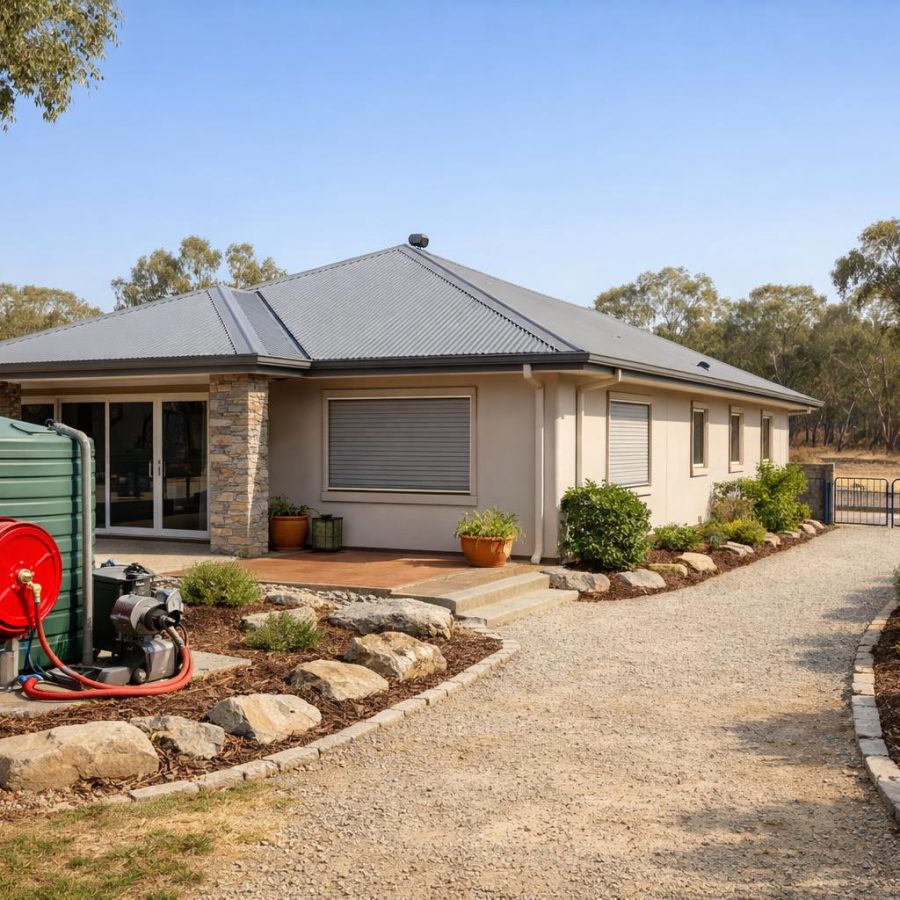
The proposed system is intended to protect a house, other buildings on the property and the immediate surrounding ground. It is not designed to wet the entire property, and it should not be understood as a substitute for broader landscape management. The goal is practical protection where it matters most: the dwelling, attachments, access points, vulnerable openings and the immediate area where ember attack can ignite fuels and create secondary fire spread.
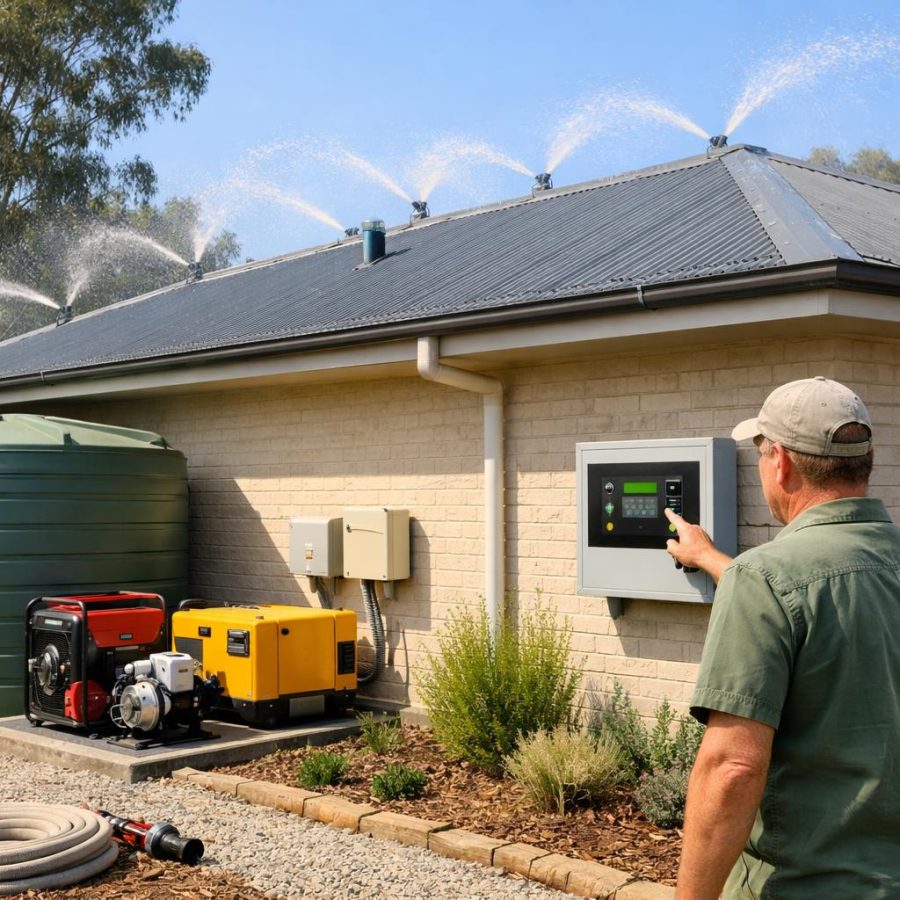
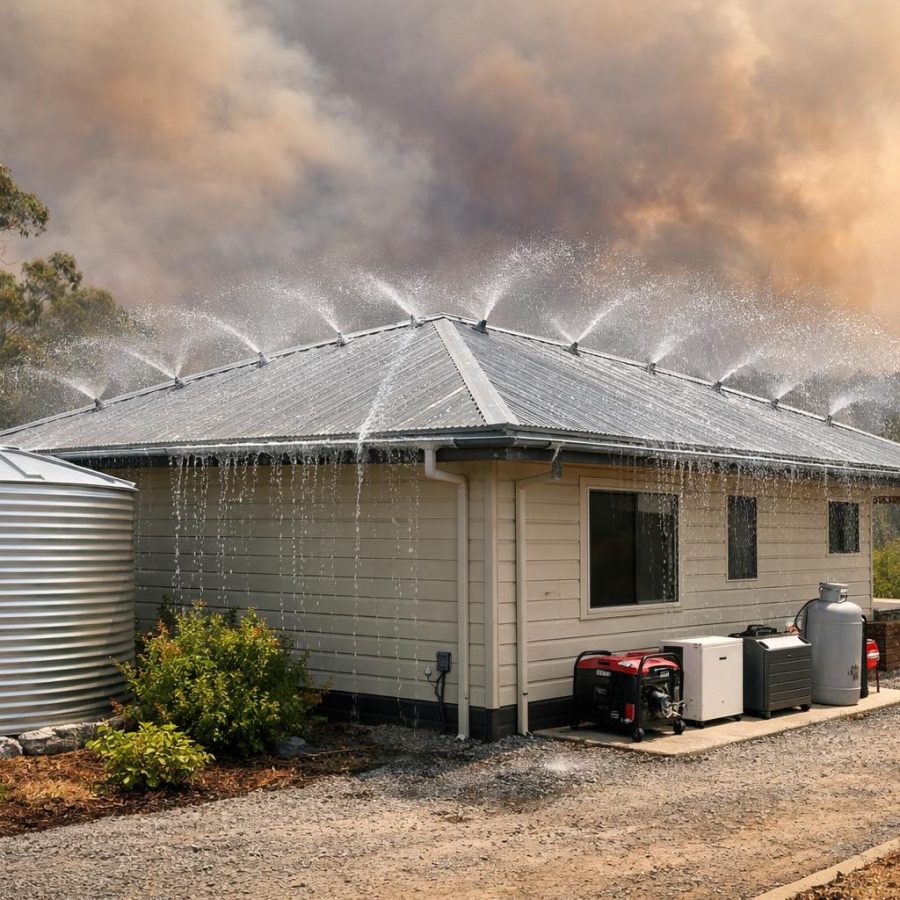
At a high level, the concept combines permanent passive protection with automatic active protection. The passive side includes things that are built in and always present, such as ember-resistant construction details, screened openings, suitable roof and wall design, protected vents and a well-prepared defendable space. The active side includes systems that can respond automatically when conditions worsen, such as smoke and heat detection, local weather sensing, zone-based sprinklers, gutter wetting, water pumping and ventilated smoke management.
The system is designed to detect smoke and heat, determine where the threat is likely coming from and activate the relevant protection zones. If the fire approaches from one side of the house, the system should not waste water treating every zone equally. Instead, it should use available sensor inputs, wind direction and local conditions to prioritise the most exposed areas while preserving water for continued operation.
This is an important distinction from conventional residential sprinkler ideas. A basic sprinkler setup may be useful, but the proposed concept goes further. It is an integrated engineered protection system with decision logic, redundancy and independent layers of defence.
Because bushfires are unpredictable, the system must be designed to keep working when the usual lifelines fail. Mains power may fail. Mains water may fail. Mobile coverage may fail. Internet access may disappear. The proposed system must still be able to protect the property locally and automatically.
Why layers matter more than a single solution
Bushfire loss is rarely caused by just one thing. Ember attack can enter roof spaces, collect in gutters, ignite mulch or lodge in small gaps. Radiant heat can break down materials and dry out fuels. Flame contact can then spread fire to other parts of the structure. Wind can drive embers further and create sudden changes in fire behaviour. If one line of defence fails, the next layer matters more.
That is why the series begins with the principle of multiple layers rather than dependence on a single device. An ordinary homeowner might be tempted to think of sprinklers as the answer, but sprinklers are only one part of a larger picture. They need water. They need power. They need controls. They need protection from damage. They need a sensible response strategy. They also need the rest of the house to be built and maintained in a way that makes their job possible.
The same is true for water tanks. A large tank is useful, but it is not enough if the pump fails, if the power fails, if the controls fail or if the tank is too easy to lose to heat or debris. The same is true for sensors. Good sensors can improve decision-making, but sensors alone do not stop embers entering eaves or fuel building up under a deck.
In practical terms, a layered system may include:
- resilient building materials and construction details that reduce ember entry
- defendable space and fuel management around the house
- a dedicated firefighting water supply
- automatic pumping with battery and generator backup
- independently controlled sprinkler zones
- automatic gutter wetting
- positive-pressure filtered ventilation to reduce smoke entry
- backup controllers and redundant control paths
- local and remote monitoring for status and awareness
- clearly defined unattended operation when residents leave early
This layered approach is consistent with a sensible bushfire mindset. If one measure is compromised, others should continue to provide protection. The aim is not perfection. The aim is resilience.
Defendable space remains fundamental
No automatic system can ignore the land around the house. Defendable space and fuel management remain fundamental because they reduce the intensity of exposure before the fire reaches the building. If bark, mulch, long grass, leaf litter, timber stacks and flammable clutter are close to the structure, then even a sophisticated system is working uphill from the start.
For this reason, the proposed system does not replace property maintenance. It depends on it. A well-managed immediate area around the house gives sprinklers, gutter wetting and passive building measures a better chance to work. It also reduces the number of ignition sources that embers can exploit.
That does not mean the whole property must be transformed into a bare, sterile zone. The concept is about the immediate surroundings that matter most during bushfire exposure. It should be practical, proportionate and suited to the site. The key point is that property preparation and automation must support each other.
In the 20-part series, we will examine how defendable space interacts with the rest of the system. We will also look at the difficult question of how much maintenance is realistic for ordinary households. If a system depends on perfect landscaping and flawless upkeep, it may not be truly resilient. If it can tolerate some imperfection while still offering useful protection, it may be more realistic.
Protecting a home in bushfire conditions is not just about defeating flame. It is about reducing ignition opportunities, slowing fire spread and keeping critical systems operating long enough for the danger to pass.
How the proposed water system is meant to work
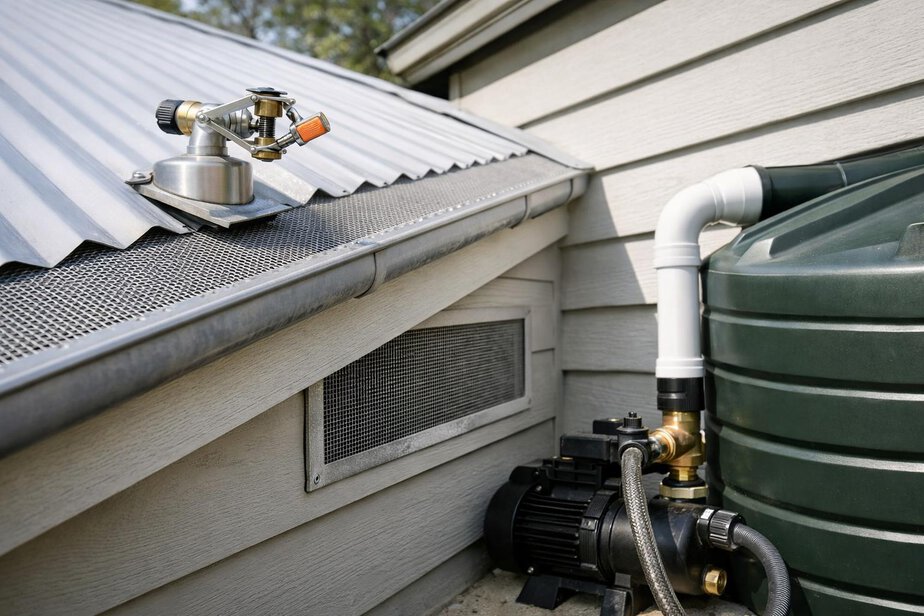
Water is central to the concept, but the design philosophy is important. The proposed system always draws firefighting water from a dedicated tank. Mains water is used only to top up that tank when available. That distinction matters because a bushfire may affect water supply, pressure and infrastructure very quickly. If the firefighting system depends directly on mains water, it may fail at exactly the wrong time.
Rainwater harvesting helps maintain the dedicated firefighting supply. Optional dams or swimming pools may provide secondary water sources, depending on site conditions and professional design. Those secondary sources should be understood as backups, not the primary plan. The primary plan remains a dedicated tank reserved for emergency protection.
The water system also needs protection from the fire itself. A tank is only useful if it remains accessible and connected to functioning pumps and controls. That means the entire water chain needs attention: storage, inlet arrangement, pumping, filtration, pipe routing, valve design and protection of exposed components.
In simple terms, the design challenge is not just storing water. It is making sure the water can still be delivered under stress.
| Layer | Purpose | Example role in the concept |
|---|---|---|
| Dedicated tank | Primary firefighting supply | Provides reserved water when mains supply is unavailable |
| Rainwater harvesting | Top-up and storage support | Helps keep the dedicated tank full over time |
| Optional secondary source | Backup water access | May assist if the main tank is compromised |
| Automatic pumps | Water delivery | Moves water to sprinklers and wetting zones |
| Protected pipework | System survival | Reduces damage from heat, debris and impact |
Later articles in the series will examine the advantages and weaknesses of this water strategy. Questions will include tank sizing, refill logic, pump reliability, blockage risk, winter maintenance and what happens when the fire threat lasts longer than expected.
Why ember protection is at the centre of the concept
Ember attack is a major cause of house loss and must be addressed through permanent building protection. That principle sits at the heart of the series. If embers can enter roof spaces, collect in sheltered corners, ignite debris in gutters or pass through gaps in the building envelope, then the house remains exposed even if sprinklers are available.
For that reason, the proposed system prefers permanent passive ember protection over complicated automatic shutters and vents. Passive measures are always there. They do not need a command signal. They do not depend on a motor starting. They do not require a resident to decide whether the threat is serious enough. They simply do their job if designed and installed correctly.
That does not mean all automated features are unnecessary. It means the first line of defence should be robust, simple and durable. Automatic systems can then support those permanent measures rather than carrying the entire burden.
Examples of passive ember protection in the concept may include protected openings, screened cavities, resistant detailing around joins and edges, appropriate roof design and attention to common ember traps. The series will explore how these features can work together with the active components of the system.
What makes the system more than a conventional sprinkler installation
A conventional residential sprinkler setup usually focuses on one or two elements: water delivery, roof wetting or external suppression. The proposed Integrated Residential Bushfire Protection System is broader. It is intended to think and act as a whole-property protection strategy, not a simple add-on.
The system uses smoke and heat sensors as its primary local fire detection tools. Local weather monitoring adds temperature, humidity, wind speed and wind direction. Sprinklers are divided into independently controlled zones. The system then uses the detected conditions to decide which zones need protection, how urgently they need it and how much water should be preserved for later use.
That means the system should be able to make more nuanced decisions than a simple on/off arrangement. It may not need every zone to activate at once. It may need to respond differently on the windward side of the house than on the sheltered side. It may need to wet gutters aggressively while preserving water elsewhere. It may need to manage the immediate ground around the building rather than try to drench the whole site.
There is also a smoke-management element. A filtered positive-pressure ventilation system is proposed to reduce smoke entering the house. This matters because smoke can make a house unsafe long before flame arrives. But ventilation systems can also fail, so they too need backup planning, sensible design and clear expectations.
In other words, the concept is not a single machine. It is a coordinated system of measures that must work together under stress.
How the system is intended to keep working when things fail
One of the most important design goals is continued operation during infrastructure failure. Bushfires often damage the very services people normally rely on. Power can fail, water pressure can collapse, roads can close and mobile towers can go offline. A protection system that collapses with those services is not resilient enough.
The proposed minimum design objective is two hours of autonomous operation without mains electricity, mains water, mobile coverage or external assistance. That is a modest but meaningful benchmark. It does not guarantee survival in a severe bushfire. It simply sets a baseline for systems that are expected to function independently for a short but critical period.
To help achieve that goal, the concept includes:
- electric firefighting pumps supported by battery backup
- an automatically starting generator for extended support
- two independent controllers to provide redundancy
- essential fire systems with priority power supply
- automatic disconnection of non-essential household loads
- loss-of-comms tolerance so the system keeps working offline
These features are not luxury extras. They are part of the logic of resilience. If a bushfire has the potential to cut power, the system cannot rely on a single battery or a single controller. If communications fail, the system must continue to act locally. If one control path is damaged, the other should keep going.
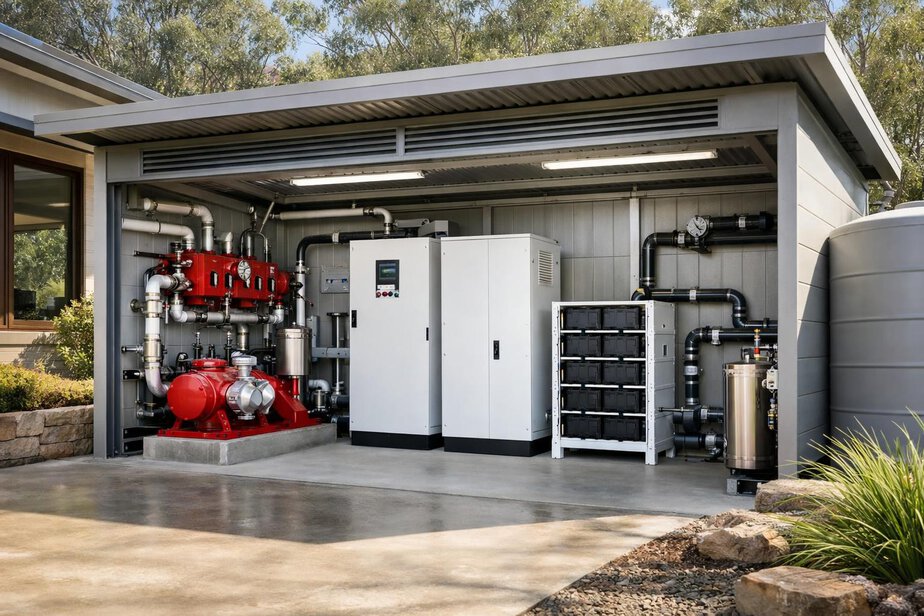
That is also why the concept emphasises protected equipment enclosures. Pumps, controllers and other critical components should be housed in a suitable fire-resistant plant enclosure so they are less exposed to radiant heat, flame, embers and physical damage.
Why monitoring, alerts and simple controls matter to residents
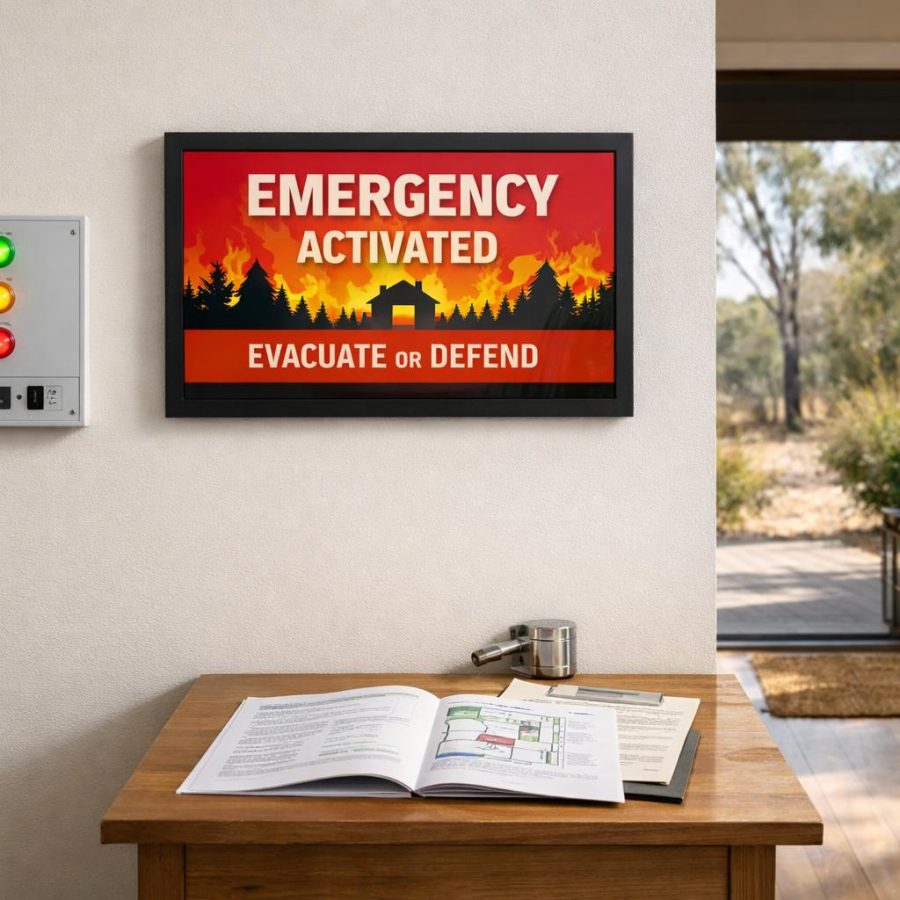
Homeowners do not need a complicated dashboard filled with technical jargon. They need a clear understanding of the system’s condition. That is why the concept includes a simple Green / Amber / Red interface. Green means the system is ready. Amber means attention is required or protection is reduced. Red means the system is not operating as intended and action is needed.
This simple display is important because ordinary residents may not be engineers or technicians. They need a clear and practical status signal, not a maze of fault codes. The same principle applies to cameras and remote monitoring. External cameras can allow residents to monitor the property locally or remotely, but the cameras are there to inform decisions, not to replace the automatic protection systems.
The system should also include scheduled self-testing. Automatic checks of major components help reveal problems before bushfire season. That might include pump tests, controller checks, sensor health checks, valve tests and backup power checks. The purpose is to move fault detection earlier, when there is still time to fix a problem.
At the same time, the system must not become dependent on internet access or mobile coverage for core operation. Remote monitoring is helpful, but a bushfire-safe system cannot stop working just because a signal is lost. Automatic protection must remain local, autonomous and dependable.
For residents, the practical advantage is peace of mind that does not depend on constant manual intervention. The home is designed to do what it can on its own, while the resident focuses on evacuation, safety and decision-making rather than trying to fight the fire from the veranda.
What happens in Catastrophic conditions
The series draws a firm distinction between a property’s Bushfire Attack Level and the Fire Danger Rating for the day. These are different concepts and they should not be confused. BAL relates to building exposure and design considerations. Fire Danger Rating reflects the conditions and expected behaviour of bushfire on that day. Both matter, but they answer different questions.
When the Fire Danger Rating reaches Catastrophic conditions, the advice for residents is to leave early. That remains the safest choice. Catastrophic conditions can involve more than flame. They can include extreme wind, falling trees, flying debris, dust, infrastructure failure and blocked roads. Even a well-designed home may not be a safe place to remain if access routes become dangerous or emergency services cannot help in time.
Under this concept, the property would then switch to an automatic Unattended Protection Mode. The resident leaves early, and the home continues protecting itself without requiring anyone to stay behind and fight the fire. This is a crucial part of the philosophy. It recognises that self-defence by residents is not always realistic or safe.
Unattended Protection Mode does not mean the house is invincible. It means the system shifts to automatic operation using its available layers of defence while the residents prioritise personal safety. That mode is intended to buy time, reduce ignition risk and maintain the best possible level of protection under severe conditions.
Future articles in the series will examine how such a mode might be triggered, how false alarms are avoided, what happens if the resident has already left and how the system balances protection with water conservation during prolonged danger.
Why this series is about both benefits and weaknesses
The question driving the whole series is not whether advanced protection sounds useful. It does. The real question is whether modern engineering and automation can substantially reduce the need for ordinary residents to physically fight a bushfire around their own home.
That question has to be tested honestly. The system may have clear benefits: better automatic response, improved resilience to power failure, less dependence on frantic manual action, more targeted water use and a better chance of protecting the house long enough for the fire front to pass. It may also have weaknesses: cost, complexity, maintenance burden, sensor errors, power dependencies, water demand, component failure, site-specific limitations and the possibility that a severe event overwhelms the design.
This is why the 20-part series will not be promotional. It will be investigative. Each article will look at one part of the system, including what can fail, practical limitations, maintenance, cost and whether current technology can realistically achieve the intended level of protection. The series will also examine how current Australian research, guidance and standards inform the concept without pretending they provide a simple answer.
That evidence-based approach matters. A bushfire safety idea should be judged by what it can actually do, not by what people hope it might do in theory. It should also be judged in the context of Australian conditions, because bushfire behaviour, housing design and emergency planning are shaped by local realities.
The series therefore aims to be practical, balanced and easy to understand. It will speak to ordinary homeowners, not just engineers. The technical content will be translated into plain language, with the focus kept on real-world usefulness.
What readers can expect from the 20-part FireRescue series
This introduction begins a broader examination of the Integrated Residential Bushfire Protection System concept. Across the series, we will look at the major building blocks one by one. That will include building envelope protection, ember control, water supply, pumps, controls, sensors, ventilation, zoning logic, backup power, monitoring, resilience, maintenance and the practical realities of keeping the whole system ready for summer.
The series will also keep returning to the same central question: can the home itself carry more of the protective load, so the resident is not forced into dangerous physical defence during the most volatile part of the event?
To answer that properly, the series will examine questions such as:
- Which parts of the system are realistic with current technology?
- Which parts are likely to be expensive or hard to maintain?
- Which failures are acceptable and which are not?
- How much protection can be delivered before the system becomes too complex?
- What should be automatic, and what should remain manual?
- How should the design differ between ordinary bushfire seasons and Catastrophic conditions?
The intention is not to suggest that every home can be transformed in the same way. Some properties will be much easier to protect than others. Site slope, vegetation, access, existing construction and local water availability all matter. The system may be more realistic for some homes than for others. That is part of what the series will explore.
Even so, the central design challenge remains valuable. If a home can be made substantially more resilient through good design and automation, then the burden on residents may be reduced at the exact time when they are least able to manage it manually.
Conclusion: a better question for bushfire home protection
The Integrated Residential Bushfire Protection System is best understood as a serious question, not a finished answer. It asks whether a home can be designed to automatically detect danger, protect itself in layers, keep operating through common failures and continue doing so long enough to make a real difference for residents.
That is a worthwhile question because it challenges an old assumption: that the resident must always be the final and most active line of defence. In some situations, that may be unrealistic, unsafe or simply too much to ask. A smarter home may not remove all risk, but it may reduce the need for a homeowner to become a firefighter when a bushfire arrives.
At the same time, the limits must stay clear. The concept does not make a house bushfire-proof. It does not remove the need for defendable space, maintenance, evacuation planning or early departure in Catastrophic conditions. It does not replace professional design or proper assessment.
The value of this 20-part series is that it will test the concept properly: what works, what does not, what can fail and what is practical for ordinary Australian homes. That is the right way to approach a bushfire safety idea that is ambitious, useful and potentially important.
Before publication or implementation, verify facts, local procedures, current research and professional advice for your area. Bushfire risks, standards and emergency guidance can change, and every property needs site-specific assessment.
FireRescue Training Hub
Access practical fire and emergency study support resources, downloads, checklists, audio guides, and member-only course content.
- Course library
- PDF downloads
- Audio guides
- Checklists
Study support only. Not accredited training or a replacement for workplace procedures.
About the author and safety review
Ken Walker
Former Station Officer and fire service educator
Former career firefighter with extensive career and volunteer fire service experience.
Qualifications: Associate Diploma of Applied Science in Fire Technology; Institute of Fire Engineers studies.
Author profilehttps://www.firerescue.com.au/about-us/