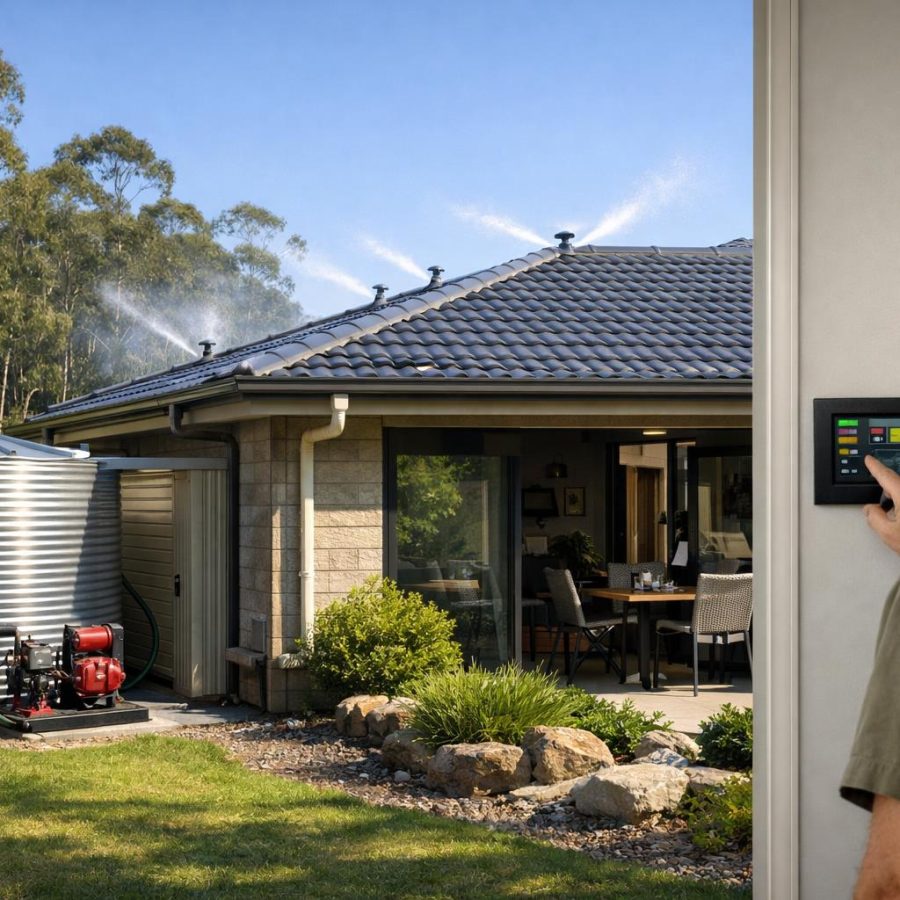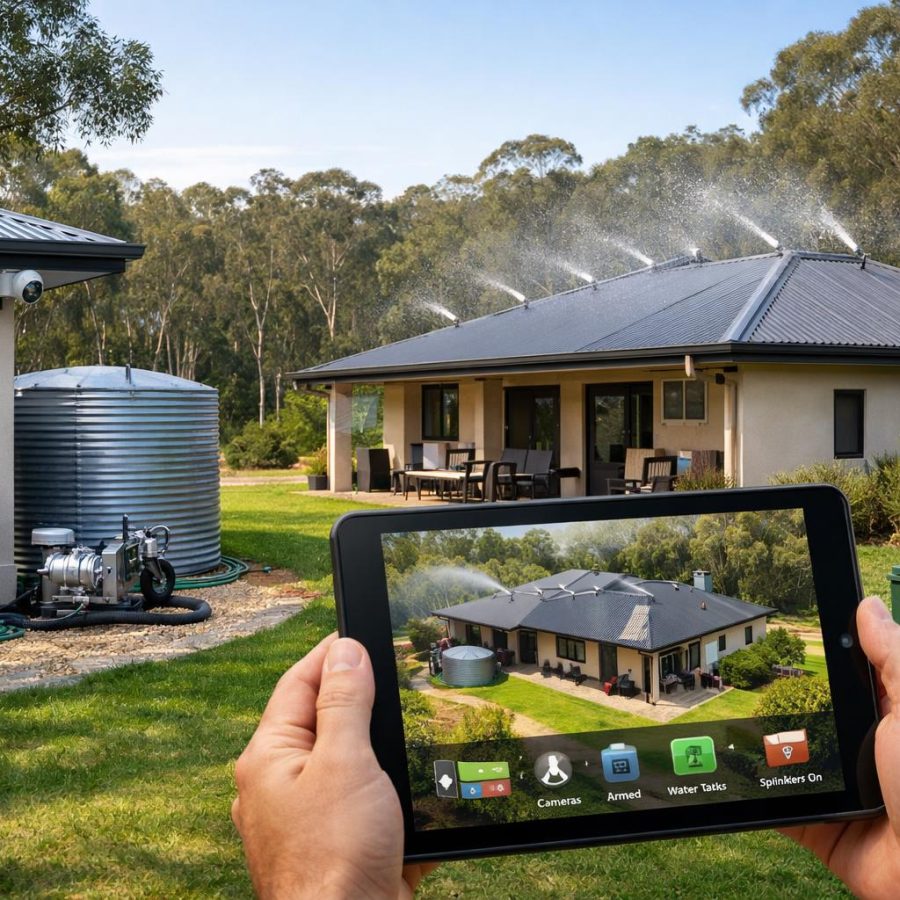
This article gives the big picture of an Integrated Residential Bushfire Protection System. The idea is simple: the home should detect a bushfire threat, work out what matters, activate the right protection layers and keep the resident informed in a clear way. The complicated engineering should happen in the background, so ordinary homeowners are not expected to manually fight fire around the property.
Why this system is more than a roof sprinkler setup
An Integrated Residential Bushfire Protection System is not just one device or one pipe network. It is a coordinated set of protection layers designed to reduce the amount of manual firefighting a resident would otherwise need to do. That matters because in a fast-moving bushfire, there may be very little time, poor visibility, falling embers, strong wind and limited access to outside help.
The aim is not to promise that a house is fireproof. No system should claim that. The aim is to improve readiness, reduce ignition risk and keep protection working for as long as possible under harsh conditions. The final design must always suit the property’s bushfire exposure, BAL, construction type and surrounding environment.
In this series, the later articles will look at individual components in more detail. This article is the overall architecture article. It explains how the system fits together so that each later part makes sense in context.
The five-stage logic: Detect, Think, Decide, Act, Inform
The simplest way to understand the system is as a five-stage loop: Detect, Think, Decide, Act and Inform. Each stage has a different job, and each one helps reduce delay and confusion when a threat appears.
1. Detect
Detection is the first layer. The system watches for signs of a bushfire threat outside and around the home.
2. Think
Thinking is the checking layer. Two controllers review the information and compare notes so the system is not relying on only one brain.
3. Decide
Decision-making is where the system works out what level of threat is most likely, which areas need priority and how to use limited water and power wisely.
4. Act
Action is where the system starts pumps, opens zones, wets gutters, supports air protection and manages backup power and alarms.
5. Inform
Information is the homeowner interface. It should be very simple, showing whether the property is ready, needs attention or has reduced protection.
These five stages matter because bushfire response is not only about spraying water. It is about detecting early, deciding carefully and preserving protection for as long as possible.
Detect: the system watches for more than smoke
Standard external detection should include smoke sensors, heat sensors, temperature, humidity, wind speed and wind direction. These inputs work together. One measurement alone may not tell the full story, but several together can paint a much clearer picture of threat.
Smoke sensors can pick up early signs of combustion. Heat sensors can detect unusual temperature rises near vulnerable areas. Temperature trends help show whether conditions are rapidly becoming more dangerous. Humidity matters because very dry air can make fire spread more easily. Wind speed and wind direction are essential because they influence ember attack, flame spread and which side of the building is most at risk.
Thermal cameras can be presented as an optional upgrade. They may help identify hotspots or fire movement, but they should not be treated as the only critical detection method. The base system should still function without them.
The basic detection logic is intentionally conservative:
- One sensor detecting a possible threat places the system into Alert Mode.
- Two or more confirming inputs can trigger Full Fire Mode.
For example, smoke plus heat may indicate a real threat. External smoke combined with a rapidly increasing temperature may also justify stronger action. This approach is intended to provide early warning while reducing unnecessary activations from dust, insects, weather quirks or isolated sensor noise.
Think: two controllers cross-check each other
The system should use two independent controllers. Both controllers continuously operate and compare their readings and decisions. This is a key safety feature because any complex system can fail, become confused by bad data or behave oddly if one part stops working correctly.
If one controller fails, provides abnormal information or disagrees with the other, the system should default towards the safer protective action rather than delaying protection. In a bushfire context, hesitation can be dangerous. A cautious response is usually better than waiting too long.
The homeowner should also be warned that a controller disagreement or fault has occurred. That warning matters because it tells the resident that the system is still trying to protect the property, but it is no longer operating at its preferred level of confidence.
This is a practical balance. The system should not require the resident to interpret controller messages or guess which one is right. If there is disagreement, the system should protect first and report the fault clearly.
Either controller must be capable of maintaining protection if the other fails. That means the architecture is built for resilience, not single-point dependence.
Decide: the system chooses where protection matters most
A good bushfire protection system does more than simply turn everything on. It should evaluate the threat and manage resources intelligently. The decision layer looks at location of detected smoke or heat, heat intensity, wind direction, confirmed wind changes, available tank water, water consumption, pump status, resident occupancy, overall system readiness and other local conditions.
This is where the system starts to prioritise. A zone close to the detected threat may need earlier or longer protection than a lower-risk area. If the wind is carrying smoke and embers towards one side of the house, that side may need to become the priority. If heat intensity rises sharply in one area, the system should respond to that change rather than treating all zones the same.
Sprinkler priority should be determined using the combination of sensor location + wind direction + heat intensity. That combination gives a more realistic picture than any one input alone.
Wind changes should not cause constant switching every time a brief gust passes through. Instead, wind direction changes should be confirmed for a short period before sprinkler priorities are changed. That helps the system avoid unstable behaviour and unnecessary zone swapping.
Water conservation in stages
Water is a limited resource, so the system should manage it in stages rather than using it all at once. A practical sequence is:
- Reduce operating time of lower-priority zones.
- Reassess fire threat and tank level.
- Stop lower-priority zones if necessary.
- Maintain protection to the highest-threat areas for as long as possible.
This approach helps keep the most important areas protected for the longest possible period. It also reduces the chance that the system uses up its stored water too quickly at the start of an incident.
The same logic applies to power. The system should know what electrical power is available, whether pumps are running correctly, whether backup power is active and whether load shedding is needed to preserve critical functions.
| Decision factor | What it tells the system | Why it matters |
|---|---|---|
| Smoke or heat location | Where the threat may be strongest | Helps choose the most important zones |
| Wind direction | Where smoke, embers or flame may travel | Helps protect the exposed side of the property |
| Heat intensity | How severe the threat may be | Helps decide how strongly to respond |
| Tank water | How long the system can keep operating | Supports water conservation decisions |
| Pump and power status | Whether the system can keep working | Prevents silent failure |
Act: the system responds automatically in the background
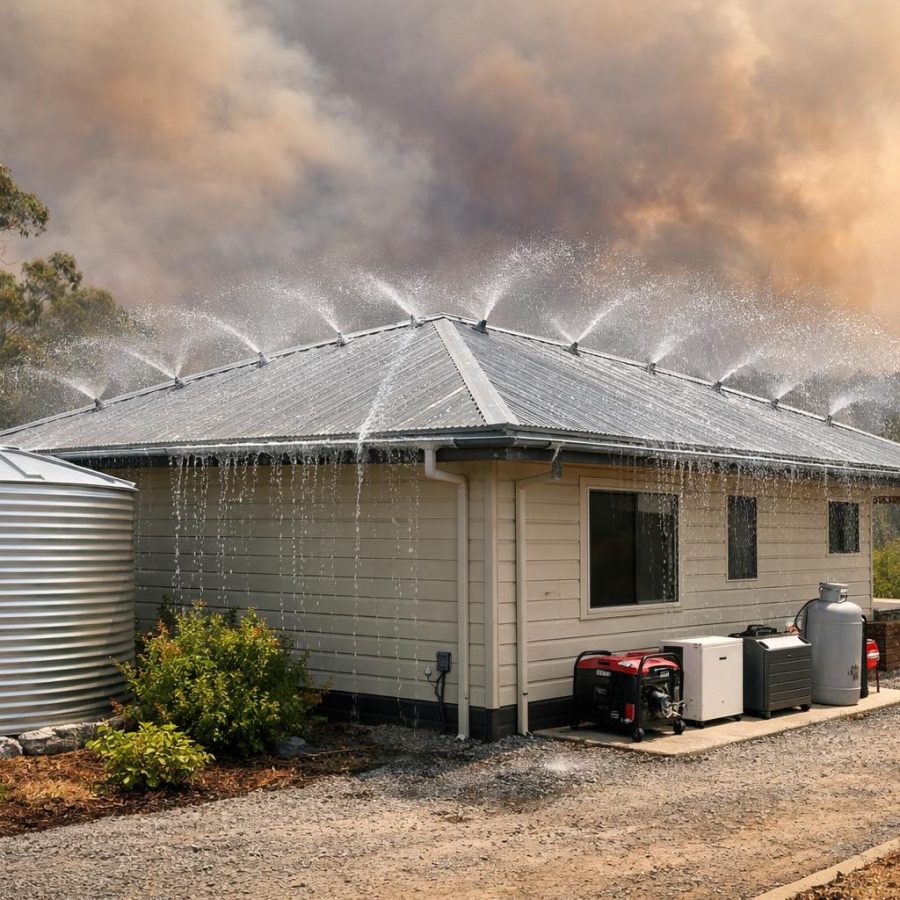
Once the system has detected a credible threat and made its decisions, it should act automatically. The goal is to reduce the amount of manual firefighting expected from residents. That means the system needs to control several protection layers without waiting for someone to stand outside and make hard choices in a dangerous situation.
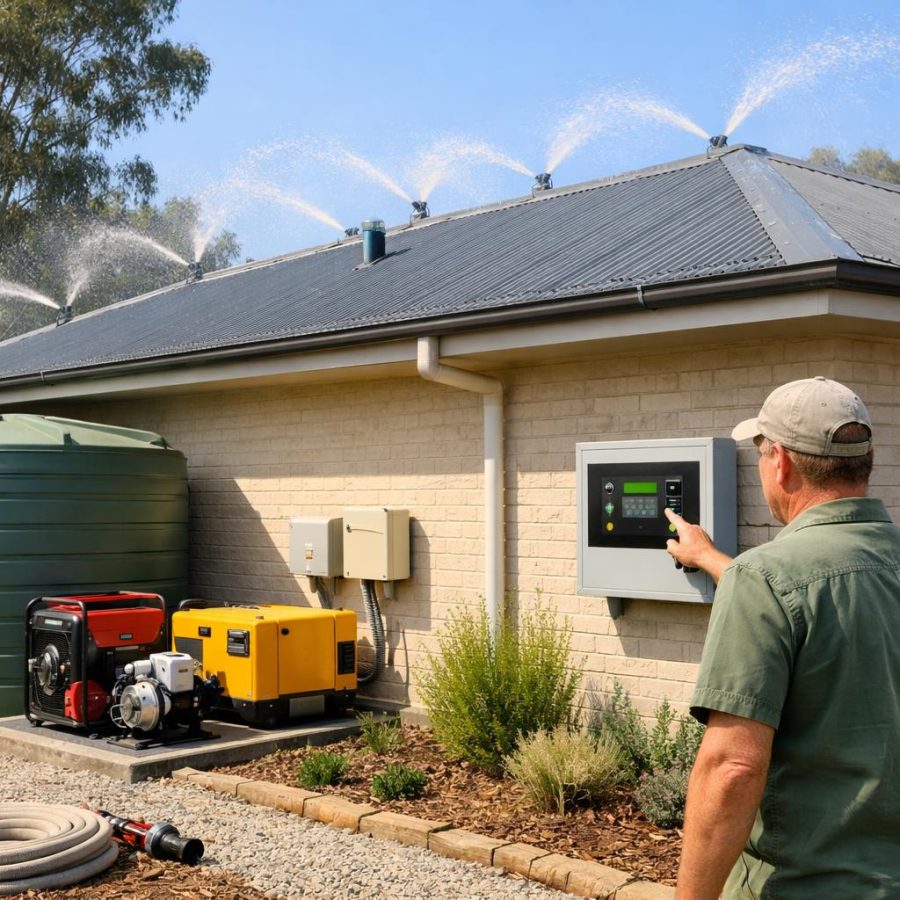
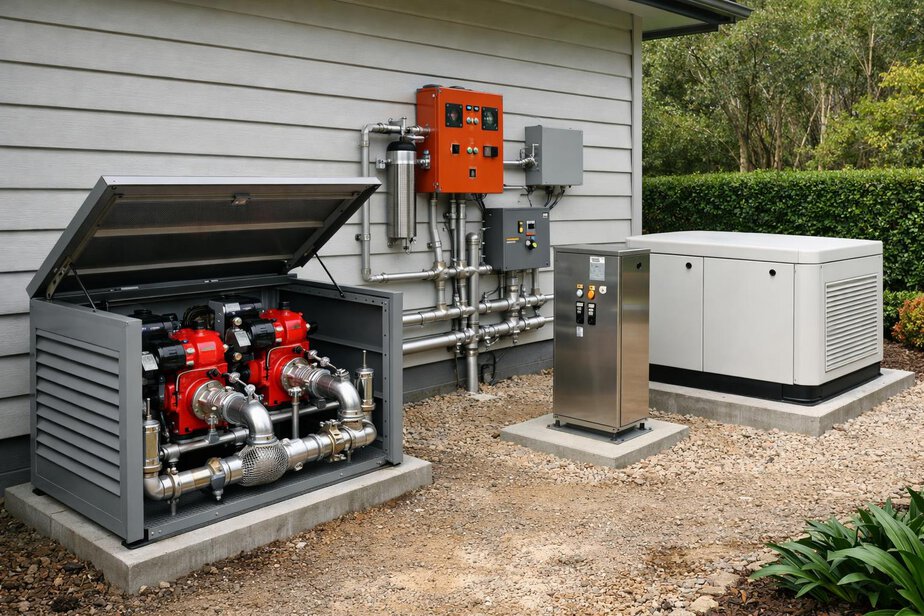
Automatic actions can include electric firefighting pumps, individual sprinkler zones, gutter wetting, immediate ground protection, electrical load shedding, battery backup, automatic generator, positive-pressure filtered air system, audible warnings, mobile notifications, external emergency controls and a firefighter interface.
Each of these has a different role. Pumps supply the pressure. Sprinkler zones protect different parts of the building envelope. Gutter wetting can help reduce ignition risk around vulnerable edges. Ground protection may help reduce ember impacts and local ignition near the building. Load shedding helps preserve power for critical equipment. Backup power and generators support continuity when mains electricity fails. Audible warnings and notifications tell people what is happening. A firefighter interface can help trained and authorised responders understand the system status quickly.
Positive-pressure filtered air protection should start when external smoke is confirmed near the house, rather than waiting until the fire front arrives. This is an important design point. Smoke infiltration can be a major problem well before flames are close, so air protection should not be delayed unnecessarily.
Fire protection itself should operate the same whether residents are at home or away. Occupancy mainly changes alerts, remote controls and resident instructions. In other words, the core bushfire response should not depend on whether someone happens to be present to press a button.
Automatic protection should also include manual override. That does not mean the resident must micromanage the event. It means the system should allow a trained person to adjust or isolate functions if the situation requires it.
Inform: the homeowner sees a simple status, not a technical maze
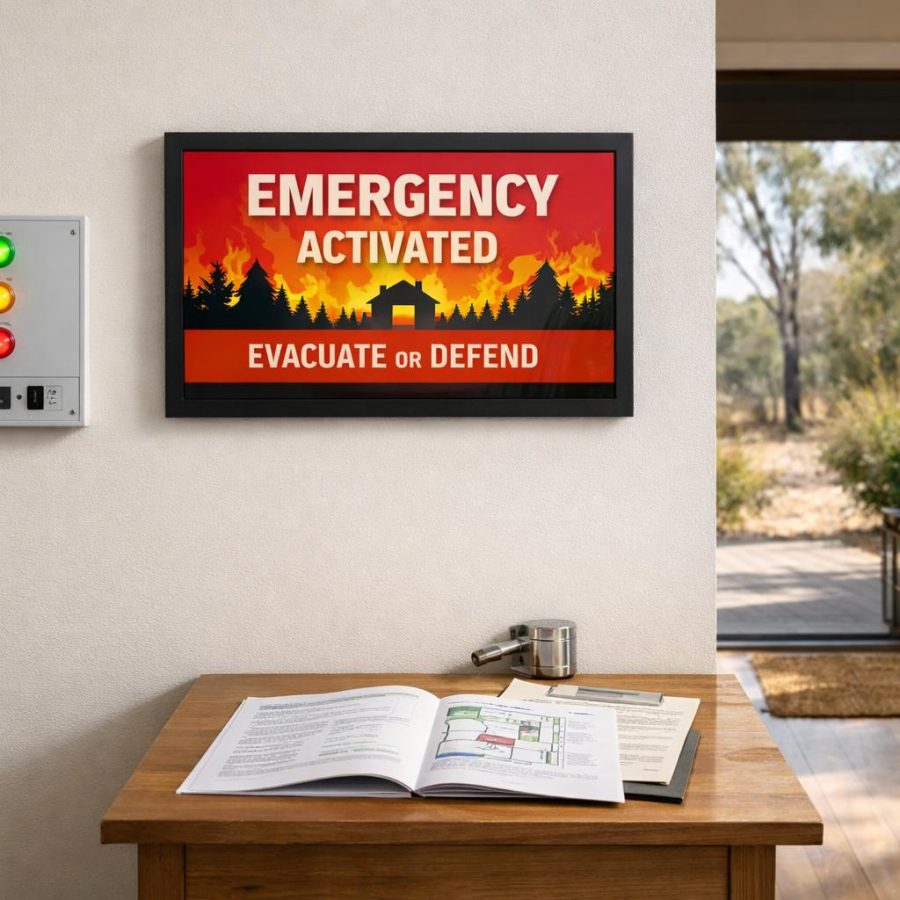
The homeowner interface should be extremely simple. It should not be a wall of numbers, graphs or technical alerts. It should tell the resident only what they need to know: whether the system is ready, whether attention is needed, or whether protection is reduced.
The recommended colour status is:
- GREEN — READY
All critical systems are available and the property is ready. - AMBER — ATTENTION REQUIRED
The system can still operate, but maintenance, reduced capacity or another issue requires attention. - RED — PROTECTION REDUCED / SYSTEM FAULT
A critical system has failed or the property is no longer capable of providing its intended level of protection.
This colour must represent overall system readiness, not just whether one fault exists. It should take into account water, pumps, power, backup power, sensors, controllers, sprinkler zones, communications, critical equipment and current environmental conditions.
That is important because a house can look fine from one angle and still have a hidden limitation. For example, a tank may be full but a pump may be unavailable, or the sensors may be working but the backup power may be down. The resident should not have to piece that together manually.
When a problem is detected, the interface should provide a simple explanation in ordinary language. The resident should know whether the issue is minor maintenance, reduced capacity or a critical fault that affects protection.
How the system should behave when the resident is home, away or leaving early
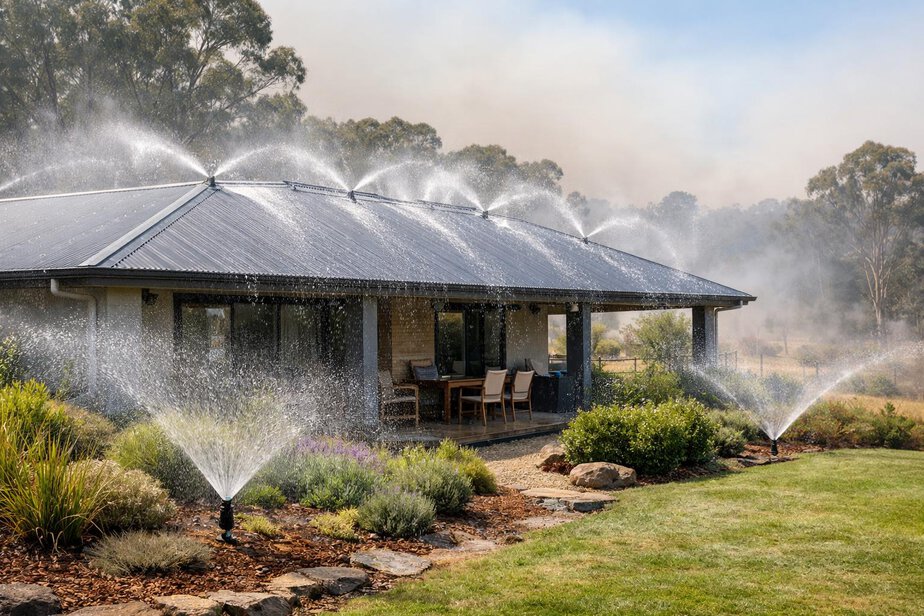
The basic fire protection logic should remain essentially the same whether residents are home or away. The system should not become a different machine just because someone is present. Bushfire threats do not care whether the house is occupied, so the main protection sequence should stay consistent.
Occupancy mainly changes three things: alerts, remote interaction and instructions to the resident. If the resident is home, the system may need to provide clearer audible warnings and urgent status messages. If the resident is away, it may rely more on remote notifications and automatic operation. If the resident is leaving early, the interface should make it obvious what to do and whether the property has shifted into unattended automatic protection mode.
On Catastrophic Fire Danger days, residents should leave early and the system should change to unattended automatic protection mode. That is a planning decision, not an on-the-day improvisation. The system should then continue operating automatically for as long as it can, without depending on people remaining on site.
The overall design target is at least two hours of operation without mains electricity, mains water, mobile communications or outside assistance. That is not a guarantee of safety or survival, but it is a practical resilience goal that helps the property keep protecting itself during a severe interruption.
How the layers work together in a real event
It may help to imagine a simple sequence. A hot, dry, windy afternoon turns into a bushfire threat. First, the detection layer notices smoke or a sudden heat change. One sensor is enough to move into Alert Mode. The system then starts thinking harder, comparing readings through both controllers and checking whether the evidence is growing stronger.
If a second confirming input appears, such as smoke plus heat or external smoke plus rapidly rising temperature, the system can shift into Full Fire Mode. At that point, the decision layer assesses where the threat seems strongest, which side of the house is most exposed and how much water and power are available.
The act layer then starts the right equipment. Some sprinkler zones may run longer than others. Gutter wetting may begin. Ground protection may be activated. Backup power may come online. Positive-pressure filtered air may start if smoke is confirmed near the house. The resident gets a simple colour status and a clear message about the overall condition.
If one controller fails, the safer response should still continue. If wind changes, the system should confirm the new direction before reprioritising zones. If water drops, the system should protect the highest-risk areas for the longest possible time. If communications fail, local control must still work. The property should keep defending itself even when the outside world becomes unreliable.
Materials, placement and protection of critical equipment
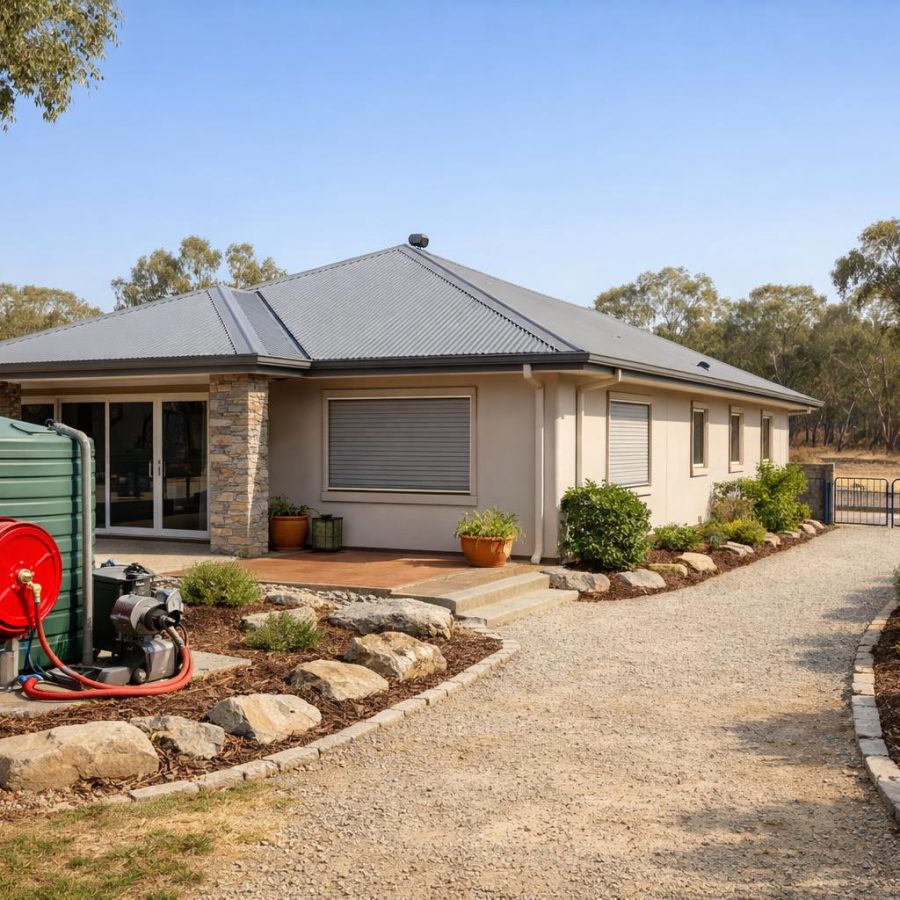
The architecture also depends on where components are installed and what they are made of. Bushfire pipework should use metal or suitably fire-resistant materials. Plastic components should be treated as potential points of failure unless they are specifically protected and suitable for the design.
If plastic water tanks are used, protection should include appropriate sprinkler coverage, separation and/or fire-resistant shielding, walls and roofing. The point is to reduce the chance that the water supply itself becomes vulnerable when it is most needed.
Fire pumps, generators and critical controllers should be installed in a suitably protected or fire-rated plant room or enclosure. That helps shield the most important equipment from radiant heat, embers and flame contact.
The dedicated bushfire tank should be the main water source for protection. Mains water, where available, should only top up the tank. That way the system is not relying on mains supply during the event itself.
These design details are not glamorous, but they matter. A system is only as strong as its weakest exposed part.
What this architecture means for ordinary homeowners
For a homeowner, the main benefit of this architecture is simplicity. You should not need to understand every sensor, relay, pipe or decision rule. You should be able to see a clear status, receive a simple warning when something needs attention and trust that the core protection layers are working automatically.
That is the real purpose of the system. It is not meant to turn residents into fire engineers. It is meant to reduce the burden of manual action when conditions become dangerous. Instead of asking a family member to decide what to do under stress, the system is designed to detect the threat, make the important decisions and activate the appropriate protections in the background.
This does not remove the need for a wider bushfire plan. Residents still need to prepare the property, understand local conditions, leave early when required and follow official emergency advice. But a well-designed integrated system can improve readiness and give the home a far better chance of maintaining protection when time is short.
In the next parts of this series, the individual components will be explored one by one. For now, the main takeaway is that the architecture should be layered, local, automatic, resilient and easy for the resident to understand.
Before publication or installation, verify the design against current local requirements, site conditions and professional advice, and confirm that the final system and procedures suit the property’s actual bushfire risk.
FireRescue Training Hub
Access practical fire and emergency study support resources, downloads, checklists, audio guides, and member-only course content.
- Course library
- PDF downloads
- Audio guides
- Checklists
Study support only. Not accredited training or a replacement for workplace procedures.
About the author and safety review
Ken Walker
Former Station Officer and fire service educator
Former career firefighter with extensive career and volunteer fire service experience.
Qualifications: Associate Diploma of Applied Science in Fire Technology; Institute of Fire Engineers studies.
Author profilehttps://www.firerescue.com.au/about-us/