Australian farm safety • Practical equipment guide
Farm firefighting equipment: the unit matters, but preparation matters more.
A useful Australian guide to slip-on fire units, water tanks, pumps, hoses, vehicle loading, seasonal checks and working safely alongside emergency services.
A farm fire can start in harvested stubble, a hay shed, a paddock, a machine or along a roadside. Having farm firefighting equipment ready can help a properly prepared operator respond to a small, manageable incident. But owning a pump and a tank does not make anyone a trained firefighter, and no private unit can make a dangerous fire safe.
This guide is for Australian farmers, rural property owners, farm workers and people who operate private farm fire units. It explains what equipment is useful, how to check it and where the limits are. The emphasis is simple: prevent a fire first; protect people; call Triple Zero (000); and follow official warnings and responding crews.
If a fire starts
Call Triple Zero (000) immediately for an uncontrolled fire or whenever assistance may be required. Move people away from danger. Never delay leaving to save a vehicle, shed, crop or piece of machinery. Private units are not a substitute for a fire appliance, trained crew or an early-leaving plan.
In this guide
What counts as farm firefighting equipment?
Fire danger ratings and farm planning
What changed in this 2026 update
Expanded guidance on private fire unit limitations, pump selection, vehicle mass and load restraint, cooperation with CFA and NSW RFS, the current national fire danger rating system, seasonal maintenance and practical farm checklists. Previous overconfident instructions and an unnecessary product recommendation have been removed.
What counts as farm firefighting equipment?
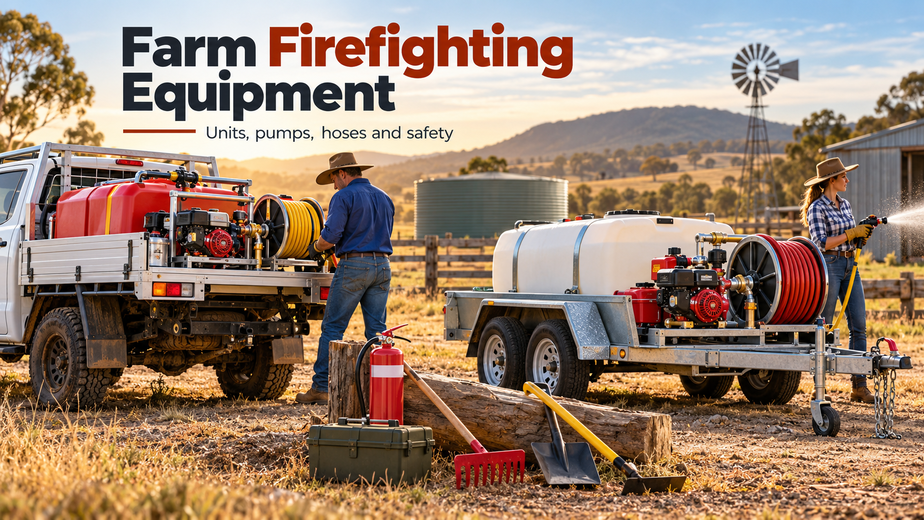
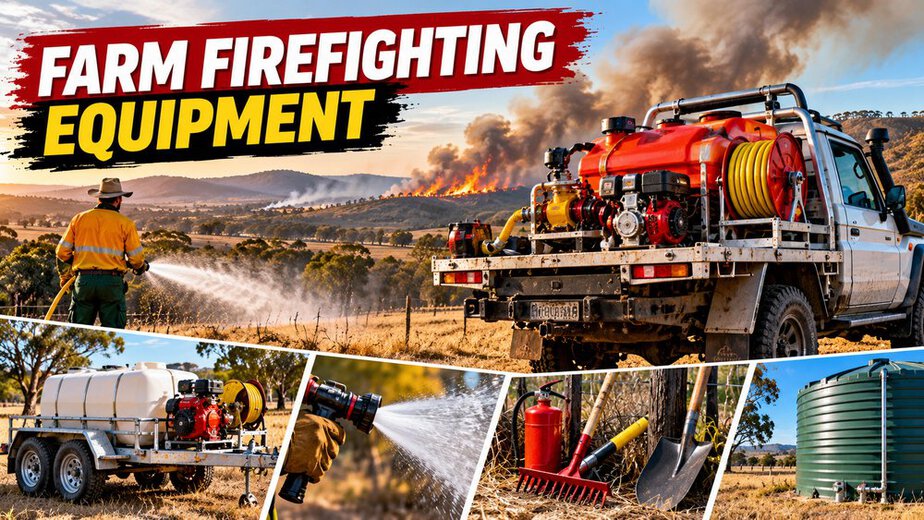
A farm fire unit is generally a privately owned vehicle or trailer with water, a pump and a hose. The equipment might be a small slip-on unit fitted to a ute tray, a larger farm tanker, a trailer-mounted unit or a stationary pump connected to a dedicated tank. Some landholders also use tractors and other machinery for fire prevention or support tasks when it is safe and authorised.
CFA identifies portable firefighting units, slip-ons, tankers, extinguishers and hand tools as useful farm resources. Its advice also stresses that everyone expected to use the equipment needs proper training. See CFA advice on private firefighting equipment.
Slip-on fire unit
A compact water tank, pump and hose mounted on an appropriate ute or truck. Good for planned small-scale work where access, vehicle load limits and escape options have been assessed. The tank and pump must be secured; the vehicle must remain within its permitted mass limits.
Trailer-mounted fire unit
A tank and pump carried by a suitable trailer. Useful when a dedicated vehicle is unavailable, but towing, turning around, surface stability, hitch rating, trailer brakes and total mass become key safety issues.
Stationary firefighting pump
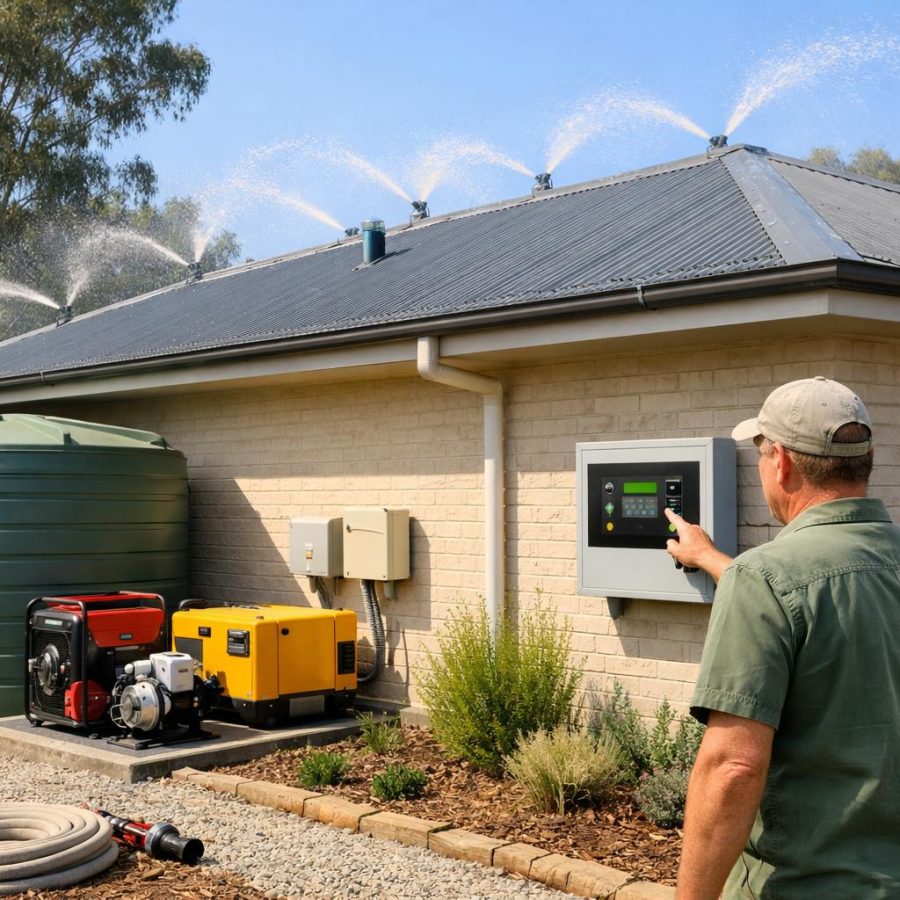
A pump serving a tank, dam or other water source. It needs a dependable power or fuel supply and a safe location. It cannot follow a fast-moving fire and should not be treated as a stand-alone bushfire survival system.
Supporting farm equipment
Appropriate fire extinguishers, hand tools, farm maps, clear access tracks, radios, first aid, personal protective equipment and water supply information. Equipment choice depends on the farm activities and local requirements.
Choosing a farm fire fighting unit: match it to the property
There is no single tank size or pump model that is right for every property. A small lifestyle block has different requirements from a broadacre cropping property, and an orchard may have different water access from a grazing operation. Start with a farm fire risk assessment and speak with your local fire authority before treating any equipment purchase as your protection plan.
Five questions to ask before buying
- What is the actual task? Preventing a machinery fire, providing water for minor spot fires, or supplying firefighters are different applications. Do not choose equipment based on a claimed ability to defend against a major bushfire.
- How much water can you carry legally and safely? Account for the loaded tank, pump, hoses, fittings, vehicle occupants and other cargo.
- Where can the unit travel and turn? Consider driveways, gateways, boggy paddocks, steep slopes, smoke, livestock, fences and trailers.
- Can the pump deliver sufficient usable flow at the nozzle? Compare the manufacturer’s flow/pressure curve with actual hose length, lift and outlet configuration.
- Who will maintain and operate it? Assign trained operators, practise safe checks and keep written inspection records.
Australian suppliers commonly advertise slip-on units in a range of tank capacities, such as 200, 400, 600 and 800 litres. Those are illustrative commercial sizes, not minimum safe sizes or an endorsement of any model. Larger capacity may improve water availability but creates a heavier vehicle and can make handling worse.
Pumps, hoses, nozzles and water supply
The pump is not just an engine with a horsepower number. Buyers need to consider flow (litres per minute) and pressure/head together. A pump advertised with a high maximum flow may deliver substantially less through a long, narrow hose, against elevation or with multiple outlets in use. Ask for a performance curve at the expected operating pressure, rather than relying on the headline maximum.
- Pump type: Petrol or diesel engines need correct fuel, maintenance and safe exhaust clearance. Electric systems need independent reliable power if mains electricity fails. Follow the manufacturer’s installation instructions.
- Water source: Verify how the tank will be filled, whether an independent reserve is available and whether a refill trip can be made safely.
- Hose and nozzle: Check fittings, reach, compatibility and nozzle performance. A hose that looks fine on the reel may leak or kink under pressure.
- Suction and filtration: Confirm correct suction hose, strainer, priming procedure and protection from debris where drawing from dams or other open water.
- Heat exposure: Position pumps, fuel and hoses to limit heat exposure, consistent with the equipment design. Do not place or operate equipment in a threatened area to keep a pump running.
For a separate explanation of portable arrangements, see our fire fighting pump guide. CFA also provides practical advice on accessible water supplies and connections for emergency services.
Water planning is not a guarantee
A full tank may be emptied far faster than expected, depending on nozzle flow and operating time. Never assume that a particular tank capacity will let you defend a building or survive a fire front. Plan independent water for the property with local professionals, and keep leaving early as the safest option when conditions deteriorate.
Water is heavy: vehicle mass, stability and load restraint
One litre of water has a mass of approximately one kilogram. That means even a modest tank may use most of a ute’s remaining payload once the pump, tank, fittings, people and tools are added. A vehicle can appear level and still be overloaded. An overweight or poorly secured load can make braking, steering and cornering dangerous, particularly on rough tracks.
| Water volume | Water mass only | Important reminder |
|---|---|---|
| 200 L | Approx. 200 kg | Tank, pump and occupants are extra |
| 400 L | Approx. 400 kg | Tank, pump and occupants are extra |
| 600 L | Approx. 600 kg | Tank, pump and occupants are extra |
| 800 L | Approx. 800 kg | Tank, pump and occupants are extra |
Check the vehicle’s gross vehicle mass (GVM), axle ratings, payload, tray limits and any towing limits. For a trailer, check gross trailer mass, towball download, coupling and brakes. Use a properly engineered frame, suitable baffles and rated restraints. Have modifications and installation assessed by competent specialists. Do not assume a home-built arrangement is road legal.
Transport Victoria explains that loads must be secured and must not undermine vehicle stability. See vehicle load restraint guidance. Local vehicle and registration rules may differ between states.
Farm fire unit readiness checklist: before the season
A written check is more reliable than hoping somebody tested the unit last summer. Carry out the checks before the local fire danger season, again at intervals recommended by the manufacturer, after repairs and after any deployment. Do not test a pump in unsafe surroundings.
- Water: Confirm a suitable supply, clean tank, secure lid, correct level indication and no visible leaks.
- Pump: Follow the maker’s start-up, priming, maintenance and test instructions. Check oil, fuel, battery or starting system as applicable.
- Hose: Inspect the complete length, reel, clamps, connections, seals and nozzle. Test only in a controlled safe location.
- Mounting: Check tank frame, restraints, fasteners, baffles and tray condition for damage or movement.
- Vehicle: Confirm tyres, brakes, lights, steering, registration where applicable and loaded mass compliance.
- Communications: Check UHF, phone, charging equipment and relevant local procedures. Know the limits of reception.
- Personal protection: Have suitable clothing, boots, gloves, eye and head protection and the required training. A P2 mask does not make toxic smoke safe to enter.
- Emergency kit: Carry first aid supplies, drinking water, a torch, a map and necessary farm emergency contact details.
- People: Confirm who may operate the unit, what tasks they are trained for, and who is responsible for leaving and accounting for people.
- Record: Write down the test date, faults, repairs, responsible person and next inspection due.
The Agriculture Victoria Fire Preparedness Toolkit provides farm planning and equipment checklists that can be adapted to your property. It recommends an annual review involving family and workers.
Make the unit part of a farm fire plan, not the whole plan
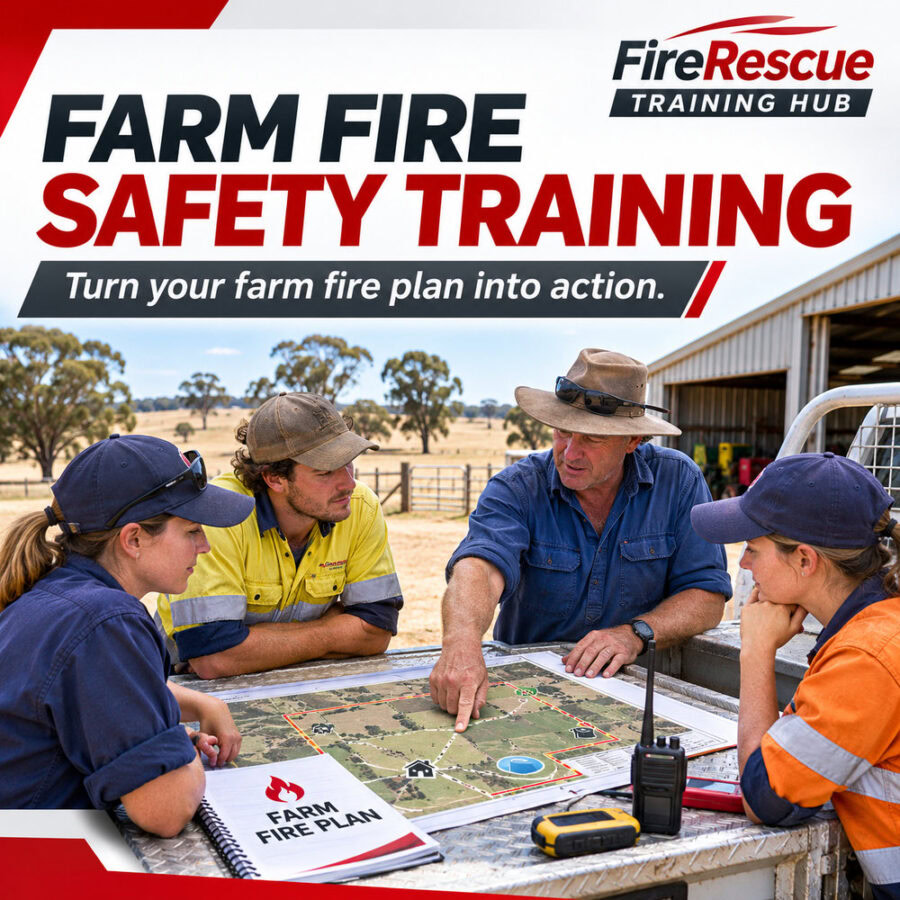
Before the season, draw a farm map. Mark access roads and gates, water tanks and dams, powerlines, chemical and fuel stores, buildings, livestock areas, known hazards, safe assembly areas and evacuation routes. Share relevant information with family, workers and the local brigade where practical. Revisit the plan when conditions, property use or staffing change.
Your plan should distinguish between a small incident that suitably trained and equipped people can manage safely and a developing bushfire that requires professional fire services and early evacuation. Establish clear triggers to stop work and leave. Include older family members, children, people needing assistance, visitors and contractors. Everyone must know the emergency number and their own role.
Australia’s current Fire Danger Ratings
Moderate — Plan and prepare
Stay up to date. Review your plan, check access and keep equipment maintained.
High — Prepare to act
Heightened risk means be ready to act, reconsider high-risk work and confirm when you will leave if fire threatens.
Extreme — Take action now
Fires can spread quickly and be extremely dangerous. Review official advice and make early safety decisions; do not rely on a private fire unit for protection.
Catastrophic — Leave bushfire risk areas
For your survival, leave bushfire risk areas. Do not remain simply because firefighting equipment is available.
On days of minimal fire danger, the system may display No Rating. Check the daily local rating, active warnings and restrictions. The official Australian Fire Danger Ratings explanation sets out the nationally consistent categories. A Fire Danger Rating is different from a Fire Danger Period or Total Fire Ban declaration.
When a fire starts: safe priorities for a farm property
The biggest mistake is assuming that a private unit has to be used just because it is available. Every incident is different. Wind, fuel, terrain, rate of spread, visibility and escape options can change in minutes. No written guide can replace a site-specific risk assessment, training or fire service direction.
- Raise the alarm. Call 000 when a fire is uncontrolled or could require assistance. Give the property address, nearest access point, type of fire and obvious hazards.
- Protect people first. Warn family, workers and visitors. Use the farm plan and leave early if threatened or if official instructions require it.
- Assess from safety. Do not approach flame, smoke, powerlines, dangerous goods or machinery that may become involved. Keep a clear means of withdrawal.
- Only undertake tasks within your training and capability. Any small-fire response must be low risk, with adequate equipment, communication and an immediate ability to disengage. Do not attempt to stop a running fire front.
- Coordinate with responders. Identify yourself and your equipment to the arriving brigade. Inform them of hazards, access, water and the location of people or livestock.
- Withdraw if conditions change. Loss of visibility, communications, water, a viable exit or situational awareness are reasons to stop, not reasons to push harder.
Private units have serious limitations
Most farm units lack the trained crews, specialised protective systems and operational support of emergency service appliances. Do not drive into smoke or through fire, travel into a closed fire area without authorisation, or perform defensive firefighting against a severe bushfire front.
Firefighter and farm-operator perspective: working with brigades
A farm owner often knows the access tracks, gates, dams, livestock movements and local hazards better than anyone arriving from outside the district. That local knowledge can be extremely useful. But unmanaged private vehicles can also block roads, interfere with aircraft or machinery, and create accountability problems if crews do not know who is on the fireground.
The NSW RFS Farm Fire Unit Operational Guide emphasises preparation, personal safety, communications, working within incident arrangements and lower-risk tasks for privately operated units. CFA likewise sets expectations for private equipment operating at fires.
- Make yourself known: When safe, report your location, available water and equipment to the responding agency or designated supervisor.
- Follow the incident plan: Do not freelance, enter exclusion zones or make independent tactical decisions on an established fireground.
- Use agreed communications: Follow local brigade guidance for radios and channels. Do not assume there is a universal UHF channel appropriate everywhere.
- Explain local hazards: Share information about private powerlines, chemicals, fuel tanks, fallen trees, locked gates and stock.
- Maintain accountability: Advise the relevant contact when moving, refilling, leaving or finishing an assigned activity.
- Respect traffic control: Access restrictions and road closures apply. A private unit does not automatically have authority to enter.
In Victoria, CFA has a process for eligible private firefighting equipment operators seeking a yellow access sticker for certain emergency-services-only Traffic Management Points. This is not an unrestricted entry pass: access remains controlled by incident management. Check CFA’s current requirements before applying.
What about protective clothing?
Farm workers should not regard jeans, a cotton shirt or a dust mask as equivalent to approved firefighting PPE. Appropriate equipment depends on training, task and jurisdiction. The NSW RFS guide discusses protective clothing, boots, gloves, head and eye protection and respiratory considerations for operators. A filtering mask may reduce some airborne particles but does not protect against all hazardous gases or make fireground smoke safe. Avoid smoke and seek agency-specific training rather than improvising PPE.
After using a farm fire unit: refill, repair and record
Once the fire service or relevant authority confirms the location is safe, inspect the equipment without exposing yourself to ash pits, damaged trees, hot debris, electricity, fuels or unstable buildings. Do not enter a burned area simply to retrieve gear. Refill and return the unit to a serviceable state before it is needed again.
- Check the tank, pump, engine, hoses, fittings, frame, electrics and vehicle for visible damage or overheating.
- Clean the unit according to the manufacturer’s instructions, including any strainers or filters where appropriate.
- Drain, dry or store hoses as directed by the supplier to prevent deterioration and mould.
- Refill the tank, replenish first aid items, restore suitable fuel levels and charge communication equipment safely.
- Record faults and arrange competent repairs before the unit returns to service.
- Ask the people involved what worked, what failed and whether the farm plan or training needs to change.
Burns first aid
If somebody is burned, move them away from danger and cool the affected area under cool running water for 20 minutes. Do not put a woollen blanket onto the burn as treatment. Seek urgent medical help for serious burns and call 000 when appropriate. See CFA burns first-aid advice.
Frequently asked questions about farm firefighting equipment
What is the best farm firefighting unit for a ute?
There is no universal best unit. Start with the ute’s legal payload and axle limits, likely tasks, access tracks, pump performance, hose requirements and servicing support. A smaller compliant unit may be safer than a larger overloaded one.
How big should a farm firefighting water tank be?
That depends on the job, local fire risk, water access and the vehicle or trailer. Tank capacity alone does not demonstrate safe firefighting capability. Seek advice from your local fire authority and competent equipment suppliers.
Is a high-pressure pump always better?
No. Pump choice is a balance of usable flow and pressure through the actual hose and nozzle arrangement. Compare the performance curve at operating conditions, not just maximum advertised figures.
Can I fight a grassfire by myself?
Working alone at a fire introduces serious risk. Do not attempt active firefighting without suitable training, help, communications and an immediate safe exit. Call 000 for a fire that is not immediately controllable or if help may be needed.
Can private farm units assist the local brigade?
Sometimes. CFA and NSW RFS recognise their contribution when people are properly prepared and cooperative. The incident controller determines operations and access restrictions. Contact your local brigade well before the season.
Can I take my farm fire unit through a roadblock?
Do not assume so. Emergency road closures and traffic controls apply. CFA has a specific private-equipment sticker arrangement in Victoria, but approval and entry are conditional and may be refused.
Do I need a fire unit if I already have a dam?
A dam is a water source, not a complete operating system. Access, safe refilling, pump reliability and the farm plan all matter. A unit might be beneficial for some properties but is not a substitute for official fire planning.
How often should the pump be tested?
Use the manufacturer’s service and test schedule, local legal requirements and a documented before-season inspection. Recheck after use, repairs or suspected damage. A made-up fixed monthly schedule is not a substitute for the equipment manual.
Does a farm fire unit mean I can stay during Catastrophic conditions?
No. Official advice for Catastrophic fire danger is to leave bushfire risk areas. No private pump, tank or vehicle offers a guarantee of survival.
Practical next steps for safer farms
Five useful things to do this week
- Inspect the fire unit and write down any faults.
- Check loaded vehicle weight and tank restraints.
- Confirm who can operate the pump and how they will communicate.
- Update the farm map, evacuation arrangements and emergency contacts.
- Speak with your local brigade before fire season, not during an emergency.
Good farm fire safety is built long before smoke appears. A maintained unit, a reliable water source and practical people can help with some manageable incidents. But prevention, sensible decisions and leaving early are always more important than protecting property at any cost.
More FireRescue guides
- Grass fire safety and fire season preparation
- Fire fighting pump and water supply guide
- After-bushfire clean-up safety checklist
Official sources and further reading
- CFA — Private fire fighting equipment
- CFA — Fire safety on the farm
- CFA — Property access for emergency services
- NSW RFS — Farm Fire Unit Operational Guide (PDF)
- Agriculture Victoria — Fire Preparedness Toolkit
- Transport Victoria — Securing loads
- Emergency Victoria — Australian Fire Danger Ratings
- CFA — Preventing burns and burns first aid
About this guide
Author: Ken Walker, FireRescue Training Hub. This guide combines public safety information with a firefighting and training perspective. It does not claim personal attendance at incidents described by other sources.
Sources checked: 30 October 2026. Editorial safety review: confirm before publishing. This article is general Australian education, not an operational order, accredited training, legal advice or a site-specific protection plan.
Have a correction, updated agency guidance or a useful practical lesson? Please contact FireRescue so information can be checked and improved.
FireRescue Training Hub
Access practical fire and emergency study support resources, downloads, checklists, audio guides, and member-only course content.
- Course library
- PDF downloads
- Audio guides
- Checklists
Study support only. Not accredited training or a replacement for workplace procedures.
About the author and safety review
Ken Walker
Former Station Officer and fire service educator
Former career firefighter with extensive career and volunteer fire service experience.
Qualifications: Associate Diploma of Applied Science in Fire Technology; Institute of Fire Engineers studies.
Author profilehttps://www.firerescue.com.au/about-us/