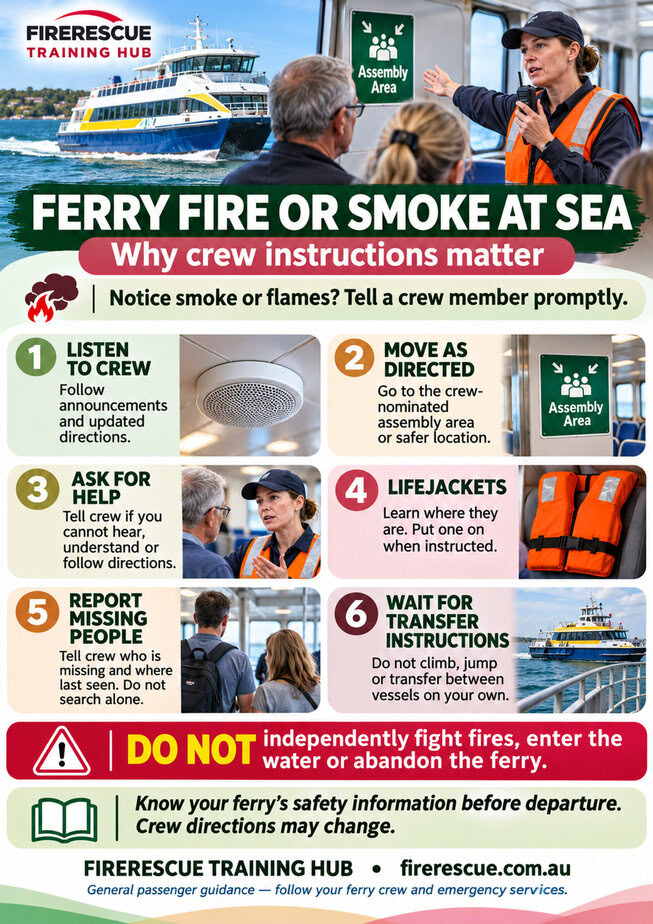
If fire or smoke is reported on a ferry, listen carefully to the crew, follow their emergency directions promptly and tell them if you cannot understand or carry out an instruction. If you notice smoke, flames or another immediate concern, alert a crew member promptly rather than assuming someone else has reported it.
A ferry emergency is not simply a choice between staying aboard and getting off. Crew may need to move passengers away from an affected area, gather them for instructions, organise lifejackets or arrange a transfer. Those decisions depend on the vessel and the developing situation.
The most useful preparation is to learn the safety information for the ferry you are actually travelling on. A familiar route does not necessarily mean a familiar vessel, layout or emergency arrangement.
Why crew instructions matter during a ferry fire
As a passenger, you can usually see only a small part of what is happening. Crew coordinate the vessel’s response and passenger arrangements, including communications between different areas on board.
An apparently clear doorway may not be the route crew want passengers to use. A gathering place used earlier may no longer be suitable. Another vessel coming alongside does not mean passengers should begin boarding it.
Following coordinated directions helps avoid conflicting movements and keeps access available for the response. It also helps crew establish where passengers are and who needs assistance.
Directions may change as the situation develops. Listen to each announcement rather than assuming an earlier instruction still applies. If two directions seem inconsistent, ask a crew member to clarify the current instruction.
Before departure: learn the arrangements on your ferry
Use the briefing, announcements, signs and other safety information provided for your journey. Depending on the vessel, information may be available through a demonstration, recording, display, safety card or direct explanation from crew. Do not assume every ferry uses the same format.
Look for information about:
- How passengers will receive emergency instructions.
- Where passengers may be directed to assemble.
- How to identify passenger exits and emergency routes.
- Where lifejackets are located and how to use the type provided.
- How to contact crew or ask for assistance.
If something is unclear, ask before you need it. A useful question is: “If there is an emergency, where should I go, and how will I know?”
Finding an exit does not mean choosing it in advance for every emergency. Likewise, knowing where lifejackets are stored does not replace instructions about when and how to use them.
Discuss assistance needs early
If you may need help hearing announcements, understanding instructions, using stairs or moving around the vessel, speak with the operator before travelling where possible, and identify yourself to crew on board.
Explain what assistance would help rather than assuming crew will recognise your needs. This is also useful when travelling with children or someone who depends on you for communication or mobility support.
Ask about arrangements for your actual sailing. Do not assume an assistance plan from another ferry or operator will apply.
What to do when crew give an emergency instruction
Give the instruction your full attention. Pause conversations and remove headphones so you can hear what is being said. Encourage those travelling with you to listen too.
Focus on three practical questions: What am I being asked to do? Where am I being directed? Do I need help to do it?
| Situation | Useful passenger response |
|---|---|
| You are directed to an assembly area | Go to the place crew identify and remain available for further instructions or passenger checks. |
| You are told to move elsewhere | Use the route crew direct. Tell them promptly if you cannot use it or see a hazard they may not know about. |
| You are instructed to put on a lifejacket | Follow the directions for the lifejacket provided and ask for help if you are unsure about its fit or fastening. |
| You cannot hear or understand | Ask a crew member to repeat, demonstrate or clarify the instruction. |
| Someone in your party is unaccounted for | Tell crew who is missing and where they were last seen. Do not independently leave the directed area to search. |
Do not delay following emergency directions to collect bags or make a recording. If essential medication or an assistance item is elsewhere, tell crew rather than returning for it without their direction.
Why passengers may be told to muster or move
Muster means gathering at a designated place for emergency organisation. Crew may use the term “assembly station” or give a direct location instead.
Gathering passengers can support communication, assistance and accounting for everyone aboard. Being told to assemble does not, by itself, mean the vessel is about to be abandoned.
Crew may also direct passengers away from smoke or another affected area, keep response routes clear, or position people for the next stage of the response. Moving to another part of the ferry and leaving the ferry are different actions.
There is no suitable universal passenger rule to always go upstairs, head outside, use the nearest exit or move to a particular side. The safe arrangements depend on the vessel and incident. Learn the available safety information, then follow the directions given for the actual emergency.
Lifejackets: know where they are, then follow directions
Lifejacket arrangements can differ between ferries. Before an emergency, find out how to locate and use the equipment provided. If you are travelling with a child or someone who may need help with fitting, ask crew about suitable arrangements.
If crew instruct you to put on a lifejacket, follow their directions and the instructions for that particular device. Ask for assistance if you cannot identify the correct size, understand the fastening or achieve a secure fit.
Do not treat lifejacket advice from a different activity or vessel as a substitute for the information on your ferry. An instruction to put on a lifejacket also does not mean you should enter the water.
Why a transfer needs crew coordination
A transfer to another vessel may be part of an emergency response, but it is not something passengers should organise themselves.
The vessels’ movement, the transfer location, access and assistance needs all matter. Crew need to coordinate when people approach and cross, as well as keep track of who has moved.
If a transfer is directed, listen for the specific instructions and tell crew about any difficulty you expect before attempting it. Do not climb across, jump, launch equipment or enter the water on your own initiative.
A successful transfer in one incident is not a template for every ferry emergency. Other incidents may require different arrangements.
If you cannot hear, understand or follow an instruction
Noise, stress, unfamiliar terminology and language differences can make an otherwise simple instruction difficult to understand. Asking for clarification is part of cooperating with the response.
Use short, specific statements:
- “I could not hear the announcement. Where should I go?”
- “Can you show me which lifejacket fastening you mean?”
- “I cannot use those stairs. I need assistance.”
- “My companion cannot hear the instructions.”
- “My child is not with me. They were last seen in the forward passenger area.”
If you cannot carry out a direction, make that clear promptly. Do not silently remain behind or follow other passengers without understanding where they are going.
You can help a companion understand what crew have said, but avoid adding guesses or passing on rumours as instructions.
How passenger accounting supports the response
Emergency planning needs to address more than moving people away from a hazard. Crew also need a way to account for passengers and identify anyone requiring help.
Depending on the operation, this may involve passenger numbers, counts, records or checks at an assembly area or during a transfer. Do not assume every ferry uses a named passenger list or the same checking process.
Cooperate with requests to be counted or identified. If directed to remain in an area, do not wander elsewhere without telling crew. Report a missing companion promptly, including their description and last known location.
Report uncertainty honestly: “I cannot find them” is more useful than assuming they have already transferred or are waiting somewhere else.
Which Australian ferries does this advice cover?
The passenger principles in this article are broadly useful, but the underlying operating and legal arrangements are not identical across all vessels.
Australian domestic commercial vessels: AMSA provides guidance on safety management systems and passenger safety for this sector. Whether a particular requirement applies depends on the vessel and operation. The practical approach here is to learn and follow the arrangements explained for your service.
Other vessels and routes: International passenger ships, some other commercial operations and overseas services may operate under different regulatory arrangements. Recreational boating advice is also not a substitute for commercial ferry procedures.
This article does not set out legal requirements for every ferry. Do not assume that a particular briefing format, sign, assembly station, drill schedule or lifejacket practice is identical across Australian services.
Know the basics, then listen to the crew
You do not need to learn a generic firefighting or abandonment procedure before taking a ferry. You do need to pay attention to the information for your journey and ask questions when something is unclear.
If smoke or fire occurs, report what you notice, listen closely, follow crew directions and speak up about assistance needs or missing companions. Those actions help crew coordinate the response without passengers having to guess what should happen next.
Have a correction or a vessel-specific clarification? Please share it with the FireRescue.com.au editorial team for review.
Related FireRescue guides
- integrated Residential Bushfire Protection System Part 10: Smoke, Heat and Local Weather Detection
- Smoke Alarms for Deaf and Hard-of-Hearing Australians: Visual, Vibrating and Interconnected Alerts
- Undertake Road Accident Rescue Capstone, Part 8 of 8, Full Crew Scenario and Readiness Check
Sources and further reading
Source material was gathered for this draft on 17 November 2026. Confirm current official advice for your location. Readers can contact FireRescue with corrections or relevant field experience.
FireRescue Training Hub
Access practical fire and emergency study support resources, downloads, checklists, audio guides, and member-only course content.
- Course library
- PDF downloads
- Audio guides
- Checklists
Study support only. Not accredited training or a replacement for workplace procedures.
About the author and safety review
Ken Walker
Former Station Officer and fire service educator
Former career firefighter with extensive career and volunteer fire service experience.
Qualifications: Associate Diploma of Applied Science in Fire Technology; Institute of Fire Engineers studies.
Author profilehttps://www.firerescue.com.au/about-us/