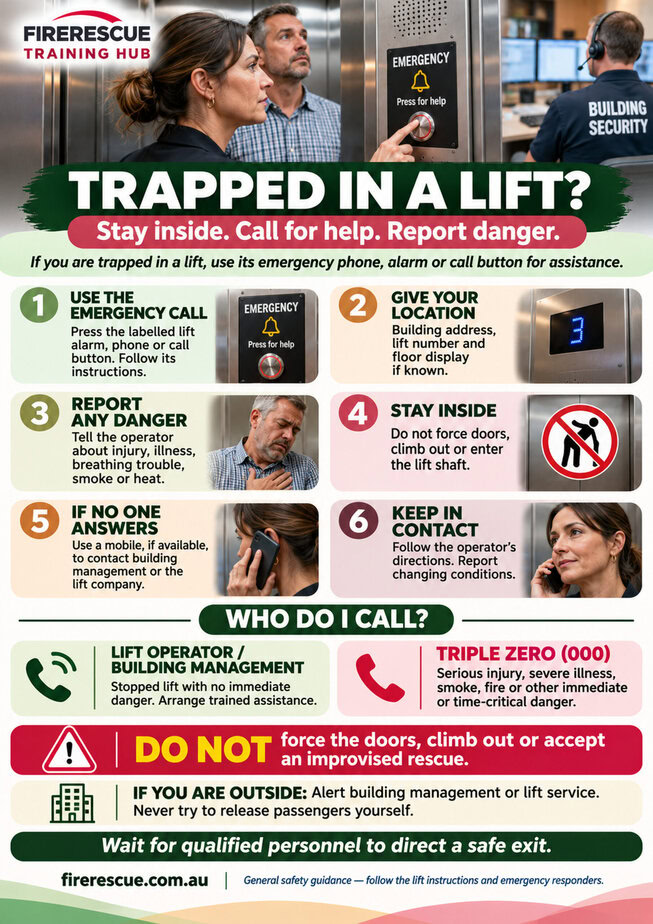
If you are trapped in a lift, use its emergency phone, alarm or call button according to the instructions displayed. Tell the person who answers that passengers are trapped, identify the building and lift as accurately as you can, and report any injury, illness, smoke or other immediate danger.
Remain inside the lift. Do not force the doors or try to climb out. A lift that has malfunctioned needs assistance from the lift service company or emergency responders, not an improvised passenger rescue.
If someone is seriously injured, has severe breathing difficulty or faces another life-threatening or time-critical emergency, call Triple Zero (000). Do not wait for a maintenance response before reporting an urgent threat.
Your first steps if the lift stops
- Use the emergency communication device. Look for the labelled emergency phone, alarm or call button and follow its displayed instructions.
- Explain the situation. Say that you are trapped and need assistance. Give the building address, lift identification and number of passengers if known.
- Report urgent concerns immediately. Mention injuries, difficulty breathing, significant illness, smoke, heat or any other developing danger.
- Stay inside. Do not pry the doors apart, climb through an opening or attempt to reach another floor.
- Keep communication available. Follow the operator’s directions and report any change in conditions.
A stopped lift can be frightening, especially when you do not know how long help will take. Concentrate on the next useful action: establish contact, explain what is happening and keep the person arranging help informed.
How to use the alarm, emergency phone or call button
Lift controls vary. An emergency button may connect to a monitoring service, while another device may sound an alarm or provide a telephone connection. Do not assume every lift works the same way.
Read the instructions beside the device and use it as directed. If someone answers, begin with a clear statement: “We are trapped in a lift and need assistance.”
Ask whether they have identified your lift and arranged help. Follow their instructions about staying on the line, answering a return call or making contact again.
What information should you give?
| Information | What to say |
|---|---|
| Building location | The street address, building name and suburb or town, if known. |
| Which lift | A lift number or identification label visible inside the car, and the building section or tower if relevant. |
| Where it stopped | What the floor display shows and where you were travelling. Say if you do not know the actual position. |
| Passengers | How many people are inside and whether anyone needs assistance communicating or moving. |
| Health and safety concerns | Any injury, illness, breathing difficulty, smoke, unusual heat or urgent medication need. |
| Contact details | A mobile number for a return call, if available. |
You do not need to investigate the fault or open anything to find this information. Give what you can see safely and distinguish what you know from what you are guessing.
If the device does not connect
If there is no response, follow any further instructions displayed in the lift. If your mobile phone has reception, use it to contact building management, security or the lift service company using a number displayed inside the lift or already known to you.
Tell them that the lift’s emergency communication device has not connected. Ask them to arrange assistance and confirm which lift you are in.
If you can contact only a friend or colleague, ask them to notify building management and pass on your exact location and circumstances. An urgent threat still needs an emergency call; do not rely solely on a message that may not be seen promptly.
Should you call Triple Zero, building management or the lift company?
Urgent danger and a mechanical fault are different needs, but they can occur together. A lift service company can arrange technical assistance. Emergency services may be needed when people are in immediate danger or need urgent medical help.
| Situation | Passenger action |
|---|---|
| Someone is seriously injured, severely unwell or in immediate danger | Call Triple Zero (000), give the location and explain that the person is trapped in a lift. Also tell the lift operator or building contact. |
| The lift has stopped and no immediate threat has been identified | Use the emergency communication system and follow the building’s lift-entrapment procedure to get assistance arranged. |
| The emergency communication device does not connect | Use another available way to reach building management or the lift service company. Escalate any urgent danger to 000. |
| Conditions worsen while you wait | Report the change immediately. Call 000 if the situation has become life-threatening or time-critical. |
Australian Government guidance describes Triple Zero as the number for life-threatening or time-critical situations. However, lift-entrapment procedures are not expressed identically across all settings: Queensland Government Schoolies guidance for accommodation providers takes a more precautionary approach and directs providers to call 000 first for entrapment or overloading incidents.
That means a single rule such as “never call 000 for a stopped lift” is not appropriate. Follow the applicable emergency procedure, explain the actual circumstances and do not minimise a health or safety concern.
When calling 000, say which emergency service you need, speak clearly and give your location. Explain that access to the affected person is restricted because they are inside a stopped lift.
Why you should not force the doors or climb out
A door opening does not establish that it is safe to leave. SafeWork NSW identifies both uncontrolled lift movement and people trying to exit a malfunctioning lift as risks.
Trying to squeeze through a gap or climb to a landing can turn an entrapment into a serious injury. Passengers cannot establish from inside the car that the lift has been secured for a safe release.
- Do not pry or force the doors.
- Do not climb through a partial opening.
- Do not attempt to access the lift shaft or roof.
- Do not accept an improvised rescue from an untrained bystander.
Wait for the attending lift technician or emergency responders to direct any exit. If smoke or another immediate threat develops, report it urgently rather than attempting to work out your own escape route.
If someone is injured, unwell or panicking
Tell the operator about health concerns early, not only after they become severe. Being unable to reach medication, becoming increasingly distressed or feeling unwell can change the assistance needed.
Describe what is happening in plain language. For example, say that someone is struggling to breathe, has become less responsive, feels faint or cannot access medication they need. Do not assume symptoms are “only panic”.
For an urgent medical problem
Call 000 for a life-threatening or time-critical concern and follow the call-taker’s instructions. Give the building and lift location, describe the symptoms and make clear that responders will need help reaching the patient.
Do not try to climb out to collect medication or bring someone out through a gap. Explain the medication issue to the operator so it can be considered when arranging assistance.
For anxiety or distress
Speak calmly and keep explanations short. Let the person know what has actually been done to get help. If practical, have one person speak with the operator while another offers reassurance.
Avoid promises such as “we will be out in five minutes” or “nothing can happen”. Instead, use factual reassurance: “We have made contact and told them where we are.” Report worsening symptoms or distress.
How someone outside the lift can help
If you hear trapped passengers or receive a call from them, notify building management, security or the lift service company. Give the building address, lift identification and any known health or safety concerns.
SafeWork NSW advises that the lift service company should be called to assist anyone trapped when a lift malfunctions.
- Establish contact if possible. Ask how many people are inside and whether anyone is injured or unwell.
- Confirm help is being arranged. Do not assume another person has already made the call.
- Report urgent danger. Call 000 where there is a life-threatening or time-critical emergency, and explain the restricted access.
- Pass on useful information. Help the attending personnel identify the correct building entrance and lift.
- Do not attempt a release. Do not force doors, enter the shaft, operate machinery or try to pull passengers through an opening.
If you remain in contact with passengers, share confirmed updates. Do not give a rescue time unless the responsible service has supplied one, and make clear that an estimate may change.
Private home lifts, commercial buildings and fire emergencies
Private residential lifts
A home lift may have different controls, communication arrangements and service contacts from a commercial passenger lift. Use the instructions supplied for that particular installation.
Owners and regular users should know where the emergency instructions and service contact details are kept before a problem occurs. Do not assume that a family member can safely release a trapped passenger using tools or a key.
Commercial and public buildings
Offices, hotels, shopping centres and other managed premises may have security staff or a building emergency procedure. Use those arrangements to help identify the lift and coordinate assistance, while reporting urgent danger directly when necessary.
Requirements for lift management and emergency communication depend on the jurisdiction and installation. A procedure from one venue is not automatically the procedure for every Australian building.
A fire alarm, smoke or fire
Lift entrapment and building fire evacuation are different situations. This guidance is not an instruction to use a lift to evacuate during a fire.
If you are already trapped and notice smoke, heat or signs of fire, report that immediately through the emergency communication system and call 000 if able. Give your precise location and follow emergency-service directions. Do not force the doors or attempt to enter the shaft.
If you are outside the lift, follow the building’s emergency plan and directions from wardens or emergency services rather than approaching the lift to attempt a rescue.
The key message
Make contact, give a clear location, report changing conditions and leave the release to qualified personnel. Do not assume entrapment is harmless, but do not turn a stopped lift into a self-rescue attempt.
If you identify an error or a lift-specific issue in this guidance, please let the FireRescue.com.au editorial team know so it can be reviewed.
Related FireRescue guides
- Integrated Residential Bushfire Protection System Part 20: What Could Go Wrong?
- Electrical Substation and Transformer Fires: What First Responders Need to Know
- Home Oxygen Fire Safety: What Australian Families Need to Know
Sources and further reading
Source material was gathered for this draft on 17 November 2026. Confirm current official advice for your location. Readers can contact FireRescue with corrections or relevant field experience.
FireRescue Training Hub
Access practical fire and emergency study support resources, downloads, checklists, audio guides, and member-only course content.
- Course library
- PDF downloads
- Audio guides
- Checklists
Study support only. Not accredited training or a replacement for workplace procedures.
About the author and safety review
Ken Walker
Former Station Officer and fire service educator
Former career firefighter with extensive career and volunteer fire service experience.
Qualifications: Associate Diploma of Applied Science in Fire Technology; Institute of Fire Engineers studies.
Author profilehttps://www.firerescue.com.au/about-us/