PUBLIC FIRE SAFETY GUIDE | AUSTRALIA
A battery does not have to be charging to cause a fire. When someone puts a used battery in the household rubbish or recycling, it may be crushed inside a collection truck or damaged by equipment at a waste facility. The result can be smoke, fire, an emergency response and a risk to workers and nearby residents.
Quick answer: Never put batteries, vapes or battery-powered electronic waste in kerbside rubbish, recycling or garden-organics bins. For ordinary, undamaged loose batteries, protect their terminals and use an approved drop-off service. Bulging, damaged, leaking or overheating batteries need extra care and may not be accepted at standard collection points.
Key takeaways
- Both the general rubbish bin and household recycling bin are the wrong places for batteries.
- Small batteries hidden inside everyday products can be just as easily overlooked as loose batteries.
- Taping the metal terminals helps prevent a short circuit while undamaged loose batteries await collection.
- Not every collection point accepts e-bike batteries, vapes, damaged batteries or devices with built-in batteries.
- Your council and the national B-cycle collection finder are the best places to begin checking disposal options.
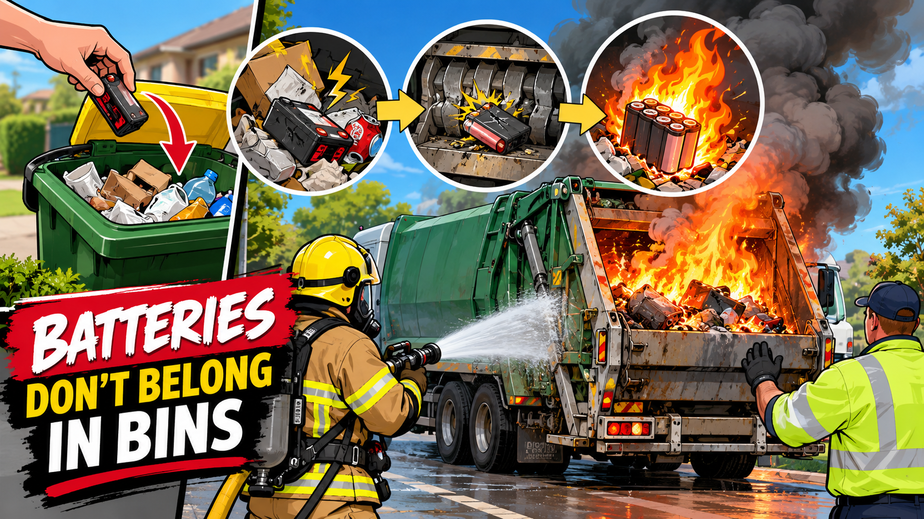
Why can a discarded battery start a rubbish truck fire?
A household bin seems a fairly harmless place to put something that has stopped working. But a used battery can still hold electrical energy. If its terminals connect through a metal object, it can short circuit. If a battery is crushed, punctured or otherwise damaged, internal components can fail.
Waste collection vehicles are designed to compact waste. Sorting facilities also use conveyors, crushers and other machinery. A battery mixed with normal rubbish or recycling may therefore be exposed to forces it was never designed to withstand. It can be damaged before anybody even knows it is there.
Lithium-ion batteries are of particular concern. Severe damage or an internal failure can cause a process called thermal runaway. Heat builds within a cell, which may release hot and flammable gases, smoke and flames. Nearby combustible waste can catch alight. Where several cells form a battery pack, the event may spread from cell to cell.
Not every battery uses lithium-ion chemistry and not every discarded battery will ignite. Alkaline, lithium-metal, nickel-metal-hydride and lead-acid batteries have different hazards. But the practical household rule is straightforward: keep all used batteries out of kerbside bins and take them through an appropriate collection pathway. This advice is consistent with guidance from Fire and Rescue NSW, the NSW EPA and CFA.
How one small battery can affect a much bigger area
1In the bin
A battery or battery-powered item is mixed with ordinary waste. It may still contain stored energy even though it no longer works.
2During collection
Compaction can crush a cell or battery pack, potentially causing short circuits, overheating and ignition.
3At the waste facility
Handling and processing can create another chance for damage. Surrounding waste provides material that can burn.
4Emergency consequences
Fire may threaten drivers, sorting staff and the public, damage vehicles or facilities, and interrupt essential waste services.
This is why a bin fire is not always a small, isolated incident. Smoke can affect surrounding streets, a vehicle may need to be isolated, and the burning load can be difficult to reach without specialised equipment and a controlled response.
Real Australian incidents: the risk is not theoretical
Two NSW garbage truck fires, September 2026
On 8 September 2026, Fire and Rescue NSW responded to two garbage truck fires in Sydney. At Marayong Park, firefighters found the back of a waste collection vehicle alight. The load was discharged under incident conditions to help crews gain access and extinguish the fire. A separate fire occurred in Chippendale that morning. Authorities said the fires were possibly linked to incorrectly discarded batteries; the second incident was possibly associated with a vape battery. These were reported possibilities, not confirmed causes for both fires. Read the FRNSW report.
Victorian recycling truck fire, February 2026
Mornington Peninsula Shire reported a recycling truck fire in Mount Martha on 5 February 2026. The driver noticed smoke and contacted emergency services. A battery was suspected, but the shire did not report that cause as confirmed. The incident illustrates why batteries should never be placed in household recycling, even when residents are trying to dispose of them responsibly. Read the shire’s incident account.
Everyday products with batteries people forget about
Many people already know not to throw an old AA battery in the bin. The harder problem is the battery they cannot see. As more products become rechargeable, waste workers encounter small electrical items that look like ordinary plastic, metal or household rubbish.
| Product or battery | Why it gets missed | Better disposal starting point |
|---|---|---|
| AA, AAA, 9V and button batteries | Small and easy to throw away after use | Approved loose-battery collection point; cover terminals |
| Power tool and camera batteries | Often left in a drawer or a toolbox | Check B-cycle acceptance and collection-point limits |
| Power banks and Bluetooth speakers | The battery may be inside a sealed product | Check whether the complete item requires an e-waste service |
| Electric toothbrushes and shavers | Small appliance with a built-in rechargeable cell | Local council e-waste collection |
| Light-up toys, headphones and wearable devices | Battery hidden within an everyday product | Suitable e-waste or specialist product collection |
| E-bikes and e-scooters | Battery packs can be larger and may be removable | Confirm a collection point accepts that particular pack |
| Vapes and e-cigarettes | Often mistaken for ordinary litter | Ask the council for an appropriate vape/embedded-battery pathway |
| Mobile phones and laptops | Battery built into a complete device | MobileMuster for phones; approved computer/e-waste collection for laptops |
| Car, caravan and home-storage batteries | Not ordinary loose household batteries | Automotive, electrical or specialist battery recycler; check first |
As a useful check, ask whether an item lights up, makes a noise, moves without a cable, or can be charged. If so, it may contain a battery. Do not guess whether it belongs in household recycling. Check the collection service before disposal.
How to dispose of used batteries safely in Australia
The right process depends on the battery’s condition, chemistry, size and whether it is loose or built into a device. The following steps are for ordinary, undamaged household batteries. They are not instructions to handle a battery that is hot, leaking heavily, hissing or smoking.
Step 1: Identify what you are disposing of
Separate loose batteries from complete electronic devices. Check whether a battery can be removed normally using the manufacturer’s instructions. Do not pry open a glued or sealed device, puncture a casing, disconnect wires or dismantle a battery pack just to make it fit a collection bin.
Step 2: Cover the exposed terminals
For ordinary used loose batteries, place clear sticky tape over the metal terminals without hiding the information needed to identify the battery. A 9V battery has two terminals together at one end; a typical AA has a terminal at each end. Button batteries need their contact surfaces protected. This reduces the chance of loose batteries short-circuiting when stored or transported. Follow the battery collection provider’s instructions.
Step 3: Store them only until you can drop them off
Keep used, undamaged batteries in a cool, dry location away from children, pets and heat. B-cycle recommends a suitable non-airtight glass container, not a metal container or a container mixed with loose metal items. Avoid letting batteries accumulate for months when a collection point is available.
Step 4: Choose an approved collection pathway
Use the B-cycle drop-off finder for eligible loose batteries. Many approved collection points are at supermarkets, hardware retailers and community facilities, but participation and accepted types vary. Check the current details before visiting, particularly for larger removable batteries or unusual chemistries.
For electronic devices with built-in batteries, consult your local council’s e-waste service. For mobile phones, MobileMuster offers a dedicated pathway. Car batteries, home energy-storage batteries and other specialist packs may need a qualified recycler rather than a household drop-off box.
Step 5: Check the destination, not just the sign on the bin
Do not assume that a box labelled “battery recycling” accepts every type of battery. B-cycle’s normal collection system does not accept vapes, built-in batteries in complete devices, car lead-acid batteries or mobile phone and laptop batteries. Special arrangements can exist for some e-bike and e-scooter packs, but the collection site must be suitable for the battery. B-cycle explains its accepted items and restrictions.
What to do with damaged, swollen or leaking batteries
A battery that is swollen, cracked, punctured, crushed, leaking, unusually hot or giving off a strong odour is not just an ordinary item awaiting recycling. Stop using it. Do not charge it, test it, squeeze it, drill it, tape up a damaged casing or try to repair it.
When there is immediate danger
If a battery is smoking, hissing, producing gas or vapour, visibly burning, or heating rapidly, leave the area, keep others away and call 000. Do not pick it up and carry it outside, put it into your car, or attempt home-made treatments. Close doors as you leave only if safe. Fire services warn that lithium-ion batteries may burn fiercely and can reignite.
When a battery is damaged but not actively reacting
Do not put it in an ordinary battery recycling box or household bin. Keep others away and contact your council, transfer station or a specialist recycler for instructions before moving or transporting it. The condition and type of battery matter. Guidance from B-cycle and CFA outlines precautions for damaged batteries, including protective handling where it is safe, suitable non-airtight containers for some non-reacting items, and specialist disposal advice.
If a battery has been submerged in floodwater, involved in a fire or exposed to serious impact, do not assume it is safe because it looks normal. Seek the manufacturer’s or appropriate specialist’s advice; batteries can have internal damage that is difficult to see. For related reading, see FireRescue’s guide to flood-damaged lithium batteries.
What if a household bin, recycling truck or waste area starts smoking?
Smoke or flames from a waste bin should be treated as a developing fire, not as proof that a battery is responsible. The contents may include unknown materials, hot gases and other hazards.
At home or near a public bin
- Move away from the bin and keep children, bystanders and pets clear.
- If there is smoke, fire or an immediate threat, call Triple Zero (000).
- Do not lift the lid for a better look, reach inside, or try to recover the battery.
- Do not drag a burning bin through a home or crowded area.
- Tell attending firefighters what you saw, including any known battery or vape disposal.
If you see a garbage truck or waste facility fire
Keep away from the truck, spilled waste, smoke and machinery. Do not park close, gather around to film, or attempt to assist unless directed by emergency personnel. Call 000 if the incident has not been reported. Follow traffic diversions, site restrictions and instructions from firefighters and police.
Waste truck drivers and facility operators should follow their employer’s emergency plans and training. Moving a burning vehicle or unloading material can create additional hazards; those actions require an incident-specific decision and must not be treated as general instructions for the public.
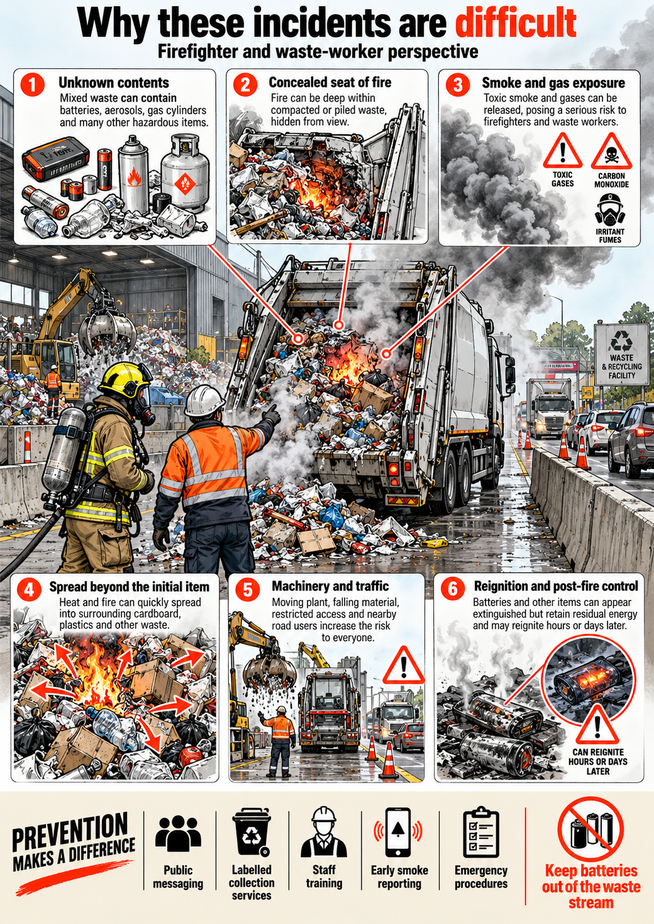
Firefighter and waste-worker perspective: why these incidents are difficult
From an operational fire-safety perspective, a collection vehicle or recycling facility creates several challenges at once. These principles are drawn from the public information and recognised hazards discussed above; they are not a claim that the author attended any of the incidents cited.
- Unknown contents: responders may not know which battery chemistry, gas cylinders, aerosols or other hazardous items are present.
- Concealed seat of fire: compacted or piled waste can hide the heat source and make direct access difficult.
- Smoke and gas exposure: burning rubbish and battery failures can produce harmful products of combustion and hazardous gases.
- Spread beyond the initial item: cardboard, plastics and mixed waste can become involved, expanding the fire well beyond the original cell.
- Machinery and traffic: large trucks, moving plant, narrow access, falling or discharged material and nearby road users complicate scene safety.
- Reignition and post-fire control: damaged lithium-ion cells may retain energy or reignite, so apparently extinguished material can still require management.
For councils and waste operators, prevention begins well before collection day. Clear public messaging, correctly labelled collection services, staff training, early reporting of smoke and appropriate emergency procedures all support safer operations. Fireground tactics, isolation distances and extinguishing methods must be selected by trained responders under the relevant agency procedures and the conditions found at the scene.
The public has a critical role too. Keeping batteries out of the waste stream reduces the chance that crews will face these hazards in the first place.
A simple battery disposal system for every household
Good household fire safety usually comes down to making the safe option easy. Create one clearly identified place for ordinary used batteries, choose an approved recycling destination, and make sure other members of the household understand that old electronics do not belong in the yellow recycling bin.
For families with children, older people, visitors or people who need assistance with household waste, a short written reminder beside the bins can be more useful than a long explanation. Consider a sign saying “No batteries or electronics in these bins — ask before throwing them away”. Ask carers, support workers, tenants and family members to follow the same rule.
If your house has a garage, workshop, camping equipment or a drawer of old chargers and gadgets, include those areas in your next clean-up. Many battery-powered products are kept for years after they stop working. Do not keep damaged packs indefinitely while waiting for a convenient disposal day; arrange appropriate handling advice promptly.
Household checklist: stop a battery fire before it starts
Save this page or print this section for the kitchen, garage, school or workplace noticeboard.
- I will keep batteries, vapes and electronics out of all kerbside bins.
- I will look for hidden batteries before disposing of broken gadgets and toys.
- I will cover the terminals of ordinary, undamaged loose batteries with clear tape.
- I will store used batteries away from heat, metal objects, children and pets.
- I will check what my chosen drop-off location actually accepts.
- I will use e-waste and specialist collection services for batteries not accepted by B-cycle.
- I will not put swollen, leaking or damaged batteries into a public collection box.
- I will seek specialist advice for damaged batteries and call 000 for smoke, fire or immediate danger.
- I will remind family, neighbours and anyone who helps with household rubbish.
Frequently asked questions
Can I put a flat AA battery in the general rubbish?
No. A battery can still present a short-circuit, fire or pollution risk after it stops powering a device. Tape its terminals as directed by the collection scheme and take it to an appropriate battery drop-off point.
Is the yellow-lid recycling bin a safe place for batteries?
No. Household recycling trucks and sorting machinery can crush batteries. Batteries require a separate recycling or recovery service, not mixed kerbside recycling.
Can I put a swollen lithium-ion battery in a B-cycle box?
No. Badly damaged or swollen batteries are not suitable for standard B-cycle drop-off points. Contact your council, transfer station or a specialist battery collector for instructions before moving it. Call 000 for smoke, hissing, rapid heating or other signs of an active emergency.
Where do disposable vapes go?
Not in ordinary household bins and not in a standard B-cycle battery collection box. Vapes contain batteries and other components requiring an appropriate disposal service. Ask your local council about its current pathway.
Can I take an old e-bike battery to the supermarket?
Do not assume so. Some collection pathways accept removable e-bike and e-scooter batteries, but acceptance, weight limits and participating locations must be checked. Contact the collection point before travelling with a larger pack.
What if I have already put a battery in the bin?
If it is an intact, cool, easily accessible item that you can retrieve safely before collection, remove it without rummaging in waste or exposing yourself to hazards. Otherwise, contact your local waste service for advice. Never climb into a bin, handle a damaged item or put yourself at risk to recover a battery.
Does this advice apply to regional and remote Australia?
Yes, the fire risk applies wherever batteries enter the waste stream. But collection options vary. Residents of regional and remote towns may need to use council transfer stations, planned collection events or specialist providers. Phone first so you do not transport a battery to a site that cannot accept it.
Conclusion: the safest battery fire is the one prevented
Battery-powered products are now part of everyday Australian life. The disposal step is easy to overlook, yet a small battery in the wrong bin can create a risk for a collection driver, recycling workers, firefighters and the wider community.
Start today: check your household bins, identify forgotten batteries and rechargeable gadgets, protect the terminals on ordinary used loose batteries, and find a suitable local drop-off service. For damaged batteries, seek specialist advice rather than using a normal collection box. It is a small habit with a worthwhile safety benefit.
Related FireRescue guides
- Flood-Damaged Lithium Batteries: The Hidden Fire Risk After Water Recedes
- Power Banks on Planes: Australian Airline Rules and Battery Fire Risks
- Fire Safety, Fuel Loads and Fire Extinguishers: What Households Need to Know
- More Australian Home Fire Safety Guides
Official sources and further reading
The following primary sources were consulted for this article. Local acceptance rules, collection schemes and emergency guidance can change; check the linked provider’s current instructions before acting.
- Fire and Rescue NSW — Two garbage truck fires prompt reminder: Never Bin A Battery (8 September 2026)
- Country Fire Authority — Battery and charging safety
- NSW Environment Protection Authority — Never Bin a Battery
- Victorian Government — How to dispose of batteries and electronic waste
- B-cycle — Frequently asked questions, accepted battery types and damaged batteries
- B-cycle — Battery safety and terminal protection
- Mornington Peninsula Shire — Recycling truck fire and hazardous waste warning (February 2026)
- Fire Rescue Victoria — Battery safety for consumers
- ACCC Product Safety — Button batteries guide
Corrections and community experience: Have your council’s collection rules changed? Do you have relevant verified experience from waste collection, recycling, fire services or community safety? Contact FireRescue with a correction, updated source or practical lesson. Contributions should be checked before this article is changed.
Editorial source check: 29 October 2026. Publication approval and any claim of firsthand experience must be confirmed separately by the site editor.
FireRescue Training Hub
Access practical fire and emergency study support resources, downloads, checklists, audio guides, and member-only course content.
- Course library
- PDF downloads
- Audio guides
- Checklists
Study support only. Not accredited training or a replacement for workplace procedures.
About the author and safety review
Ken Walker
Former Station Officer and fire service educator
Former career firefighter with extensive career and volunteer fire service experience.
Qualifications: Associate Diploma of Applied Science in Fire Technology; Institute of Fire Engineers studies.
Author profilehttps://www.firerescue.com.au/about-us/