Rangehood and kitchen exhaust fires often begin with everyday cooking, but the real danger is what you cannot easily see: grease deposits inside filters, canopies, ducting and fans. In Australian homes and commercial kitchens alike, a small flare-up can ignite that buildup and send fire beyond the stovetop.
For households, the priorities are simple: keep cooking surfaces clean, know how to respond to a pan fire, and never put yourself at risk trying to fight a spreading fire. For commercial kitchens, the picture is more complex because the exhaust system can carry grease deeper into concealed spaces, where fire may spread out of sight and be harder to access.
In a small pan fire that is still contained and safe to approach, shutting off the heat and covering the pan with a lid may be appropriate. If that is not safe, evacuate immediately, close the door if you can do so safely, and call Triple Zero (000). Never use water on burning cooking oil or fat.
Quick summary
Grease fires above the stove are a combination hazard: cooking vapours and airborne fat settle on filters, rangehood surfaces, the canopy, and sometimes inside ducting and fans. Over time, that residue becomes fuel. If overheated oil, flame, or hot gases reach it, the fire may move beyond the pan and into the exhaust system.
Homeowners and renters can usually clean removable filters and visible surfaces safely if they follow the manufacturer’s instructions and keep clear of electrical parts. Anything involving inaccessible ducting, damaged motors, or electrical faults should be left to a competent professional.
Commercial kitchens need a broader maintenance plan because visible filter cleaning alone does not prove the whole exhaust system is safe. Firefighters should consider concealed extension, roof spaces, system isolation, and overhaul access when dealing with these fires.
Table of contents
- How grease accumulates above the stove
- How rangehood and exhaust fires start and spread
- Ducted versus recirculating rangehoods
- Warning signs of grease buildup or equipment problems
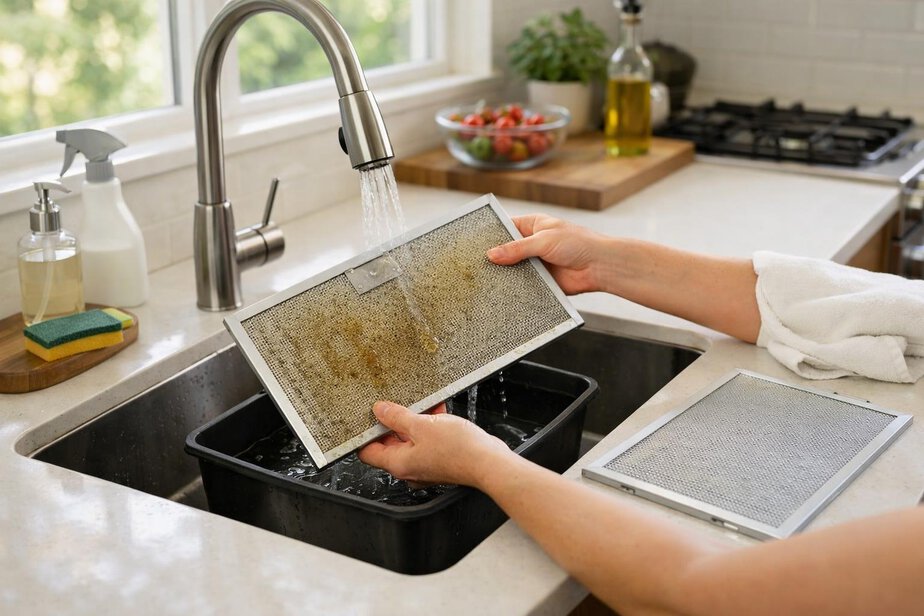
- Safe cleaning of removable household filters
- How often to inspect and clean
- When to call a professional
- What to do during a cooking-oil or rangehood fire
- Commercial kitchen risks and maintenance
- What firefighters want you to know
- Checklists, FAQs and next steps
How grease accumulates above the stove and why it is hazardous
Cooking produces more than visible steam. Frying, searing, grilling and roasting can release tiny droplets of oil and fat, along with vapours that travel upward from the cooktop. Those particles cool as they move into the rangehood and can settle on surfaces throughout the system.
In a kitchen, grease often builds up in layers:
- on rangehood filters
- on the canopy or underside of the hood
- around the fan housing
- inside ductwork in ducted systems
- on ceiling void surfaces near exhaust penetrations
- in commercial kitchens, inside plenums and exhaust fans
That residue matters because grease is combustible. It does not usually need a dramatic event to become dangerous. A pan that is too hot, a flare-up from oil, or flames that rise high enough can ignite the deposits. Once ignited, the fire may continue burning in hidden spaces that are difficult to reach from the kitchen itself.
Accumulated grease also affects how a rangehood works. Filters blocked with grime reduce airflow. Poor airflow can allow more smoke, heat and vapours to remain in the kitchen. That can make cooking less safe and can contribute to further deposits building up over time.
For households, the fire load is smaller than in a commercial kitchen, but the mechanism is similar. A neglected rangehood can become the path by which a simple cooking fire turns into a larger room fire.
How rangehood and exhaust fires start and spread
Most kitchen fires begin at the heat source, usually the stovetop or inside cookware. The fire then spreads upward or outward in one of several ways.
Common ignition pathways
- Cooking oil overheats: Oil can reach its smoke point and then ignite if heating continues.
- Flare-up from food: Flames from a pan can reach the underside of the rangehood and ignite grease deposits.
- Open flame contacts residue: Gas flames or burning food can ignite accumulated grease on nearby surfaces.
- Heat transfer into the hood: Very hot gases can preheat greasy deposits until they catch fire.
Once the deposits burn, the fire may follow the exhaust path. In a ducted system, that path can extend beyond the kitchen ceiling. In a commercial system, it may run through long duct sections, around bends, through the roof space and to the exhaust fan.
Fire spread is not always obvious at first. Smoke may appear to be coming only from the rangehood, but fire can also be travelling inside concealed spaces. That is one reason firefighters treat kitchen exhaust fires cautiously and reassess the incident as conditions change.
Why these fires can be deceptive
Kitchen exhaust fires can appear small at the cooktop while the concealed area is more involved. Grease inside the system may keep burning after the visible flames are knocked down or after the appliance is turned off. Heat can also damage plastic parts, insulation, cable insulation or surrounding linings, creating a broader hazard than the original pan fire.
For this reason, a fire that seems “under control” can still require urgent evacuation and emergency response. If the fire is growing, if smoke is spreading, or if the hood or ceiling space is involved, leave the area and call Triple Zero (000).
Ducted versus recirculating household rangehoods
Not all rangehoods work the same way. Knowing the difference helps you understand where grease may build up and what cleaning is realistic for a homeowner.
| Rangehood type | How it works | Main grease concern | Typical homeowner task |
|---|---|---|---|
| Ducted | Draws air through filters and sends it outside through ductwork. | Grease can build up in filters, the canopy, the duct and the fan. | Clean removable filters and visible surfaces only; seek professional help for inaccessible parts. |
| Recirculating | Draws air through grease filters and often charcoal filters, then returns air to the room. | Grease remains in the filters and housing; charcoal filters may also need replacement. | Clean or replace filters as directed and wipe accessible surfaces. |
In a ducted rangehood, the grease path extends beyond the kitchen. That means a buildup in the duct or fan can become a hidden fuel source. In a recirculating rangehood, there may be no ductwork, but the filter pack still needs care because it traps grease right above the cooking area.
Some appliances combine grease filters with charcoal or carbon filters. Grease filters are meant to capture oil droplets. Charcoal filters help with odour control and are usually not washable unless the manufacturer says otherwise. Do not guess. Follow the exact appliance instructions.
Do not assume that a rangehood is safe just because the outside looks tidy. If extraction is weak, the appliance is noisy, or you can smell burnt grease, there may be a deeper maintenance issue.
For apartment dwellers and renters, the same safety principles apply. You may be able to clean removable parts, but you should not dismantle fixed components or access concealed ducting without permission and proper expertise.
Warning signs of excessive grease or equipment problems
Early warning signs do not diagnose the exact fault, but they do tell you that the rangehood or exhaust system needs attention.
- visible sticky grease on filters or the hood body
- dripping deposits or dark staining around the canopy
- persistently weak extraction
- smoke lingering longer than usual after cooking
- unusual noises, rattling or vibration
- burning smells when the fan runs
- filters that are damaged, warped or difficult to secure
- flickering lights, tripping circuits or other suspected electrical faults
- grease collecting on nearby cupboards or ceilings faster than expected
If these signs are present, stop and assess. A dirty filter may be part of the problem, but it is not always the whole problem. A motor, fan wheel, duct bend, or electrical issue may also be involved.
For commercial premises, these signs may indicate that inspection and cleaning intervals are too long for the cooking load. In a home, they can mean the household cooking routine is producing more grease than expected or the appliance is overdue for maintenance.
Safe, step-by-step cleaning of removable household grease filters
Household cleaning should stay within the limits of the manufacturer’s instructions. If you are unsure, stop and check the appliance guide before you begin.
Before you clean
- Turn the appliance off and let everything cool fully.
- Read the manufacturer’s instructions for your exact model.
- Confirm whether the filters are washable or must be replaced.
- Make sure you can remove the filters without forcing them.
- Keep cleaning products away from motors, switches and exposed wiring.
Cleaning the removable filters
- Remove the filter carefully once it is cool.
- Handle greasy parts over a sink or protected surface to avoid drips.
- Clean only with suitable products recommended by the manufacturer.
- Rinse and dry thoroughly before refitting.
- Check that the filter sits back in place securely.
If the filter is not washable, replace it as directed. Do not keep using a filter that has torn mesh, bent frames or a clog that cannot be removed safely.
Wipe accessible external surfaces of the hood with a suitable cleaner and soft cloth. Avoid spraying cleaning fluid into the appliance. Never spray or pour liquids into the motor housing, duct entry points or any hidden electrical area.
Do not try to clean ceiling voids, roof spaces or concealed ducting from inside the kitchen. Those areas require proper access, suitable tools and competent personnel.
What not to do
- Do not use abrasive pads that may damage finishes or mesh.
- Do not soak electrical parts.
- Do not run the fan with wet filters refitted.
- Do not use solvents unless the manufacturer explicitly allows them.
- Do not dismantle fixed internal parts if that exposes wiring or the motor.
After cleaning, confirm that the filters are dry and correctly seated before using the rangehood again. A poorly fitted filter can rattle, reduce airflow or fall out during cooking.
How often to inspect and clean
There is no single safe schedule for every kitchen. Inspection and cleaning frequency should reflect how often you cook, the type of cooking you do, and the appliance manufacturer’s instructions.
As a practical guide, households that fry food often or cook oily meals several times a week should inspect filters and visible surfaces more often than a household that cooks lightly. A busy family kitchen can build grease faster than expected, especially if the hood is used on a low setting or the filters are already partially blocked.
For home users, it is sensible to:
- visually check the hood and filters regularly
- clean removable filters as soon as visible grease becomes obvious
- replace non-washable filters when the manufacturer says to do so
- review the appliance manual at least once a year
For commercial kitchens, frequency should be based on measured grease accumulation, cooking intensity and applicable requirements. A heavy-use kitchen may need far more frequent inspection than a light-use venue.
Standards and maintenance regimes can vary by building class, system design, state or territory requirements and the actual appliance setup. In commercial work, verify the applicable Australian Standard edition and local obligations before setting a cleaning plan. Do not rely on a one-size-fits-all schedule for every premises.
If you are a landlord, body corporate manager or property operator, make sure maintenance responsibilities are clear. Tenants may clean removable parts, but concealed systems and any electrical faults should be addressed by qualified persons.
When inaccessible ducting, motors or faulty equipment need professional attention
Some tasks are not suitable for homeowners, renters or untrained staff. If the issue is beyond removable filters and visible surfaces, bring in a competent professional.
Professional attention is appropriate when:
- ducting cannot be reached safely from the kitchen
- the fan motor is noisy, hot or behaving erratically
- you suspect electrical damage or overheating
- grease has leaked into places you cannot safely clean
- the hood has been exposed to a fire, flare-up or heavy smoke
- the unit is damaged, loose or no longer secured properly
- commercial access panels, roof penetrations or ceiling spaces are involved
Never attempt to access roof spaces, concealed duct runs or internal electrical parts unless you are trained and authorised to do so. In a commercial setting, that work usually belongs to maintenance contractors, mechanical services technicians or other competent professionals under the site’s safety procedures.
After any fire event, damaged equipment should be inspected before it is used again. Heat can distort metal, weaken fixings and damage fan motors or wiring even if the visible fire was small.
What to do during a cooking-oil or rangehood fire
The right response depends on whether the fire is small and contained or already growing. The safest action is the one that keeps you alive and gets everyone out of danger.
If the fire is small and safe to approach
- Turn off the heat source if you can do so without reaching through flames.
- Use a lid or a fire blanket to smother a small pan fire if you can do so safely.
- Leave the lid in place until the pan is completely cool.
- Call Triple Zero (000) if the fire does not go out immediately or if you are uncertain.
Never use water on burning oil or fat. Never pick up a burning pan and carry it outside. That can spread burning liquid and put you, other occupants and the escape route at risk.
If the fire is spreading or the rangehood is involved
- Get everyone out immediately.
- Close the door if it is safe to do so as you leave.
- Do not stop to collect belongings.
- Do not try to dismantle the rangehood or remove filters.
- Call Triple Zero (000) once you are safe.
A fire blanket or portable extinguisher should be located where it can be reached quickly but not right in the flame path. In a home, this means easy access without placing it above the stove where fire or heat could prevent safe use. If you are not trained or if the fire is already beyond a very small stage, evacuation comes first.
Suitable extinguishers and blankets can help only if used correctly and only when escape remains available. If the fire grows, smoke makes breathing difficult, or you are in doubt, leave.
Personal safety and evacuation always come before attempting to fight a kitchen fire. If in doubt, get out.
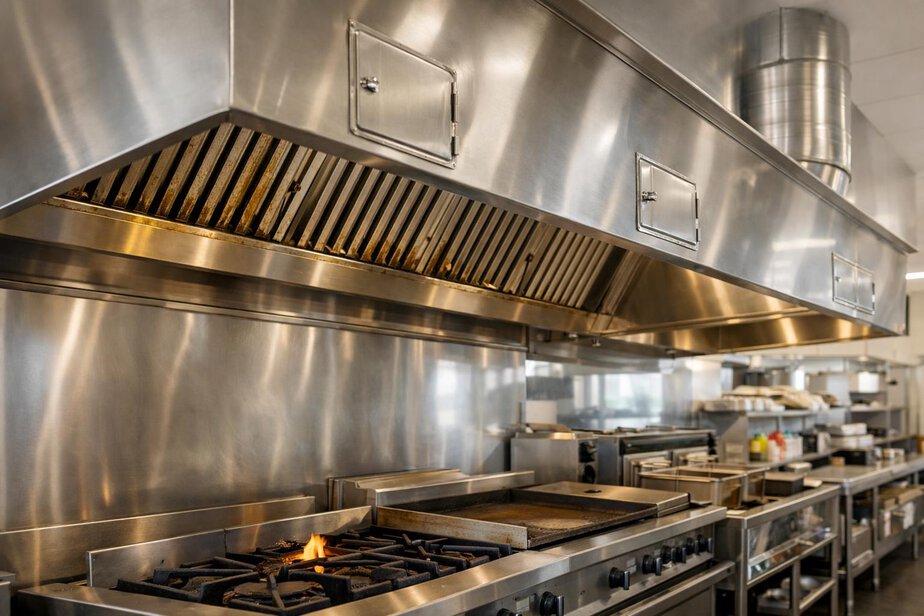
Commercial kitchen risks involving canopies, filters, plenums, ducts and exhaust fans
Commercial kitchens present a larger and more complex fire risk than domestic kitchens because they often run hotter, cook for longer and generate more grease-laden vapour.
The main components that matter are:
- Canopy: captures rising heat, smoke and grease vapours above the cooking line
- Filters: remove some grease before air enters the duct system
- Plenum: the internal cavity where air may collect before moving into ducting
- Ductwork: carries contaminated air away from the kitchen
- Exhaust fan: moves the air and may itself collect grease deposits
Cleaning the visible filters is important, but it is not enough on its own. Grease can remain inside the canopy, in the plenum, along duct walls, at bends and at the fan. That is why commercial exhaust management needs planned inspection, documentation and professional cleaning, not just front-of-house wiping.
Fire and Rescue NSW notes that restaurant fire hazards include unattended cooking, overheated oil and ignition of fatty deposits in rangehoods and ducting. Australian industry guidance also recognises that the whole system, not just the filter face, needs attention.
In practice, commercial maintenance should be based on the actual cooking load, the amount of grease observed, the equipment design and the rules that apply to the site. A deep-fry heavy kitchen will not have the same risk profile as a light-duty café line.
Staff training matters too. People working the line should know how to recognise a flare-up, when to isolate equipment if it is safe, when to use suppression measures if installed, and when to evacuate and call Triple Zero (000).
Commercial maintenance checklist
- clean filters according to the site plan and manufacturer instructions
- inspect canopies, plenums and visible duct access points
- check fans, belts, guards and access panels where applicable
- confirm suppression systems and extinguishers are in service and accessible
- review staff response procedures and emergency evacuation steps
- record maintenance, cleaning and any defects found
Do not treat this as a fixed legal program for every premises. Local requirements, system type and building classification may change what is needed. Use competent professionals and verify the applicable standards for the site.
Simple diagram: where grease can build up and how fire may spread
The following simple layout shows the general path. It is not a technical drawing, but it helps explain why fire can travel beyond the cooktop.
| Location | What may accumulate there | Why it matters |
|---|---|---|
| Cooktop and pan | Hot oil, fat, food debris | Initial ignition point for many kitchen fires |
| Rangehood filter | Grease droplets and residue | Can ignite if flames or hot gases reach it |
| Canopy and hood interior | Sticky grease film | Can spread flame upward into the appliance |
| Ducting or plenum | Deposited grease beyond the filter | Can burn in concealed spaces |
| Fan or roof space | Grease on moving parts or nearby surfaces | Can complicate suppression and overhaul |
Think of the system as a pathway. The fire may start at the pan, travel into the hood, then continue into hidden parts of the exhaust system if grease has been allowed to build up.
Household inspection checklist
This checklist is suitable for a quick routine check in a home or rental property. If anything looks damaged or unsafe, stop and seek advice.
- Are the filters seated properly and free of obvious damage?
- Is there visible sticky grease on the hood or surrounding cupboards?
- Does the fan sound normal when operating?
- Is extraction still strong enough to remove steam and smoke?
- Is there any burning smell, rattle or unusual vibration?
- Are lights and switches working without flicker or tripping?
- Have you cleaned or replaced filters as the manufacturer directs?
- Are any signs of grease dripping from hidden areas?
- Is a fire blanket or suitable extinguisher accessible but not in the cooking zone?
If more than one of these items is not right, the appliance needs attention. Do not ignore it because the rangehood still turns on.
What firefighters want you to know
From an emergency response perspective, kitchen exhaust fires are not just “small grease fires”. They can involve concealed extension, smoke movement through the building, and hidden grease in places that are difficult to reach safely.
When firefighters attend, initial size-up should focus on:
- life safety and whether occupants are accounted for
- the fire location, including whether it is in the pan, canopy or duct system
- signs of concealed extension into ceiling spaces or roof cavities
- how the building construction may channel heat and smoke
- whether the exhaust system can be safely isolated
- the likelihood of re-ignition from hidden grease deposits
In commercial premises, the duct path, roof penetration and fan location can change the incident significantly. Smoke showing from a hood does not always tell the whole story. A small visible fire may be a symptom of a more extensive concealed fire within ducting or the plenum.
Overhaul can be difficult because grease may remain in cavities, bends and inaccessible sections. That means crews may need to reassess repeatedly, especially if smoke continues after visible flame knockdown. Ventilation choices must be made in the context of the specific fire, the building layout and agency procedures.
Firefighters should also consider the possibility of contamination spread. Grease and smoke deposits can extend beyond the immediate fire area and may affect neighbouring spaces, roof voids or adjoining service runs.
These are operational considerations, not universal tactics. Training, local doctrine and incident conditions should determine the response.
Author experience note and review details
Author experience note: This guide has been prepared from a public-safety and emergency-management perspective using verified Australian fire authority guidance and industry source notes. It does not rely on personal incident claims.
Last reviewed: October 2026.
Corrections welcomed: If you work in fire safety, mechanical services, hospitality, or emergency response and notice anything that should be updated, please suggest a correction before publication use or local distribution.
Practical next steps
- Check your rangehood filters this week.
- Read the manufacturer instructions for cleaning and replacement.
- Keep a lid or fire blanket nearby, but not in the direct cooking hazard zone.
- Make sure everyone in the home knows never to use water on burning oil.
- In a commercial kitchen, confirm who is responsible for canopy, duct and fan maintenance.
- Review evacuation and emergency call procedures with staff or family members.
- If you suspect a fault or hidden grease buildup, arrange professional inspection rather than improvising.
For related FireRescue guides, you may also want to review: https://www.firerescue.com.au/home-fire-safety-checklist-australia-firerescue/ and https://www.firerescue.com.au/emergency-resilience-managing-fuel-load-and-using-fire-extinguishers-effectively/
FAQs
Can I put out a small pan fire with water?
No. Water can spread burning oil and make the fire flare violently. If the fire is small and safe to approach, turn off the heat and cover the pan with a lid or fire blanket. If it is not safe, evacuate and call Triple Zero (000).
Should I remove the rangehood filters during a fire?
No. Do not remove filters if there is fire, heavy heat or smoke. Your priority is escape and calling for help if the fire is spreading.
How do I know if my rangehood needs professional cleaning?
If you cannot reach all the dirty parts safely, if the hood smells burnt, if extraction is weak, if the fan is noisy, or if there is any electrical concern, arrange professional attention.
Are recirculating rangehoods safer than ducted ones?
Neither type is automatically safe or unsafe. Recirculating units still collect grease and need filter care. Ducted systems can spread fire beyond the kitchen if grease builds up inside them.
Do commercial kitchens need the same cleaning routine as homes?
No. Commercial kitchens usually need more frequent and more detailed maintenance because cooking intensity and grease loads are greater, and the exhaust system is more complex.
Conclusion
Rangehood and kitchen exhaust fires are often preventable, but prevention depends on more than wiping the outside of the appliance. Grease must be controlled at the cooktop, in removable filters, and, in commercial systems, throughout the canopy, plenum, ducting and fan path. If a fire starts, the safest response is to protect life first, avoid water on burning oil, and call Triple Zero (000) whenever the fire is spreading or unsafe to control.
Use the checklist, follow the manufacturer’s instructions, and escalate to a competent professional when the job moves beyond routine household cleaning. Before using or sharing this article, verify the facts, standards and local procedures that apply in your area.
Proposed featured image: Modern bright realistic editorial photograph, wide landscape orientation, Australian home kitchen with stainless steel rangehood above a stovetop, subtle grease-cleaning context, no text, no logos, no identifiable people. Filename: rangehood-fire-safety-australia-featured.jpg. Alt text: Modern Australian kitchen with stainless steel rangehood above a stovetop.
Proposed A4 educational infographic: Modern bright realistic editorial infographic-style layout, wide landscape orientation, showing a simple diagram of grease build-up from pan to filter to ducting and a safe response checklist, no text watermark brands, no people, clean background. Filename: rangehood-grease-fire-infographic-a4.jpg. Alt text: Diagram showing how grease can build up in a rangehood and spread fire through the exhaust system.
FireRescue Training Hub
Access practical fire and emergency study support resources, downloads, checklists, audio guides, and member-only course content.
- Course library
- PDF downloads
- Audio guides
- Checklists
Study support only. Not accredited training or a replacement for workplace procedures.
About the author and safety review
Ken Walker
Former Station Officer and fire service educator
Former career firefighter with extensive career and volunteer fire service experience.
Qualifications: Associate Diploma of Applied Science in Fire Technology; Institute of Fire Engineers studies.
Author profilehttps://www.firerescue.com.au/about-us/