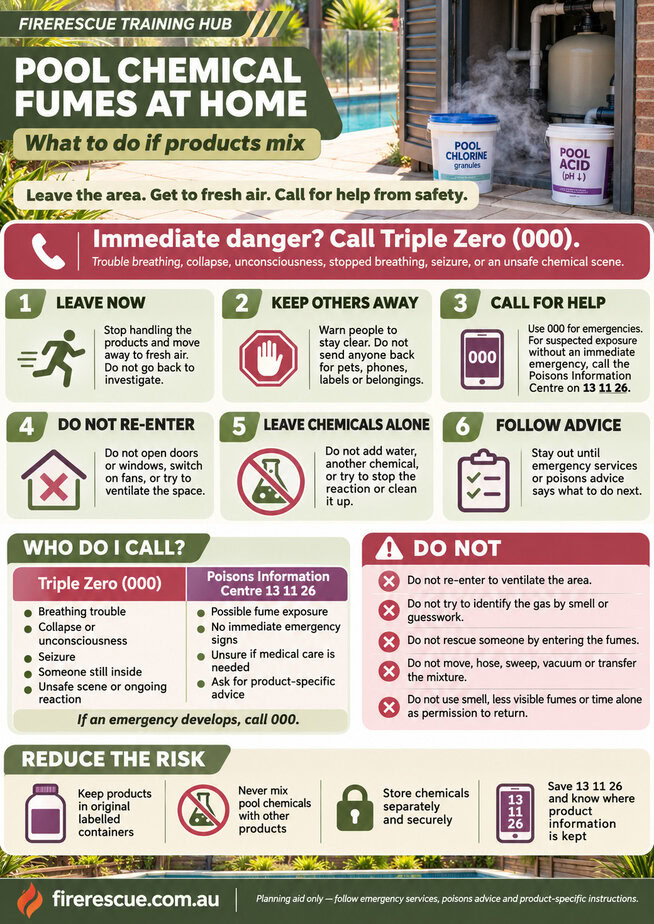
If pool chemicals have mixed and fumes are present, stop what you are doing and leave the affected area for fresh air. Do not go back to investigate, open windows, collect containers or attempt a rescue.
Call Triple Zero (000) from a safe location if anyone is having trouble breathing, has collapsed, is unconscious, has stopped breathing or is having a seizure. Also call Triple Zero if the chemical reaction is creating an unsafe scene or someone remains in the affected area.
For suspected exposure without an immediate emergency, call the Poisons Information Centre on 13 11 26. Do not wait for symptoms before seeking advice. If there is an emergency, call Triple Zero first.
First steps: people before products
- Leave the fumes. Stop handling the products and move away from the affected area to fresh air. Do not approach the mixture to identify it.
- Warn others without entering the area. Tell people to stay away. Do not send someone back for pets, phones, labels or belongings.
- Call for help from a safe place. Tell the operator that pool chemicals have mixed and fumes are present, and describe anyone’s symptoms.
- Leave the chemicals alone. Do not add anything, try to stop the reaction or begin cleaning up.
- Stay out until you receive appropriate advice. A quieter reaction or less noticeable smell is not a reliable basis for deciding to return.
You do not need to know the chemical names before calling. The location, what happened and whether anyone is exposed are enough to start the conversation.
Should I open doors or windows?
Do not re-enter a fume-affected space to ventilate it. Do not delay leaving to open windows, switch on fans or inspect the spill.
General poisoning advice sometimes recommends fresh air and opening doors or windows only if it is safe. That condition matters. It is not an instruction to enter a shed, garage, pool plant room or other space containing chemical fumes.
If you are already outside, stay out. If you are leaving, prioritise getting away rather than trying to ventilate the area on your way. Let emergency responders decide how to manage ventilation at an unsafe scene.
There is no single safe distance or ventilation method that suits every incident. The products, amount involved, location and surrounding conditions all matter. Give the emergency operator your location and follow their directions about where to wait.
Triple Zero or the Poisons Information Centre?
These services have different roles. Triple Zero is for an immediate emergency; the Poisons Information Centre provides advice about suspected poisoning and what medical care may be needed.
| Situation | What to do |
|---|---|
| Someone has trouble breathing, collapses, is unconscious, stops breathing or has a seizure. | Call Triple Zero (000) immediately. Describe the chemical exposure and ask for an ambulance. |
| Fumes or an ongoing reaction make the scene unsafe, or someone is still inside the affected area. | Call Triple Zero (000). Explain the chemical incident and whether anyone is trapped or exposed. Stay out. |
| Someone may have inhaled fumes but has no immediate emergency signs. | Once clear of the fumes, call the Poisons Information Centre on 13 11 26 promptly. Do not wait for symptoms. |
| You are unsure whether an exposure needs medical attention. | Call 13 11 26 for case-specific advice. If breathing becomes difficult or another emergency develops, call 000. |
The Poisons Information Centre can be contacted at any time. A call about possible exposure does not replace an emergency response to a hazardous scene, and it does not provide automatic clearance to return.
Helping someone who has inhaled fumes
Do not enter the contaminated area to reach them. An attempted rescue can expose another person and make the emergency worse.
If someone remains inside or cannot get out, call Triple Zero immediately. Tell the operator exactly where the person is and that chemical fumes are involved. Follow the operator’s instructions without entering the affected area.
If the person has already reached fresh air, remain in a safe location and seek help according to their symptoms. Tell the operator about breathing difficulty, coughing, eye irritation or any other symptoms, and whether they are changing.
If someone is unresponsive or not breathing normally, call Triple Zero and follow the call-taker’s first-aid and resuscitation instructions. Make the chemical hazard clear so the advice takes account of the scene.
Do not assume that feeling better after leaving the area means the exposure needs no further attention. Contact the Poisons Information Centre and follow its advice about medical assessment and what to watch for.
What if chemicals also touched skin or eyes?
Tell Triple Zero or the Poisons Information Centre about every type of contact, not just inhalation. A splash, contaminated clothing and fumes may require different first-aid advice.
Ask for immediate instructions appropriate to the actual product and exposure. Do not return to the affected area to reach a tap, collect protective equipment or obtain a label.
What information should I give when I call?
Start with what is happening now. Do not delay the call while trying to work out the chemistry.
- Location: the street address and whether the incident is in a house, garage, shed, pool equipment area or outdoors.
- People involved: how many may have been exposed, their ages if known, their symptoms and whether anyone remains in the affected area.
- What happened: when the products mixed and what you were doing at the time.
- Products: names and label details, but only if already known or available without approaching the hazard.
- Amounts: an estimate if you know it. Say when you are unsure.
- Current conditions: any fumes, smoke, fire or continuing reaction you have already noticed. Do not approach to check.
- Exposure details: roughly how long the person was nearby, whether chemicals touched their skin or eyes, and any first aid already given.
A label photograph or safety data sheet may help if it is already accessible from a safe location. Do not retrieve one from the affected area, and do not carry a leaking or reacting container to someone for identification.
Why you should not guess which gas is present
“Pool chemicals” describes a range of products, not one substance. A product’s purpose or appearance is not enough to identify the ingredients or predict what an accidental mixture will do.
Do not rely on an online mixing chart, a familiar smell or a guess about the gas to decide whether the area is safe. Emergency responders and poisons specialists need the actual product information where it can be obtained safely.
The immediate priority does not depend on identifying the gas: avoid further exposure, get people clear and seek appropriate help.
Who should handle cleanup and decide when to return?
Do not treat a fume-producing reaction as an ordinary household spill. Keep away from the mixture and leave cleanup decisions to emergency responders or appropriately qualified, product-specific advice.
- Do not add water, another chemical or a household substance to try to dilute or neutralise the mixture.
- Do not sweep, vacuum, hose away or transfer the material into another container.
- Do not move a reacting container or try to seal it.
- Do not put the mixture into household rubbish, drains or the pool.
These are boundaries for an accidental reaction, not instructions for normal pool dosing. Routine product directions should never be improvised into a spill-cleanup method.
If emergency services attend, follow their directions about access, ventilation and any remaining cleanup arrangements. If no service attends, obtain specific advice about the products and circumstances before approaching the area.
Do not use a fixed waiting period, the disappearance of visible fumes or your sense of smell as permission to return. Ask who will assess the area and what must happen before normal use can resume.
Reducing the risk of another incident
Prevention starts with knowing exactly which product you are using and keeping it separate from other chemicals. General household-poisoning guidance supports original, clearly labelled containers and secure storage away from children. Pool products also need storage and handling arrangements that match their own labels.
- Read the actual label before use. Do not assume a replacement product has the same ingredients or directions as the previous one.
- Never mix pool products together or with other household chemicals. Follow the directions for each product’s intended use.
- Keep products in their original labelled containers. Never transfer them into food or drink containers.
- Follow product-specific storage requirements. Check which materials must be kept separate rather than assuming one cupboard suits everything.
- Prevent access by children. Keep chemicals secured, out of sight and out of reach in storage suitable for those products.
- Avoid improvisation. If directions are missing, unclear or inconsistent with your equipment, seek advice before using the product.
- Plan for unwanted chemicals. Ask about an appropriate local disposal service before transporting them. Do not take an active reaction or leaking container to a routine collection point.
Save 13 11 26 in your phone and make sure adults who maintain the pool know where product information is kept. An accessible digital copy can help avoid the temptation to retrieve a label during an incident.
The main thing to remember
If pool chemicals mix and produce fumes, the first job is not to save the chemicals or fix the spill. Leave, keep others away and call for help from safety. Use Triple Zero for serious symptoms or an unsafe scene, and the Poisons Information Centre for exposure advice when there is no immediate emergency.
If you spot an error or have updated Australian agency guidance relevant to this article, please let the editorial team know so it can be reviewed.
Related FireRescue guides
- Home Oxygen Fire Safety: What Australian Families Need to Know
- Integrated Residential Bushfire Protection System Part 20: What Could Go Wrong?
- Integrated Residential Bushfire Protection System: A New Approach to Protecting Homes and Residents
Sources and further reading
- healthdirect Australia: Inhaled substance or object
- healthdirect Australia: Poisoning
- South Australian Metropolitan Fire Service: Hazardous Materials
- Sydney Children’s Hospitals Network, NSW Health: Poisons safety
Source material was gathered for this draft on 17 November 2026. Confirm current official advice for your location. Readers can contact FireRescue with corrections or relevant field experience.
FireRescue Training Hub
Access practical fire and emergency study support resources, downloads, checklists, audio guides, and member-only course content.
- Course library
- PDF downloads
- Audio guides
- Checklists
Study support only. Not accredited training or a replacement for workplace procedures.
About the author and safety review
Ken Walker
Former Station Officer and fire service educator
Former career firefighter with extensive career and volunteer fire service experience.
Qualifications: Associate Diploma of Applied Science in Fire Technology; Institute of Fire Engineers studies.
Author profilehttps://www.firerescue.com.au/about-us/