In an apartment fire, a closed fire door can mean the difference between a contained incident and a smoke-filled escape route. These doors are part of the building’s passive fire protection, and they only do their job when they are correctly installed, maintained and kept closed or automatically released as designed.
Quick summary: Fire doors are not ordinary doors. They help slow the spread of fire, heat and smoke, protect corridors and stairs, and support safe evacuation and firefighting operations. Never wedge one open unless it is part of an approved automatic hold-open system that will release when required.
Table of contents
- What is a fire door, and how is it different from an ordinary door?
- Why fire doors are important in apartment buildings
- How closed doors help restrict smoke, heat and fire
- Apartment entrance doors, corridor doors, stairwell doors and smoke doors
- How fire compartmentation protects neighbouring apartments
- Why wedging fire doors open creates serious risks
- Self-closing devices, latches, door frames and smoke seals
- Common fire door defects and warning signs
- Why residents should never modify fire-rated doors without professional approval
- What residents should do when a fire door is damaged or will not close
- Responsibilities of residents, landlords, owners corporations and building managers
- What to do during an apartment fire, including when escape is unsafe
- What firefighters want you to know
What is a fire door, and how is it different from an ordinary door?
A fire door is part of a building’s fire safety system. It is designed and installed as an assembly, not just as a single door leaf. Depending on the building, that assembly can include the door leaf, frame, hinges, closer, latch, seals, glazing and compatible hardware. Some fire doors are also smoke doors, meaning they are intended to limit the passage of smoke as well as fire.
An ordinary internal door is made for privacy, noise reduction and day-to-day use. It may look similar to a fire door, but it is not built or tested the same way. A fire door has to suit the building design, the door’s location and the relevant construction requirements. In Australian apartment buildings, those requirements can vary depending on the building’s classification, construction type, approval documents and applicable state or territory rules.
That is why it is important not to assume that every apartment door is a certified fire door. Some apartment entrance doors are fire-rated. Some are not. Some internal doors within an apartment may be ordinary doors, while others may form part of the building’s required fire resistance measures.
What is a fire resistance level?
You may hear the term Fire Resistance Level, or FRL. In plain language, it describes how a building element is tested to resist structural failure, flame spread and heat transfer under standard conditions. It does not mean a door will perform perfectly in every real-life fire. Fire doors are still only one part of a wider safety system, and their performance depends on correct installation, maintenance and use.
Why fire doors are important in apartment buildings
Apartment buildings place many people close together. Fire doors help create barriers that limit how quickly fire, heat and smoke can move from one part of the building to another. That matters because in a multi-storey building, the safest exit route is often shared by many residents at once.
When a fire starts in one apartment, the biggest immediate danger is often smoke. Smoke can spread faster than flames, reduce visibility, irritate breathing, and make stairs and corridors unusable. A properly functioning fire door helps preserve these paths long enough for people to escape and for firefighters to access the fire area.
Fire doors also help protect people who are not directly involved in the fire. A resident two floors away may never see flames, but they can still be affected if smoke migrates into a corridor or stairwell. That is why a fire door sitting closed and latched is not a small detail. It is part of the building’s life safety strategy.
In many apartment buildings, fire doors are part of the required Essential Safety Measures or equivalent fire safety measures. They support the building’s overall fire engineering intent and help reduce the chance that one fire becomes a building-wide emergency.
How apartment safety changes during a fire
- Fire may be confined for longer in the room or apartment where it started.
- Smoke may be slowed from entering corridors and stairs.
- Occupants in other units may have more time to evacuate or shelter safely.
- Firefighters may be able to move through protected access routes more effectively.
How closed doors help restrict smoke, heat and fire
Closing a door does not make a space fireproof. It does, however, reduce the path available for fire and smoke to move. That simple action can have a major effect in a building where escape routes depend on protected corridors and stairwells.
Smoke spread is especially important. A door left open between a fire apartment and the corridor may allow smoke to fill the hall and move toward the stairs. Once smoke enters a stairwell, it can affect multiple levels and place people who are trying to evacuate at greater risk. Even a modest amount of smoke can make it hard to breathe, hard to see and hard to orient yourself in an emergency.
Closed doors also help manage heat. Heat can weaken materials, damage nearby fittings and make evacuation more dangerous. By slowing the transfer of heat, a closed fire door can help maintain conditions in neighbouring areas for longer.
Fire spread is influenced by many factors, including ventilation, pressure differences, building design and the intensity of the fire. That is why firefighters and building safety specialists talk about compartmentation. The building is divided into intended fire-resisting spaces, and protected openings such as fire doors help preserve those boundaries.
In practical terms, a closed fire door buys time. That time may be enough for someone to leave safely, for another resident to avoid smoke in a stairwell, or for crews to attack the fire from a safer position.
Closed doors versus open doors
| Condition | Likely effect | Safety impact |
|---|---|---|
| Correctly closed and latched fire door | Helps restrict smoke, heat and flames | Improves protection of corridors, stairs and adjoining spaces |
| Door wedged open | Allows smoke and heat to move more freely | Can compromise evacuation routes and firefighting access |
| Door held open by approved automatic system | Opens for normal use, closes when triggered | Can be acceptable if designed, installed and maintained correctly |
Apartment entrance doors, corridor doors, stairwell doors and smoke doors
Not every door in an apartment building has the same purpose. The location of the door helps determine what level of protection it needs and how it should operate. Residents should understand the broad differences, even if they do not need to know the technical specifications.
Apartment entrance doors
Some apartment entrance doors are designed as fire-resisting doors, particularly where they form part of the fire separation between a dwelling and a common corridor. Others may have different construction depending on the building design. Residents should not assume a door can be modified just because it is “only the front door”.
Corridor doors
Common corridor doors may separate different fire compartments or protect access to a stairway or service area. These doors may need to self-close and latch so that shared paths remain protected.
Stairwell doors
Fire-isolated stairways are critical escape routes. Their doors are intended to help keep smoke and heat out of the stairwell as long as possible. If these doors are left open or do not latch properly, the stair may become hazardous for everyone relying on it.
Smoke doors
A smoke door is intended primarily to restrict smoke movement. In some situations, a door may perform both fire and smoke control functions. The exact design depends on the building’s approval and the applicable construction requirements.
Some fire doors may be held open by approved automatic release systems. These systems are different from a wedge, a chair, a box or any improvised stop. If the system detects fire conditions or receives a signal, the door should close as designed. Residents should never interfere with that operation.
How fire compartmentation protects neighbouring apartments
Fire compartmentation is the idea that a building is divided into spaces intended to slow the spread of fire. In apartment buildings, those barriers are commonly provided by fire-resisting walls, floors and protected openings. A fire door is one of the key protected openings in that system.
When a fire door is closed and latched, it helps preserve the separation between compartments. That can protect neighbouring apartments, common corridors and stairwells long enough for occupants to evacuate or shelter.
If a required fire door is propped open, the compartment boundary may be compromised. That does not guarantee the fire will spread, but it removes an important layer of protection. A small fire can then have a larger effect on the building than expected.
This is particularly important in buildings where people may evacuate through the same corridor or stairwell. If the route is contaminated by smoke, residents from unaffected apartments may be forced into danger even though the fire began elsewhere.
Why wedging fire doors open creates serious risks
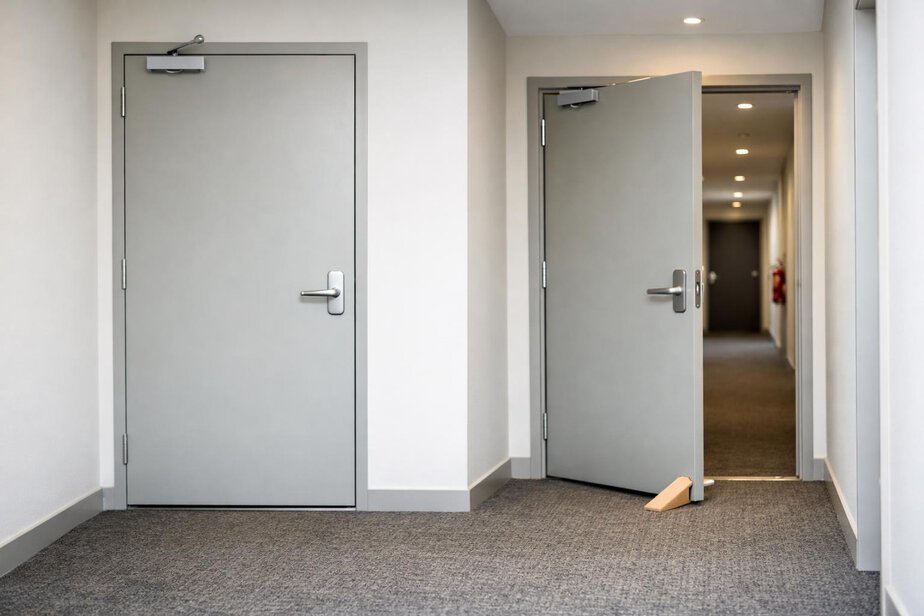
Wedging a fire or smoke door open is one of the most common and dangerous mistakes in apartment buildings. A wedged-open door may feel convenient during moving days, hot weather, deliveries or cleaning, but the convenience comes at a safety cost.
Fire doors are designed to close. If they are blocked open, they cannot do the job they were installed for. In the event of a fire, the open doorway may become a direct path for smoke and heat into the corridor or stairwell. That can cut off escape and make firefighter access harder.
Why residents sometimes wedge doors
- To move furniture or groceries more easily
- For ventilation on warm days
- To make cleaning or maintenance easier
- To stop a door from slamming
- Because the closer is faulty and the door seems annoying to use
These reasons may sound minor, but fire safety systems must be treated as essential, not optional. If a door is difficult to use or closes too quickly, that is a fault to report, not an excuse to disable it.
Some approved fire doors are part of automatic hold-open systems. Those are different because they are engineered to release when required. An improvised wedge, however, does not know when to let go and cannot assist evacuation or firefighting.
| Correctly closed fire door | Wedged-open fire door |
|---|---|
| Helps preserve the building’s intended fire separation | Removes an important barrier to smoke and heat |
| Can support evacuation and firefighting | Can expose escape routes to smoke |
| May self-close or hold open only by approved system | Held open by obstruction or convenience |
| Aligned with the building’s fire safety design | Can undermine the building’s safety measures |
Self-closing devices, latches, door frames and smoke seals
A fire door works as a system. Several components must work together for the door to perform as intended. If one part is damaged, missing or incompatible, the whole assembly may be affected.
Key parts of the assembly
- Door closer: Returns the door to the closed position after use.
- Latch: Helps keep the door shut when closed.
- Frame: Supports the door and helps maintain the intended fit.
- Hinges: Allow the door to move smoothly without sagging.
- Smoke seals: Help limit the movement of smoke around the edges of the door where required.
- Compatible hardware: Includes approved handles, locks, glazing and other fittings.
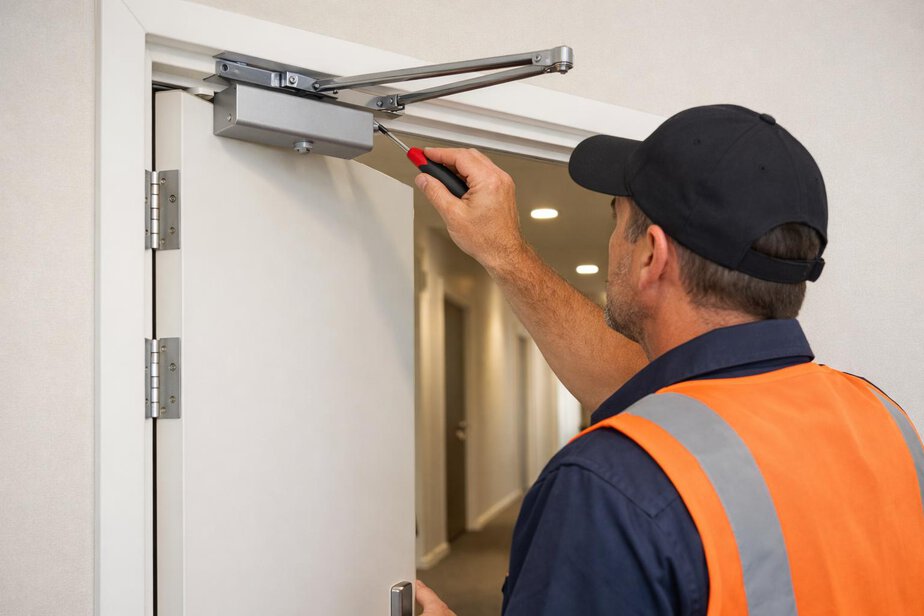
Problems with any of these parts can affect how the door closes and whether it latches properly. A door that nearly closes but does not latch is not doing its job. A closer that is too weak, disconnected or poorly adjusted may leave the door open by a small amount, which is enough to reduce protection.
Residents should not try to tune, remove, replace or upgrade these parts themselves unless they are authorised and qualified to do so. Fire doors are not a place for general DIY work.
Approved systems versus makeshift fixes
An approved automatic hold-open device is part of the fire safety design and should be installed and maintained accordingly. A towel under the door, a hook, a coin, a piece of timber or a rubber stop is not an acceptable substitute. Improvised fixes can create false confidence and may delay a door closing when it is needed most.
Common fire door defects and warning signs
Residents, owners corporations, landlords and building managers should know what to look for. The aim is not to diagnose the problem in detail, but to spot issues early and report them before they become serious.
| Common defect | Associated risk | Appropriate action |
|---|---|---|
| Door is wedged or held open by an object | Smoke and fire may move into protected areas | Remove the obstruction only if it is safe to do so, then report the issue immediately |
| Door does not close fully | Reduced protection of corridors or stairs | Report to building management or the landlord without delay |
| Door fails to latch | Door may swing open in normal use or during fire conditions | Report for professional inspection |
| Damaged closer or loose hinge | Door may not self-close as designed | Report promptly and avoid forcing the door |
| Damaged seals, frame or glazing | Protection from smoke, heat or fire may be compromised | Report and do not attempt repairs yourself |
| Unapproved cuts, holes, new hardware or modifications | Assembly may no longer match its approved design | Stop using the area as a place for DIY changes and seek specialist review |
Warning signs can also include scraping at the floor, a door that swings freely when it should not, visible gaps that look larger than before, signs of impact damage, or a door that has been painted, drilled or altered in ways that seem inconsistent with its intended use.
These are reasons to report, not reasons to test aggressively. Do not repeatedly slam, wedge or dismantle a fire door to see whether it works. That can create more damage and may interfere with building operations.
Why residents should never modify fire-rated doors without professional approval
Residents sometimes want to install a new lock, change a handle, replace a closer or hang something from a door. On an ordinary internal door, these changes may seem harmless. On a fire-rated door, they can undermine the assembly.
A fire door works because it is a tested system. Hardware compatibility, door thickness, frame fit, glazing, seals and the method of attachment all matter. A change that seems minor can alter the door’s performance or move it away from the approved configuration.
That does not mean residents must live with a faulty door. It means the repair or modification should be handled by the right person, using the right parts, with the right approval. Building management, the landlord or the owners corporation should be notified, and a competent specialist should assess the issue if necessary.
Do not assume that a hardware store replacement part is acceptable. Do not cut into the door to fit a wider lock. Do not remove seals to make the door shut more quietly. Do not paint over labels or identification marks that may be needed for compliance records.
What residents should do when a fire door is damaged or will not close
If you notice a fire door is damaged, wedged open or not closing properly, act promptly. A small defect can become a major safety issue if it is ignored.
- Do not continue using the door as if nothing is wrong.
- If safe to do so, remove any obvious obstruction such as a wedge or box.
- Do not force the door, disconnect hardware or try to repair it yourself.
- Report the issue to the landlord, building manager, owners corporation or relevant emergency contact as soon as possible.
- Describe the problem clearly: for example, “door does not latch”, “closer looks damaged”, or “door is being held open”.
- If the door is in a common area and appears to create an immediate safety risk, treat it as urgent.
Where there is a building emergency system or fault-reporting process, use that process as directed. If you are unsure who is responsible, report the issue to whichever building contact is listed for urgent safety matters and follow up in writing if needed.
Resident fire door safety checklist
- Check that the door is not wedged or obstructed.
- Look for visible damage to the leaf, frame, closer, hinges or seals.
- Confirm the door appears to close and latch normally after use.
- Note any unusual gaps, scraping, missing parts or obvious tampering.
- Report problems promptly and keep a record of when you reported them.
Responsibilities of residents, landlords, owners corporations and building managers
Fire door safety is shared work. Residents must use doors properly and report faults. Landlords, owners corporations and building managers must help ensure building safety systems are maintained.
Responsibilities can vary depending on the building, the ownership structure and the relevant law. In some cases, apartment entrance doors or hardware may be part of common property. In other cases, the responsibility may sit with the lot owner or another party. The important point is not to guess. Check the building documents and the relevant local arrangements.
For residents
- Do not wedge fire or smoke doors open.
- Do not alter, paint, drill or replace fire-rated hardware without approval.
- Keep escape routes clear of prams, shoes, bikes, furniture and stored items.
- Learn the building’s emergency procedures.
- Report defects quickly and clearly.
For landlords, owners corporations and building managers
- Maintain fire doors and associated hardware as part of the building’s safety systems.
- Arrange inspections and repairs by competent persons where required.
- Keep maintenance records and follow the building’s approval documents and local obligations.
- Respond promptly to reports of doors that do not close, latch or align properly.
- Make sure residents know how to report faults and who is responsible for action.
In Victoria, fire doors may form part of the building’s Essential Safety Measures. Other states and territories have their own frameworks and terminology. The practical lesson is the same: a fire door is not a set-and-forget item.
What to do during an apartment fire, including when escape is unsafe
The correct action in a fire depends on what is happening around you. If you are alerted to a fire and it is safe to evacuate, leave immediately, follow the building’s emergency plan and use the fire stairs rather than ordinary lifts. Close doors behind you where it is safe to do so. Do not stop to collect unnecessary items.
If you are in a corridor or common area with smoke, move quickly and calmly. Keep low if needed, follow exit signs and use the nearest appropriate exit. If a fire door or stair door is open, do not assume it is safe simply because it is open. Check the conditions around you and follow the emergency plan.
If escape is unsafe, seek protection inside your apartment or another protected area, close doors against smoke and call Triple Zero (000). Give your exact apartment number, level and building address. Follow any instructions given by emergency services. If smoke begins entering the unit, reduce movement, stay low where possible and communicate your location as clearly as you can.
People with reduced mobility or disability should consider a Personal Emergency Evacuation Plan where appropriate and discuss it with building management in advance. The right plan depends on the building and the individual. It should be practical, known to the right people and reviewed when circumstances change.
Simple action guide for residents
- Alert others only if it is safe.
- Leave by the designated exit route if safe to do so.
- Close doors behind you where safe.
- Use the fire stairs, not the lift.
- If you cannot escape safely, shelter from smoke, call 000 and wait for instructions.
What Firefighters Want You to Know
Firefighters rely on apartment fire doors to support safe and effective operations. A closed and intact fire door can help preserve a stairwell, protect access routes and reduce the amount of smoke moving through the building. When doors are compromised, crews may face heavier smoke conditions, more difficult access and greater uncertainty about where occupants may be located.
Smoke logging in corridors and stairs can slow rescue and make it harder for crews to move through the building. If a stairwell is contaminated, it may no longer serve as a reliable route for evacuation or attack. That is one reason fire doors and stair doors are taken seriously by emergency services.
Door control matters. Firefighters may need to open or close doors as part of their work, but that is a professional task carried out under agency procedures and incident conditions. Residents should not try to direct, copy or imitate that work. Their job is to avoid obstructing fire doors, evacuate when safe and give clear information to emergency services.
Compartment integrity also matters. If a required fire door has been wedged open, damaged or altered, the intended barriers may not be available when needed. That can affect the spread of smoke and heat as well as the ability to isolate the fire area from the rest of the building.
For firefighters, inspectors and fire safety practitioners
- Assess door condition as part of the broader building compartmentation picture.
- Consider whether self-closing, latching and door alignment are functioning as intended.
- Pay attention to smoke movement through corridors, lobbies and stair enclosures.
- Note compromised barriers that may affect evacuation or attack routes.
- Confirm that any hold-open arrangements appear to be approved and functioning as designed.
Professional judgement, agency procedures and the building’s approved fire safety design should guide operational decisions. The key public message remains simple: a fire door is a life safety feature, not an inconvenience to be propped open.
Building management inspection and maintenance checklist
Building managers, owners corporations and landlords should build fire doors into routine inspection and maintenance programs. The exact frequency and documentation requirements depend on the building and its approvals, so check the relevant local obligations and the approved fire safety schedule where one exists.
Management checklist
- Inspect doors for visible damage, tampering, wear and obstruction.
- Confirm doors close and latch correctly.
- Check closers, hinges, seals and frames for obvious defects.
- Verify that any approved automatic hold-open systems release as intended.
- Keep common areas clear so doors can operate properly.
- Record defects, actions taken and completion of repairs.
- Follow up resident reports promptly and communicate clearly.
- Use competent persons for inspection, repair and compliance work.
Where a building has an emergency plan, fire door checks should sit alongside other life safety measures such as exit routes, emergency lighting, smoke control systems and stairwell management. A building can look tidy and still have a dangerous fire door problem, so visual checks need to be taken seriously.
Practical conclusion
Fire doors in apartment buildings are one of those safety features people often ignore until something goes wrong. They are important because they slow the movement of smoke, heat and fire, protect escape routes and support firefighting operations. Keeping them closed, free of obstructions and in good working order is a simple habit with major safety value.
For residents, the message is straightforward: do not wedge fire doors open, do not modify fire-rated doors without approval, and report defects quickly. For building managers, landlords and owners corporations, the responsibility is to maintain these doors as part of the building’s life safety systems. For firefighters and fire safety professionals, door condition is part of the broader picture of compartmentation, access and smoke control.
If there is one rule worth remembering, it is this: when a fire door is meant to be closed, keep it closed. That small action can help save lives. Before publication or use, always verify local requirements, building-specific documentation and current procedures in your area.
FireRescue Training Hub
Access practical fire and emergency study support resources, downloads, checklists, audio guides, and member-only course content.
- Course library
- PDF downloads
- Audio guides
- Checklists
Study support only. Not accredited training or a replacement for workplace procedures.
About the author and safety review
Ken Walker
Former Station Officer and fire service educator
Former career firefighter with extensive career and volunteer fire service experience.
Qualifications: Associate Diploma of Applied Science in Fire Technology; Institute of Fire Engineers studies.
Author profilehttps://www.firerescue.com.au/about-us/