Suspected clandestine drug laboratories are high-risk incidents for firefighters, police, paramedics, rescuers and support crews. The danger is often not the drugs themselves, but the unknown chemicals, improvised equipment, toxic atmospheres, fire and explosion risk, contamination, and the fact that the scene may also be a crime scene. In Australia, immediate life-threatening emergencies require Triple Zero (000), and responder safety must remain the first priority throughout the incident.
What a Clandestine Drug Laboratory Is
A clandestine drug laboratory is any place where illegal drugs are manufactured, prepared, extracted or processed outside lawful and regulated settings. These locations may be as obvious as a shed, house or warehouse, or as concealed as a vehicle, apartment, motel room or temporary camp. They are not limited to large operations. Small improvised setups can still produce severe hazards for anyone who enters or works nearby.
For first responders, the key issue is not the type of drug that may be involved. The operational problem is that the environment can contain unknown substances, reactive mixtures, toxic vapours, contaminated surfaces, poor ventilation, makeshift power supply arrangements and occupants who may be frightened, intoxicated, injured or hostile. The same scene can present simultaneously as a fire, hazmat, police, medical and environmental incident.
Why These Incidents Can Be Extremely Dangerous
Suspected drug laboratories are dangerous because responders usually do not know what chemicals are present, how they have been stored, or how stable they are. Containers may be leaking, mixed incorrectly, heated, pressurised, damaged or exposed to water, fire or sunlight. A seemingly minor disturbance can create a new hazard such as toxic gas release, flash fire, explosion or corrosive splash.
The scene may also be unpredictable because people involved in illegal activity may not want help, may try to hide evidence, or may not be honest about what is inside. That means responders cannot rely on occupant statements alone. A chemical odour, visible fumes or one suspicious container may be the only warning before conditions worsen.
For emergency services, these incidents can involve several overlapping dangers:
- fire and explosion;
- toxic exposure from gases, vapours, dusts or liquids;
- oxygen deficiency in enclosed spaces;
- chemical burns to skin, eyes and airways;
- electrical hazards from makeshift wiring or power sources;
- structural instability or fire-damaged building elements;
- sharp objects, weapons or aggressive occupants;
- contaminated runoff entering drains, soil or waterways.
Standard structural firefighting PPE offers important protection, but it does not provide complete protection against all hazardous chemicals. Respiratory protection, specialist decontamination and HazMat procedures may be required depending on the scene.
Warning Signs First Responders Should Recognise
No single sign proves that a clandestine laboratory is present. However, several indicators together should increase suspicion and prompt a cautious response. The safest approach is to observe, withdraw if needed and request specialist support before disturbing anything.
Possible indicators include:
- strong or unusual chemical odours;
- numerous chemical containers in a room, vehicle or outbuilding;
- unlabelled, partially labelled or mismatched containers;
- improvised chemical equipment such as glassware, tubing, hotplates, pumps or makeshift heating arrangements;
- stained containers, floors, benches or walls;
- unusual ventilation arrangements, fans or ducting;
- chemical waste, spill residue or discarded packaging;
- multiple gas cylinders or cylinders in unusual locations;
- covered windows, blackout material or heavily secured rooms;
- signs warning people to stay away, or obvious attempts to block entry;
- burnt, scorched or damaged chemical containers;
- occupants showing unexplained symptoms such as coughing, eye irritation, vomiting, confusion, burns or breathing difficulty.
Additional caution is warranted if responders notice unusual storage of solvents, fuels, acids, alkalis, fertilisers, pool chemicals or laboratory-style equipment in a residential or makeshift setting. Again, these signs do not prove illegal drug production on their own. They do, however, justify a cautious hazard-based approach.
The presence of children, older people, people with disability, pets or livestock should heighten concern. Vulnerable occupants may not understand the hazard, may have been exposed for longer and may need urgent removal to fresh air, medical assessment or welfare support.
First Actions at a Suspected Clandestine Laboratory
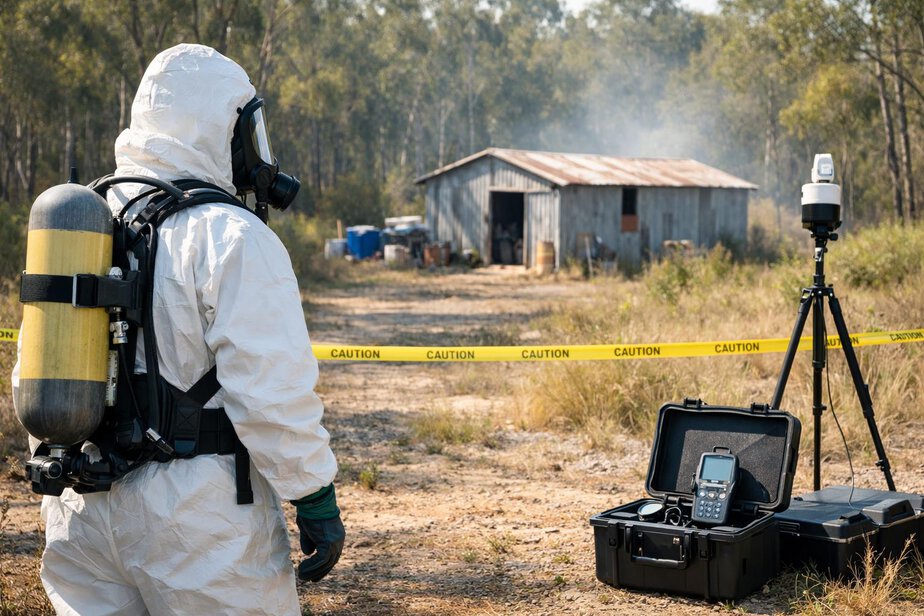
The first decisions at a suspected clandestine laboratory should protect life, prevent unnecessary exposure and preserve the scene as much as practicable. A simple operational sequence can assist decision-making under pressure:
- Stop and assess the scene.
- Avoid unnecessary entry.
- Move personnel and members of the public away from immediate hazards.
- Establish appropriate incident control.
- Notify police and specialist HazMat resources.
- Identify known or suspected hazards without disturbing containers or equipment.
- Establish exclusion, contamination-reduction and support areas where required.
- Use appropriate PPE and respiratory protection.
- Control ignition sources where this can be done safely.
- Establish emergency decontamination arrangements.
- Arrange medical assessment for suspected exposures.
- Preserve the scene for police investigation.
- Maintain responder accountability.
- Record exposures and significant operational actions.
Where the situation is unclear, a measured pause is usually safer than an impulsive entry. If there is any indication of fire, vapour release, structural compromise or a potentially violent occupant, the initial response should favour isolation, observation and coordinated support rather than rapid commit-in actions.
Approach from a safe direction where practicable. This can reduce the chance of moving towards vapours, runoff, concealed hazards or a point of ignition. It also helps preserve air quality for monitoring and gives crews a better chance to observe wind direction, smoke movement, visible leaks and occupant behaviour.
Isolation should be large enough to account for the uncertainty of the hazard. The initial exclusion zone may need to be expanded as more information becomes available. Support areas should be placed upwind and uphill where relevant, and contamination-reduction points should be managed so that clean areas remain clearly separated from dirty areas.
Fire and Explosion Hazards
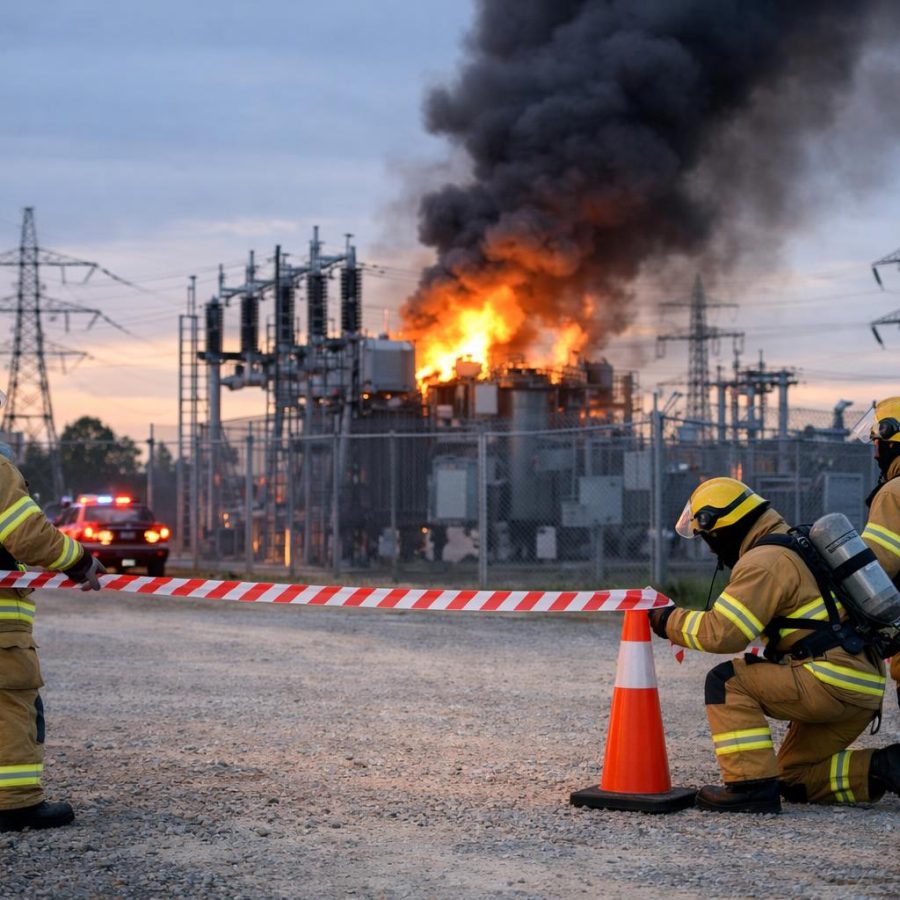
Fire crews should treat suspected clandestine laboratories as potentially complex HazMat scenes with significant ignition and explosion potential. These sites may contain flammable liquids, flammable vapours, reactive chemicals, pressurised cylinders, unknown substances and contaminated runoff. Even when no active fire is visible, vapours may be accumulating or spreading into adjoining spaces.
Ignition sources can include exposed wiring, sparking switches, batteries, generators, heaters, static discharge, running engines and common electrical appliances. If flammable vapours are present, actions that might normally seem routine can become dangerous. Opening a door, operating a fan, turning on a light, using intrinsically unsafe equipment or creating friction or sparks may worsen conditions.
When fire is involved, crews should consider whether an interior attack is justified or whether a defensive strategy is safer. If there is credible risk of flashover, vapour cloud ignition, secondary explosion or collapse of a contaminated structure, specialist advice is essential before committing crews indoors. Water application may create runoff that spreads contamination, so suppression should be carefully coordinated with containment and environmental considerations.
In these incidents, fire attack, ventilation and overhaul cannot be treated as routine tasks. Vapours, containers and chemical residues may be displaced by heat and water. This can expose crews, bystanders and nearby properties. It may also complicate evidence preservation and environmental clean-up. Defensive tactics, perimeter control, exposure protection and monitoring are often more appropriate until the hazards are understood.
Where conditions are uncertain, the safer choice is often to hold the line, isolate the area and wait for HazMat and police coordination rather than forcing entry into a chemically compromised building.
Toxic Gases, Vapours and Oxygen-Deficient Atmospheres
Uncontrolled chemical reactions, spills, heating, poor ventilation and fire can release gases and vapours that are harmful by inhalation. Some may irritate the eyes and airways immediately. Others may cause delayed symptoms or serious internal injury without much early warning. In a closed or partly enclosed space, displaced oxygen can also create an oxygen-deficient atmosphere, which is especially dangerous because it may be difficult to detect without proper monitoring.
Because the materials are unknown, responders should assume that air monitoring and respiratory protection may be necessary before entry. Atmospheric monitoring must be carried out by trained personnel using appropriate equipment and procedures. Monitoring should not be treated as a quick box-ticking exercise. Conditions can change as doors are opened, fans operate, fires burn, containers rupture or weather shifts.
Respiratory protection should be selected and used in line with agency procedures and the assessed hazard. Standard firefighting breathing apparatus may be suitable for some operations, but not all. Some chemical atmospheres require specialist protective clothing and entry protocols. Any responder entering a contaminated area should be properly trained, equipped, authorised and accounted for.
Possible symptoms of exposure may include:
- coughing or wheezing;
- shortness of breath;
- eye irritation or tearing;
- headache or dizziness;
- nausea or vomiting;
- confusion or unusual behaviour;
- skin redness or burning;
- disorientation or collapse.
These signs should trigger immediate reassessment, withdrawal from the hazard area and medical evaluation. Do not wait for severe symptoms if there is a credible exposure concern.
Corrosive, Reactive and Unknown Chemical Containers
Responders should never touch, move, open, smell or sample unknown chemical containers. Containers may be leaking corrosive liquids, unstable mixtures or substances that react with air, water, heat or incompatible materials. Even a container that looks intact may be compromised by damaged seals, internal pressure or contamination on the exterior.
Unknown or mismatched containers create several problems at once. They can hide the actual contents, complicate identification, increase the chance of secondary reactions and pose a contamination risk to gloves, PPE, equipment and vehicle interiors. If a container has been heated, burnt or partially destroyed, the hazard may be even less predictable.
Supporting crew should avoid stacking or collecting containers unless that task is specifically directed by trained HazMat personnel under approved procedures. A cautious approach is to isolate, document from a safe distance where possible, and leave item handling to the appropriate specialists. Evidence preservation is important, but it must never override life safety.
Any visible residue, pooled liquid or dried chemical staining should be treated as hazardous until assessed. Chemical marks on floors, benches, walls, containers or drainage points may indicate leaks, previous spills or intentional disposal. This contamination can spread through shoes, tools and vehicle steps long after the initial task has ended.
Contamination of Buildings, Vehicles and Equipment
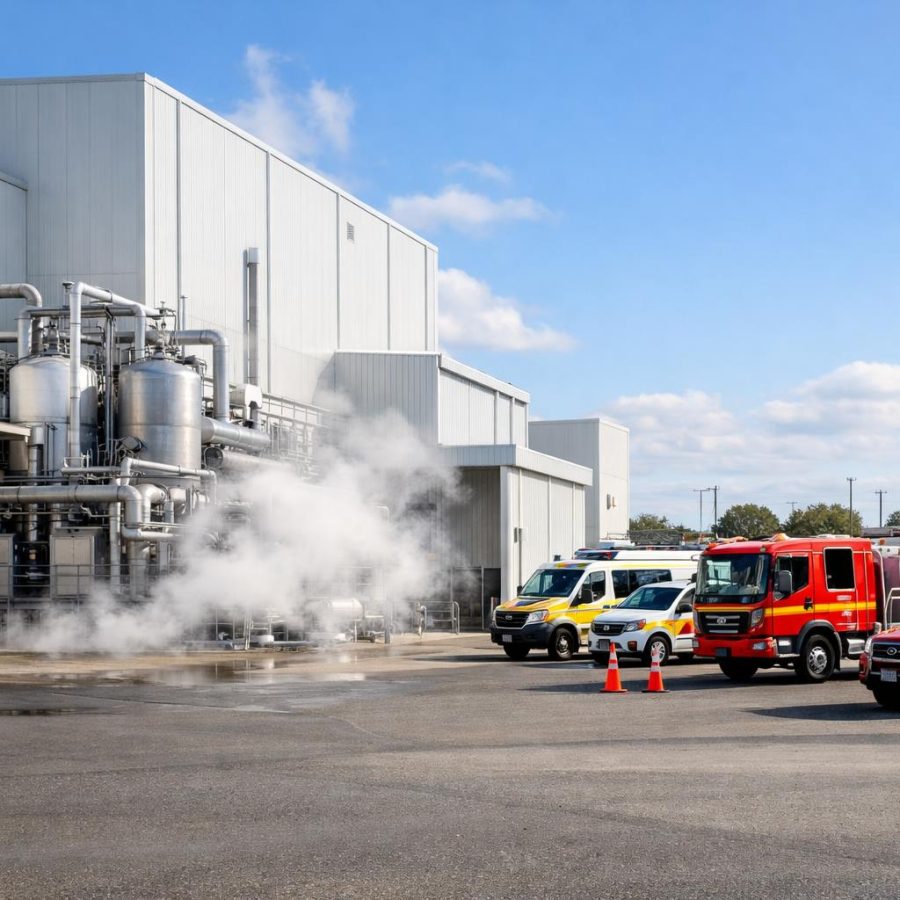
Contamination in a suspected clandestine laboratory is rarely limited to one bench or one room. Vapours and residues may spread through building cavities, carpet, soft furnishings, ventilation systems, drains, adjoining rooms, yards and sheds. Vehicles used to store, transport or conceal chemicals may also be contaminated internally and externally. Occupants may carry residues on clothing, skin, hair, shoes, personal items and bedding.
This means that rescue, medical treatment and evidence control are all affected. Casualties from a contaminated environment should not be moved into clean treatment areas without considering decontamination. Ambulance and hospital personnel should be advised of possible contamination before casualties are transported or brought into treatment spaces. That communication supports safe receiving arrangements and protects other patients and staff.
Equipment contamination is a major post-incident issue. Hoses, tools, stretchers, radios, monitors, PPE, vehicle steps and glove surfaces can all become contaminated. Once contaminated, these items should be isolated, tagged and managed under agency procedures. Crews should not assume that visible cleanliness means the item is safe for use.
Post-incident personnel contamination management is just as important. Responders may need to remove gear in a controlled way, undergo decontamination, change clothing and report any symptoms promptly. Apparent minor exposure can become significant later, particularly where the substance involved is unknown.
| Area | Common concerns | Response emphasis |
|---|---|---|
| Building interior | Vapours, residues, structural instability, fire spread | Isolation, monitoring, controlled entry |
| Vehicles | Concealed containers, ignition sources, enclosed contamination | Do not disturb, ventilate only if safe, specialist support |
| Surrounding ground and drains | Runoff, soil contamination, environmental spread | Containment, notify environmental authorities |
Risks to Firefighters, Police, Paramedics and the Public
Firefighters may face heat, smoke, vapour, hidden containers and contaminated runoff while also trying to protect nearby exposures. Police may be the first to make contact with occupants, secure the scene, identify criminal risk and manage evidence. Paramedics may encounter injured or poisoned people in unstable environments and may need to delay transport until contamination is addressed.
Other responders and support personnel can also be affected, including rescue crews, incident management staff, environmental officers and utility workers. In addition to chemical hazards, there may be aggressive occupants, confused children, weapons, sharps or booby-trap-style improvised hazards. These risks reinforce the need for a slow, disciplined and shared operating picture.
Members of the public can be affected even if they never enter the building. Neighbours may be exposed to smoke, vapour, odour, visible fire, contaminated water or panic. Children or vulnerable residents found on scene may require urgent medical assessment because they may have had a longer or more direct exposure than they are able to describe. Animals may also be exposed and should not be handled casually if contamination is suspected.
Coordination, Decontamination, Evidence and Handover
Clandestine laboratory incidents work best when agencies stay in their lanes and share information early. Police normally have an important role because the site may be a crime scene. Fire and rescue services manage life safety, fire control and hazardous materials support. Ambulance services assess and treat exposed or injured people. HazMat specialists may be needed for hazard identification, atmospheric monitoring, entry procedures, decontamination and technical advice. Environmental authorities may need to become involved where chemicals, wastewater or hazardous waste have entered soil, drains or waterways.
Establish clear incident control, scene sectors and communication channels. Confirm who is responsible for exclusion zones, contamination-reduction points, evidence preservation, casualty movement and environmental notifications. If local arrangements require a specific doctrine or command structure, follow that framework. The important principle is that everyone understands the hazard and the handover points.
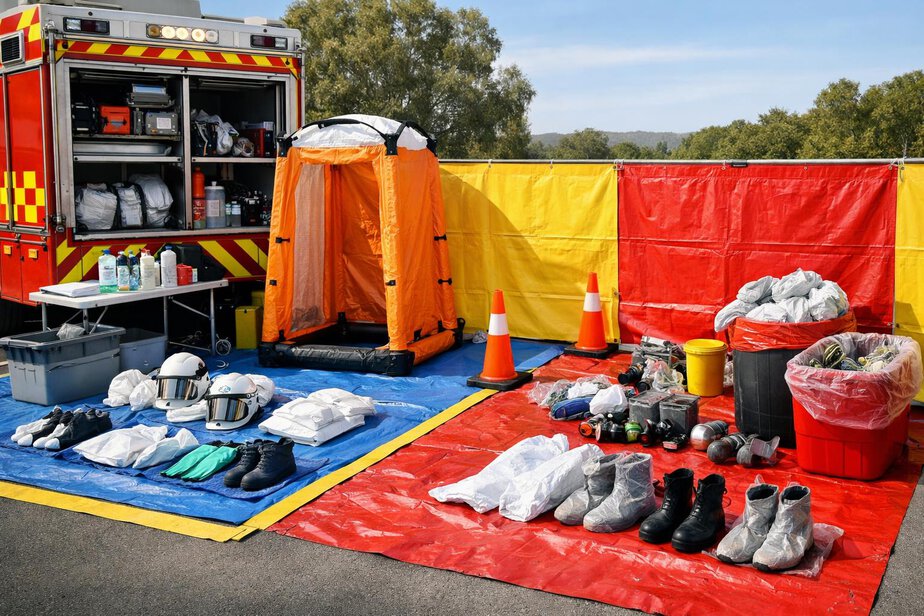
Decontamination should be arranged early, not as an afterthought. The right process depends on the contaminant, exposure route and agency capability. Responders and casualties may need removal from contaminated clothing, gross decontamination, bagging of affected items and medical review. Decontamination should be carried out in a way that prevents secondary contamination of appliances, stations, hospitals and public spaces.
Handover must include known or suspected substances, observed symptoms, actions taken, areas isolated, exposures recorded and any continuing risks such as vapour drift, runoff or unstable containers. Scene security should continue after the initial emergency phase so that evidence is preserved and the public stays clear. Record-keeping is important for health monitoring, contamination tracing and later review of operational decisions.
After the incident, contaminated PPE and equipment should be segregated, cleaned or disposed of according to agency procedures. Crews should be monitored for delayed symptoms and encouraged to report irritation, headache, dizziness, coughing, skin burns or other concerns promptly. Apparent low-level exposure still deserves attention because the exact contaminant may remain unknown.
A practical final principle is simple: do not normalise the scene. A room that looks quiet, a vehicle that looks abandoned or a container that appears sealed may still present a serious hazard. Use the available local procedures, seek specialist support early and keep the focus on life safety, contamination control and disciplined coordination. Before publication or operational use, verify facts, titles, local processes and current procedures with the relevant Australian agency guidance.
FireRescue Training Hub
Access practical fire and emergency study support resources, downloads, checklists, audio guides, and member-only course content.
- Course library
- PDF downloads
- Audio guides
- Checklists
Study support only. Not accredited training or a replacement for workplace procedures.
About the author and safety review
Ken Walker
Former Station Officer and fire service educator
Former career firefighter with extensive career and volunteer fire service experience.
Qualifications: Associate Diploma of Applied Science in Fire Technology; Institute of Fire Engineers studies.
Author profilehttps://www.firerescue.com.au/about-us/