A residential bushfire protection system should not wait until flames are visible at the fence line. For an Australian home, the smarter approach is to detect smoke, heat and local weather changes early, confirm whether the threat is real, and then trigger the right protection before the fire reaches the house.
Why local detection matters before flames arrive
Bushfire damage often begins well before a wall of flame reaches a property. Smoke can move ahead of the fire, fine hot particles can appear in the air, and local weather can shift quickly as a fire front approaches. A good system uses those early warning signs to start protective actions while there is still time.
This part of the Integrated Residential Bushfire Protection System focuses on detection and local weather monitoring. It contributes a modest but important part of the overall readiness model. It does not guarantee survival, and it is not a substitute for good property design, ember control, water supply, defensible space or a clear household plan. Its value is in giving the system enough time to act intelligently.
For ordinary homeowners, the main idea is simple: the system should sense change early, check that the change is credible, and then respond locally even if the internet, mobile network or external warning services are unavailable.
What should be monitored around the home
A practical home system should monitor more than smoke alone. The most useful inputs are smoke, heat, temperature, humidity, wind speed and wind direction. Each one tells a different part of the story.
Core detection inputs
- Smoke: useful for early warning when smoke drifts into the property before flames are close.
- Heat: useful for detecting a genuine nearby fire or hot plume.
- Temperature: helps show a rapid rise in local conditions.
- Humidity: helps estimate drying conditions and the severity of the immediate fire environment.
- Wind speed: influences ember travel and sprinkler performance.
- Wind direction: helps predict which side of the property may be threatened first.
Together, these readings help the controller decide whether the property is seeing harmless background conditions or a developing bushfire threat. The system should use local sensors as the primary source of information for automatic decisions. Official warnings, Fire Danger Ratings and weather forecasts can be used as secondary context when available, but they should not be the only trigger for action.
That distinction matters. A forecast or warning may describe a wider area, but a home needs to respond to the conditions actually happening on the site. Smoke drifting over one ridge, a sudden wind change or a hot plume entering the yard can be more relevant than a general regional message.
Sensor placement must suit the property
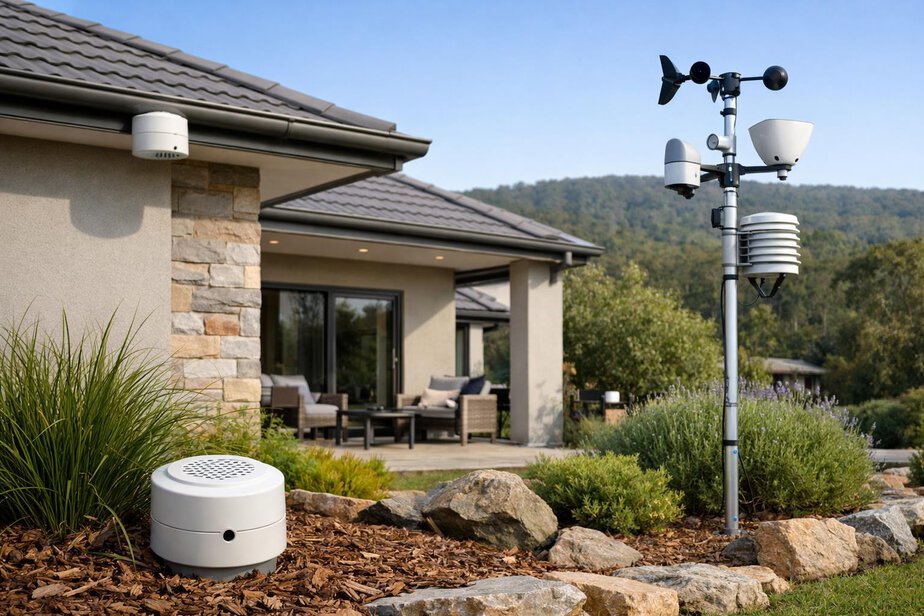
There is no single sensor layout that suits every house. Placement must reflect likely fire approach, surrounding vegetation, slope, prevailing winds, building layout and vulnerable sides of the property. A sensor that works well on one block may be poorly placed on another.
As a general rule, sensors should be positioned where they can detect approaching smoke or heat without being constantly disturbed by normal household activity. That often means separating outdoor detection zones from common false-alarm sources such as BBQ areas, driveway exhaust, workshop doors, generator locations and dusty access tracks.
Factors that should shape placement
- Likely fire approach: place sensors to detect the direction from which bushfire smoke or heat is most likely to arrive.
- Vegetation: heavier fuel loads nearby may justify earlier and more layered detection.
- Slope: fire and hot air can move differently uphill and downhill, affecting where early change is first sensed.
- Prevailing winds: sensors on the windward side may detect smoke and ember conditions earlier.
- Building layout: wings, verandahs, garages and gaps between structures can create different exposure points.
- Vulnerable sides: windows, doors, gutters, vents and external services may need earlier protection on the most exposed side.
Many properties will benefit from multiple detection points rather than one central sensor. The goal is not to detect every possible particle of smoke in the district. The goal is to identify a credible threat near the home in enough time to start the right response.
Use more than one sensor technology where practical
Different sensor technologies can see different aspects of a bushfire threat. Using more than one type can improve confidence and reduce false alarms, provided the system still responds quickly. A home system may combine smoke detection, heat detection and optional thermal imaging to cross-check what is happening outside.
Smoke detection
Smoke sensors can provide very early warning, especially when smoke drifts into a property before flames are visible. Outdoor smoke sensing needs careful location because dust, insects, cooking smoke and machinery exhaust can all create false triggers if the sensor is poorly placed.
Heat detection
Heat sensors are valuable because they can confirm a genuine nearby fire environment. The system should ideally use both fixed-temperature and rate-of-rise heat detection. Fixed-temperature detection can identify when ambient conditions become dangerously hot, while rate-of-rise detection looks for a fast increase that may signal an approaching fire front or hot plume.
Using both methods is useful because not every bushfire starts with the same temperature pattern. Sometimes the important clue is a steady rise. At other times, the clue is a sudden spike as heat and smoke reach the property edge.
Thermal cameras as an optional feature
Thermal cameras can be a useful advanced detection tool. They may assist with hot-spot detection, identify unusual heat signatures and support threat confirmation. They are optional rather than essential. For a typical homeowner, the main value is additional situational awareness, not complexity for its own sake. Normal external cameras can still help with remote viewing, but they do not replace thermal sensing.
How the system should confirm a real bushfire threat
The biggest challenge is balancing early warning with false-alarm control. A bushfire system must react fast enough to matter, but not so easily that every patch of smoke or hot afternoon causes full activation. The answer is confirmation logic.
The basic response model can be kept straightforward:
- One credible sensor input: Alert Mode.
- Two or more confirming inputs: Full Fire Mode.
That means one strong sign of trouble should not be ignored, but it may justify a preparatory response rather than the full protective sequence. If additional evidence arrives, the system escalates.
Examples of confirming inputs
- Smoke plus heat.
- Two nearby heat sensors detecting the same change.
- Smoke plus a rapid temperature rise.
- Heat combined with wind direction that matches the likely fire approach.
- Smoke, rising temperature and falling humidity together.
This approach is useful because it lets the system interpret patterns, not just single readings. A lone sensor can fail, drift or be temporarily disturbed. Multiple confirming inputs from different technologies create a more reliable picture.
Confirmation should never create dangerous delay. If one credible sensor shows a real threat, Alert Mode should begin immediately. The purpose of the second step is to increase confidence and escalate action, not to sit waiting while the situation worsens.
Do not design the system to wait for visible flames. By the time flames are obvious, the house may already be under serious ember, heat or smoke exposure.
Reducing false alarms without losing speed
False alarms are a real problem in bushfire detection. Common sources include BBQ smoke, vehicle exhaust, machinery, dust, hot roof spaces, garden burning, workshop fumes and very hot but otherwise normal weather. The system should reduce these triggers as much as practical, but not at the cost of a dangerous delay.
There are several ways to do this. The first is location. Keep sensors away from obvious nuisance sources. The second is cross-checking. A heat sensor and wind pattern that match a smoke reading are more convincing than smoke alone. The third is trend analysis. A sudden rise in heat or temperature during a hot afternoon is more serious than a brief puff of smoke from a nearby barbecue.
Useful filtering ideas
- Place outdoor smoke sensors where exhaust and cooking smoke are unlikely to reach them.
- Use heat sensors to confirm smoke before escalating to full protection.
- Compare multiple sensors so one unusual reading does not dominate the response.
- Check whether wind direction supports a genuine external threat.
- Use rate-of-rise data to distinguish a true fire signature from steady background heat.
Normal hot weather is another reason to use confirmation logic. A hot day alone should not trigger full sprinkler operation. The system can become more sensitive on Severe and Extreme fire-weather days, but it should still rely on local sensors to decide when action is needed. Fire Danger Rating is helpful context, not a direct sprinkler trigger.
How local weather data guides protection decisions
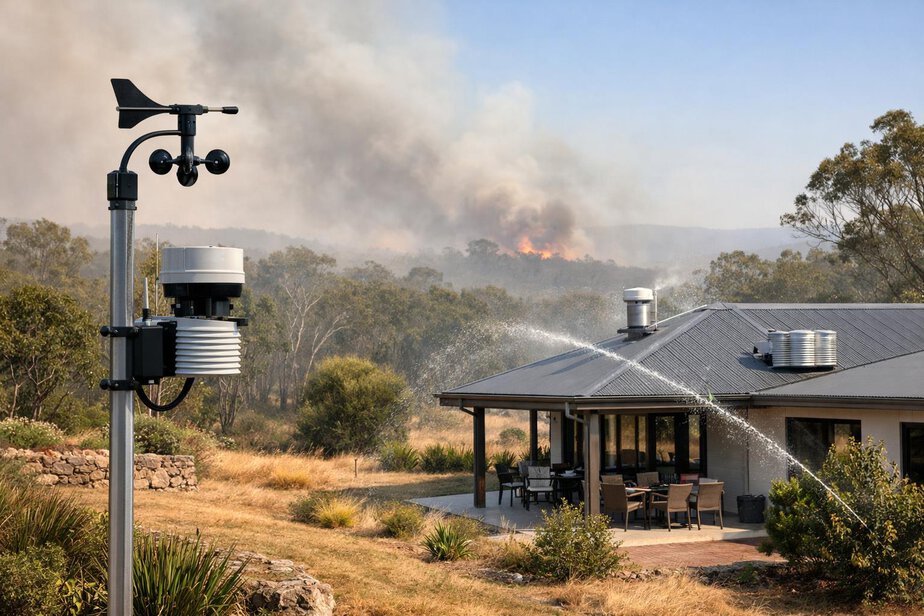
Local weather readings can do more than raise a warning. They can help the system decide what kind of response is most useful. Temperature, humidity, wind speed and wind direction together help estimate threat level, likely fire approach, sprinkler-zone priority and water use.
| Weather input | What it helps the system decide |
|---|---|
| Temperature | Whether conditions are becoming hotter and more hazardous |
| Humidity | How dry the immediate environment is and how quickly fuels may respond |
| Wind speed | How fast embers may travel and how the sprinkler system should prioritise water use |
| Wind direction | Which side of the house may be threatened first |
Wind direction is especially important. If the wind is pushing smoke and heat toward one side of the building, that side should be treated as the most likely early exposure zone. The system can prioritise sprinkler lines, window protection, eaves, decks and other vulnerable surfaces on the windward side first.
Wind speed matters too. Stronger winds can increase ember attack, change fire behaviour near the property and reduce the effectiveness of some water application patterns. A smarter controller can use that information to adjust the timing and priority of sprinkler activation rather than applying water evenly everywhere at once.
Humidity helps provide context. A dry local air mass may support faster ignition of fine fuels and can support a more cautious response. Again, this is not about predicting the entire fire event. It is about making the local system better informed than a simple on-off alarm.
How the system should respond on Severe or Extreme days
On Severe or Extreme fire-weather days, the system should increase monitoring sensitivity automatically. That means it can watch more carefully, compare readings more often and lower the threshold for Alert Mode when a credible local signal appears. However, it should not activate sprinklers solely because the Fire Danger Rating is high.
This distinction is important for homeowners. A bad fire-weather day means the environment is more dangerous, but it does not mean the house should start full protection without local evidence. The actual decision should still come from the sensors on the property.
A sensible response hierarchy
- Higher sensitivity during dangerous weather.
- Earlier Alert Mode when one credible sensor indicates a real change.
- Escalation to Full Fire Mode when two or more inputs confirm the threat.
- Use wind and local conditions to prioritise the most exposed zones first.
By doing this, the system remains responsive without becoming reckless. Severe or Extreme conditions should make the system more ready, not make it blind to what the property itself is actually experiencing.
Sensor health, controller logic and local resilience
A detection system is only useful if it can tell when part of itself has stopped working. Sensor-health monitoring should be standard. Failed, obstructed or unrealistic sensors should create a warning, while the remaining sensors continue operating where possible.
Examples of sensor-health issues include a smoke sensor that reports no change for an implausibly long period, a heat sensor that sits at an unreasonable constant value, a weather sensor obstructed by debris or a wind reading that conflicts strongly with the rest of the system. These problems should not stop the whole protection platform if other components are still healthy.
Sensor faults should also affect the overall readiness status. If protection is reduced because a key sensor has failed, the system should show that clearly through its Green, Amber or Red status logic. Homeowners need to know whether they are fully protected, partially protected or operating with a limitation.
Local control must continue when communications fail
The system must continue operating locally if internet or mobile coverage fails. That means the essential decisions should be made by on-site controllers, not by a cloud service that may be unavailable during a fire. Dual independent controllers are a sensible resilience feature. They can cross-check sensor information and reduce the risk that one fault creates the wrong response.
If the two controllers disagree, the system should default toward the safer protective response. In bushfire conditions, hesitation can be more damaging than a cautious over-response, provided the system still avoids unnecessary and repetitive nuisance activations as much as practical.
How detection feeds the rest of the protection system
Smoke, heat and local weather detection are not standalone features. They feed the wider integrated system, including smart sprinkler zoning, gutter protection, ground protection, pumps and positive-pressure ventilation. That is why early detection matters so much. The more time the system has, the better it can stage protection.
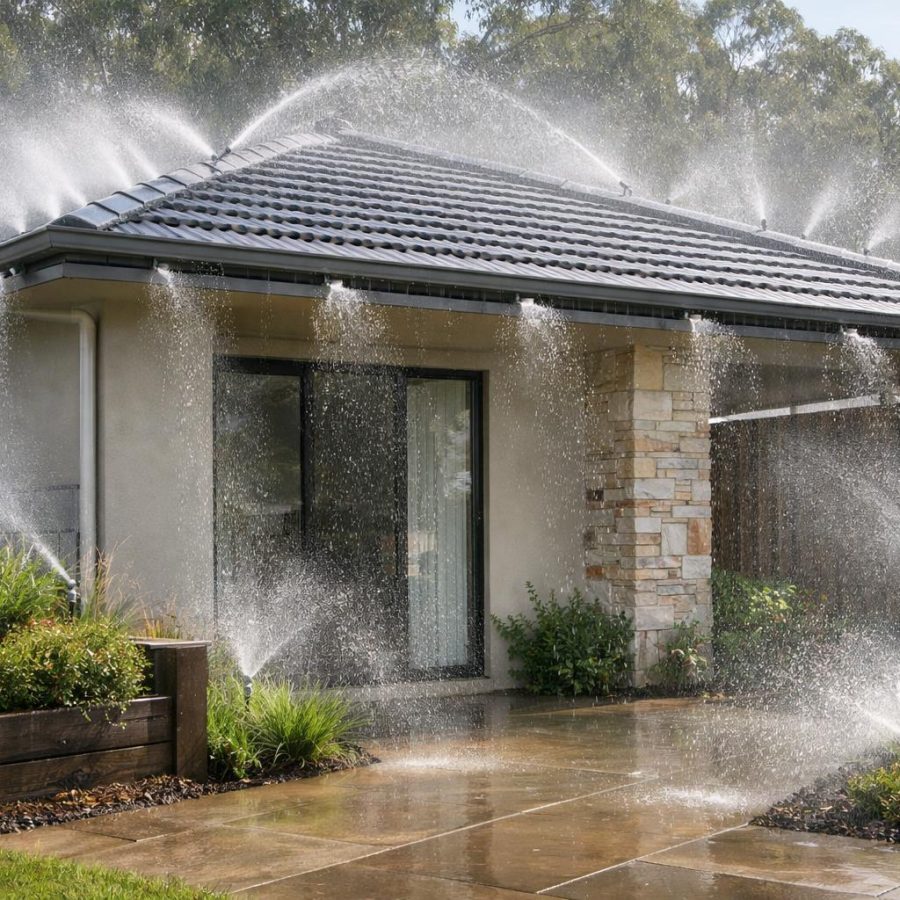
When smoke is confirmed near the house, positive-pressure ventilation should activate as part of the protective sequence. The goal is to help keep smoke out of the building envelope where the design allows it. At the same time, sprinklers can focus on the zones most exposed to the expected fire approach, while wind direction and wind speed help determine which side needs attention first.
Not every property will have every feature, and not every feature will suit every site. A modest home system may use only a few sensors and simple response zones. A more advanced system may layer thermal imaging, multiple heat points and more refined zoning. The principle is the same in both cases: local detection should drive local action.
For ordinary homeowners, this may be the most reassuring part of the design. The system does not need perfect information from the internet to begin protecting the house. It can read the immediate surroundings, confirm what matters and then act.
Conclusion: early warning, local confirmation and timely action
A well-designed bushfire detection layer should give a home a better chance of responding before the fire arrives. By monitoring smoke, heat, temperature, humidity, wind speed and wind direction, the system can recognise a developing threat, distinguish it from common false alarms and begin the right protective response early enough to matter.
The practical lesson for homeowners is straightforward. Use multiple sensor types where appropriate. Place them to suit the site. Confirm a threat with more than one input when possible. Let local conditions drive the first automatic decisions. Keep the system operating if the internet fails. And make sure sensor faults are visible rather than hidden.
Part 10 is about watching the property itself, not waiting for a distant alert to catch up. That local focus is what makes early detection useful in a bushfire-ready home.
Before publication or installation, verify facts, product capabilities, local procedures and any site-specific requirements with qualified professionals and current official guidance.
FireRescue Training Hub
Access practical fire and emergency study support resources, downloads, checklists, audio guides, and member-only course content.
- Course library
- PDF downloads
- Audio guides
- Checklists
Study support only. Not accredited training or a replacement for workplace procedures.
About the author and safety review
Ken Walker
Former Station Officer and fire service educator
Former career firefighter with extensive career and volunteer fire service experience.
Qualifications: Associate Diploma of Applied Science in Fire Technology; Institute of Fire Engineers studies.
Author profilehttps://www.firerescue.com.au/about-us/