Part 9 of the Integrated Residential Bushfire Protection System focuses on one of the most overlooked bushfire risks: the ground immediately around the house. If embers land in mulch, a fence burns, or fire runs along a step, retaining wall or garden edge, that small ignition can become the fire that reaches the building. The aim here is simple: protect the first few metres around the house so they do not become the fuel path into the house.
Why the ground around the house matters
The area closest to the building is often where a bushfire either stops or gains a direct route to the home. During ember attack, the danger is not only flames from the main fire front. Small spot fires can start in garden beds, under decking edges, beside fences, or in leaves and bark close to the wall. If those fires are not contained quickly, they can transfer heat to the building and ignite combustible parts of the structure.
That is why the active ground-protection area should be site-specific, but generally concentrated within about 3 to 5 metres of the house. This is not about watering the whole property. It is about identifying the places where fire is most likely to travel toward the building and protecting those pathways first.
The first 1 metre: a very low-combustible zone
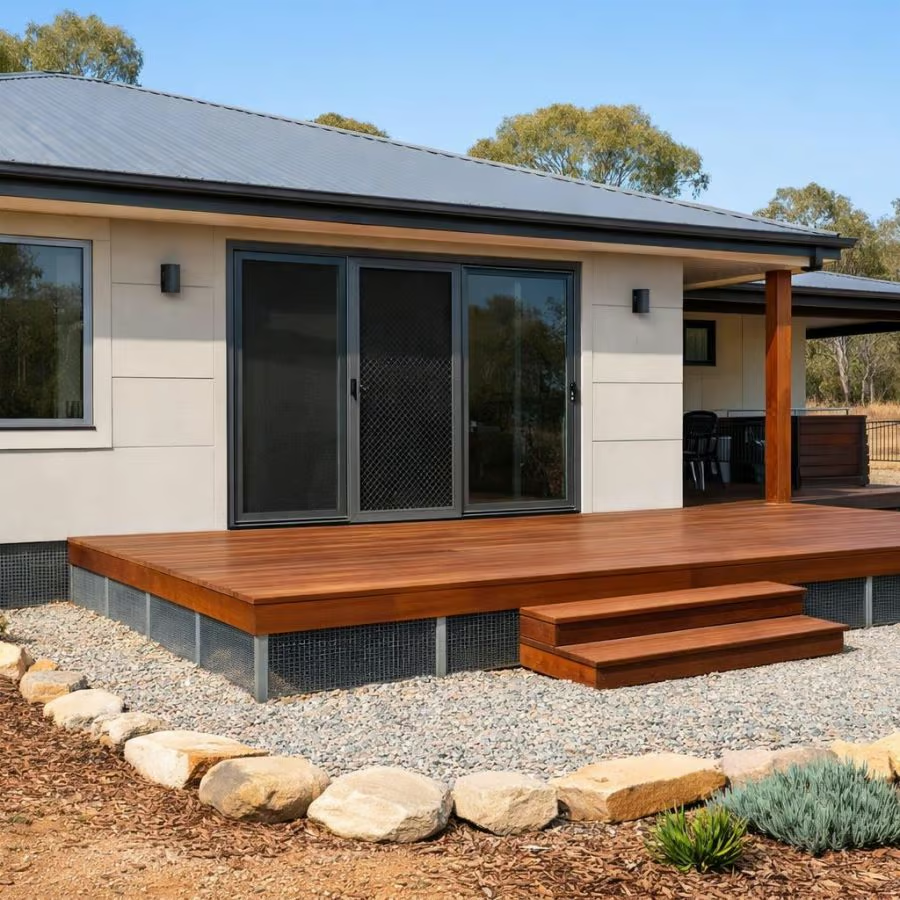
The first metre around the house should be treated as a very low-combustible zone. That does not mean a bare, sterile edge around every home. It does mean there should be very little that can catch, smoulder or feed a flame right beside the building.
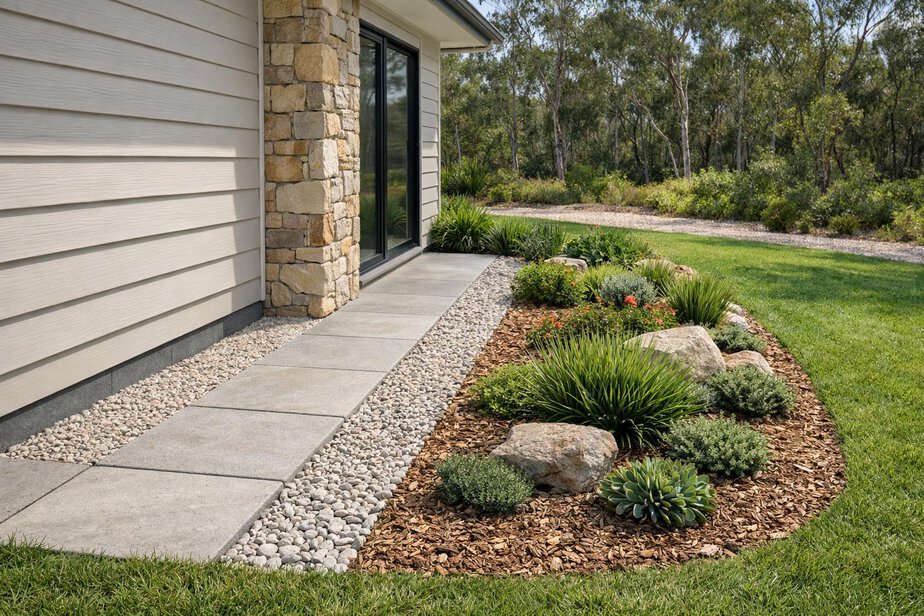
Where planting is used, keep it limited and carefully selected. Avoid dense, continuous fuel and avoid species that create heavy litter or hold dry material close to the wall. The aim is to keep the area tidy, open and easy to inspect. If a gardener or homeowner cannot easily see and reach the base of a wall, the planting is probably too dense for the immediate protection zone.
Combustible mulch should not be used immediately beside the house if a lower-combustible alternative is practical. Better choices often include gravel, stone, pavers or other suitable non-combustible ground finishes. These materials reduce the chance that a stray ember finds something easy to ignite.
Ground finishes should also be chosen for drainage and maintenance. A very low-combustible zone still needs to shed water, stay stable underfoot and remain easy to clean. Loose fuel such as leaf litter, bark and trapped debris should be removed regularly, especially after windy days or before a fire season.
Priority areas: where fire is most likely to travel
Rather than trying to wet every part of the yard, ground protection should concentrate on likely fire pathways. These are the places where a fire could move from the landscape or a small ignition to the house.
- Garden beds near the house
- Fence lines close to the building
- Steps and stair landings
- Retaining walls and wall connections
- Deck edges and under-deck perimeters
- Building perimeter junctions
- Other structures that can carry fire toward the house
These areas deserve special attention because they often combine fuel, hidden cavities and direct contact points. A fire does not need a large fuel load if the path to the building is short and continuous. Even a small ignition in the wrong place can become a major problem when it reaches a dry timber element or a combustible gap beside the house.
Think of this layer as a series of targeted interruptions. The point is not to make every surface wet all the time. The point is to break the chain that lets a ground fire become a house fire.
Timber fences and the risk of a direct path
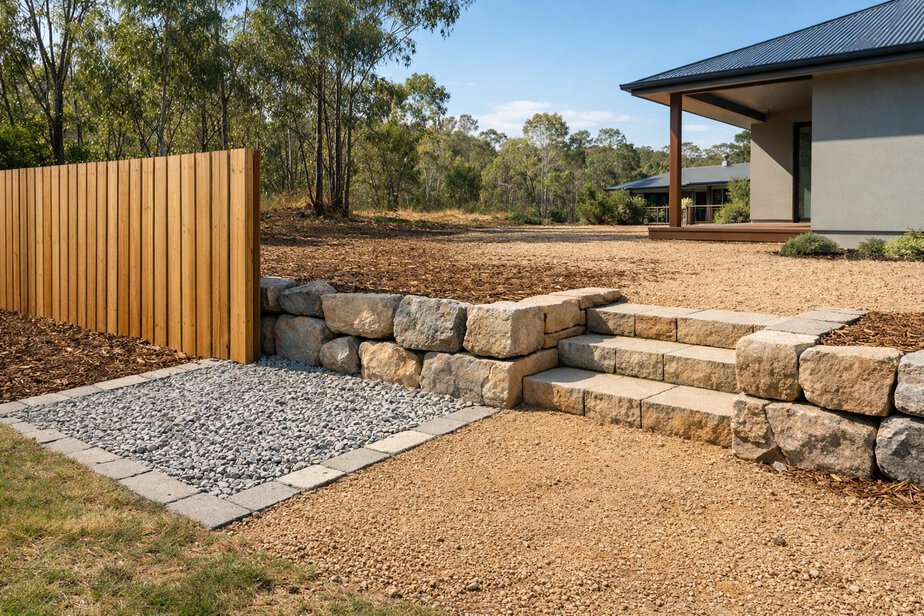
Timber fences can remain part of a property where suitable, but they should not connect directly to the house without protection. A fence fire is a common concern because a fence can act like a wick or a line of fuel leading straight to the building.
The practical solution is to include a non-combustible break before the fence reaches the house. That break might be a short section of metal fencing, masonry, stone, pavers or another suitable non-combustible separation. The exact solution will depend on the site, the design of the property and what can be built safely and legally.
The aim is not to ban timber fencing altogether. It is to stop the fence from becoming a direct pathway into the house. If the fence must run near the building, it should be interrupted so a fence fire does not easily transfer into the wall, eaves or nearby openings.
Retaining walls, edging and garden features
Retaining walls and garden edging should allow architectural flexibility, but they should not create a continuous combustible path to the building. In some places, timber or other combustible materials may still be used where appropriate. The key requirement is that they do not link into the home in a way that carries fire directly to the structure.
Where practical, use non-combustible separation between these features and the house. That separation may be small, but it should be deliberate. A short break in material can make a meaningful difference if an ember lands in the wrong place.
Garden steps, planter edges and raised beds deserve the same thinking. A timber step assembly or planter that runs into the wall can create hidden gaps and easy ignition points. If these features are needed for the garden design, they should be detailed so they do not become a combustible bridge to the house.
This is one reason bushfire protection works best when it is integrated early in the design rather than added later as a patch-up. The better the separation at the start, the easier it is to keep the ground around the home manageable over time.
Targeted sprinkler protection without wasting water
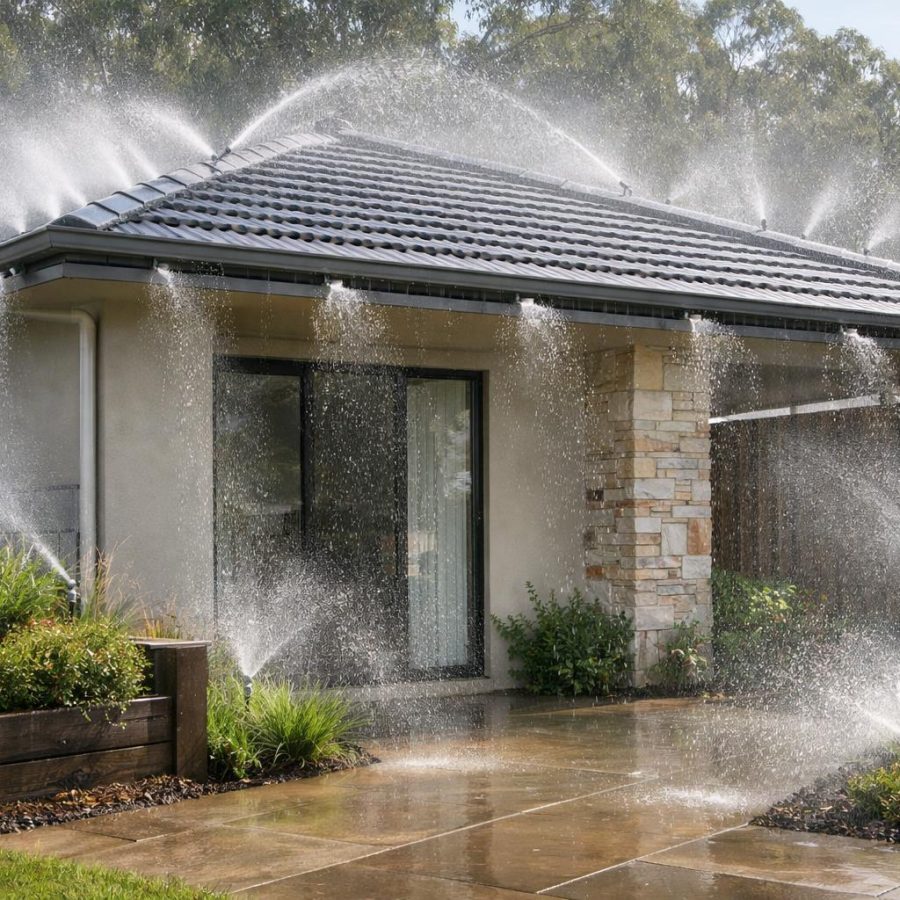
Dedicated sprinkler protection can be useful in the ground-protection layer, but it should be used only where a clear fire pathway exists. Not every fence, wall or garden bed needs its own sprinkler. The system should focus on the parts of the site that are most likely to carry fire toward the house.
Examples of good target areas include fence-to-house junctions, timber steps, retaining-wall connections, vulnerable garden beds and deck perimeter areas. These are the places where a small fire can gain enough heat or continuity to threaten the building. A localised sprinkler or wetting line can help reduce that risk when conditions justify it.
Different areas may need different delivery methods. A fixed spray head may suit one zone. A low-level wetting approach may suit another. Some areas may need a combination of methods. The important point is not to assume one sprinkler type suits every ground-protection task.
| Area | Main risk | Possible response |
|---|---|---|
| Fence-to-house junction | Flame transfer along the fence line | Non-combustible break plus targeted wetting |
| Timber steps | Direct ignition of a small timber structure | Localised spray or low-level wetting |
| Retaining-wall connection | Heat and debris collecting at the join | Separation plus focused protection |
| Garden bed near wall | Mulch or vegetation ignition | Low-combustible finish and targeted wetting |
| Deck perimeter | Embers entering gaps and under-edge spaces | Perimeter wetting and fuel reduction |
Automatic activation and confirming inputs
Ground protection should use confirmed threat detection rather than reacting to every minor signal. One sensor input may be enough to place the system into Alert Mode, but automatic ground-protection activation should normally require two confirming inputs. That could be smoke and heat, two nearby heat sensors, or heat combined with a rapid temperature increase.
This approach helps reduce unnecessary activation while still responding quickly to a genuine ignition. It is especially useful for ground zones because they can be numerous, and a system that triggers too easily can waste water, create maintenance problems and reduce confidence in the system.
Confirmed activation does not mean delay. It means the system should be smart enough to distinguish between a passing condition and a real threat near the building. The goal is rapid response with fewer false activations.
Homeowners should understand the difference between alerting and activating. Alert Mode can warn that conditions are becoming dangerous. Active ground protection should then respond when the system has stronger evidence that a local fire pathway is forming.
Water use, conservation and practical control
Water in a bushfire system should be used where it matters most. Ground watering should adjust according to temperature, run time, current fire threat and tank level. Zone priority also matters. If one area is already receiving enough protection and temperatures remain low, the system should reduce water use there and preserve supply for hotter or more vulnerable zones.
This is one reason the system should not waste water on low-risk parts of the yard. A large garden that does not threaten the house does not need the same response as a fence running into the eaves. Smart zoning is about putting available water where it will do the most good.
Unnecessary soil-moisture sensors should be avoided unless they are specifically justified. They can add maintenance without offering a clear benefit in the bushfire context. The system should stay practical, robust and easy to understand. Simplicity is usually an advantage when a homeowner must trust the system under stress.
Water conservation also matters because bushfire events can last longer than people expect. A system that drains its supply too early may leave the most important zones unprotected later on. The design should therefore be selective rather than broad and untargeted.
Vehicles, caravans and trailers as optional protected assets
Vehicles, caravans and trailers can be treated as optional protected assets. Where the homeowner chooses this option, dedicated sprinkler coverage may be provided. This can be useful where an asset is parked close to the house and the owner has a specific reason to protect it.
However, vehicle protection should not be part of the basic core system. The core purpose of this part of the system is to stop the ground around the house from igniting the house. Once that is achieved, additional asset protection can be considered as an optional layer if the site, water supply and budget allow it.
Keeping that distinction clear helps avoid design confusion. The house remains the priority. Other items are only added when they do not reduce the reliability of the core protection layers.
Self-testing, maintenance and system reliability
Ground-protection zones should be included in automatic self-testing. The system should check valves, flow, pressure, zone operation and basic coverage. If a zone is blocked, damaged or not operating correctly, the resident should receive a simple warning.
This matters because ground protection often depends on parts of the system that sit low, close to vegetation, soil, paving and garden edges. These areas can be affected by debris, movement, impact or wear. If a nozzle is blocked or a line is compromised, the homeowner needs to know before a fire season starts, not during the emergency.
All exposed bushfire pipework should be metal or another suitably fire-resistant material. Exposed plastic pipework or heat-sensitive fittings should be treated as potential points of failure. In a high-heat event, the weakest exposed component can become the point where the system stops protecting the most important area.
Bringing this layer together with the rest of the home
Ground protection works best as part of the full residential bushfire system. It should operate with defendable space, ember-resistant construction, roof and gutter protection, dedicated water, pumps and smart zoning. No single layer is enough on its own, and no ground system should be presented as a guarantee that a home will survive.
The value of this layer is in stopping the first few metres around the house from becoming the fuel source that ignites the house. That is a practical and realistic goal. It recognises how often home loss begins with a small local ignition rather than a dramatic wall of flame.
For homeowners, the immediate action is straightforward. Walk around the house and look for direct fuel paths: timber touching walls, mulch against cladding, fence runs into the building, and hidden corners where debris collects. Then separate, simplify and protect those areas first. Use low-combustible materials where possible, and add targeted sprinkler coverage only where a real pathway exists.
That approach keeps the focus where it belongs: on the strip of ground most likely to carry fire into the home. In bushfire design, the closest few metres often matter more than the far edge of the property.
In practical terms, Part 9 is about control, separation and restraint. Protect the first few metres around the house. Do not let the ground become the fire that ignites the building. Before publication or installation, verify current bushfire advice, local council requirements and site-specific design details with qualified professionals and the latest local procedures.
FireRescue Training Hub
Access practical fire and emergency study support resources, downloads, checklists, audio guides, and member-only course content.
- Course library
- PDF downloads
- Audio guides
- Checklists
Study support only. Not accredited training or a replacement for workplace procedures.
About the author and safety review
Ken Walker
Former Station Officer and fire service educator
Former career firefighter with extensive career and volunteer fire service experience.
Qualifications: Associate Diploma of Applied Science in Fire Technology; Institute of Fire Engineers studies.
Author profilehttps://www.firerescue.com.au/about-us/