When a major fire, flood, storm, cyclone or other emergency stretches beyond one crew, one station or one council area, the work behind the scenes becomes just as important as the work on the fireground or at the incident scene. An Emergency Operations Centre, Emergency Coordination Centre or similar facility helps bring information, agencies, resources and decisions together so the response stays organised and the public gets timely support.
What an Emergency Operations Centre Is
An Emergency Operations Centre, often shortened to an EOC, is a coordination facility used during major emergencies. It is a place where information is gathered, decisions are supported, resource requests are managed and different agencies work from a shared understanding of what is happening.
In Australia, the exact name, purpose and authority of these centres varies between states, territories, agencies and types of incident. Some jurisdictions use terms such as Emergency Coordination Centre, State Control Centre, Regional Coordination Centre or Local Emergency Coordination Centre. The title matters less than the function.
In practical terms, these centres help answer questions such as:
- What is happening now?
- What is likely to happen next?
- What resources are needed?
- Which agency is responsible for which task?
- What community impacts need attention?
- What information needs to go to the public?
They are not simply offices with radios and maps. A well-run centre supports decision-making across the broader emergency, particularly when the incident affects several agencies, several local government areas or a large part of the community.
Why a Centre May Be Activated
A coordination centre may be activated when an emergency is too large, complex, long-lasting or interconnected to be managed comfortably by the incident team alone. Activation may also occur when the incident creates wider consequences that need attention beyond the immediate scene.
Common reasons include:
- multiple agencies are involved
- resources are stretched or coming from a wide area
- the incident is growing or changing quickly
- there are major public safety implications
- critical infrastructure is affected
- communities need warnings, evacuation support or relief
- the incident is likely to continue for a long period
- the event has consequences across several localities or regions
Major fires, floods, storm damage, hazardous materials incidents, mass rescue events and severe infrastructure failures may all trigger some form of coordination centre. The decision to activate is often based on anticipated complexity, not just what is happening at that moment.
Incident Control Versus Emergency Coordination
Incident control and broader emergency coordination are related, but they are not always the same function.
An Incident Controller and the incident management team generally focus on controlling operations at, or directly associated with, the incident. That usually means managing tactics, assigning sectors or divisions, monitoring safety, directing crews and making operational decisions within the incident ground or hazard area.
An Emergency Operations Centre may support the wider emergency by coordinating matters such as:
- resources
- agency liaison
- community consequences
- public information
- infrastructure disruptions
- relief arrangements
- strategic priorities
- requests for assistance
In some Australian arrangements, a coordination centre may support the Incident Controller closely without directing frontline crews. In other arrangements, the centre may have more formal authority over specific coordination tasks. The important point is that local arrangements, agency procedures and appointed roles must be followed.
Good coordination should avoid sending mixed messages to operational personnel. Frontline crews need clear direction from the right authority, not competing instructions from several centres or agencies.
| Function | Typical focus | Where it sits |
|---|---|---|
| Incident control | Tactical direction, safety, suppression, rescue or hazard management | At or near the incident, through the incident management team |
| Emergency coordination | Resources, liaison, community impacts, warnings, logistics and wider support | Coordination centre or broader emergency management structure |
What Happens Inside an Emergency Operations Centre?
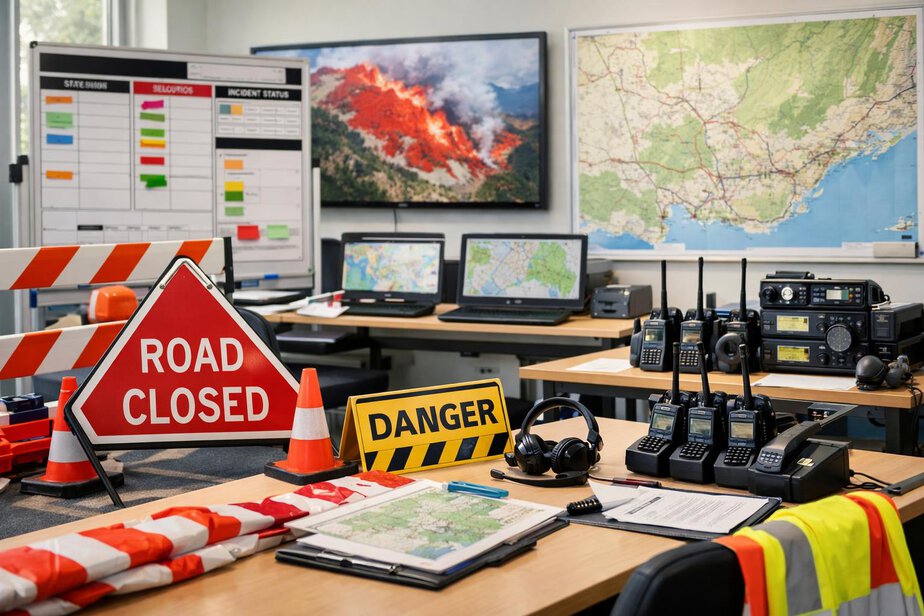
Inside a coordination centre, staff are usually trying to build and maintain a clear picture of the emergency while helping the response keep moving. The work can be busy, repetitive and highly time-sensitive.
Typical functions include receiving information from the incident, confirming and assessing that information, and keeping situation awareness current. Staff may compare reports from field personnel, councils, utilities, warning systems, weather sources and other agencies to understand what is changing and where pressure is building.
A centre may track practical information such as:
- incident maps
- fire or flood progression
- road closures
- evacuation areas
- relief centres
- weather information
- power outages
- telecommunications outages
- available emergency resources
- hospitals and health facilities
- vulnerable communities
- critical infrastructure
- current warnings
The centre also helps identify emerging risks. For example, a flood event may be worsening upstream, a wind change may affect fire behaviour, or a transport disruption may cut access to a town or relief centre. These are not only operational problems. They can quickly become community problems if they are not noticed early.
Other tasks may include liaising with emergency services, councils and government agencies; monitoring key infrastructure; supporting public warnings and information; planning for likely future developments; and recording important decisions and actions.
Information systems and mapping tools are often central to this work. They help staff combine data from multiple sources so the emergency can be understood in one place rather than in fragments.
That said, not every detail will be equally reliable. Information should be verified where possible, time stamped, clearly sourced, updated regularly and shared with the people who need it.
The Importance of a Common Operating Picture
A common operating picture is a shared understanding of what is happening, what has been confirmed, what is still uncertain and what is likely to matter next. It does not mean every agency thinks exactly the same way. It means the main players are working from the same core facts.
This matters because major emergencies generate a lot of information, and not all of it is equally trustworthy. A report from the field may be accurate but incomplete. A community report may be useful but unverified. A map may be current in one area but already outdated in another. A good coordination centre sorts through these differences so decision-makers are not relying on guesswork.
To support a common operating picture, information should be:
- verified where possible
- time stamped
- clearly sourced
- updated regularly
- shared with the people who need it
That means showing the difference between confirmed information, developing information and rumours or unconfirmed reports. It also means keeping a record of what was known at the time, because major decisions may later need to be explained or reviewed.
In large emergencies, information management is not a background task. It is part of the response itself, because poor information leads to poor coordination.
A common operating picture also supports smoother handover between shifts and clearer communication between agencies. Without it, the response can become fragmented, with different groups acting on different assumptions.
Key Roles Within a Coordination Centre
The exact structure will depend on the jurisdiction, agency and size of the emergency. Not every centre will use every function, and some people may cover more than one role. The important thing is that key tasks are covered, not that the chart looks the same everywhere.
Possible functions include:
- Emergency management coordinator – oversees the coordination function and helps link agencies, priorities and approvals.
- Operations liaison – maintains communication with the incident or field operations.
- Planning – looks ahead to likely developments and possible contingencies.
- Intelligence – gathers, checks and interprets information from multiple sources.
- Logistics – arranges supplies, equipment, transport and support services.
- Public information – supports warnings, community messages and consistent public advice.
- Communications – helps keep radio, phone and data links working and coordinated.
- Welfare and relief coordination – supports accommodation, relief centres and community assistance.
- Infrastructure liaison – works with utilities, transport and other infrastructure providers.
- Agency liaison officers – connect the centre with police, fire, ambulance, councils, health and other stakeholders.
- Administrative and documentation support – records decisions, logs actions and helps maintain orderly files.
In larger incidents, these roles may operate in a more formal structure. In smaller activations, one person may be responsible for several of them. Even so, the work should still be clearly allocated and recorded.
Good coordination also depends on strong relationships before the emergency starts. A centre is much easier to run when agencies already understand one another’s terminology, authority and limitations.
Managing Resource Requests
One of the most practical tasks in a coordination centre is handling requests for additional resources. These may come from an incident controller, an operations officer, a council, a utility provider or another part of the emergency management system, depending on the arrangements in place.
A simple process often looks like this:
- The incident identifies a resource requirement.
- The request is recorded.
- Availability is checked.
- Appropriate approval is obtained where necessary.
- The resource is allocated.
- Deployment information is communicated.
- Arrival and tasking are confirmed.
- Resource status continues to be tracked.
Examples may include fire appliances, rescue resources, aircraft, ambulances, police, heavy machinery, fuel, food and water, portable communications equipment, generators, emergency accommodation and specialist technical personnel.
A well-run centre helps prevent duplicate or competing requests. That matters because several people may hear the same problem and try to solve it separately. If requests are not tracked properly, the system can waste scarce resources or send the wrong equipment to the wrong place.
Tracking is not only about getting the resource there. It is also about knowing whether it has arrived, whether it is being used effectively, whether it needs support and when it can be released.
Planning Beyond the Current Operational Period
Major incidents require managers to think ahead. A response that only deals with the next few minutes can quickly fall behind, especially if weather, terrain, access, community movement or infrastructure problems are likely to change.
Planning in a coordination centre may consider what might happen during the next 6, 12 or 24 hours. That could include weather changes, additional evacuations, resource fatigue, fuel and supply requirements, incoming reinforcements, road access, medical needs, community relief, infrastructure restoration, public communications and recovery arrangements.
The point of forward planning is not to guess the future perfectly. It is to prepare for likely developments so the system is less reactive and less likely to be surprised.
For example, if conditions suggest a fire may intensify later in the day, the centre can begin planning additional warnings, staging areas, welfare support, traffic control and relief resources before the pressure becomes critical. If a flood is expected to isolate a community, planners may arrange supply chains, temporary accommodation and health support early.
This kind of thinking helps keep the response moving in step with the incident rather than always lagging behind it.
Communications, Liaison and Public Information
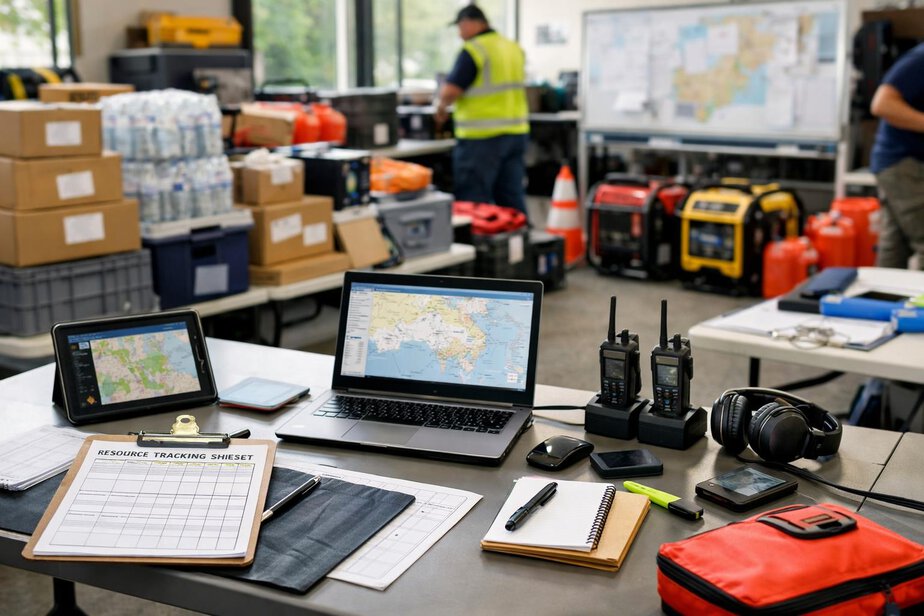
Communication is one of the most important jobs in a coordination centre. If agencies cannot speak clearly to one another, or if the public receives inconsistent advice, the entire response becomes less effective.
Coordination centres often help manage agency liaison, including police, fire services, ambulance services, State Emergency Services, local government, health agencies, transport authorities, electricity providers, water authorities, telecommunications providers, environmental agencies, community organisations and state or Commonwealth government agencies.
They may also support public information and warnings. This can involve confirming what has changed, what people need to do and which areas may be affected next. Public messages should be consistent with the relevant emergency management arrangements and should be issued through authorised channels.
Critical infrastructure issues often sit in this area too. A flooded substation, damaged bridge, downed telecommunications site or closed arterial road can affect evacuation, response access, medical services and long-term recovery. The centre needs to know not only that the infrastructure is affected, but also what that means for people and services.
Communications also includes practical matters such as radio availability, phone congestion, data access, interoperable systems, backup power and contact lists. These details are easy to overlook until they fail, which is why they deserve active monitoring.
Shift Handover and Fatigue Management
Major emergencies may run continuously for days or even weeks. That makes shift handover and fatigue management essential, not optional.
A good handover should include:
- current situation
- major risks
- current warnings
- outstanding tasks
- resource status
- important decisions
- expected developments
- agency issues
- critical contacts
The handover should be clear, concise and documented. The incoming team needs to know not only what happened, but also what is unfinished, what is uncertain and what needs immediate attention.
Fatigue matters because tired decision-makers make mistakes. They may miss changes in the situation, repeat earlier work, misread priorities or fail to challenge bad assumptions. In a centre environment, fatigue can be harder to spot than it is in the field, because the work is often desk-based and mentally demanding rather than physically obvious.
That is why breaks, shift lengths, welfare support and sensible rostering are part of emergency management, not side issues. If the people coordinating the response become exhausted, the quality of the whole system drops.
When the Emergency Moves Into Recovery
Coordination does not necessarily end when the immediate hazard is under control. In many emergencies, the response gradually shifts into recovery while some response activities are still continuing.
Recovery may involve temporary accommodation, community welfare, damage assessment, infrastructure restoration, waste removal, environmental issues, financial assistance, community information, mental health and wellbeing support, and the reopening of roads, schools and businesses.
This transition needs to be organised. If response teams stand down too quickly, important issues can be missed. If recovery starts too late, communities may be left without clear support or direction.
Coordination centres can help manage this handover by passing information, records and priorities to recovery arrangements. They may also help identify which tasks still need response-style urgency and which can now be managed through longer-term recovery systems.
Strong transition planning is especially important after large fires, major floods, severe storms and long-duration incidents where the community impact is wider than the hazard itself.
Documentation matters here too. Decisions about evacuations, warnings, resource allocation, public information, infrastructure priorities and major expenditure should be recorded carefully so the recovery phase has a reliable foundation.
Deactivation and Post-Incident Review
When the emergency is over, the coordination centre should not simply go quiet without a proper close-out. Deactivation should be deliberate and documented.
Before stand-down, managers generally need to confirm that key responsibilities have been passed on, records are complete, outstanding actions are assigned and any remaining issues are being handled elsewhere in the system. This helps avoid confusion about who is still responsible for what.
After deactivation, a post-incident review can help the participating agencies learn from the event. The review may look at what worked well, what caused delay, where information was incomplete, how resources were moved, how public information was handled and whether handover processes were effective.
Review is most useful when it is practical and honest. The aim is not blame. The aim is to improve the next response, strengthen relationships and identify gaps in plans, systems or training.
For Australians working in fire, rescue, police, ambulance, SES, councils, utilities and emergency management, these lessons are important because the next event may be different, but it will still rely on the same core disciplines: clear roles, reliable information and coordinated action.
Emergency Operations Centres are valuable because they connect the incident to the wider system around it. They help turn information into action, action into coordination and coordination into better outcomes for the community. The strongest centres do not replace frontline incident management; they support it with reliable information, practical logistics, strong liaison, careful planning and disciplined record keeping. In a major emergency, that behind-the-scenes work can make a real difference.
Before publishing or relying on any emergency coordination material, verify the relevant jurisdictional arrangements, local terminology and current agency procedures. Good emergency management starts with accurate facts and clear responsibility.
FireRescue Training Hub
Access practical fire and emergency study support resources, downloads, checklists, audio guides, and member-only course content.
- Course library
- PDF downloads
- Audio guides
- Checklists
Study support only. Not accredited training or a replacement for workplace procedures.
About the author and safety review
Ken Walker
Former Station Officer and fire service educator
Former career firefighter with extensive career and volunteer fire service experience.
Qualifications: Associate Diploma of Applied Science in Fire Technology; Institute of Fire Engineers studies.
Author profilehttps://www.firerescue.com.au/about-us/