
Can you take a power bank on a plane in Australia? In most cases, yes — but only in your carry-on baggage, with rules that depend on the battery’s watt-hour rating and the airline you are flying with. If a battery gets hot, swells, hisses or smokes in flight, tell cabin crew immediately and follow their directions.
Quick answer: power banks are treated as spare lithium batteries. They must travel in the cabin, not in checked baggage. Small power banks are usually allowed, larger ones may need airline approval, and damaged or recalled units should not be taken on board.
Key takeaways:
- Power banks must be carried in cabin baggage, not checked baggage.
- Airline rules can be stricter than the general CASA guidance.
- The key number is watt-hours (Wh), not just milliamp hours (mAh).
- Protect terminals from short circuits.
- Do not travel with swollen, damaged, leaking, overheating or recalled power banks.
- If a battery behaves strangely in flight, alert cabin crew immediately.
Table of contents
- Can you take a power bank on a plane in Australia?
- Carry-on only: why cabin access matters
- Australian airline comparison
- Regional and international flights
- What watt-hours mean
- Power bank size thresholds
- How to pack power banks safely
- Faulty, swollen, counterfeit or recalled batteries
- Can you use or charge a power bank onboard?
- What to do if a battery overheats or smokes
- What aviation firefighters want you to know
- Related items: phones, laptops and smart luggage
- FAQs
- Practical next steps
- Conclusion
- Related FireRescue guides
- Sources and corrections
60-second Check Before You Fly
Print this or save it on your phone.
- Check the power bank’s label for Wh, or calculate it from mAh and volts.
- Confirm it is under the airline’s allowed limit.
- Make sure it is not damaged, swollen, leaking, recalled or unlabelled.
- Pack it in carry-on baggage only.
- Protect terminals with the original packaging, a cover, or a separate pouch.
- Keep it away from coins, keys and other metal objects.
- If your carry-on is gate-checked, remove the power bank first.
- Check whether airline approval is needed before you fly.
- For international or codeshare flights, check the operating airline rules as well as the booking airline.
- If anything looks wrong, leave the battery behind and replace it safely.
Can you take a power bank on a plane in Australia?
Yes, in most cases you can take a power bank on a plane in Australia, but it must be treated as a spare lithium battery. That means it travels in your carry-on baggage only. It should not go in checked baggage.
This is the first rule most travellers need to remember. The reason is simple: if a battery fails, cabin crew can reach it quickly. In the hold, there is no such access. Fire, smoke or heat can escalate before anyone can intervene.
CASA guidance is the baseline for Australian travel, but the airline can be stricter. A power bank that is acceptable under one carrier’s rules may still need approval, or be refused, by another. That is why the answer to “can I take a power bank on a plane?” is really: yes, if it meets the specific airline and battery rules.
Power banks are not the same as batteries installed inside a device. A phone, laptop or camera with its battery inside the device is usually managed under different conditions than a loose spare battery or power bank. The moment you carry the battery separately, it becomes a higher-priority item for packing and screening.
Carry-on only: why cabin access matters
Power banks belong in the cabin because the cabin gives crew a chance to see, isolate and respond to a developing battery event. That matters because lithium battery problems can change quickly. A unit may look normal, then suddenly become hot, swell or emit smoke.
If a power bank is inside checked baggage, it is harder to detect early warning signs and much harder to manage safely. That is why Australian guidance is clear: spare lithium batteries, including power banks, should not be packed in checked baggage.
For travellers, this creates a simple habit:
- keep the power bank with you;
- do not place it in your checked suitcase;
- do not hand it over with hold baggage unless you have removed it first;
- keep it accessible in case crew ask you to stop using it or hand it over temporarily.
Australian airline comparison: Qantas, Jetstar, Virgin Australia and Rex
Airline rules can change, so always check the latest baggage and dangerous goods page before travel. The table below is a practical summary, not a substitute for the current airline instructions.
| Airline | General approach to power banks | Higher-capacity batteries | What travellers should check |
|---|---|---|---|
| Qantas | Carry-on only for spare batteries and power banks | Approval may be needed above 100 Wh up to 160 Wh | Any onboard use or charging restrictions, and whether the device’s rating is clearly marked |
| Jetstar | Carry-on only for dangerous goods items like power banks | Approval may be needed for larger permitted batteries | Current size limits and any in-flight use restrictions |
| Virgin Australia | Detailed guidance on storage, use and charging | Approval may be needed in the larger battery range | Rules for carrying, using and charging, including earbud charging cases |
| Rex | Check current dangerous goods guidance before travel | Check approval and carriage limits carefully | Current wording for power banks and any regional route differences |
Because airlines update conditions from time to time, do not rely on memory, old screenshots or someone else’s recent trip. For codeshare flights, the operating airline’s rules are the ones that matter most. If you booked through one carrier but are flying on another, check both sets of conditions.
Regional services can also have practical differences. Smaller aircraft, shorter turnaround times and different cabin procedures may affect what can be carried and where it must be stored. The safe rule is simple: check before you pack.
Regional and international flights: check the operating airline
Not all flights follow the same practical rules, even when the basic CASA guidance is similar. Regional operators, partner airlines and international carriers may set different approval thresholds or onboard-use restrictions. If the airline page and your booking confirmation seem to conflict, follow the operating airline’s current dangerous goods policy.
For international travel, remember three things:
- The departure country may have its own aviation rules.
- The operating airline may be stricter than the airport or booking site.
- Transit flights can involve more than one policy set if you change carriers.
If you are flying overseas with a power bank, the safest approach is to assume nothing and verify everything before you leave home. That includes checking the battery label, the airline’s current watt-hour limits, and any limits on how many spare batteries you can carry.
What watt-hours mean and how to calculate Wh
Watt-hours tell you how much energy a battery stores. For airline safety, this is the number that matters most. Many travellers only know the milliamp-hour figure printed on the battery, but mAh alone is not enough because the voltage also matters.
The basic formula is:
Wh = (mAh ÷ 1000) × volts
Here are simple worked examples using a common nominal voltage of 3.7 V:
- 20,000 mAh at 3.7 V = 20 × 3.7 = 74 Wh
- 27,000 mAh at 3.7 V = 27 × 3.7 = 99.9 Wh
- 30,000 mAh at 3.7 V = 30 × 3.7 = 111 Wh
These are examples only. Always check the rating marked on the battery or in the manufacturer’s specifications. Some products show the capacity in mAh, some in Wh, and some show both. If the label is unclear, treat that as a warning sign and confirm with the manufacturer or retailer before you fly.
Quick rule: if you can see the Wh value directly on the label, use that. If you only see mAh, calculate carefully using the stated voltage.
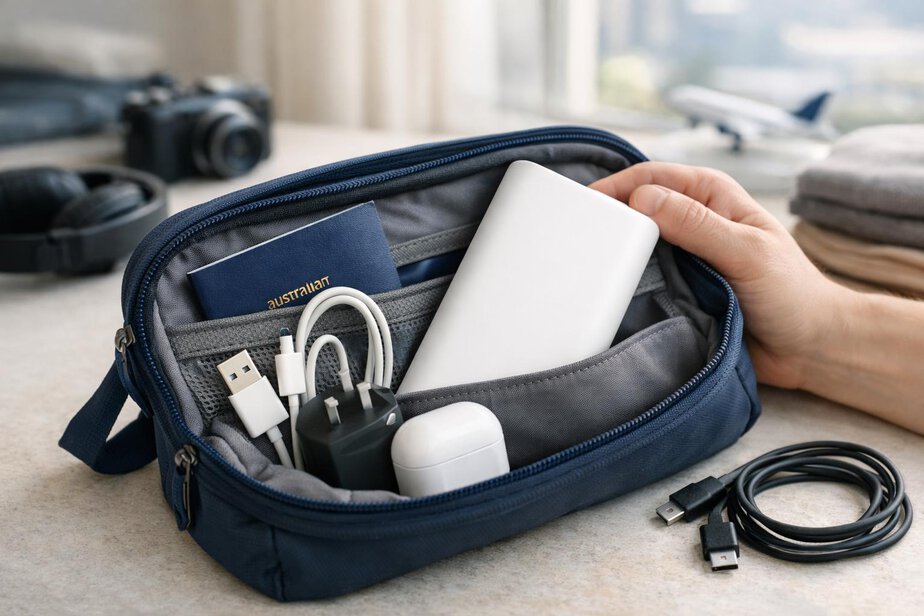
Power bank thresholds: up to 100 Wh, 100 Wh to 160 Wh, and above 160 Wh
Most travel power banks sit in the lower range, but travellers should still understand the three main categories.
| Battery range | Typical status | What usually applies |
|---|---|---|
| Up to 100 Wh | Common consumer power banks | Carry-on only; airlines may still limit the number allowed per person |
| Above 100 Wh to 160 Wh | Larger batteries and some high-capacity power banks | Carry-on only; airline approval usually required before travel |
| Above 160 Wh | Generally not allowed in passenger baggage | Limited exceptions may exist for specific equipment, such as some mobility aids, under controlled rules |
For Australian travel, CASA notes that power banks and spare lithium batteries must be in cabin baggage. Batteries above 100 Wh and up to 160 Wh need airline approval. Batteries above 160 Wh are generally not permitted in passenger baggage, subject to limited exceptions.
One important detail: the limit is not just about the item being “a power bank”. It is about the battery’s actual energy rating, condition and approval status. A brand-name product can still be outside the allowed range if its capacity is too high.
How to pack power banks safely
Packing a power bank properly is not hard, but it matters. Short circuits, pressure damage and loose items in a bag can all increase risk.
Safe packing steps
- Keep the power bank in your carry-on bag.
- Protect the terminals with a cover, the original packaging or a separate pouch.
- Do not let it rub against coins, keys, loose change or metal pens.
- Keep spare batteries separate from other electronics where possible.
- Do not tape over ventilation openings unless the manufacturer instructs you to do so.
- Do not crush, bend or wedge the power bank tightly under heavy items.
What to avoid
- checked baggage
- loose packing with metal items
- damaged cables attached to the battery
- covering over warning labels
- using makeshift repairs on swollen or cracked units
Some travellers like to carry spare batteries in a small electronics pouch. That can be useful as long as the batteries are individually protected and cannot contact metal objects. The aim is simple: stop the terminals from shorting and stop the battery from being damaged in transit.
Swollen, recalled, counterfeit or faulty power banks: warning signs
Not every power bank is safe to fly. A battery that looks damaged on the outside may be unstable on the inside.
Do not travel with a power bank if it is:
- swollen, puffed up or misshapen;
- leaking, cracked or visibly damaged;
- getting unusually hot;
- smelling chemical, burnt or unusual;
- missing its label or identification details;
- known to be recalled;
- counterfeit, unbranded or suspiciously cheap from an unknown source.
If a battery has been recalled, check the relevant Australian product safety information and follow the recall instructions. Do not assume a battery is safe just because it still charges a phone. A battery can appear to work normally and still be unsafe to carry.
For travellers, the safest decision is often the simplest one: if it looks wrong, do not take it. Replace it through a reputable seller and dispose of the old item through an appropriate battery recycling pathway.
Can you use or charge a power bank during a flight?
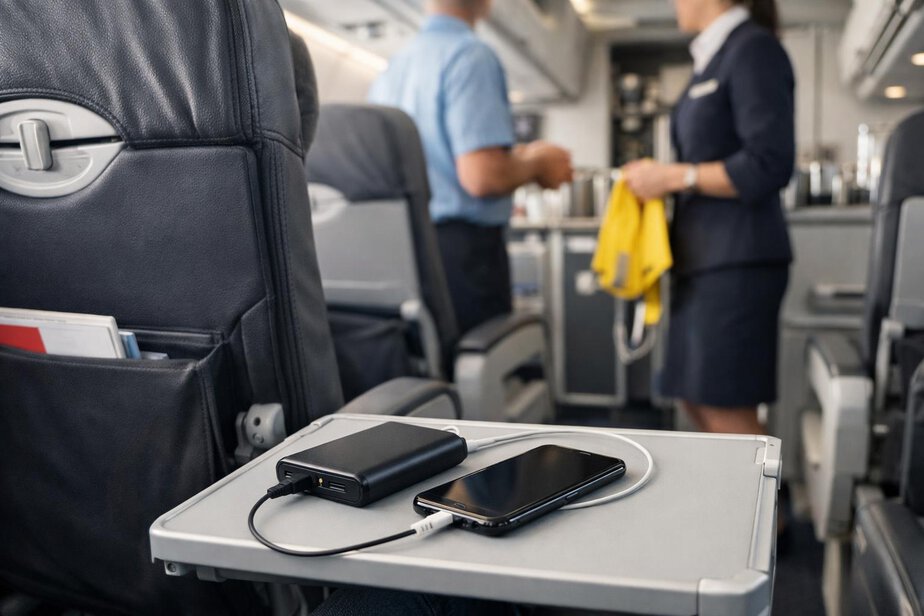
This is where airline policies often differ. Some carriers allow limited use of approved power banks, while others restrict charging or require that power banks remain stowed. In-seat USB ports and aircraft power outlets are a separate issue from carrying a power bank. A seat power outlet may be available for charging a phone or laptop, but that does not automatically mean you can freely use your own power bank during the flight.
For passengers, the safest approach is to assume there may be restrictions unless the airline explicitly says otherwise. Be careful not to confuse three different things:
- carrying the power bank;
- charging a device from the aircraft seat outlet or USB port;
- charging the power bank itself during the flight.
Those are not the same. An airline may allow one and restrict another. If crew instruct you to stop using the power bank, comply immediately. Do not argue or continue charging after being told to stop.
Also be careful with earbud charging cases, magnetic charging pouches and similar accessories. They can contain small batteries and may be treated as lithium battery items by some airlines. Check how the airline classifies them before you pack.
What to do if a battery gets hot, swells, hisses, smokes or catches fire in flight
The passenger instruction is simple: alert cabin crew immediately and follow instructions. Do not wait to see whether it settles. Do not pass the item around the cabin. Do not try to be the hero.
Battery events can change fast. Warning signs include:
- rapid heating;
- swelling or bulging;
- hissing or popping sounds;
- smoke;
- unusual smell;
- sparking or visible flame.
What passengers should do
- Tell cabin crew immediately.
- Move away only if crew direct you to do so.
- Do not touch a smoking battery unless instructed.
- Do not place it in water or a drink container.
- Do not open, squeeze or puncture it.
- Do not pack it away in a bag or overhead locker unless crew instruct otherwise.
Cabin crew are trained to manage the event. Your role is to report it quickly, keep clear and help reduce confusion in the cabin. If there is smoke in the cabin generally, follow crew directions, keep low if instructed, and prepare to assist with any emergency procedures as directed.
For ground emergencies or if there is any immediate threat to life after landing, call Triple Zero (000) in Australia.
What aviation firefighters want you to know
From a rescue and firefighting perspective, power bank fires are not ordinary small fires. A lithium battery can enter thermal runaway, where heat, gas and fire build quickly and can spread within the battery pack itself. That is one reason cabin accessibility matters so much.
Firefighters and aviation rescue crews focus on four practical issues:
- early detection — smoke, smell and heat need fast reporting;
- access — crews must be able to reach the battery quickly;
- containment — the event needs to be isolated from surrounding materials;
- re-ignition risk — a battery can flare up again even after it appears to be out.
The ATSB investigation into the Virgin Australia Sydney–Hobart power-bank fire highlighted several important lessons: cabin access matters, thermal runaway can occur even when a battery is not charging, crew response is critical, and re-ignition is possible. That case reinforced why spare batteries belong in the cabin and why rapid reporting matters.
For operational staff, the handover from cabin to emergency services needs clear communication: what was seen, where the item was located, whether it was removed, whether the item is still hot, and whether there is any chance of re-ignition. That information helps aviation rescue firefighters and airport fire services decide how to isolate the area and manage the risk.
For firefighters and flight crews, the key challenge is not only stopping visible flames. It is preventing escalation, protecting nearby passengers and materials, and managing the possibility of flare-up after the initial event.
Real-world lessons from Australia and overseas
The ATSB investigation into the 21 July 2025 Virgin Australia Sydney–Hobart event is a useful Australian reminder that a power bank can fail in flight without charging being the trigger. That matters because some travellers assume the battery is safe if it is simply sitting in a bag. It may not be.
Internationally, there have been many battery fire incidents involving power banks, phones and other lithium battery items on aircraft and in airports. The practical lesson is consistent: damaged, poorly packed or unsupported batteries create unnecessary risk, and crew need a clear path to manage any developing event.
For public guidance, the lesson is not to memorise each incident. It is to build safe habits before every flight:
- carry batteries in the cabin;
- know the battery rating;
- check for damage or recalls;
- follow crew directions immediately if there is heat, smoke or smell.
For safety professionals, the lesson is also about communication. Passengers often do not know the difference between a battery in a device and a spare power bank, or between normal warmth and dangerous heat. Clear pre-flight messaging can close that gap.
Related items: phones, laptops, spare batteries, smart luggage and medical equipment
Power banks are only one part of the lithium battery picture. Travellers also need to think about other battery-powered items in their luggage.
Phones, tablets and laptops
Devices with batteries installed inside them are usually treated differently from spare batteries. In general, the device can travel in cabin baggage and may be used under airline rules. However, large devices can still attract extra screening, and batteries inside devices can still overheat if damaged.
Camera batteries and spare device batteries
Loose spare batteries should be protected against short circuit and carried in the cabin. Do not toss them into a pocket with keys or coins. Keep them in a dedicated pouch or package.
Earbud charging cases
These may contain small batteries and may be treated like battery-powered accessories. Check the airline’s rules before packing multiple charging cases or similar items.
Smart luggage
Some smart bags contain removable batteries. If the battery can be removed, airline rules may require the battery to be taken out before the bag is checked. If a battery is fixed in place and cannot be removed, the bag may not be acceptable.
Mobility aids and medical equipment
Some larger batteries above 160 Wh may be allowed only in limited, controlled circumstances, often linked to mobility aids or medical equipment. These are specialist cases and may require advance approval and documentation. Travellers should not assume a consumer power bank falls into this category.
Do and don’t summary
| Do | Don’t |
|---|---|
| Carry power banks in hand luggage | Put power banks in checked baggage |
| Check Wh and airline approval rules | Guess based on size alone |
| Protect terminals from short circuits | Carry loose batteries with metal objects |
| Remove the battery if your bag is gate-checked | Assume gate-checked bags are treated the same as carry-on |
| Report heat, smoke, smell or swelling at once | Handle a smoking battery yourself |
| Check for recalls and visible damage | Fly with damaged, swollen or recalled batteries |
FAQs
How many power banks can I take on a plane?
That depends on the battery rating and the airline. CASA guidance allows up to two power banks per person in some categories, but the airline may set stricter limits. Always check current rules before travel.
Can I pack a power bank in my checked suitcase if it is switched off?
No. The key issue is not whether it is switched on. Power banks are spare lithium batteries and must be carried in the cabin, not checked baggage.
Do I need approval for all power banks?
No. Smaller power banks are usually allowed without special approval, but batteries above 100 Wh and up to 160 Wh often need airline approval. Check the battery label first.
What if my power bank does not have a Wh label?
Try to confirm the rating from the manufacturer. If you cannot identify it clearly, do not guess. Unlabelled or unclear batteries are a warning sign and may be rejected.
Can I use my power bank while charging my phone on the plane?
Maybe, depending on the airline. Some airlines allow use with conditions, while others restrict charging or storage. Check before you fly and follow cabin crew instructions onboard.
What if the battery starts smelling hot but there is no smoke?
Tell cabin crew immediately. Heat and unusual smell can be early warning signs before visible smoke or fire.
Practical next steps before your next flight
- Check every battery-powered item in your carry-on.
- Read the label and identify the Wh rating.
- Separate approved power banks from damaged or old ones.
- Look up the airline’s current dangerous goods page.
- Put the power bank in a safe pouch with terminal protection.
- Keep it easy to remove if asked.
- Share the rules with family members travelling with you, especially teenagers carrying multiple charging accessories.
If you travel often, keep a small “flight battery kit” ready: one compliant power bank, a cable, a pouch and a note with the Wh rating. That simple habit can save time at security and reduce the chance of packing the wrong item.
Conclusion
Yes, you can usually take a power bank on a plane in Australia, but the rules are specific and safety-critical. Carry it in your hand luggage, check the watt-hour rating, follow the airline’s current limits, and never travel with a damaged, swollen or recalled battery. If anything overheats, hisses or smokes in flight, alert cabin crew immediately and follow their instructions.
For passengers, the main job is to pack correctly and stay alert. For aviation and emergency professionals, the main lesson is the same: fast reporting, cabin access and clear procedures reduce risk. Before publication or travel, verify the latest airline and CASA information, and confirm local procedures where required.
Related FireRescue guides
- Lithium battery fire safety for homes and workplaces
- Travel safety for portable chargers and electronic devices
- Aircraft emergencies: what passengers need to know
- How firefighters manage lithium-ion battery incidents
Sources and corrections
This article is based on current Australian guidance from CASA, airline dangerous goods information and the ATSB investigation reference supplied for editorial use. Airline policies can change, and international or codeshare flights may use different operating rules.
If you spot an error, a policy change or a correction needed for a specific airline or route, please submit it to the FireRescue editorial team for review before publication or republication.
Author note: This article was prepared from verified aviation safety guidance and public regulatory material, with a focus on practical traveller advice and responder-relevant battery fire considerations.
FireRescue Training Hub
Access practical fire and emergency study support resources, downloads, checklists, audio guides, and member-only course content.
- Course library
- PDF downloads
- Audio guides
- Checklists
Study support only. Not accredited training or a replacement for workplace procedures.
About the author and safety review
Ken Walker
Former Station Officer and fire service educator
Former career firefighter with extensive career and volunteer fire service experience.
Qualifications: Associate Diploma of Applied Science in Fire Technology; Institute of Fire Engineers studies.
Author profilehttps://www.firerescue.com.au/about-us/