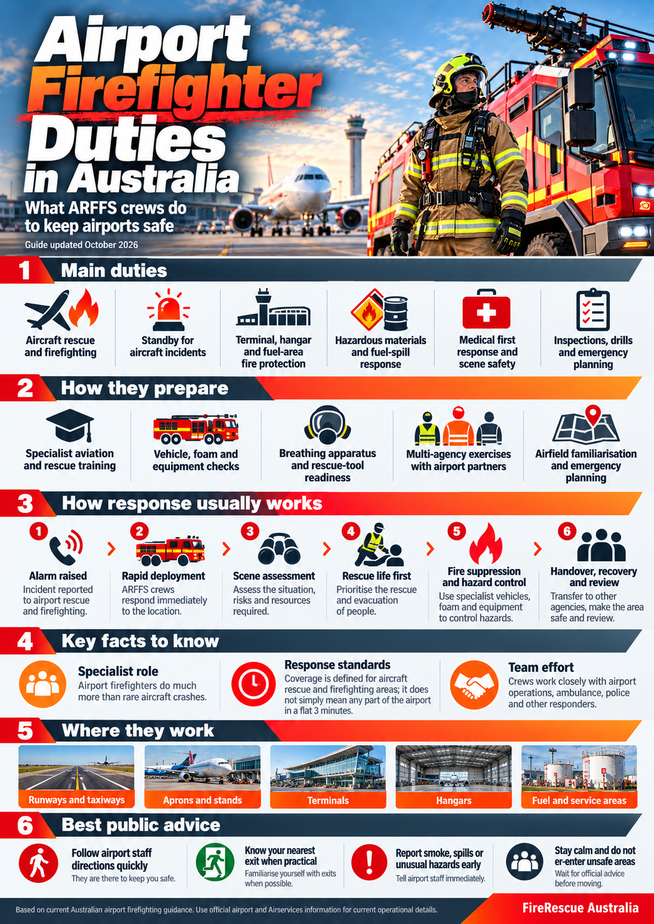
Airport firefighting in Australia is a specialist form of emergency response. Airport firefighter duties centre on rescuing people from aircraft accidents and fires, controlling fires on the aerodrome, maintaining immediate operational readiness, and training continuously for incidents where seconds can matter.
In Australian regulation the service is called an Aerodrome Rescue and Fire Fighting Service (ARFFS). The role is broader than responding to aircraft crashes, but it is also more specific than many public descriptions suggest. Not every airport has a dedicated ARFFS, and the well-known “three-minute response” is not a promise that a fire truck can reach every terminal, car park or airport building within three minutes.
This guide was reviewed on 4 October 2026 against Airservices Australia information, the Civil Aviation Safety Regulations and the current Part 139H Manual of Standards. Always follow the current procedures of the airport, ARFFS provider, airline and emergency-service authority involved.
- Removed the extra body H1 so the WordPress post title remains the page H1.
- Replaced broad claims about “reaching any part of the airport in three minutes” with the actual Australian ARFFS response-time standard.
- Separated core ARFFS functions from duties that may instead belong to airport operators, police, security, airlines or other emergency services.
- Removed unsourced “real stories”, unsupported claims about volunteer backgrounds and the unrelated affiliate grab-bag promotion.
- Added current information about service coverage, training, competency maintenance and aerodrome categories.
- Added practical guidance for travellers and a clearer operational explanation for firefighters and emergency-service readers.
What is an airport firefighter in Australia?
Airport firefighters are specialist responders trained for aircraft and aerodrome emergencies. Airservices Australia is the major civil provider and currently states that its Aviation Rescue Fire Fighting Service operates at 28 of Australia’s busiest airports. Its service page says crews respond to more than 4,500 aircraft and airport emergency-assistance requests each year.
That does not mean every Australian airport has its own specialist aviation fire service. CASA explains that specialised aviation firefighters operate at the busiest airports, while airports without a dedicated aviation firefighting service rely on local emergency services for incidents. The regulatory requirements depend on matters including the type of air service, passenger numbers, aircraft size and the level of ARFFS established at the aerodrome.
The word aerodrome is used in the regulations, while the public more commonly says airport. In this guide, “airport firefighter” is used in the plain-English sense and “ARFFS” when discussing the regulated specialist service.
The two core legal functions of ARFFS
The Civil Aviation Safety Regulations give ARFFS two central functions. First, the service is there to rescue people and property from an aircraft that has crashed or caught fire during landing or take-off. Second, it must control and extinguish fires on the aerodrome and protect people and property threatened by those fires, whether or not an aircraft is involved.
Respond rapidly to an aircraft accident, landing or take-off fire, rescue occupants where possible, protect evacuation paths and apply the required firefighting agents.
Control and extinguish fires on the aerodrome and protect people and property threatened by fire, whether the fire involves an aircraft or another aerodrome asset.
An ARFFS provider can also perform fire-control or rescue services away from the aerodrome, but the regulations require priority to be given to its aviation and aerodrome functions. Mutual-aid arrangements with state, territory or local emergency services remain important for larger or prolonged incidents.
What airport firefighters do on a normal shift
A large part of aviation firefighting is readiness. Crews cannot wait until an alarm to discover that a vehicle, breathing apparatus set, radio, monitor, hose or rescue tool is unavailable. Daily work therefore includes operational checks, training and maintaining familiarity with the aerodrome.
Airservices’ current recruitment material also lists first aid and emergency assistance, maintenance of specialist vehicles and equipment, ongoing operational and fitness training, and support for airport safety and emergency preparedness as parts of the role.
The three-minute rule: what it actually means
The current Australian Part 139H Manual of Standards defines response time from the initial call to the point where the first responding vehicle is in position at the aircraft or incident site and, if required, is producing foam at at least 50 per cent of the specified discharge rate.
The operational directive is to achieve a response time of no more than three minutes to the end of each runway in optimum visibility and surface conditions. The operational objective is two minutes to each runway end, and no more than three minutes to any part of the movement area. This is not the same as saying crews will reach any location anywhere across an airport precinct within three minutes.
The movement area includes the parts of the aerodrome used for aircraft take-off, landing and taxiing, including aprons. Weather, visibility, route conditions and difficult terrain can affect operations, which is why the standards also address emergency access roads and response arrangements for difficult terrain.
Why aviation firefighting is different
An aircraft accident can develop quickly and may involve large numbers of occupants, aviation fuel, confined cabin spaces, damaged structures, hot engines, difficult access and hazards unfamiliar to firefighters who do not routinely work around aircraft. The response has to combine rescue, fire control and protection of survivable areas while maintaining safe access for emergency crews.
Specialist vehicles are designed to deliver large quantities of firefighting agent rapidly and while manoeuvring across an aerodrome. Crew positioning, vehicle access, communications and the ability to maintain agent application are therefore central to ARFFS planning.
The required level of protection is not identical at every airport. Under the Part 139H standards, aerodromes are categorised according to the aircraft operating there. Aircraft dimensions and movement frequency help determine the category, which in turn affects matters such as the minimum number of firefighting vehicles and required extinguishing-agent performance.
How an aircraft emergency response generally unfolds
- Alert and information. The ARFFS receives the emergency call or alert and obtains the available information about the aircraft, location and nature of the problem.
- Immediate mobilisation. Appropriate vehicles and crews deploy using established routes while maintaining communications with the fire-station communications function, air traffic services and other agencies as required.
- Approach and positioning. Crews assess aircraft position, fire conditions, wind, evacuation, hazards and access before committing vehicles and personnel.
- Rescue and fire control. Firefighting agents are applied, rescue is supported and occupants or responders are protected from fire and other immediate hazards.
- Command and reinforcement. The incident command structure coordinates ARFFS resources and integrates supporting police, ambulance and external fire services where required.
- Recovery and handover. Once immediate life safety and fire control are achieved, the scene moves into stabilisation, investigation, recovery and restoration under the appropriate authorities.
The exact tactics depend on the aircraft, location, emergency type and local procedures. A public article cannot replace an airport emergency plan, ARFFS standard operating procedures or incident-specific command decisions.
Training is continuous, not a one-off course
Australian ARFFS personnel must maintain the qualifications and competencies required for their operating position. The current Part 139H standards require operational firefighters to maintain competencies through on-the-job training, with core competencies validated regularly and a maximum interval of 90 days.
The competency areas identified in the standards include foam application from an attack vehicle monitor, aerodrome topography, aircraft familiarisation, fire-station communications, fire alarms, vehicle operation, breathing apparatus, hose and branch work, ladders, rescue equipment, first aid, incident command and pre-incident planning.
The standards also require realistic exercises representing aircraft crashes, accidents or incidents. This is important because airport firefighting is a low-frequency but potentially high-consequence environment: crews need to maintain skills they may not use at a major incident for long periods.
How Airservices recruits and trains aviation firefighters
Airservices Australia says its ARFF workforce includes more than 900 operational and support personnel across airport fire stations around Australia. Its current careers information states that new recruits complete an initial 11-week training program in Melbourne before transitioning to their station.
Applicants do not need previous firefighting experience for general recruit campaigns. Airservices currently requires applicants to meet its eligibility, medical, physical, licensing and other recruitment standards. The organisation also makes clear that the work involves rotating shifts, including nights, weekends and public holidays.
For readers interested in joining, use Airservices’ current careers page rather than relying on old recruitment posts because entry standards and course dates can change.
Operational perspective: what municipal and volunteer firefighters should understand
A firefighter from a structural, rural or industrial background brings useful fundamentals to an aviation incident: crew discipline, dynamic risk assessment, incident command, breathing apparatus, hose work, rescue and casualty care. But aviation response introduces its own hazards, aircraft systems, access issues and movement-area controls.
From a general fire-service perspective, the key lesson is role clarity. External crews supporting an airport incident should work through the established command structure, use designated access, follow airside controls and avoid assuming that normal road, industrial or structural-fire practices automatically transfer to the aircraft environment. This article does not claim that the author has served as an ARFFS firefighter; the operational observations draw on broader career and volunteer firefighting experience.
What travellers should do during an airport emergency
- Follow crew and airport instructions immediately. Airline, airport and emergency personnel may need people to move in a particular direction or remain clear of an operational area.
- Do not approach an incident scene. Fire appliances need unobstructed access and aircraft emergencies may involve hazards that are not obvious to bystanders.
- Report smoke, fire, unusual odours or spills promptly. Tell airport or airline staff rather than assuming someone else has already reported it.
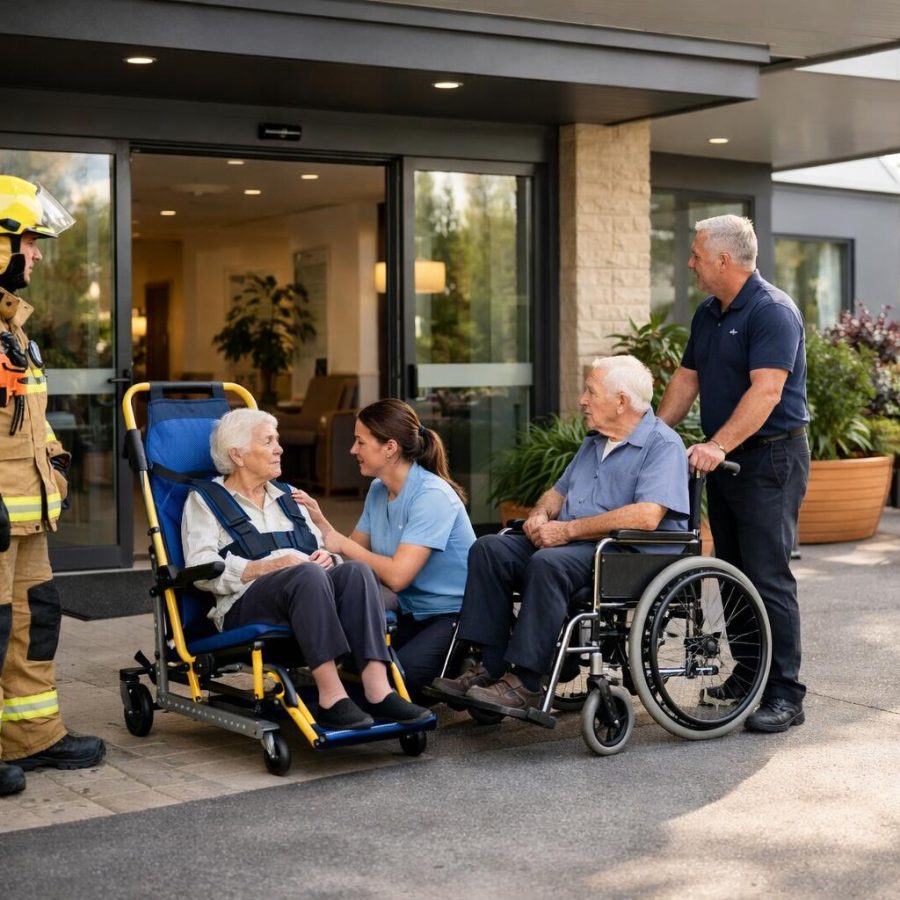
- Use accessible assistance early if you need it. Travellers who may need mobility, communication or other assistance should tell the airline or airport staff so appropriate support can be arranged.
- Expect other emergency services to be involved. Airport incidents can involve ARFFS, state or territory fire services, ambulance, police, airport operations and airline personnel.
Common misconceptions about airport firefighters
“Every airport has its own specialist fire brigade.”
No. Dedicated ARFFS operates at airports that meet the relevant criteria or where a service is otherwise established. CASA states that airports without specialised aviation firefighters rely on local emergency services.
“The three-minute standard applies everywhere on airport property.”
No. The Australian standard is framed around runway ends and the aircraft movement area under specified optimum conditions. It should not be turned into a blanket promise covering terminals, public car parks or every property boundary.
“Airport firefighters only deal with aircraft crashes.”
No. Their regulatory functions also include fires elsewhere on the aerodrome. Airservices also describes broader aviation and airport emergency-assistance work, first aid and emergency assistance, equipment readiness and emergency-preparedness support.
“A structural firefighter can simply step into the same role.”
No. General firefighting experience can be valuable, but ARFFS requires aviation-specific qualifications, local competencies and continuing training. Aircraft and aerodrome knowledge are central to the role.
Practical next steps
- For current Australian ARFFS requirements, start with CASA Part 139 and the current Part 139H Manual of Standards.
- For Airservices operations and careers, use the current Airservices ARFFS and careers pages.
- If you are an emergency responder who may attend aviation incidents, refresh your organisation’s aircraft, airside-access and incident-command procedures.
- If you are a traveller, follow airline, airport and emergency-service directions rather than trying to interpret an incident yourself.
- Recheck regulatory and recruitment information periodically because aviation standards and employment requirements can change.
Related FireRescue guides
- Respond to Aviation Incidents Foundations, Part 1 of 4
- Work Safely Around Aircraft Foundations, Part 1 of 3
- Firefighter Jobs in Australia: How to Join, Training and Salaries
Conclusion
Airport firefighters provide a specialist safety layer for aviation. Their job combines rapid aircraft rescue and firefighting with aerodrome fire protection, equipment readiness, aircraft and site knowledge, first aid, incident command and constant competency maintenance.
The most important public takeaway is that ARFFS is built around defined aviation risks and performance standards. The most important firefighter takeaway is that general fire-service skills remain valuable, but aviation incidents demand specific aircraft knowledge, airside discipline and local procedures.
Official sources checked
- Airservices Australia — Aviation Rescue Fire Fighting Service
- Airservices Australia — ARFF careers and recruit information
- Civil Aviation Safety Authority — Part 139 of CASR
- Civil Aviation Safety Authority — passenger information on aviation accidents and emergencies
- Federal Register of Legislation — Civil Aviation Safety Regulations 1998, Subpart 139.H
- Federal Register of Legislation — current Manual of Standards Part 139H
Ken Walker — former Station Officer and fire-service educator with career and volunteer firefighting experience. The operational perspective in this article is based on general fire-service experience and does not claim personal service as an ARFFS firefighter.
This article provides general educational information for an Australian audience. It does not replace CASA requirements, an aerodrome emergency plan, ARFFS procedures, airline procedures, workplace training or directions from emergency authorities. Aviation and emergency-response requirements can change. Always follow current official procedures and instructions.
Corrections and field experience: FireRescue Training Hub welcomes source-backed corrections where aviation firefighting requirements have changed, and practical observations from current or former ARFFS personnel that can improve this guide. Operational anecdotes should be clearly identified as experience and should not override current official standards.
FireRescue Training Hub
Access practical fire and emergency study support resources, downloads, checklists, audio guides, and member-only course content.
- Course library
- PDF downloads
- Audio guides
- Checklists
Study support only. Not accredited training or a replacement for workplace procedures.
About the author and safety review
Ken Walker
Former Station Officer and fire service educator
Former career firefighter with extensive career and volunteer fire service experience.
Qualifications: Associate Diploma of Applied Science in Fire Technology; Institute of Fire Engineers studies.
Author profilehttps://www.firerescue.com.au/about-us/