Mobility scooters and powered wheelchairs help many people stay independent, travel safely and live with more freedom. Because these devices are important mobility equipment, safe charging deserves simple, practical planning at home and in shared residential settings.
Why charging safety matters
Mobility scooters and powered wheelchairs may use different battery technologies, and each device has its own charging requirements. Some use sealed lead-acid batteries, including gel and AGM types. Others use lithium-ion batteries. The safety steps are not identical, which is why the device manual, battery instructions and supplier advice must come first.
Good charging habits help reduce the risk of overheating, damaged batteries, electrical faults and fire. They also help protect the person using the equipment, family members, carers and other residents in the building. This is especially important where a person relies on the scooter or powered wheelchair to move around quickly or to leave the home.
Understand the battery type before you charge
Different battery types charge in different ways and can respond differently to heat, age and damage. It helps to know what is fitted to the device before you choose a charger, an outlet or a charging location.
| Battery type | Common points to remember |
|---|---|
| Sealed lead-acid | Often used in mobility equipment. Charge only as directed by the manufacturer and avoid using an unsuitable charger. |
| Gel | A sealed lead-acid style battery that still needs the correct charger and charging settings. |
| AGM | Another sealed lead-acid type. It still needs the right charger and regular inspection for damage or wear. |
| Lithium-ion | Needs particular care with charging, storage and damage checks. Follow the manual closely and do not assume it can be charged like other battery types. |
Do not mix batteries, chargers or electrical components simply because the plug fits. A plug that appears to fit is not proof that the charger is safe or compatible.
If you are unsure what battery type is installed, ask the supplier, manufacturer or a qualified repair technician before charging it in a new location or with a replacement charger.
Choose a safer charging location
A good charging location is stable, dry, well ventilated and easy to supervise. It should let the device charge without blocking access, exits or movement around the room.
Keep the scooter or powered wheelchair, the charger and the electrical lead away from beds, curtains, clothing, paper, blankets, heaters and other combustible materials. Keep them away from anything that can fall onto the charger or press against the battery area.
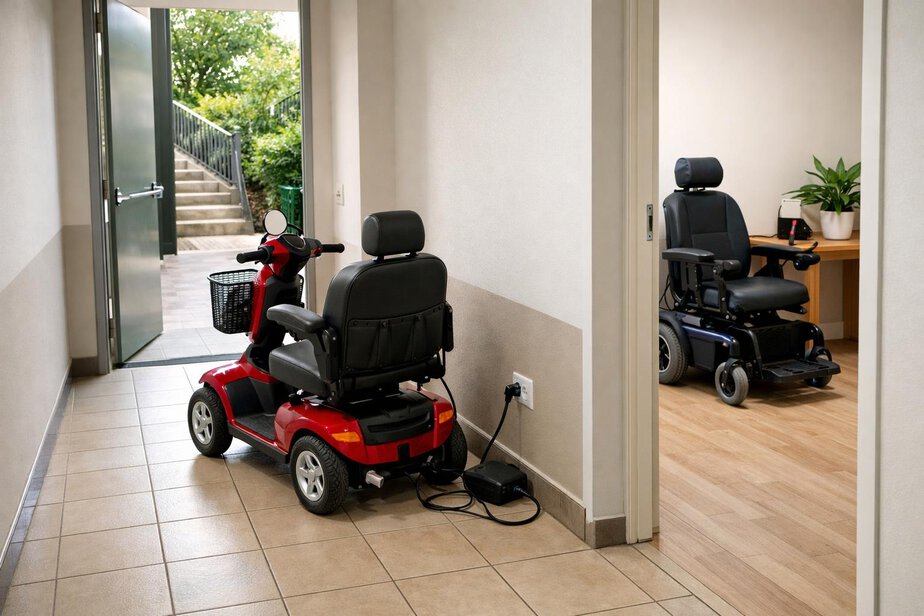
In particular, do not charge the device where a fire could block the person’s only exit. Fire and Rescue NSW advises that battery-powered devices should not be charged or stored near exits or escape paths, because a fire there can stop people leaving safely.
For homes, this often means choosing a spot with a clear route out of the room and away from the main sleeping area. In units, retirement villages, supported accommodation and other shared buildings, the charging spot may need to be agreed with the building manager or responsible person so it does not obstruct evacuation.
Practical location checks
- Is the area dry and protected from spills, flooding and weather?
- Can the device charge without touching soft furnishings or clutter?
- Can doors open fully and escape paths stay clear?
- Can someone see and reach the device if needed?
- Is the area suitable for the person’s mobility and transfer needs?
Use the right charger and check for compliance
Use the original charger supplied with the device whenever possible. Fire Rescue Victoria advises using the charger and cords originally supplied with the device. If a replacement is needed, use only a compatible replacement that has been approved by the manufacturer.
Never assume another charger is safe just because it fits the socket or seems to work. An incorrect voltage or current can damage the battery, cause overheating and contribute to fire.
Where applicable, check for the Australian Regulatory Compliance Mark on the charger or equipment. This mark is one sign that the product is intended to meet relevant Australian requirements, but it does not replace the need to follow the manufacturer’s instructions and approved compatibility advice.
Be cautious with cheap, damaged or modified chargers. Risks can include poor quality wiring, overheating, repeated faults, plug damage and failure to stop charging correctly. Do not bypass a battery-management system and do not attempt home repairs on the battery or charger.
If the charger behaves differently from normal, stop using it and seek advice from the supplier, manufacturer or a qualified repair technician.
Wall outlets, extension leads and powerboards
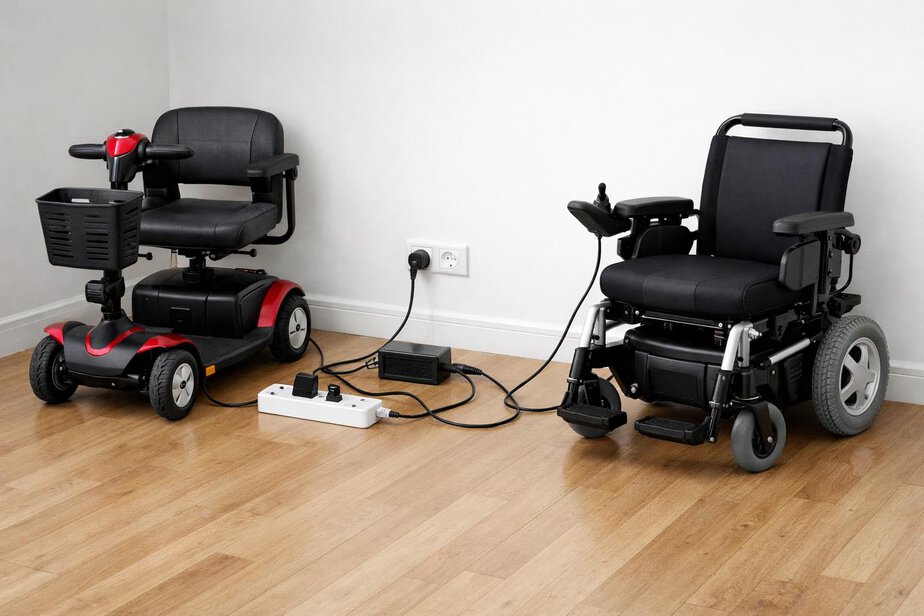
A fixed wall outlet is often the simplest and safest charging option when it is conveniently located and installed correctly. If the existing outlet cannot be reached safely, speak with a licensed electrician about whether a permanent wall outlet or another suitable solution is needed.
Extension leads and powerboards can create extra hazards. They can be damaged, overloaded, become trip hazards or be used in unsafe combinations. Do not overload a powerboard and do not connect one powerboard to another.
Keep leads stretched out enough to avoid heat build-up and physical damage. Do not run leads under rugs, through pinch points or where they can be crushed by doors or furniture. Keep plugs and sockets dry and in good condition.
If an extension lead is being used, it should be for a practical reason and only in a way that is consistent with the manufacturer’s instructions and the building’s rules. A longer-term arrangement is often better planned with a licensed electrician than relying on a long lead every day.
How to charge safely day to day
Most devices should be charged exactly as described in the manual. Some batteries are best charged after each use, while others may have specific storage or charging expectations. Fire and Rescue NSW advises disconnecting a device after it is fully charged and using only the supplied charger or certified compatible charging equipment.
Recommendations can vary between battery types and manufacturers, so do not assume one routine suits every device. For lithium-ion batteries, current fire-service advice is especially important: avoid charging while people are asleep or away from home unless the manufacturer specifically says it is acceptable and you can do so safely under local conditions.
For some lead-acid battery systems, the manual may allow different routines. For that reason, the device instructions always come first.
Daily charging checklist
- Check the manual and follow the recommended charging routine.
- Use the original charger or an approved compatible replacement.
- Place the device away from combustible items and clear of exits.
- Inspect the charger, cord and plug for visible damage.
- Check that the charger and outlet are dry and not overloaded.
- Make sure the area is supervised and easy to leave.
- Disconnect the charger when charging is complete, if the manual says to do so.
Watch for warning signs and stop charging early if needed
Do not keep charging a device that shows signs of damage or unusual behaviour. Stop charging and contact the supplier, manufacturer or a qualified repair technician if you notice any of the following:
- Swelling or bulging
- Cracks or impact damage
- Leaking fluid
- Excessive heat
- Burning or chemical smells
- Discolouration
- Sparking
- Smoke or vapour
- Hissing, popping or unusual sounds
- A charger or plug becoming unusually hot
- Repeated charging faults
After the scooter or powered wheelchair has been dropped, crashed, flooded or physically damaged, do not assume it is safe to charge again just because it still powers on. Damage can affect the battery, charger connection or internal protection systems. A professional inspection is the safer step.
Do not use the device until it has been checked by the right person. That may be the supplier, manufacturer or a qualified repair technician, depending on the fault and the warranty or service arrangement.
Emergency warning-sign checklist
- Smoke or vapour from the battery, charger or device
- Popping, hissing or crackling sounds
- A strong burning smell, chemical smell or visible flame
- Rapid heating or visible swelling
- Charger lead or plug melting, sparking or glowing
Extra planning for carers, support workers and facilities
Carers and support workers may be asked to help plug in the charger, check the setup or remind the person when charging is complete. Their role is to follow the person’s plan, the supplier’s instructions and any workplace or residential procedures.
They should not modify equipment, use unapproved chargers or decide that a damaged battery is safe to charge. If something seems wrong, the safe response is to stop charging and escalate the issue through the right service path.
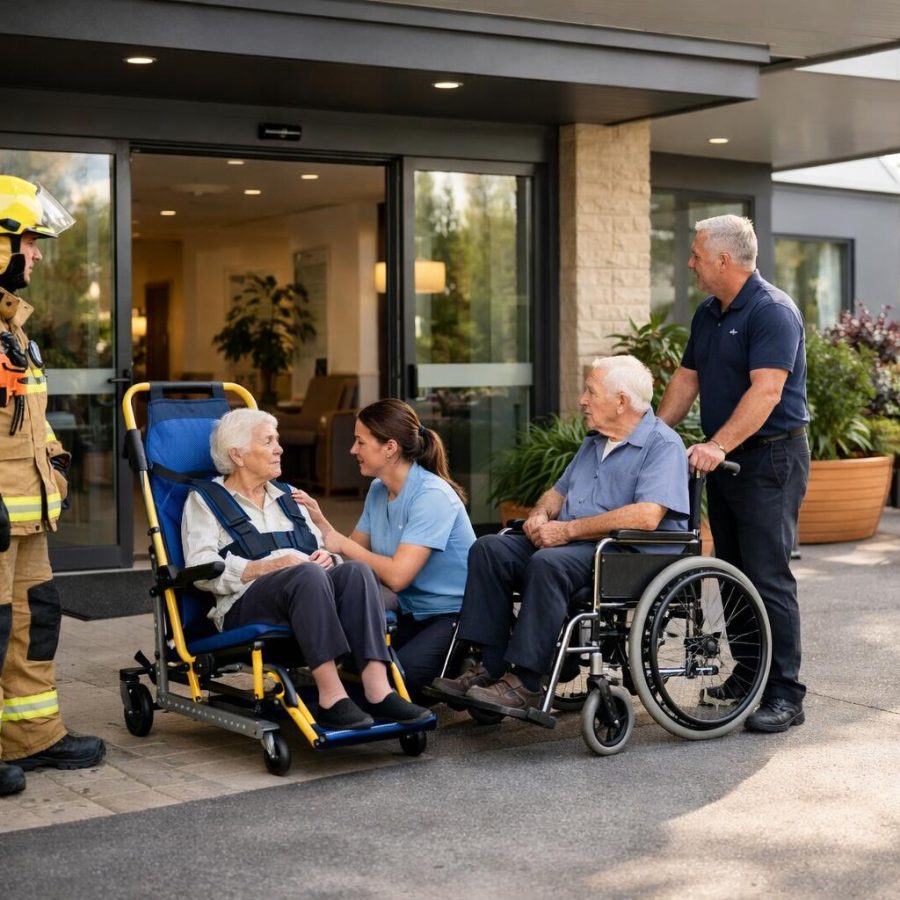
In supported accommodation, retirement villages and shared residential buildings, common hallways can be a serious hazard if they are used for parking or charging. The building manager or responsible person may need an individual charging and evacuation plan, especially where the person cannot quickly transfer out of the device or leave without assistance.
People who cannot move quickly or independently may need more than a general household plan. This can include clear communication about who will help, how the equipment will be moved only if safe and allowed, and what the exit route is if charging has to stop unexpectedly.
Smoke alarms, escape plans and what to do in an emergency
Working smoke alarms give early warning, but they do not prevent a battery fire. Every home and shared residence should also have a clear escape plan that everyone understands. Practice how to get out, where to meet and who will assist if someone needs help.
For people who rely on powered mobility equipment, the escape plan should be realistic. It should account for the time needed to wake up, move, transfer or receive assistance. It should also account for whether the device may block a path if charged in the wrong place.
If the battery produces smoke, vapour, popping sounds or fire, move away, warn others, leave the building if safe, close doors behind you and call Triple Zero (000). Do not pick up, move, disconnect or try to extinguish a battery that is hot, smoking, releasing gas or burning.
Immediate life-threatening emergencies in Australia require Triple Zero (000). Once safe, tell the operator what is burning and where the fire is located, and follow emergency instructions if given.
Keep the response simple: get away, warn others, leave if safe, close doors and call Triple Zero (000).
Putting it all together at home
Safe charging is usually about a series of small, sensible choices. Use the correct charger, charge in a clear and suitable space, check the equipment regularly and stop immediately if anything looks or sounds wrong. Keep the manual, supplier instructions, workplace procedures and personal emergency plan close at hand, because they may contain important device-specific details.
If you live in a house, unit, retirement village or supported accommodation, discuss charging early if the current setup is awkward, crowded or hard to supervise. A better outlet, a clearer path or a more suitable storage place may make a real difference to safety and convenience.
The aim is not to create fear or blame. Mobility equipment supports independence, and many people use it safely every day. With the right charging setup, routine checks and an emergency plan, you can reduce risk while keeping the equipment available when it is needed.
Before publication or implementation, verify the device manual, supplier advice, local building procedures and any relevant emergency or evacuation plan, because requirements and recommendations may change.
FireRescue Training Hub
Access practical fire and emergency study support resources, downloads, checklists, audio guides, and member-only course content.
- Course library
- PDF downloads
- Audio guides
- Checklists
Study support only. Not accredited training or a replacement for workplace procedures.
About the author and safety review
Ken Walker
Former Station Officer and fire service educator
Former career firefighter with extensive career and volunteer fire service experience.
Qualifications: Associate Diploma of Applied Science in Fire Technology; Institute of Fire Engineers studies.
Author profilehttps://www.firerescue.com.au/about-us/