From Volunteer Roots to Modern Response: The Story of Northern Territory Emergency Services
A comprehensive look at how emergency services in the Northern Territory developed, adapted to unique regional challenges, and operate today to protect communities across vast and remote landscapes.
Origins and Early Volunteerism (Pre-1970s to 1980s)
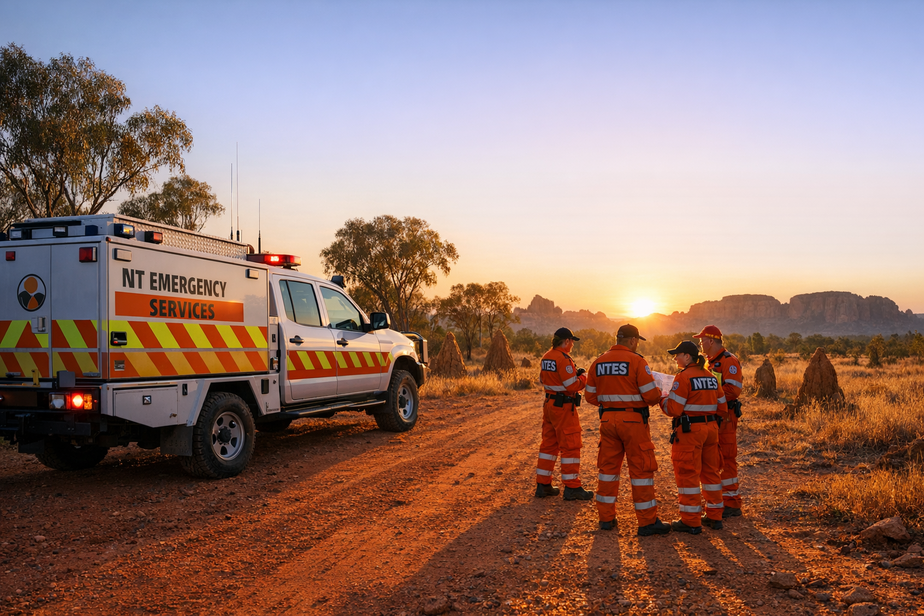
The foundations of emergency response across the Northern Territory (NT) were not built in centralised offices or sophisticated operations centres, but in the lived experience of remote communities, pastoral stations and mission settlements. For much of the 20th century, residents relied on local initiative to manage bushfires, cyclones, medical evacuations and transport accidents. These early responders were neighbours, station hands and community leaders whose skills were adapted to place and circumstance.
Community-led responses shaped by landscape
The NT’s geography — huge distances, seasonal monsoons and floodplains, hot dry seasons and isolated roads — meant that formal agencies were often days away. Practical improvisation and mutual-aid networks filled the gap. For example, pastoral stations shared vehicles and radio equipment during emergencies; churches and missions coordinated sheltering; and cattle musterers or hunter-trackers assisted with search tasks. That local knowledge, including navigation by landscape features and seasonal patterns, was an asset that formal systems later sought to incorporate.
- Early volunteer brigades formed around immediate need rather than statutory structures.
- Ad hoc transport and communications were used for medical and evacuation tasks.
- Local knowledge reduced reliance on distant government services in the first instance.
By mid-century, when high-impact events — large cyclones, extended flood episodes, or epidemics — placed extraordinary demand on communities, federal and territorial authorities began increasing investment in aerial support, communications infrastructure and coordinated disaster planning. Importantly, these changes often respected existing volunteer traditions: many of the original community responders became the nucleus of formal volunteer units in later decades.
Key point
Volunteerism in the NT was not simply an early stopgap; it set cultural expectations for community responsibility, multi-skilled response and locally-tailored training that persist today.
Formalization and Institutional Growth (1990s–2000s)
The period from the 1990s to the early 2000s marked a shift from largely improvised response toward structured, interoperable emergency management. Government investment enabled the development of standard operating procedures, formal incident management models and closer collaboration with federal resources — including the Australian Defence Force for surge capacity and logistics.
Institutional development and capability building
Key organizations matured during this period. Northern Territory Police, Fire and Emergency Services (NTPFES) extended its remit, and volunteer units were formalised within the State Emergency Service (SES) framework, adapted to NT’s unique conditions. These institutional changes were accompanied by practical upgrades: satellite communications, purpose-built four-wheel-drive appliances, and pre-positioned stores in cyclone-prone zones.
Training and credentialing grew more systematic. Accredited courses and multi-agency exercises built shared language and expectations across jurisdictions. Cross-border partnerships — particularly with Queensland and Western Australia — were developed to provide mutual aid across long distances. Risk reduction programs also gained traction, focusing on flood mapping, cyclone readiness and proactive community engagement.
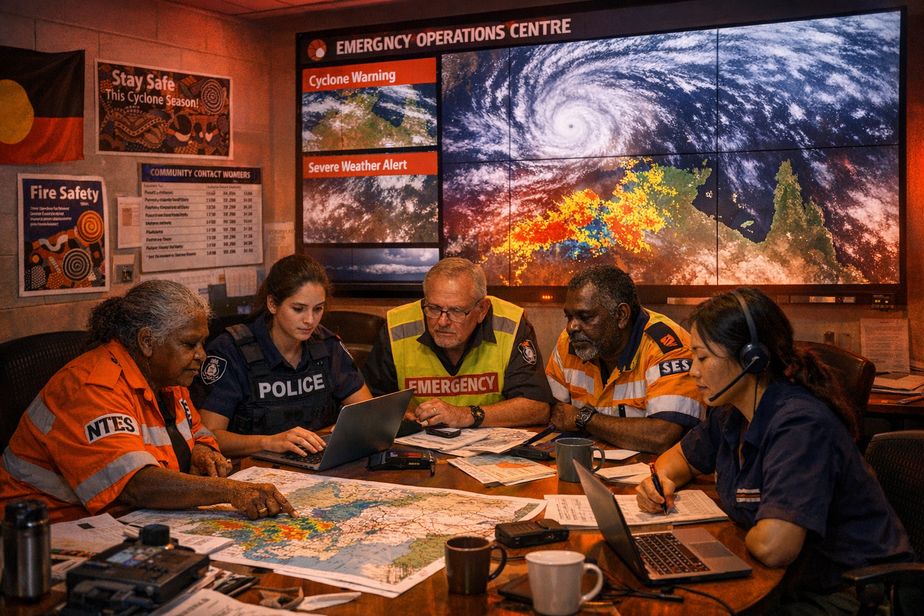
- Formal SES units modelled to fit the NT’s remote operations rather than copy metropolitan templates.
- Improvements in communications (satellite and radio) reduced isolation during incidents.
- Professionalised training increased consistency and interoperability across agencies.
“The shift from reactive to planned response reduced duplication in crises and allowed local knowledge to be amplified through better logistics and training.”
Structure and Agencies Today
Today’s NT emergency system is a deliberately blended model: government agencies, volunteer organisations, Indigenous ranger groups and local councils operate under an Incident Management System designed for scalability. This integrated approach recognises that no single agency can cover the Territory’s geographic and social complexity alone.
Who does what
- NTPFES — provides firefighting, technical rescue and coordination in many incidents.
- State Emergency Service (SES) units — largely volunteer-driven, focusing on flood and storm response, rapid damage assessment and community liaison.
- Health and aeromedical services — including the Royal Flying Doctor Service (RFDS) — deliver critical retrieval capacity for remote medical emergencies.
- Indigenous ranger and community groups — supply local reconnaissance, culturally informed messaging and logistical support during evacuations.
- Local councils and municipal services — play a key role in urban preparedness, shelter management and post-event recovery.
Volunteers remain central. In many remote communities, the first responder will be a local volunteer rather than a full-time professional. This reliance shapes training priorities, equipment procurement, and operational planning. The NT has also developed specialised capabilities tuned to local hazards: savanna-adapted bushfire tactics, cyclone sheltering frameworks, and aerial evacuation protocols for communities cut off in the wet season.
Today’s capabilities at a glance
Integrated incident management, multi-agency communication platforms, and volunteer networks combine to deliver scalable, locally-informed emergency responses across the Territory.
Technology, Training, and Community Resilience Initiatives
Technology and training have become force multipliers for NT emergency services. In a landscape where roads can be impassable and communities isolated, situational awareness and pre-planning determine outcomes as much as the number of responders on the ground.
Key advances
- Satellite communications and resilient radios that bridge gaps where terrestrial networks fail.
- Drone reconnaissance for rapid damage assessment and search in inaccessible areas.
- Localized, accredited training packages tailored to cyclone, flood and remote search-and-rescue challenges.
- Seasonal forecasting partnerships with the Bureau of Meteorology to guide pre-positioning of supplies and personnel.
- Community education programs delivered in local languages and via Indigenous media that increase uptake of preparedness actions.
Importantly, technological upgrades are complemented by straightforward, effective resilience measures: clearly marked evacuation routes, community emergency hubs with basic supplies, and the continuation of Indigenous land management that reduces fuel loads and modifies fire behaviour. These practices illustrate that high-tech tools and low-tech community systems together deliver stronger outcomes.
“In the NT, situational awareness can be the difference between a contained incident and a protracted multi-community emergency.”
Challenges and Gaps Still Facing the Territory
Despite steady improvements, the NT faces enduring challenges that require sustained attention and investment.
Operational and social hurdles
- Remoteness: Long transit times and seasonal road closures increase reliance on air assets and raise operational costs.
- Volunteer recruitment and retention: Small population centres struggle to maintain a consistent volunteer workforce, particularly through repeated hazard seasons.
- Cultural and linguistic complexity: Effective engagement requires co-designed approaches with Indigenous leaders to build trust and ensure messages are understood and acted upon.
- Infrastructure limitations: A lack of purpose-built community emergency hubs, ageing vehicles in some remote units, and insufficient shelter stockpiles reduce surge capacity.
- Climate change exposure: Increasing cyclone intensity, altered rainfall patterns and hotter fire seasons demand continuous adaptation of strategies and resourcing.
Addressing these gaps requires more than equipment purchases. It calls for workforce strategies that support volunteers (flexible training, local delivery, remuneration where appropriate), infrastructure investment in community-level hubs and shelters, and long-term partnerships with Indigenous organisations to ensure responses are culturally safe and locally endorsed.
Notable Recent Responses and Lessons Learned
Over the past decade, high-impact weather events have tested the NT’s systems and produced actionable lessons.
What worked
- Pre-positioned supplies and staged aerial assets substantially reduced response times when heavy rain and cyclone warnings were issued.
- Local leadership and community-led evacuations proved essential: where elders and trusted local figures led the process, compliance and orderly sheltering were far higher.
- Partnerships with Indigenous ranger groups allowed rapid, culturally appropriate reconnaissance and community liaison that otherwise would have been delayed.
Recurring lessons
After-action reviews commonly emphasise three consistent needs: improved communications interoperability between agencies, scalable surge-trained personnel, and targeted investment in community infrastructure. Iterative planning — capturing lessons and funding discrete improvements — has demonstrably improved preparedness metrics in many regions.
Operational takeaway
Combining local knowledge with pre-positioned assets and deliberate interoperability planning yields measurable improvement in response effectiveness across the Territory.
Conclusion — Summary and Next Steps
The Northern Territory’s emergency services have evolved from community-led volunteer action to a sophisticated, integrated system that balances local capability with statewide coordination. While modern tools — satellite comms, drones and accredited training — have improved response, the NT’s greatest strength remains its people: volunteers, Indigenous leaders and community coordinators whose knowledge and leadership shape outcomes.
Key points to remember:
- The NT model blends formal agencies and community capacity rather than replacing local initiative.
- Investment in communications, community hubs and culturally-led engagement remains a priority.
- Recruitment and retention of remote volunteers and adapting to climate-driven hazard changes are ongoing challenges.
If you live or work in the Territory, there are concrete actions you can take to strengthen resilience: create a household cyclone and flood plan, participate in local SES or community training, and support Indigenous-led preparedness programs that honour local knowledge while improving safety.
Support Stronger Emergency Services in the Northern Territory
Learn how you can volunteer, prepare your household for cyclone and flood seasons, or support community resilience programs across the Territory.
FireRescue Training Hub
Access practical fire and emergency study support resources, downloads, checklists, audio guides, and member-only course content.
- Course library
- PDF downloads
- Audio guides
- Checklists
Study support only. Not accredited training or a replacement for workplace procedures.
About the author and safety review
Ken Walker
Former Station Officer and fire service educator
Former career firefighter with extensive career and volunteer fire service experience.
Qualifications: Associate Diploma of Applied Science in Fire Technology; Institute of Fire Engineers studies.
Author profilehttps://www.firerescue.com.au/about-us/