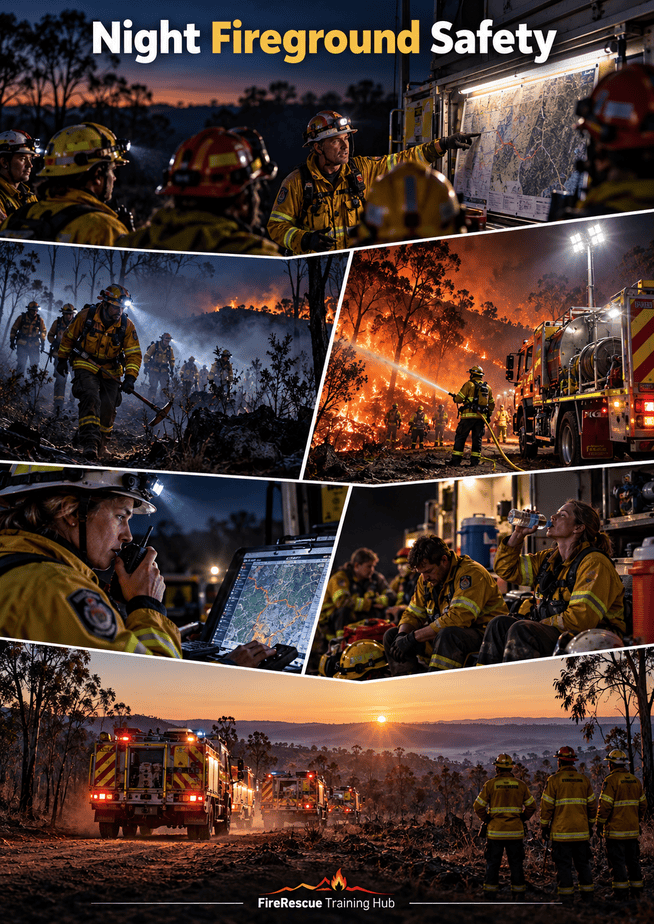
Night operations change the fireground. Darkness reduces visual information, fatigue increases as the night progresses, travel and terrain become harder to assess, and routine tasks can demand more concentration than they do in daylight.
Safe night firefighting is not about proving that crews can work longer. It is about maintaining situational awareness, controlling fatigue risk, protecting escape options, keeping communications reliable and knowing when conditions no longer justify the task.
Fatigue guidance: 2025–26
Reviewed: October 2026
Operational disclaimer
This article is general education, not an operational procedure. Firefighters must follow current agency doctrine, incident objectives, training, PPE requirements, fatigue controls, driving rules and directions from the incident management structure. If agency requirements are more restrictive than anything described here, the agency requirement applies.
Why night operations need a different risk mindset
At night, people lose much of the visual information they normally use to judge distance, terrain, tree condition, vehicle movement, escape routes and changes in the fire edge. Smoke can make artificial lighting less effective through glare and backscatter. Uneven ground, wire, drains, stumps, damaged structures and weakened trees can be harder to identify.
At the same time, the human body is working against its normal sleep-wake cycle. Safe Work Australia describes fatigue as physical, mental and/or emotional impairment that can reduce a person’s ability to work safely. Night work, long hours, inadequate recovery and high physical or cognitive demand are recognised contributors.
The result is a compound risk: less information is available at the same time that a fatigued brain may be slower to interpret it. Night operations therefore need deliberate controls rather than simply continuing daytime tactics after sunset.
AIIMS 2025: Safety First applies after dark
AFAC’s AIIMS 2025 edition makes Safety First an official AIIMS principle. For night operations, that means the incident objectives, resource plan, briefing, supervision and tactics should take account of the limits imposed by darkness and fatigue.
An operational plan should not assume that a task remains acceptable simply because it was acceptable in daylight. Conditions, visibility, personnel condition, access and communications can all change. The structure should be scaled so supervisors can maintain meaningful oversight rather than becoming overloaded.
Night work may sometimes provide operational opportunities, including cooler conditions or a reduced rate of fire spread. Those benefits are not guaranteed. Wind changes, unstable fire behaviour, dry fuels, terrain effects and poor visibility can still create dangerous conditions.
The main night fireground hazards
| Hazard | What changes at night | Control focus |
|---|---|---|
| Terrain and obstacles | Depth, slope, holes, fences, stumps and tracks can be difficult to see. | Reconnaissance, marking, lighting, slower movement and team integrity. |
| Trees and overhead hazards | Visual warning signs can be harder to detect. | Exclusion zones, specialist assessment and avoiding unnecessary exposure. |
| Fire behaviour | Crews may have fewer visual cues and can become over-confident if activity appears lower. | Weather updates, lookouts, current intelligence and conservative trigger points. |
| Traffic and plant | Drivers and operators have reduced visibility and fatigue may affect reaction time. | Traffic management, separation, high visibility, spotters and lighting. |
| Navigation and communications | Landmarks disappear and errors are harder to detect. | Maps, GPS where approved, radio checks, clear call signs and known fallbacks. |
| Fatigue | Alertness and decision-making can deteriorate during the night and with repeated shifts. | Work design, relief, breaks, reporting, task rotation and safe transport. |
Fatigue is a fireground hazard, not a character flaw
Modern fatigue guidance is important because emergency-service culture has historically rewarded people for pushing through. Current safety practice is different: if fatigue is affecting safe performance, the risk needs to be controlled.
Safe Work Australia’s 2025 model Code recommends designing work to reduce fatigue rather than relying only on the individual to cope. Current guidance includes limiting shift length, allowing enough recovery time, providing regular breaks, limiting consecutive night shifts and reducing safety-critical work during the biological low point where reasonably practicable.
WorkSafe Victoria similarly identifies early-morning work as a higher-risk period for fatigue and recommends minimising safety-critical tasks during the early hours where possible.
Important: there is no single national fire-service shift rule
Australian agencies have their own fatigue policies, industrial arrangements and operational doctrine. Do not treat one agency’s shift limits or rest periods as a universal Australian rule. Supervisors and firefighters should apply their own current doctrine.
Signs that fatigue may be affecting safety
No single sign proves a person is unsafe, but changes in behaviour or performance should trigger a conversation and, where needed, relief or reassignment. Useful warning signs can include:
- difficulty staying alert or repeated yawning;
- slower responses to radio calls or instructions;
- forgetfulness, confusion or repeated mistakes;
- poor coordination, stumbling or dropping equipment;
- uncharacteristic irritability, withdrawal or poor judgement;
- difficulty maintaining attention during monotonous tasks; and
- any indication that a driver or machinery operator is struggling to remain alert.
A professional reporting culture matters. Safe Work Australia specifically recommends having a fatigue-reporting process that workers trust and can use without fear of punishment. On a fireground, that means people must be able to say, “I am no longer safe for this task,” and have the concern managed seriously.
Lighting: more light is not always better
Effective lighting should make work safer without introducing glare, deep shadows, trip hazards or confusion. Vehicle scene lights, portable area lights and approved personal lighting can all help, but placement matters.
Dense smoke can reflect strong white light back toward the user, reducing visibility. Where practicable, lights should illuminate the work area from useful angles rather than shine directly into firefighters’ eyes. Leads, tripods and portable generators also need to be positioned so they do not create new hazards.
Each service will have its own approved equipment. The principle is simple: light the task, the access route and the hazard — not just the general area.
Briefing and handover are critical after dark
Fresh crews arriving at night may not have seen the terrain, fire edge or hazards in daylight. A weak handover can leave them operating with assumptions that are already out of date.
A night-shift briefing should cover the current incident objectives, weather and predicted changes, known hazards, crew locations, communications plan, escape options, safety zones, access restrictions, lighting arrangements, welfare arrangements and the trigger points for changing or stopping the task.
At dawn, the reverse is just as important. Night crews may have identified new hazards, damaged access, changing fire behaviour or hotspots that the incoming shift cannot see from the briefing room. That operational intelligence needs to be handed over clearly.
Driving after a night shift can be the final hazard
The fire may be controlled and the crew may be stood down, but the risk is not finished if a fatigued firefighter then drives home or returns a heavy vehicle over a long distance.
Current NSW RFS safe-driving doctrine states plainly that a person must not drive an RFS vehicle on a road while impaired by fatigue. It also applies defined maximum-work and minimum-rest requirements to drivers.
The wider principle applies everywhere: transport needs to be part of the fatigue plan. Relief drivers, crew transport, a suitable rest location or delayed departure may be safer than assuming a firefighter can simply “push through” the trip home.
Hydration, food, rest and recovery
Fatigue controls are not limited to roster times. Hard physical work, heat, cold, smoke, dehydration, inadequate food and poor sleep conditions can all increase the load on crews.
Incident logistics should provide drinking water, suitable food, shelter and a practical place for recovery. Safe Work Australia also recommends suitable worker accommodation where it is provided, so people can achieve restful sleep and recovery.
Firefighters should follow their agency and medical guidance rather than rely on caffeine or other stimulants as a substitute for rest. A stimulant may temporarily increase alertness, but it does not remove the underlying fatigue risk.
The safest system is one that plans enough people, transport and relief so exhausted personnel are not required to keep doing high-risk work simply because no alternative has been organised.
Linton: a lesson that still matters
The 1998 Linton bushfire near Ballarat remains one of CFA’s most important firefighter-safety case studies. Five Geelong West volunteer firefighters — Matthew Armstrong, Jason Thomas, Chris Evans, Stuart Davidson and Garry Vredeveldt — lost their lives after two tankers were trapped and burnt over.
CFA states that at about 8.40 pm conditions changed rapidly from apparently benign conditions to intense, fast-moving fire. The tragedy resulted in major changes to firefighter training, safety procedures, equipment, communications and operational coordination.
The lesson is broader than night work: conditions can change faster than people expect, and situational awareness depends on timely information reaching the people exposed to the risk. Darkness makes that discipline even more important.
Night fireground safety checklist
- Objectives: Is the task still necessary and achievable at night?
- People: Are crews fit for the task and adequately supervised?
- Fatigue: Who has been working longest and who needs relief first?
- Weather: What changes are expected before dawn?
- Hazards: What cannot be seen clearly after dark?
- Escape: Are routes and safety zones still usable and understood?
- Lighting: Is the task lit without creating glare or trip hazards?
- Communications: Have radio channels, emergency procedures and check-ins been confirmed?
- Logistics: Are water, food, fuel, medical support and relief available?
- Driving: Who is fit to drive when the shift finishes?
- Handover: What does the next shift need to know that is not obvious from a map?
Operational perspective
From a fireground leadership perspective, night operations reward discipline. Crews can become focused on finishing one more section of line, blacking out one more edge or reaching one more property. That commitment is valuable, but it can also narrow attention.
A crew leader, Sector Commander or Incident Controller has to keep asking a broader question: has the risk changed more than the benefit? If visibility, fatigue, communications, weather or access are deteriorating, the correct tactical decision may be to slow down, change the task, reinforce supervision or withdraw to a safer position.
That is not lost productivity. It is risk management.
Key message
Night firefighting will remain part of Australian emergency response. The goal is not to remove night operations; it is to make sure the people conducting them are supported by good planning, current information, fit-for-purpose lighting, reliable communications, manageable workloads and safe transport.
Darkness is a hazard. Fatigue is a hazard. Both need to be managed as deliberately as fire behaviour, terrain and machinery.
- Safe Work Australia — Model Code of Practice: Managing the risk of fatigue at work
- Safe Work Australia — Managing fatigue risks
- WorkSafe Victoria — High and low job demands and fatigue
- AFAC — AIIMS 2025
- NSW RFS — Safe Driving
- NSW RFS — Fatigue Management Service Standard
- CFA — Linton safety and training reforms
Ken Walker — former Station Officer and fire-service educator.
This article combines current official fatigue and incident-management guidance with documented Australian fire-service lessons and an operational firefighter perspective.
Safety disclaimer
Operational decisions must be made within current agency doctrine, training, incident objectives and command arrangements. This article does not authorise tactics, override fatigue controls or replace formal firefighter training.
FireRescue Training Hub
Access practical fire and emergency study support resources, downloads, checklists, audio guides, and member-only course content.
- Course library
- PDF downloads
- Audio guides
- Checklists
Study support only. Not accredited training or a replacement for workplace procedures.
About the author and safety review
Ken Walker
Former Station Officer and fire service educator
Former career firefighter with extensive career and volunteer fire service experience.
Qualifications: Associate Diploma of Applied Science in Fire Technology; Institute of Fire Engineers studies.
Author profilehttps://www.firerescue.com.au/about-us/