Key takeaways
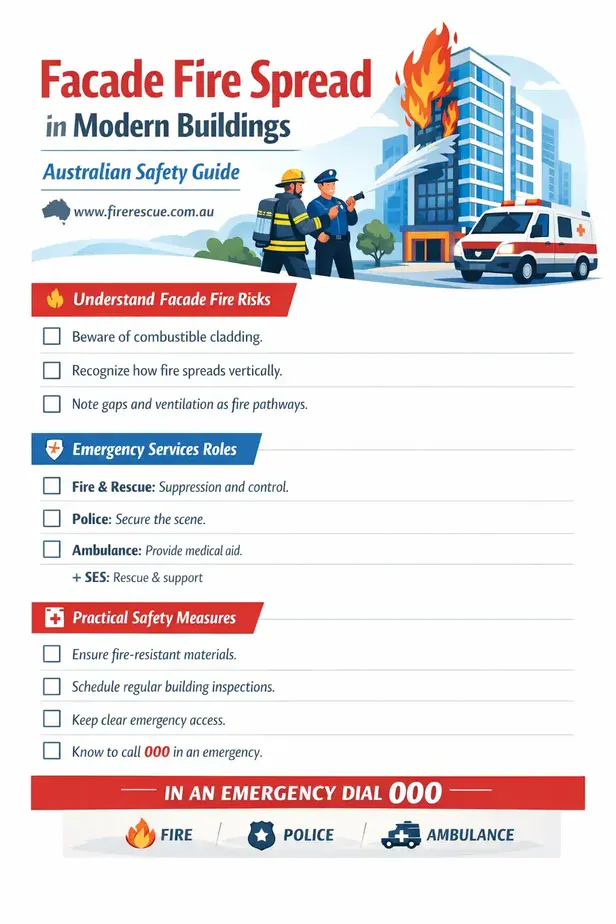
Facade fire spread in modern buildings remains a critical safety challenge, especially with the widespread use of combustible cladding and complex architectural designs. Understanding how fire can propagate externally helps inform better building practices and emergency responses.
Australian fire services play distinct roles during facade fire incidents, with Fire and Rescue leading suppression efforts, while Police and Ambulance provide vital support for safety and medical emergencies. The SES often assists in related rescue and support operations.
Practical fire safety measures include rigorous building material standards, regular inspections, and clear emergency access. Public awareness and knowing when to call 000 are crucial for timely, effective response.
Fire Safety Guide for Modern Buildings
Get a clear, practical PDF guide covering facade fire risks, emergency response roles, inspections, evacuation awareness, and simple safety actions for Australian conditions.
- Modern facade fire risk overview
- Australian emergency service roles
- Building safety and inspection focus
- Fast access on mobile or desktop
Understanding Facade Fire Spread
In recent decades, the external appearance of modern buildings has evolved dramatically, favouring sleek designs and energy efficiency. However, this architectural shift has introduced new fire risks, especially related to the spread of fire across building facades. Facade fire spread refers to the movement of flames and heat along the external surfaces of buildings, which can lead to rapid escalation of fire incidents and increased danger to occupants and neighbouring structures.
A key factor in facade fire spread is the use of combustible materials in cladding systems, insulation, and decorative elements. Materials that may perform well under normal conditions can become conduits for fire under high heat, allowing flames to travel vertically or horizontally with alarming speed. This risk is compounded by architectural features such as cavities, gaps, and ventilation channels that act as chimneys, intensifying fire propagation.
Understanding the mechanisms of facade fire spread is essential for building designers, regulators, emergency services, and occupants alike. It informs not only construction practices but also emergency preparedness and response strategies.
The complexity of modern facades, often layered with multiple materials, creates challenges in predicting fire behaviour. For instance, rainscreen cladding systems, popular for their weatherproofing and insulation benefits, can inadvertently facilitate fire spread if combustible components are present behind the outer panels. Once ignited, these cavities create a pathway for flames to bypass fire-resistant barriers, accelerating the fire’s vertical movement.
Moreover, the thermal properties of materials play a significant role. Some polymers and composite materials used in cladding can release toxic fumes when burning, complicating evacuation and firefighting efforts. The fire’s intensity on the facade can also lead to structural damage, potentially compromising the building’s integrity and increasing risks for occupants and responders.

Background and Context
Australia’s urban environment has seen a surge in high-rise residential and commercial developments, many featuring modern facade systems designed for aesthetics, insulation, and sustainability. However, the tragic consequences of facade fires in some cases have highlighted shortcomings in material choice and building code enforcement.
Regulatory bodies have responded by tightening standards around fire-resistant materials and facade construction. The National Construction Code (NCC) mandates specific requirements for external wall coverings and cladding, aiming to reduce the risk of fire spread. Yet, challenges remain in ensuring compliance, inspecting existing buildings, and retrofitting where necessary.
Emergency services have adapted their training and equipment to better manage facade fire incidents. The vertical and external nature of these fires presents unique hazards, requiring specialised tactics and coordination among agencies. Firefighters prioritise rapid containment to prevent fire from climbing the building exterior and endangering occupants and resources.
Past incidents, both in Australia and internationally, have demonstrated the devastating potential of facade fires. High-profile cases have led to widespread public concern and spurred government inquiries into building safety. These events underscore the importance of robust fire safety frameworks, continuous monitoring, and community education to prevent recurrence.
In the context of Australia’s climate, with hot and dry conditions in many urban areas, the risk of fire ignition and rapid spread is heightened. External heat sources, such as discarded cigarettes or electrical faults, can ignite combustible facade materials, emphasizing the need for preventative measures tailored to the local environment.
Fire and Emergency Response Roles
Fire and Rescue
Fire and Rescue services are the primary responders for facade fires. Their role encompasses fire suppression, search and rescue inside the building, and preventing fire spread to adjacent structures. Fire crews utilise specialised equipment such as aerial ladders and high-pressure water jets to reach and cool external surfaces. Incident commanders coordinate operations to ensure firefighter safety and effective containment.
Firefighters also face the challenge of operating at height under hazardous conditions, often dealing with limited visibility due to smoke and the potential for falling debris. The use of thermal imaging cameras assists in locating hotspots and assessing fire spread behind cladding. Additionally, crews may deploy fire-retardant foams and consider ventilation tactics to control smoke movement and reduce heat.
Police
Police support emergency operations by securing the incident perimeter, managing traffic and crowd control, and facilitating safe evacuation routes. They also assist in investigations if arson or negligence is suspected as a cause of the fire.
During large-scale incidents, police coordinate with local authorities to establish safe zones and support communication between agencies. Their role in maintaining order ensures that emergency responders can operate efficiently and that the public remains protected from secondary hazards.
Ambulance Services
Paramedics provide critical medical care to occupants affected by smoke inhalation, burns, or trauma. They work closely with Fire and Rescue to triage and treat casualties promptly, both on scene and during transport to hospitals.
Smoke exposure from facade fires can cause serious respiratory issues, and rapid assessment is vital to identify those needing urgent treatment. Ambulance personnel also prepare for potential mass casualty situations, ensuring adequate resources and coordination with hospital emergency departments.
State Emergency Service (SES)
While SES primarily deals with natural disasters and storms, they may assist in facade fire incidents by providing logistical support, helping with evacuations, or offering specialist rescue services where needed.
Their expertise in managing large-scale evacuations and coordinating temporary shelter options can be invaluable when fires threaten multiple buildings or displace residents. SES volunteers also assist in debris clearance and securing damaged structures to reduce further risks.
Practical Implications for Australian Conditions
For residents, building managers and developers across Australia, mitigating facade fire risk starts with material selection and compliance with the NCC. Combustible cladding should be avoided or carefully managed with fire-resistant barriers and regular maintenance. Retrofitting older buildings to improve fire safety is an ongoing challenge requiring expert assessment.
Emergency preparedness includes clear evacuation procedures and ensuring all occupants understand how to respond if a facade fire occurs. Knowing when to call 000 immediately is vital. If you see flames or smoke on a building’s exterior, report it promptly rather than assuming someone else has.
During an incident, remain calm and follow instructions from emergency personnel. Fire and Rescue will prioritise saving lives and containing the fire, while Police and Ambulance manage safety and health needs. The SES may be called in for additional support depending on the situation.
Building owners should implement regular fire safety audits that include inspection of facade materials and structural features that may contribute to fire spread. Training for occupants on fire drills and emergency exits can significantly enhance evacuation efficiency during an incident.
Technological advancements also offer promising tools for facade fire management. The integration of fire detection systems capable of monitoring external surfaces can enable faster alerts and targeted firefighting response. Additionally, innovative fire-resistant materials continue to evolve, providing safer options for future construction.
Community engagement remains a cornerstone of fire safety. Public education campaigns that raise awareness about facade fire risks and encourage vigilance contribute to early detection and prevention. Collaboration between government agencies, industry stakeholders, and residents strengthens the overall resilience of Australia’s urban landscapes against facade fire hazards.
Ultimately, addressing facade fire spread requires a multifaceted approach combining regulatory compliance, technological innovation, emergency preparedness, and community participation. By fostering a culture of safety and proactive management, Australia can better protect its modern buildings and the people within them from the devastating effects of facade fires.