Fire & Rescue Insights
Understanding Water Mist in Enclosed-Space Firefighting
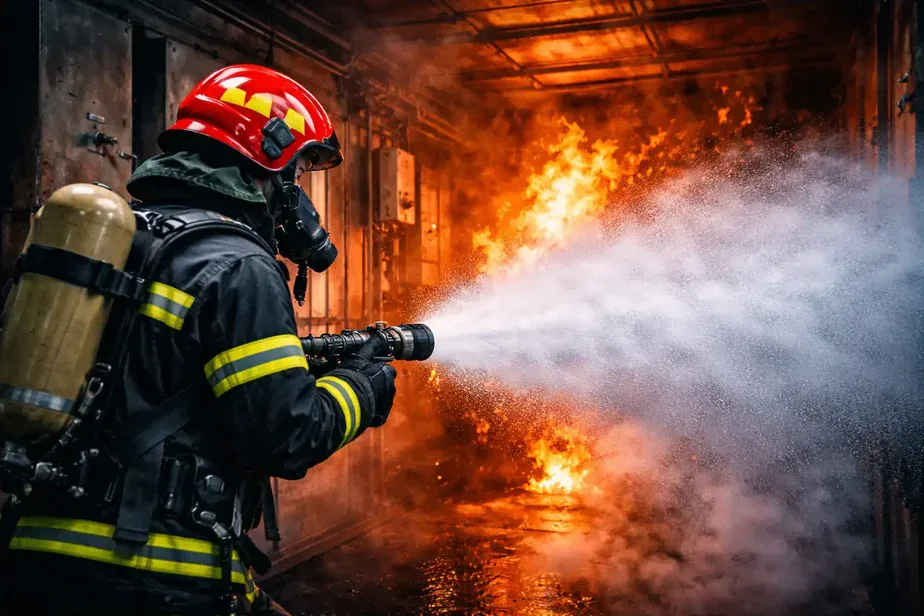
Water mist technology is gaining recognition as an effective tool for firefighting in confined or enclosed spaces across Australia. Its unique method of fire suppression provides several operational advantages, especially in scenarios where traditional water streams may be less effective or cause additional hazards.
Firefighters and emergency responders should understand the benefits and limitations of water mist systems to apply them safely and effectively, particularly in enclosed environments where smoke, heat, and access challenges are common.
This article explores the principles behind water mist firefighting, its practical applications, and important considerations for Australian fire and emergency services.
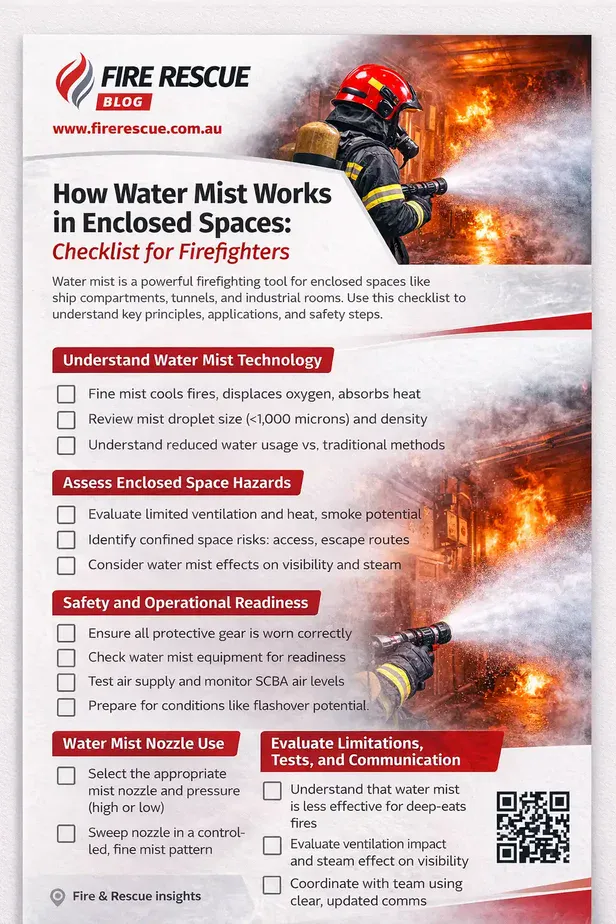
Water Mist Firefighting in Enclosed Spaces
Access this practical Australian safety guide for a clear, easy-to-follow look at how water mist works in enclosed spaces, where it helps most, and what crews should keep in mind during operations.
Helpful, practical content from Fire Rescue Blog with a clean direct path to the full guide.
Background and Context
Water mist firefighting involves the use of fine water droplets, typically less than 1000 microns in diameter, to suppress fires. This technique is distinct from conventional hose streams which discharge larger droplets. The fine mist achieves fire control through rapid cooling, oxygen displacement by steam expansion, and radiant heat absorption.
Enclosed spaces such as ship compartments, engine rooms, tunnels, aircraft cabins, or industrial plant rooms present unique firefighting challenges. Limited ventilation, restricted access, and the risk of rapid heat and smoke buildup require tailored response strategies. Water mist systems can be an asset in these environments, reducing water damage and improving firefighter safety.
Australia’s diverse infrastructure and remote industrial sites have seen increased interest in water mist technology, particularly in sectors like mining, maritime, and manufacturing where confined spaces are common.
The evolution of water mist technology has been driven by ongoing research and development aimed at enhancing firefighting effectiveness while minimising collateral damage. Compared to traditional firefighting methods which often rely on large volumes of water, water mist systems use significantly less water, reducing runoff and potential contamination, a critical factor in environmentally sensitive or remote locations.
The technology has matured to the point where it is now integrated into fixed fire protection systems as well as portable firefighting equipment. Its versatility has led to adoption not only in emergency response but also in fire prevention and protection systems installed in new building designs and retrofits.
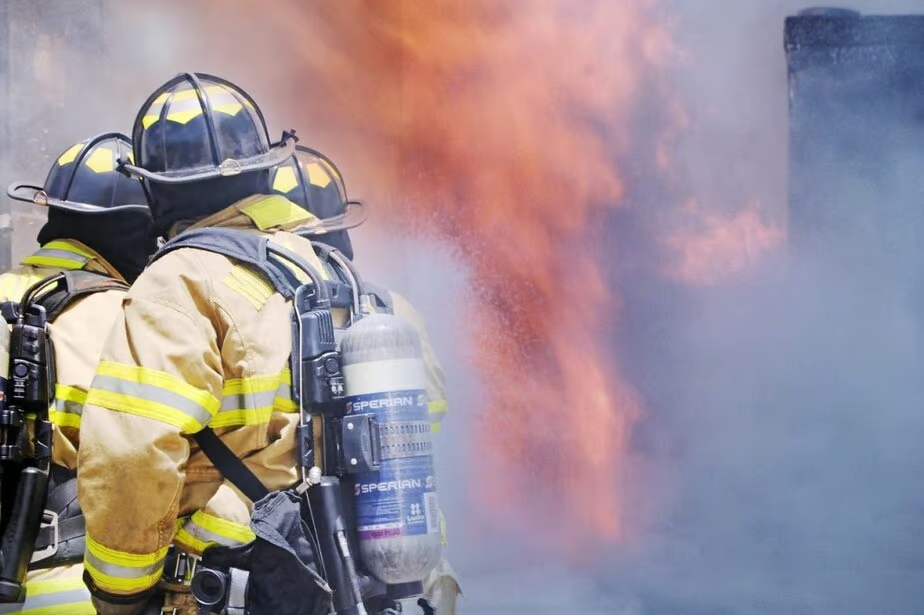
In addition to fixed and portable systems, water mist technology is increasingly being incorporated into hybrid firefighting strategies that combine mist with other suppression agents, such as inert gases or foam. These combinations can enhance fire suppression in highly complex environments, particularly where multiple fire classes may be present or where rapid knockdown is essential.
Furthermore, advances in nozzle design and pump technology have allowed water mist systems to be more compact and energy efficient, enabling their deployment not only on large industrial sites but also in urban high-rise buildings and public transport infrastructure. This broad applicability underlines the growing importance of water mist in modern firefighting tactics across Australia.
How Water Mist Works in Enclosed Spaces
Cooling Effect
The fine droplets of water mist absorb heat quickly, cooling the flames and surrounding surfaces. Because the droplets are small, their surface area to volume ratio is high, enabling rapid evaporation and heat absorption. This helps reduce the fire’s intensity more efficiently than larger water droplets.
This rapid cooling also diminishes the thermal feedback that sustains combustion, effectively interrupting the fire’s heat cycle. In enclosed spaces where heat accumulates quickly, this characteristic is particularly valuable as it helps prevent flashover conditions and slows the spread of fire to adjacent compartments or materials.
Additionally, the cooling effect of water mist extends beyond flame suppression. It reduces the temperature of structural components, electrical wiring, and sensitive equipment within enclosed spaces, potentially preventing secondary damage and reducing the likelihood of reignition after initial extinguishment.
Oxygen Displacement and Smothering
As water mist evaporates, it expands into steam, which displaces oxygen around the fire. This partial oxygen reduction suppresses combustion without completely eliminating breathable air, an advantage in enclosed spaces where maintaining safe atmospheres for firefighters is critical.
Unlike traditional suppression agents that may create hazardous atmospheres, water mist allows for safer firefighting conditions by balancing oxygen displacement with breathable air retention. This is crucial in confined environments where firefighters may need to operate for extended periods or conduct rescues.
The steam generated by water mist also helps to dilute toxic gases and smoke within enclosed spaces, improving visibility and air quality for firefighters. This dilution effect can reduce the risk of inhalation injuries and enhance operational safety during firefighting and rescue tasks.
Radiant Heat Absorption
Water mist absorbs radiant heat emitted by flames, reducing heat transfer to materials beyond the immediate fire zone. This can slow fire spread inside enclosed compartments and protect structural elements.
By reducing radiant heat, water mist systems help protect critical infrastructure and reduce the risk of secondary fires igniting beyond the initial blaze. This protective feature is especially important in industrial settings where flammable materials may be stored nearby or where structural integrity is vital to ongoing operations.
Moreover, the reduction in radiant heat lowers the thermal stress on firefighters themselves, contributing to improved safety and endurance when working in hazardous enclosed spaces.
The radiant heat absorption also plays a role in protecting sensitive electronic and mechanical equipment within enclosed spaces. By limiting heat exposure, water mist can prevent costly damage and downtime in critical operational environments such as control rooms, data centres, or transportation hubs.
Practical Implications for Australian Fire and Emergency Responders
In Australia, fire services often respond to incidents in tight, enclosed spaces where water damage must be minimised and rapid fire control is essential. Water mist systems can provide an effective firefighting option in these contexts, but responders should be aware of operational considerations unique to this technology.
Training and familiarisation with water mist equipment are critical. Firefighters need to understand nozzle operation, droplet size characteristics, and system pressure requirements to optimise fire suppression efforts without compromising safety.
Additionally, coordination with other emergency services is vital. In circumstances where water mist is deployed, the Fire and Rescue service leads the firefighting effort. Police support crowd and traffic control, while Ambulance services prepare for potential casualties. The State Emergency Service (SES) may assist with evacuation or structural safety checks if required.
For members of the public in Australia, the first step in any fire emergency remains to call Triple Zero (000) immediately. Providing clear details about the location, nature of the fire, and any people at risk ensures rapid dispatch of appropriate resources, including Fire and Rescue teams trained in water mist firefighting if relevant.
Firefighters must also consider the limitations of water mist systems. For example, while highly effective for Class A (ordinary combustibles) and some Class B (flammable liquids) fires, water mist may be less suitable for fires involving energized electrical equipment unless specifically designed nozzles and protocols are used. Understanding these nuances is key to selecting the right suppression tactic on scene.
Maintenance and regular testing of water mist systems installed in fixed locations are also essential to ensure readiness and reliability. Fire services and industrial operators should establish inspection regimes aligned with Australian standards and manufacturer recommendations to avoid system failures during critical incidents.
Furthermore, the integration of water mist technology with other firefighting tools and strategies can enhance overall effectiveness. For instance, combining water mist with ventilation control, thermal imaging, and advanced communication systems supports more precise and safer firefighting operations in enclosed spaces.
Australian fire services are also exploring the use of water mist in training simulators to better prepare firefighters for the visual and operational conditions encountered with this technology. Simulated environments allow responders to practice nozzle handling, observe mist behaviour, and coordinate ventilation tactics without the risks of live fires.
Research collaborations with academic institutions and industry partners continue to refine water mist application strategies. These efforts focus on optimising droplet size distribution, nozzle placement, and system pressures to maximise effectiveness while minimising water use and operational complexity.
Key Takeaways
Water mist firefighting technology offers rapid cooling, oxygen displacement, and radiant heat absorption, making it well-suited for controlling fires in enclosed spaces with minimal water damage.
Australian Fire and Rescue services are increasingly incorporating water mist tactics into their response toolkits, especially in industrial, maritime, and mining environments where confined spaces are common.
Effective deployment requires specialised training, understanding of the system’s operational limits, and coordination with other emergency agencies. For the public, calling 000 promptly remains essential for a timely and safe response.
Conclusion
Water mist technology represents an important advancement in enclosed-space firefighting, offering a practical and efficient method that complements traditional water-based tactics. As Australian fire and emergency services continue to evolve their capabilities, understanding and applying water mist systems will be key to improving outcomes in complex fire scenarios.
By remaining informed about the science behind water mist and its application in confined spaces, firefighters can protect lives, property, and the environment more effectively while maintaining safety for all responders.
FireRescue Training Hub
Access practical fire and emergency study support resources, downloads, checklists, audio guides, and member-only course content.
- Course library
- PDF downloads
- Audio guides
- Checklists
Study support only. Not accredited training or a replacement for workplace procedures.
About the author and safety review
Ken Walker
Former Station Officer and fire service educator
Former career firefighter with extensive career and volunteer fire service experience.
Qualifications: Associate Diploma of Applied Science in Fire Technology; Institute of Fire Engineers studies.
Author profilehttps://www.firerescue.com.au/about-us/