Earthquakes in remote Australia are easy to overlook until they happen. While the risk is often lower than in some other parts of the world, shaking can still occur across the continent with little or no warning, including in the outback, inland towns, stations, camps and remote worksites.
For travellers and remote communities, the main challenge is not only the shaking itself. It is the distance from help, the chance of damaged roads, weak communications, long response times and the possibility of being cut off for hours or days. Good preparation matters.
This guide explains why earthquakes happen in Australia, where outback Australia earthquakes can affect people and property, what to do before, during and after shaking, and how to build a simple remote travel emergency preparedness plan. It is general information only. For current advice, follow Geoscience Australia and your state or territory emergency authority.
Introduction: earthquakes can happen anywhere in Australia
Australia is not free from earthquakes. Geoscience Australia advises that earthquakes can occur anywhere across the country and may happen without warning. Most are small and many are never felt, but some are strong enough to damage buildings, roads, fences, tanks, equipment and services.
That matters in remote areas because the effects can quickly become practical. A minor road crack can stop a supply run. A fallen powerline can isolate a property. A damaged water tank, fuel line or communications tower can affect safety well after the shaking has ended.
Earthquake preparedness in the outback is not about panic. It is about being able to cope when distance, heat, dust and limited services make a simple incident harder to manage.
Why earthquakes happen in Australia
Australian earthquakes are generally intraplate earthquakes. That means they happen within the Australian tectonic plate rather than at the edge of a plate boundary. Stress builds up slowly inside the plate, then is released along faults when the rock finally moves.
This is a simple explanation for a complex process, but it is enough to understand why quakes can occur far from the places people usually associate with earthquakes. They do not need a nearby ocean trench or active mountain belt to happen. Old faults and buried structures can still shift when enough stress accumulates.
Because this stress builds over long periods, earthquakes may seem random to the people who experience them. That is part of the challenge for remote-area safety planning. You cannot rely on obvious local warning signs or assume a region is completely safe because it has been quiet for years.
Geoscience Australia is the main Australian source for earthquake dates, locations, depths and magnitudes. It also operates the National Earthquake Alerts Centre and the Earthquakes@GA reporting service.
Earthquake risk in remote Australia
Outback Australia earthquakes can affect Western Australia, South Australia, the Northern Territory and inland areas of other states and territories. Remote regions are not necessarily the most seismically active, but the consequences can be more serious because of isolation.
In a city, help may be nearby and alternative routes may exist. In the outback, a damaged road can isolate a station or camp. Communications can be patchy. Fuel and water may be limited. Emergency services may be many hours away. In some places, a power failure can also affect pumps, refrigeration, medical equipment and satellite communication systems.
Risk is also different for different groups:
- Travellers and campers may be exposed to falling objects, unstable cliffs, damaged roads and difficulties contacting help.
- Station owners and workers may face damage to tanks, sheds, fencing, machinery, water infrastructure and accommodation.
- Mining and industrial personnel may have additional hazards around heavy plant, fuel storage, conveyors, shafts, tailings areas and restricted access zones.
- Isolated communities may need to manage service outages, building damage and delayed resupply.
Remoteness does not make every earthquake more likely. It makes the impacts harder to absorb. That distinction is important when planning for remote travel emergency preparedness.
| Remote-area challenge | Why it matters after an earthquake |
|---|---|
| Long distances to help | Response and repair times can be delayed, especially after road damage or communications failure. |
| Limited communications | Mobile networks may be patchy or unavailable, making it harder to check on people or request assistance. |
| Few alternate routes | A single damaged bridge or track can isolate a property or stop travel. |
| Stored water and fuel | Damage to tanks, pumps or lines can create safety and supply issues. |
| Heavy machinery and infrastructure | Equipment, sheds, fences and fittings can shift, topple or become unsafe. |
Significant outback earthquakes
Australia has a long record of inland earthquakes, including events that caused serious damage or were widely felt across remote regions. Historical records must be checked carefully because older magnitudes can be reported using different calculation methods. Before publication, always confirm dates and magnitudes with Geoscience Australia.
Well-known examples include the Meckering, Western Australia earthquake in 1968 and the Tennant Creek, Northern Territory earthquake sequence in 1988. These events are often discussed because they show that serious inland earthquakes can occur far from Australia’s major coastal population centres.
The Yilgarn region of Western Australia has also experienced notable seismic activity. Other significant inland earthquakes are listed by Geoscience Australia and may be relevant for local awareness, site planning and emergency education.
For safety planning, the historical lesson is simple: if a region has experienced earthquakes before, it can experience them again. A quiet period does not guarantee future safety.
Older earthquake records may be revised as measurement methods improve. For any publication, use Geoscience Australia as the primary source for the confirmed date, location, depth and magnitude of each event.
Before an earthquake: prepare for isolation as well as shaking
Good earthquake preparation combines general emergency planning with remote-area self-reliance. It should be simple, practical and realistic. The goal is to reduce harm during shaking and help you cope afterwards if you are cut off for a while.
Make an emergency plan
Every household, station, camp and work team should know what to do if an earthquake happens. The plan should cover who checks on whom, where people gather after shaking stops, how to account for visitors or contractors, and how to contact emergency services if needed.
In remote places, it is also wise to plan for communication failure. Decide on a backup contact outside the area who can receive travel updates or check whether you have arrived safely.
Secure heavy furniture and equipment
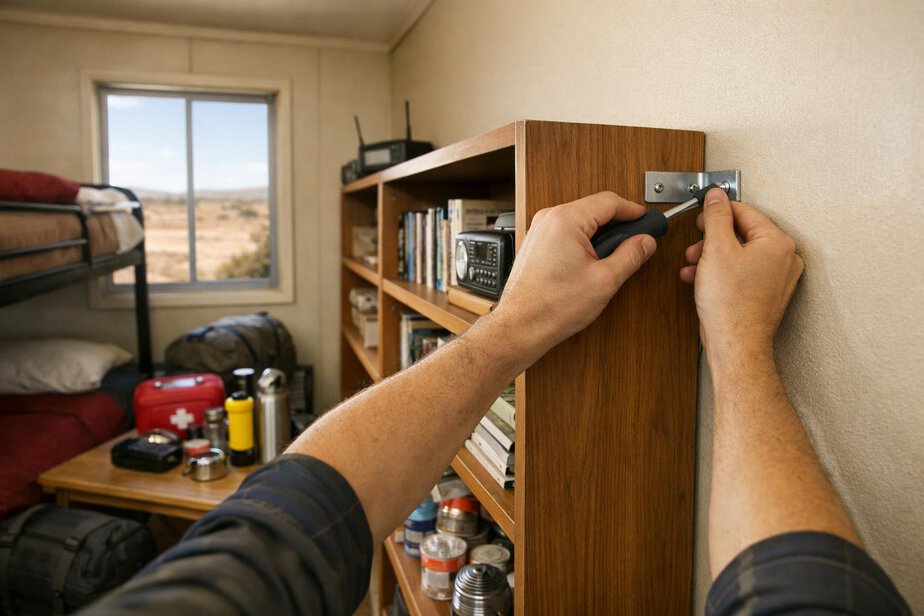
Fasten shelves, cupboards, hot water systems, file cabinets and other heavy items that may fall. In accommodation blocks, workshops and offices, check that tall or top-heavy items are anchored properly. In the home, think about beds under windows, glass cabinets and large appliances.
At stations and worksites, secure tool storage, racking, portable equipment, loose cylinders and items that could become dangerous if they slide or topple.
Protect water, gas and fuel storage
Water tanks, gas cylinders and fuel storage need special attention. Check supports, tie-downs, valves, hoses and clear access around tanks. Keep ignition sources away from areas where leaks could occur. Know how to shut off services if it is safe and if you have been trained to do so.
Do not assume that a tank or cylinder will stay upright just because it has always been stable. Vibration and ground movement can expose weak points.
Carry supplies for at least the immediate aftermath
Remote-area travellers should carry enough supplies to cope with a delay. That includes water, food, medications, first aid items, a torch, spare batteries, a power bank and a radio. Keep items where you can reach them quickly, not buried under luggage or cargo.
If you rely on refrigeration, medical devices or specialist gear, think through what happens during a power outage. Carry backups where possible and confirm that equipment is appropriate for remote travel.
Keep navigation and communications independent
Do not rely only on a mobile phone. Carry offline maps, know how to use them and keep a charger or power bank ready. If you travel into low-coverage areas, consider remote communication equipment that suits your journey and skill level.
Tell someone your route, intended stops and expected arrival time. If plans change, update them when you can. This is standard remote travel emergency preparedness and it becomes even more important if roads or communications are disrupted.
During an earthquake: what to do during an earthquake
The safest general advice during shaking is Drop, Cover and Hold On. Move quickly, but do not rush outside while the ground is shaking. Stay away from windows, glass, shelves and anything that could fall.
Inside a building
- Drop to the ground.
- Take cover under a sturdy table, desk or similar furniture if one is nearby.
- Hold on until the shaking stops.
- Protect your head and neck.
- Stay away from windows, mirrors, glass doors and tall furniture.
If there is no sturdy furniture near you, crouch beside an internal wall and protect your head and neck. Do not use lifts. Do not run outside during the shaking, because falling debris, broken glass and collapsing masonry may be more dangerous than staying where you are.
Outside
If you are outdoors, move away from buildings, powerlines, poles, streetlights and anything that could fall. Find a clear open area and crouch low if needed. Keep watching for falling objects, rock movement or unstable ground.
Driving
If you are driving, slow down and stop in a safe open area away from bridges, powerlines, trees, cliffs and damaged structures. Remain in the vehicle until the shaking stops. Avoid stopping under overpasses, near unstable slopes or where falling debris could hit the vehicle.
Camping
If you are camping, move away from anything that could fall, collapse or roll. This may include large trees with dead limbs, rock ledges, unsecured awnings, trailers, vehicles, gas bottles, fuel containers and stacked gear. Protect yourself from falling items and wait for the shaking to stop before moving around.
If you are in a tent, stay low and protect your head. After the shaking, check carefully for broken tent poles, shifting ground, nearby hazards and falling branches.
Working around mines, machinery, livestock or fuel storage
Follow site procedures if they are available and safe to apply. If you are trained and authorised, secure equipment only if that can be done without putting yourself at risk. Stay away from moving machinery, conveyors, load zones, pits, shafts, tanks and fuel points if the ground is shaking.
For livestock, avoid sudden movements that could cause panic or injury. If you can do so safely, reduce exposure to fences, gates, troughs, sheds and equipment that might shift or collapse. Do not attempt complicated rescue work while the shaking is still happening.
After an earthquake: staying safe once the shaking stops
After the main shaking stops, the situation may still be unstable. Aftershocks can happen. Damaged structures can fall. Roads may crack, shift or collapse. Smoke, dust, gas leaks and electrical hazards may not be obvious at first.
Check yourself and the people around you for injuries. Give basic first aid if you are trained and it is safe to do so. If there is a life-threatening emergency, call 000 immediately.
Do not enter damaged buildings unless they have been checked and declared safe by the appropriate authorities or qualified personnel. In remote areas, a shed, accommodation block or workshop may look intact but still be unsafe because of hidden structural damage.
Avoid driving unless you need to. Roads may be damaged, blocked or soft, and detours may be long. If you do travel, go slowly and watch for fallen rocks, washouts, bridge damage, powerlines and debris.
Look and listen for gas leaks, exposed electrical wires, small fires, fuel spills and water contamination. If you smell gas or suspect a leak, move away from the area and follow local emergency advice. Do not switch electrical equipment on or off if you think it may create a spark.
If water supplies may be contaminated, boil or treat water only if you know the local advice and the method is appropriate. In remote places, water systems can be vulnerable if tanks, pumps or lines are damaged.
Follow official emergency information and local instructions. If it is safe to do so, report the earthquake through Earthquakes@GA. That helps improve the national picture of what was felt and where.
Also be alert for aftershocks. They may be smaller than the main event, but they can still bring down loose material, worsen cracks or make already damaged structures more dangerous.
Why not to enter damaged buildings
A building that looks only slightly affected can still have hidden damage. Cracked walls, displaced roof materials, broken supports and damaged gas or electrical systems can create serious risks. If you are unsure, stay out until a qualified person says it is safe.
Why not to drive unnecessarily
Unnecessary driving increases exposure to road damage, falling debris and service interruptions. In remote areas, fuel is precious and route options may be limited. If you can safely shelter in place, that is often the better choice until the situation is clearer.
Remote-area survival checklist
Use this checklist as a starting point for household, travel and worksite planning.
- Emergency contact plan prepared and shared with someone reliable
- Travel route, stop points and expected arrival time recorded
- Offline maps downloaded and navigation equipment charged
- Torch, spare batteries and power bank packed
- Portable radio or other backup information source ready
- Water carried for people, pets or livestock where relevant
- Non-perishable food packed for delays
- Medications and prescriptions stored where they can be reached quickly
- First aid kit checked and restocked
- Vehicle fuelled and tyre condition checked before departure
- Heavy items secured in home, camp, ute, trailer or workshop
- Gas cylinders, fuel containers and tanks checked for stability
- Family, staff or neighbours know what to do during shaking
- Emergency information source identified for your state or territory
For remote properties and worksites, add site-specific items such as generator procedures, shutdown steps, muster points, spare communications equipment and water testing arrangements.
Common earthquake myths
Myth 1: Australia does not get serious earthquakes
False. Australia does experience serious earthquakes, including damaging inland events. Many earthquakes are small, but some are strong enough to affect buildings, roads and services.
Myth 2: Remote areas are too quiet to be at risk
False. Earthquakes can occur anywhere in Australia. Remoteness can make the consequences more difficult, not less possible.
Myth 3: Earthquakes can be accurately predicted
False. Current science does not allow reliable short-term prediction of earthquakes. That is why preparation and safe response are so important.
Myth 4: You should always run outside as soon as shaking starts
False. Running outside during shaking can expose you to falling glass, debris and other hazards. The safer action in most buildings is Drop, Cover and Hold On.
Myth 5: If an earthquake was small, there is no need to be careful afterwards
False. Even smaller earthquakes can trigger aftershocks, damage weak structures, disturb equipment or affect roads and services.
Frequently asked questions
How common are earthquakes in Australia?
Geoscience Australia states that Australia records approximately 100 earthquakes of magnitude 3.0 or greater each year. Larger events are less common, but they do happen.
Where can I check if an earthquake has been recorded?
Use Geoscience Australia for confirmed earthquake information, including dates, locations, depths and magnitudes. Its Earthquakes@GA service also allows people to report what they felt when it is safe to do so.
What is the safest thing to do during shaking?
Drop, Cover and Hold On. Protect your head and neck, stay away from glass and do not run outside while the ground is shaking.
Should I stay in my car during an earthquake?
If you are already driving, stop in a safe open area away from bridges, powerlines, trees, cliffs and damaged structures, then remain in the vehicle until the shaking stops.
What should I do if my property or camp is damaged?
Check for immediate danger, avoid damaged buildings, watch for gas leaks, fires and exposed electrical wires, and follow local emergency advice. If there is a life-threatening emergency, call 000.
Practical summary for travellers, stations and remote worksites
Earthquakes in remote Australia are uncommon, but they are real. The safest approach is to prepare before you travel, know what to do during shaking and plan for delays or isolation afterwards.
For most people, the biggest gains come from a few simple habits: secure loose items, carry the basics, keep your communications and maps ready, share your route with someone reliable and learn Drop, Cover and Hold On.
If you live, work or travel in the outback, think about earthquakes the same way you think about fuel, water and heat. They are part of general remote-area risk management. A calm plan is better than panic, and preparation is always more useful than guessing.
Disclaimer: This post provides general information only. Always follow current advice from Geoscience Australia and your state or territory emergency authority, and verify local procedures before publication or use.
Preparation does not remove all risk, but it makes a real difference when the ground starts to move. Stay informed, plan ahead and keep your emergency arrangements practical, current and suited to the conditions where you travel or work.
FireRescue Training Hub
Access practical fire and emergency study support resources, downloads, checklists, audio guides, and member-only course content.
- Course library
- PDF downloads
- Audio guides
- Checklists
Study support only. Not accredited training or a replacement for workplace procedures.
About the author and safety review
Ken Walker
Former Station Officer and fire service educator
Former career firefighter with extensive career and volunteer fire service experience.
Qualifications: Associate Diploma of Applied Science in Fire Technology; Institute of Fire Engineers studies.
Author profilehttps://www.firerescue.com.au/about-us/