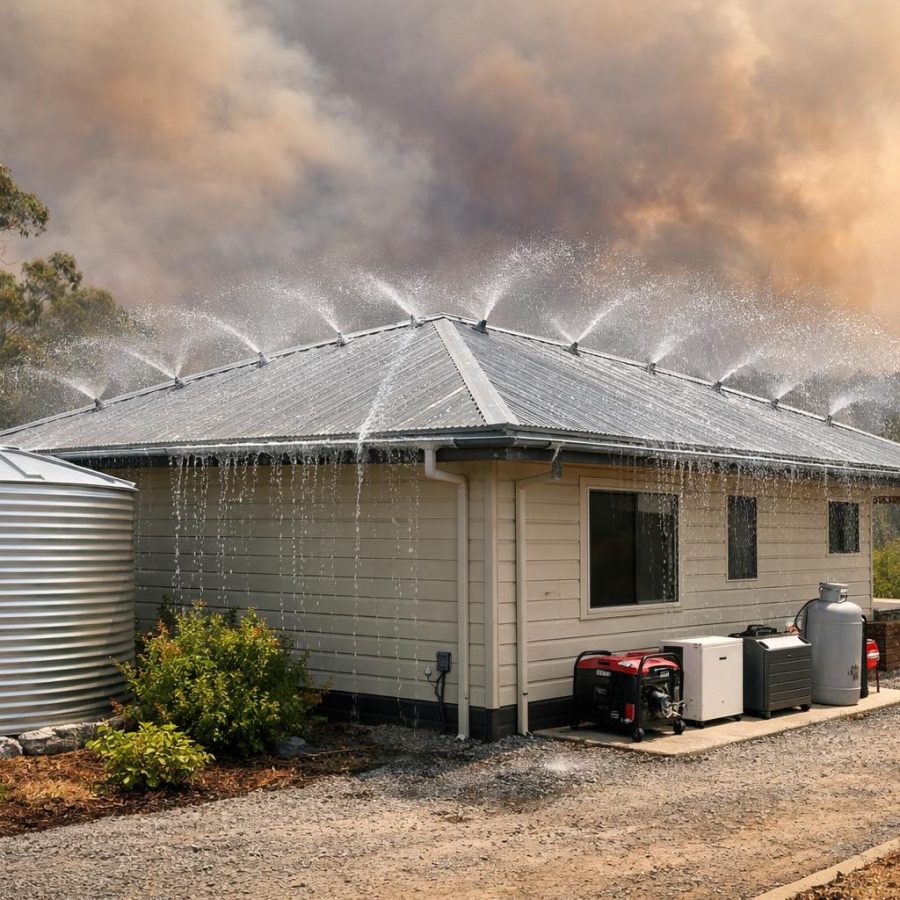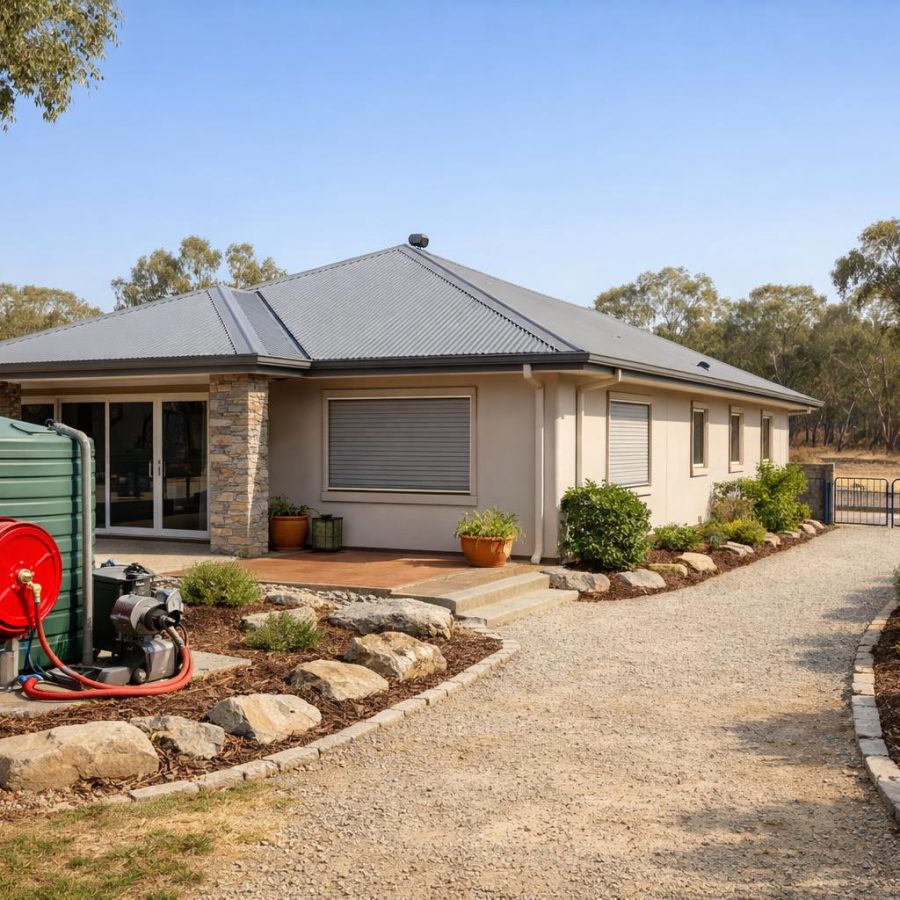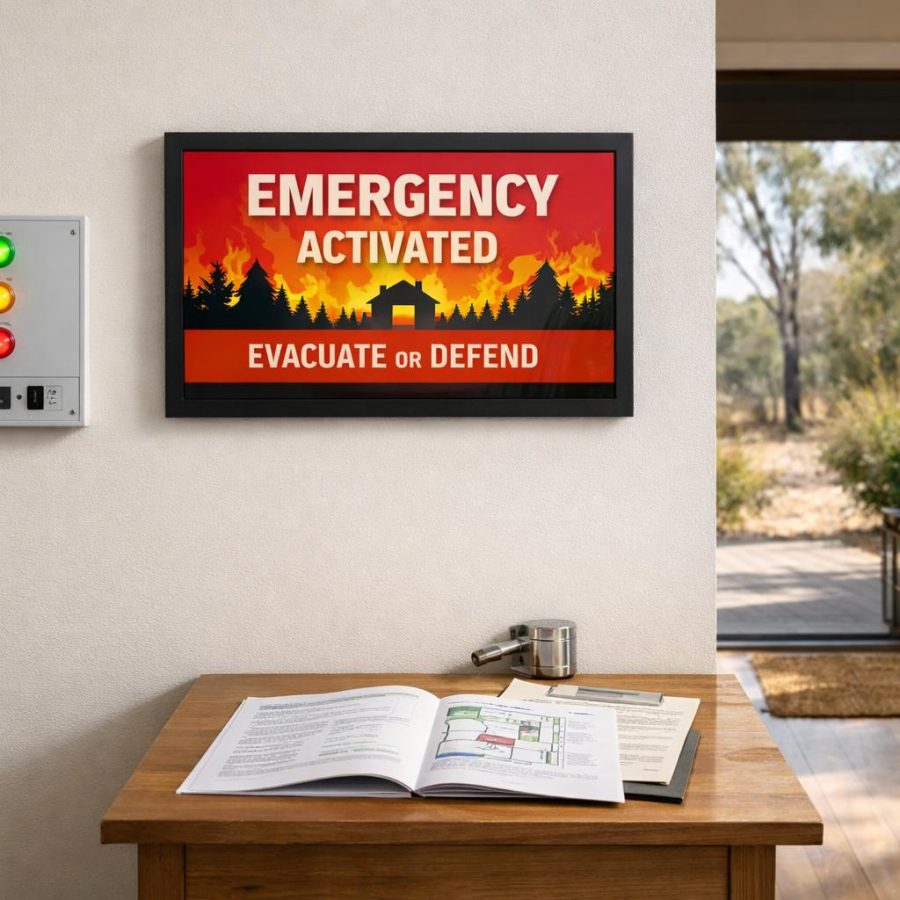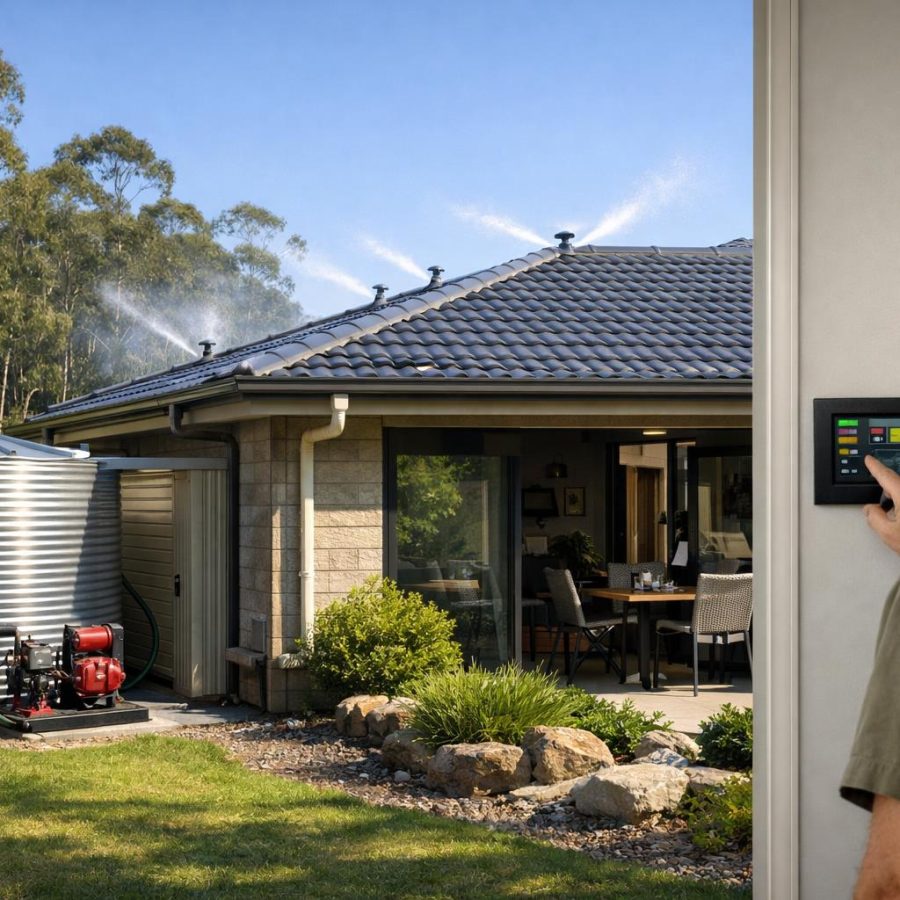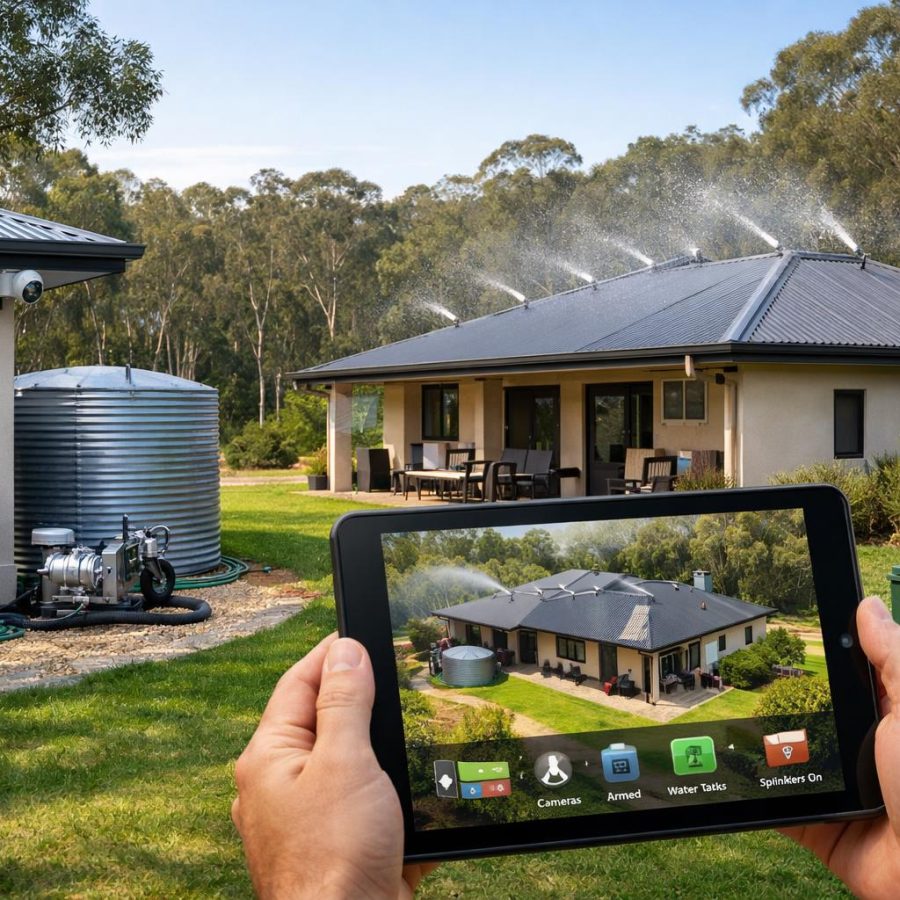
A good bushfire protection system is not designed only around how it works when everything is healthy. It is designed around how it might fail, what those failures could cause, and how much protection remains when something goes wrong.
That matters because no bushfire protection system is fail-proof. A single fault may be minor, but several smaller faults can combine into a critical overall failure. The real question is not whether a system can ever fail. The real question is whether it fails in a controlled way, leaves useful backup protection in place, and clearly tells the resident what to do next.
This article is Part 20 of the Integrated Residential Bushfire Protection System series. It focuses on failure management and resilience, which contribute 1% of the overall system readiness model. That weighting is about robust design and safe fallback behaviour. It does not mean there is a 1% probability of house survival. A bushfire is always a serious and variable hazard, and the system must never be treated as a guarantee.
Immediate life-threatening emergencies in Australia require Triple Zero (000). Residents must also continue to follow official emergency warnings, evacuation directions and local emergency-service advice, even if the protection system is operating well.
Why failure management matters
Most homeowners think in terms of success: pumps start, sprinklers spray, sensors detect heat, power stays on, and the controller coordinates the response. That is useful, but incomplete. In a bushfire, the system may be challenged by heat, ember attack, smoke, debris, wind, power loss, communication loss, human error and physical damage at the same time.
Because of that, the system should be built around layered resilience. Each layer should do useful work even if another layer is weakened. If a pump fails, another pump should take over where practical. If communications fail, local operation should continue. If a sensor goes offline, the controller should not simply assume all is well. It should move into a more cautious mode using whatever reliable information remains.
The key design principle is simple: plan for failure before the fire arrives. That means identifying likely failure modes, ranking their severity, providing backups, and making dangerous mistakes difficult. It also means accepting that some events will exceed the design limit. In those cases, the system should still preserve as much protective function as possible and give clear status to the household.
How to rank failures: critical, major and minor
Not every fault has the same effect. A useful homeowner-friendly approach is to rank failures by what they do to the overall protective function.
Critical failures
Critical failures could seriously compromise occupant protection or property protection. These are the faults that may remove a key layer, disable coordinated response, or leave the system unable to protect more than a very small area. A critical failure may not mean total collapse, but it can mean the system is no longer able to do what it was intended to do under bushfire conditions.
Major failures
Major failures reduce protection, but other layers may still work. This is where redundancy matters most. A single pump failure, for example, may be major if another pump can still carry the load. A controller communication loss may be major if local automatic operation continues. The system is weakened, but not helpless.
Minor failures
Minor failures have limited immediate impact, but they still require attention. Examples might include one blocked nozzle in a large zone, a sensor that needs recalibration, or a warning that a battery is ageing. Minor faults are important because they can grow, spread, or combine with other faults later.
Several small issues can become a critical condition. A low tank level may be only major on its own. A partially blocked filter may also be major. A weak battery may be another major issue. Together, in a real bushfire, those problems can push the whole system into critical failure.
Single points of failure and why they matter
One of the most important resilience rules is that one pump, cable, valve, controller, pipe or network connection should not be able to disable the complete system where practical. That is the idea of avoiding a single point of failure.
If a single component can take down the entire system, then the system is more fragile than it looks. A bushfire protection design should be arranged so that the failure of one item does not automatically cancel all useful protection.
Examples of single points of failure to avoid
- One pump feeding every zone with no workable backup.
- One cable carrying power or control to the only active protection path.
- One valve that, if stuck shut, isolates the whole water supply.
- One controller that has no independent local fallback.
- One network connection needed for all decisions.
- One switchboard fault that disables every critical load.
Redundancy does not mean duplication for its own sake. It means making sure the backup path is genuinely independent enough to help when the main path fails. If two pumps share the same vulnerable power feed, the same control board and the same blocked inlet, they are not really independent. They may look like two units, but they can still fail together.
Where practical, backup components should be separated by different cables, different power paths, different control logic and different physical routes. That reduces the chance that one local fault or one external hit removes every layer at once.
Simple failure mode and effects analysis for homeowners
A simple Failure Mode and Effects Analysis, or FMEA, helps a homeowner think in practical terms. It asks: what failed, what did that do, how serious was it, what backup was available, and what action is needed?
| Failure | Effect | Severity | Backup protection | Required action |
|---|---|---|---|---|
| Water tank level too low | Reduced spray duration and reduced firefighting margin | Major | Secondary water source, water conservation mode, lower-priority zone shedding | Refill and inspect water demand, leaks and usage history |
| One pump fails | Reduced flow or pressure to some zones | Major | Standby pump, staged zone operation, priority loads only | Isolate failed pump and service before full readiness |
| Main power loss | Systems may lose non-essential loads | Major | Battery supply, generator, local control logic | Confirm backup supply, fuel and transfer behaviour |
| Controller fault | Automation may stop or behave incorrectly | Critical | Secondary controller, local safe mode, manual protected operation | Shift to Conservative Fallback Mode and inspect immediately |
| Sensor blocked by debris | Detection quality reduced | Minor | Other sensors, conservative thresholds, manual verification prompts | Clean, test and confirm sensor integrity |
| Manual override used incorrectly | Protection may be weakened or shut down | Critical | Safety interlocks, confirmation prompts, restricted override access | Restore safe settings and retrain authorised users |
| Sprinkler heads blocked | Coverage reduced in affected area | Major | Other heads in zone, adjacent zones, automatic isolation of fault | Inspect, clear or replace affected heads |
| External debris impact | Physical damage to exposed components | Critical | Protected routing, redundant pathways, conservative response | Assess damage, isolate hazards, repair before re-arming |
This table is deliberately simple. A real design review would be more detailed, but even this basic exercise helps homeowners understand that failure is not one event. It is a set of possibilities that need to be planned for before conditions become dangerous.
Water failures
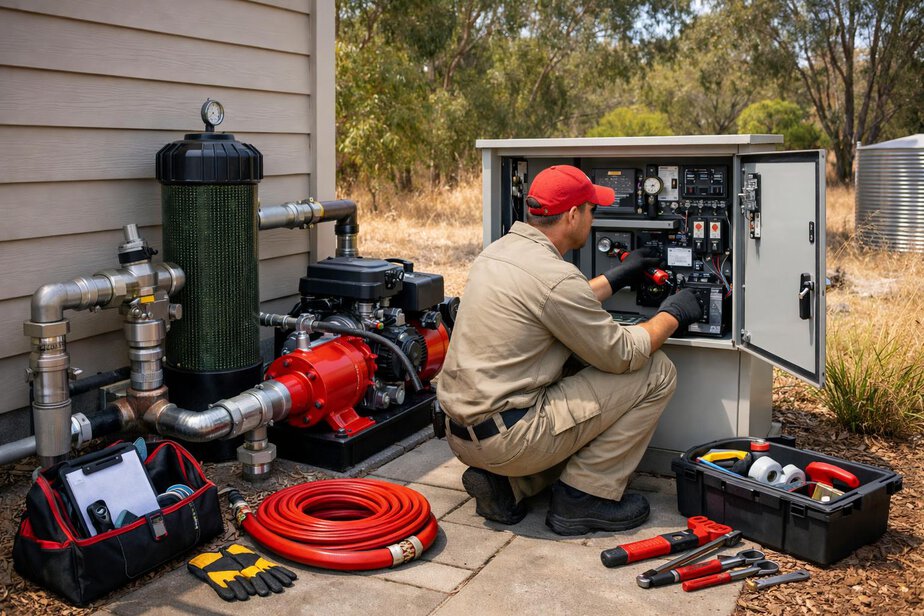
Water is the core resource of most residential bushfire protection systems, so water failures deserve close attention. If water is lost, restricted, contaminated or poorly distributed, the rest of the system may be working but still unable to protect effectively.
Common water failure modes
- Low tank level or no usable reserve.
- Damaged tank, cracked fittings or leaking joints.
- Burst pipe, dislodged pipe or hidden leak.
- Blocked filter, strainer or inlet.
- Failed valve, stuck valve or mis-set valve.
- Sprinkler faults such as blockage, misalignment or damaged nozzle.
Some of these faults are visible, while others are hidden. A tank can slowly leak without being obvious. A filter can become partly blocked and still allow some flow, which can mislead the system into thinking it has more protection than it really does. That is why water monitoring should be based on more than one indicator where practical.
For example, tank level alone does not tell the full story if the pump cannot draw water fast enough. Flow and pressure confirmation can show whether water is actually reaching the intended protection points. If one sprinkler zone fails, isolate it where possible and keep other zones operating. It is usually better to protect most of the house reliably than to lose everything by insisting on one compromised zone.
Water faults can also cascade. A blocked filter may reduce flow, which makes the pump work harder, which may increase power demand, which may stress the backup supply. That is why the system should detect combinations, not just single failures.
Power failures
Power failure is one of the most common reasons a normally healthy system becomes vulnerable. A bushfire can cause mains loss before the fire even reaches the property. Power can also be lost by damaged cabling, switchboard faults, a failed inverter, battery failure, generator failure or low fuel.
What good power resilience looks like
- Critical loads remain identified and separated from non-essential loads.
- Battery power preserves essential control and detection for as long as practical.
- A generator, if installed, can support the intended loads without overloading.
- Fuel level and battery health are monitored before an event, not during it.
- The system can restart safely after a temporary outage.
A failed generator is not just an inconvenience. It may become critical if the batteries were expected to only bridge a short gap. Likewise, low generator fuel may be a simple oversight in calm weather, but in a bushfire it can become a serious operational weakness. Human error and power failure often interact.
Automatic load shedding can help. If power is limited, the system should preserve the most important functions first. That might mean keeping control logic, sensors, communications and the main protection pump online while dropping non-essential loads. The important point is to fail intelligently, not randomly.
Controls, detection and communications failures
Control systems are powerful, but they can also create hidden fragility if everything depends on one decision path. A controller fault, software fault, lost message or incorrect input can lead to the wrong action at the wrong time.
Control failures
Control failures may include a frozen controller, corrupted settings, bad timing, software errors or conflicting commands. If one controller fails, the second controller should continue operating the complete system where practical. That is a strong resilience measure because it avoids a total automation collapse from one electronics fault.
Detection failures
Detection failures happen when sensors are blocked, damaged, dirty, disconnected, frozen by poor design assumptions or giving unrealistic readings. A sensor that says everything is normal when conditions are worsening is dangerous. So is a sensor that triggers false alarms and encourages residents to ignore warnings.
Communications failures
Communications loss should never stop local operation. If remote monitoring goes down, the system should still be able to act on local information. Remote data is useful, but it should not be the only path to safe operation.
If critical sensor data or communications are lost, the system should enter Conservative Fallback Mode. That means it should protect more cautiously using whatever reliable information remains. It should not simply shut down and wait for perfect data, because perfect data may not return in time.
Building failures and how the house can defeat the system
Even a strong protection system cannot fully overcome building weaknesses. The building itself can fail in ways that undermine sprinklers, detection and safe access. Glazing can fail, ember entry can occur, the roof can be damaged, structure can be compromised and heat exposure can become too intense for the system’s intended operating range.
A home may also lose protection if access paths are blocked, protection equipment is mounted too close to vulnerable surfaces, or important lines are exposed to direct flame, debris or impact. The building must be considered part of the system, not just the backdrop to it.
Some building failures are gradual. For example, damaged seals or gaps may make ember entry more likely over time. Others are sudden, such as broken glazing or structural impact. A system should be able to recognise that once the building envelope has been significantly compromised, the overall protection picture has changed. It may still reduce damage, but it can no longer promise the same level of defence.
This is also where design assumptions matter. If wind, radiant heat or ember load exceed the assumptions used in design, the system may be overwhelmed. That does not mean the system is useless. It means its safe operating expectations have been exceeded. Residents should still rely on official warnings and evacuation directions.
Human error as a major risk
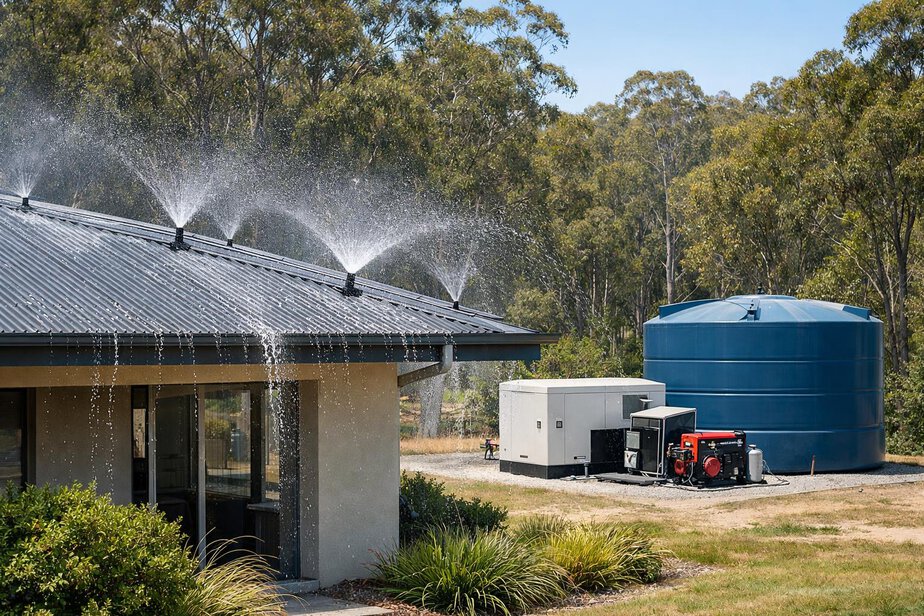
Human error is a major risk because people can make the system less safe without meaning to. A resident may choose the wrong manual override, miss maintenance, forget to refuel a generator, disable a sensor, leave sprinkler heads blocked, enter an incorrect setup or accidentally shut down a critical feature.
These are not rare or trivial issues. They are among the most likely ways a resilient system can be weakened in ordinary life. That is why safety interlocks are so important. A good design should make dangerous mistakes difficult, especially during a confirmed threat.
Ways to reduce human error
- Restrict critical overrides to authorised users only.
- Use clear status labels such as Green, Amber and Red.
- Require confirmation for actions that reduce protection.
- Keep maintenance tasks simple and visible.
- Use reminders for fuel, battery and inspection schedules.
- Make the default state the safer state where practical.
Normal users should not be able to easily disable critical protection during a confirmed threat. Firefighters and authorised technicians may require higher-level override capability, but that access should be tightly controlled and documented. The aim is not to remove all human control. It is to ensure that control is safe, traceable and appropriate to the role of the person using it.
Manual intervention should also be easy to understand under stress. In an emergency, a resident does not need a complex menu. They need simple status, simple instructions and a clear fallback path.
External hazards and cascading failures
Some risks sit outside the system’s control altogether. These include falling trees, flying debris, neighbouring structure fires, structural impact, damaged infrastructure, extreme wind beyond design assumptions and multiple simultaneous ignition sources.
These hazards matter because they can damage more than one layer at once. A falling tree may crush a pipe, damage a cable and block access for repairs. A neighbouring fire may expose the house to heat and debris while also interrupting power or communications. A single event can therefore create a cascade across water, power, control and building layers.
Cascading failure is one of the most important ideas in system resilience. One fault leads to another, and the second fault makes the first one more serious. A damaged cable may stop a controller from receiving a status update. The controller then makes a conservative decision. That may be appropriate, but if the battery is also low and the tank is partly empty, the combined effect may be critical.
The system should recognise when combined faults materially reduce readiness. One minor fault may stay minor. Two or three together may cross a threshold that changes the status from Green to Amber, or from Amber to Red. That change should be obvious to the resident.
Conservative Fallback Mode, status and post-failure reporting
When the system loses critical data, loses confidence in its inputs, or experiences a serious component failure, it should enter Conservative Fallback Mode. In that mode, the system should protect more cautiously using whatever reliable information remains. It should favour keeping essential layers active, reduce dependence on uncertain inputs and avoid actions that could make protection worse.
In practical terms, Conservative Fallback Mode might mean holding a safe default spray pattern, preserving local control, keeping critical pumps available, and warning the resident that confidence is reduced. It should not pretend that everything is normal when it is not.
Readiness status should use simple Green, Amber and Red reporting.
- Green: all essential systems healthy and available.
- Amber: one or more faults present, but protection still partly effective.
- Red: serious reduction in protection or major uncertainty about system performance.
After a serious event, the system should automatically produce a simple diagnostic report. This report should show what failed, when it failed, what backup took over, whether protection was reduced, and what needs inspection or repair. It should also record failures, backups, water use, pump operation, power events and controller actions.
That report is valuable because memory fades quickly during emergencies. A clear record helps a homeowner, technician or insurer understand what happened and what must be fixed before the system returns to full Ready status. Significant events should trigger professional inspection before the system is declared fully ready again.
Automatic self-testing can reduce risk, but it does not replace physical inspection. A sensor can report correctly and still be dirty. A pump can start in a test and still fail under real load. Professional servicing remains necessary.
System limitations and practical conclusion
The Integrated Residential Bushfire Protection System is intended to reduce risk through layered protection, automation and redundancy. It cannot eliminate bushfire risk or guarantee that occupants, buildings or property will survive every event. Equipment may fail, several failures may occur together, and bushfire conditions can exceed the design capability of the building and protection systems.
That is why the best bushfire designs do not ask only, “How does it work?” They also ask, “What happens when it fails?” A strong answer includes redundancy, testing, clear status reporting, safe fallback behaviour, and maintenance that keeps hidden faults from stacking up.
For homeowners, the practical message is straightforward. Look for single points of failure. Ask how the system behaves if a pump, cable, valve, controller, sensor or communication path is lost. Confirm that human error is made difficult. Make sure critical data loss leads to Conservative Fallback Mode rather than silence. And check that serious events trigger inspection before the system is trusted again.
System limitations: The Integrated Residential Bushfire Protection System is intended to reduce risk through layered protection, automation and redundancy. It cannot eliminate bushfire risk or guarantee that occupants, buildings or property will survive every event. Equipment may fail, several failures may occur together, and bushfire conditions can exceed the design capability of the building and protection systems. Official warnings, evacuation directions and emergency-service advice must always take priority.
Final design must be site-specific and completed by appropriately qualified professionals. Any commercial version should have legal, safety and technical documentation independently reviewed. Before publication or implementation, verify facts, local procedures and the suitability of all design choices for the property and its conditions.
Conclusion: A reliable bushfire protection system is not one that never fails. It is one that fails safely, keeps enough protection alive to matter, tells people what has changed, and supports the right next action when conditions deteriorate.
FireRescue Training Hub
Access practical fire and emergency study support resources, downloads, checklists, audio guides, and member-only course content.
- Course library
- PDF downloads
- Audio guides
- Checklists
Study support only. Not accredited training or a replacement for workplace procedures.
About the author and safety review
Ken Walker
Former Station Officer and fire service educator
Former career firefighter with extensive career and volunteer fire service experience.
Qualifications: Associate Diploma of Applied Science in Fire Technology; Institute of Fire Engineers studies.
Author profilehttps://www.firerescue.com.au/about-us/