Australia uses one of the world’s most diverse aerial firefighting systems. Small fixed-wing bombers, large air tankers, heavy helicopters, air-attack aircraft and intelligence platforms can all support firefighters — but aircraft are only one part of the suppression system. They are most effective when they are matched to the task, coordinated with ground crews and used early enough to influence fire behaviour.
This updated guide explains what aerial firefighting can realistically do, how Australia’s 2026–27 system is organised, what has changed since the original report, and what the public and firefighters need to understand about aircraft operating around bushfires.
Focus: Australia first
Audience: Public + firefighters
Want the original detailed report?
The original long-form report contains extensive aircraft, cost, jurisdiction and international material. It remains available as a background resource, while this page is the shorter and more current web guide.
The previous article ran to more than 27,000 words and mixed useful operational material with dated fleet information, the former fire-danger terminology and some claims that were difficult to verify. This version has been rebuilt around current official sources, including the 2026–27 National Aerial Firefighting Centre fleet, AIIMS 2025, the Australian Fire Danger Rating System, current aviation safety guidance and recent international practice.
The most important public-safety point
Do not wait for a water bomber or helicopter before leaving a bushfire risk area. Aircraft may be unavailable, unable to fly safely, committed elsewhere, or unable to operate effectively because of smoke, wind, terrain or fire intensity. Follow official warnings and evacuation advice. Aerial firefighting supports the response; it does not guarantee protection of a particular house, road or community.
Australia’s aerial firefighting system in 2026–27
Australia does not operate one single national air force for bushfires. State and territory agencies retain primary responsibility for emergency response, while the National Aerial Firefighting Centre (NAFC), working within AFAC’s national arrangements, contracts and coordinates aviation resources that can be shared across jurisdictions.
For the 2026–27 season, NAFC’s current fleet page lists 175 contracted aircraft on behalf of state and territory governments. When Call When Needed aircraft plus state-owned and state-contracted fleets are included, NAFC says more than 500 aircraft from over 150 operators can be available for firefighting across Australia. NAFC also states that the emergency aviation capability is predominantly Australian owned and registered, strengthening sovereign capacity while still allowing specialist international support when required.
The nationally funded 2026–27 National Aviation Assets program adds strategically shared aircraft to this wider system. Current national assets include a C-130Q Hercules large air tanker with a Cessna Citation birddog based at Richmond in New South Wales, two UH-60L Black Hawks based at Albury and Parafield, and a Bell 214ST based in Queensland. The Bell 214ST is intended as a multi-role aircraft capable of firefighting as well as personnel, evacuation and cargo tasks.
The Australian Government has continued funding to strengthen national surge capability. That is important because severe fires, floods and cyclones can occur at the same time, and because longer fire seasons can reduce the old assumption that aircraft will always be available from the Northern Hemisphere when Australia needs them.
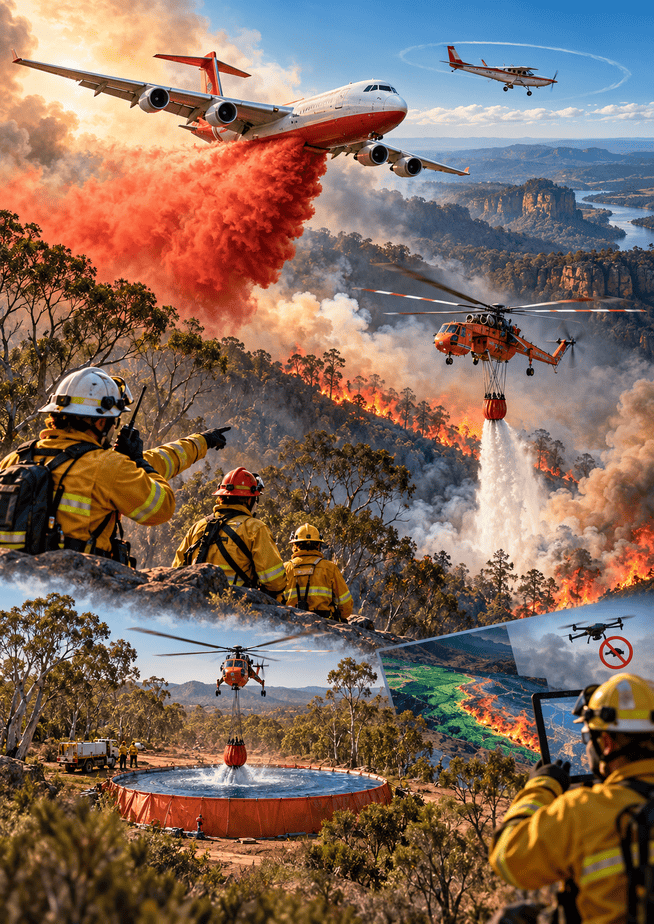
| Aircraft / capability | Typical role | Main strength |
|---|---|---|
| Single-engine air tanker (SEAT) | Initial attack, grass and bushfire bombing | Fast response, distributed regional basing and lower operating footprint |
| Large air tanker (LAT) | Large retardant or suppressant drops | Speed, range and large delivery volume |
| Heavy / medium helicopter | Direct attack, asset protection, repeated water drops, transport | Precision and quick refill where water is nearby |
| Air attack / birddog | Supervision and coordination of bombing aircraft | Safer, better targeted multi-aircraft operations |
| Intelligence / linescan / RPAS | Mapping, reconnaissance, hotspot detection and situational awareness | Better decisions without relying only on visual reports from the ground |
What aircraft actually do on a bushfire
The popular image is a large aircraft flying low and dropping thousands of litres onto a wall of flame. That happens, but it is only one part of aerial operations. Current NSW RFS doctrine lists roles including strategic and tactical reconnaissance, fireground reconnaissance, firebombing, air-attack supervision, transport of firefighters and equipment, insertion and recovery of remote-area crews, and rescue.
Water is mainly a short-duration cooling and knock-down agent. It can reduce flame intensity and help ground crews move in. Foam can improve wetting and penetration. Long-term retardant is generally laid on unburnt fuels to slow combustion after the water carrier has evaporated. The tactical choice depends on the fire, fuels, weather, terrain, available aircraft, nearby water or reload bases and the objective set by incident management.
Aircraft suppress fire — crews still have to secure it
A drop that lowers flame height or slows a flank may create the opportunity for crews, machinery or other aircraft to establish and hold control. Without follow-up, fire can burn around, through or beyond the treated area. This is why judging an aircraft only by the size of its tank can be misleading.
Why early attack matters — and why aircraft still have limits
Aerial resources are often most valuable during initial attack, while a fire is still relatively small. Aircraft can reach remote ignitions quickly, slow the head or flanks, deal with spot fires and support crews travelling over slower or difficult access routes. Victoria is also investing in remote helicopter dip tanks to cut refill turnaround times; in 2026, Forest Fire Management Victoria reported that strategically located tanks could reduce some turnaround times by up to 15 minutes.
But aircraft operate inside an aviation safety envelope. Strong wind, turbulence, terrain, dense smoke, poor visibility, electrical hazards and crowded fireground airspace can all reduce or stop operations. In the most extreme fire behaviour, spotting may occur well ahead of a retardant line and fire intensity may exceed what a drop can hold.
This is also why the phrase “send more water bombers” can oversimplify the problem. The useful question is whether the available aircraft can safely deliver the right product, in the right place, at the right time, with a realistic tactical objective and ground follow-up.
AIIMS 2025 and air-ground coordination
A major change since the original report is the release of AIIMS 2025. AFAC published the new Australasian Inter-service Incident Management System manual in October 2025, replacing AIIMS 2017. AIIMS remains the common incident-management system used by Australian fire, emergency service and land-management agencies.
For aviation, the practical importance is integration. Aircraft are not an independent layer operating above the incident. Air operations must fit the incident objectives, intelligence, safety controls, logistics and priorities of the wider response. The current AIIMS resources retain fire-specific aviation roles within the system and place stronger emphasis on safety, information flow and adaptable multi-agency management.
At national level, AFAC’s National Resource Sharing Centre helps prioritise and move aircraft between jurisdictions. This matters when several states are under pressure at once. A large tanker sitting in one state is not automatically the best resource for the next fire; national coordination is about placing capability where it can have the greatest operational effect.
Fire danger terminology has changed
Older aerial-firefighting material often describes public fire danger using the former Forest Fire Danger Index categories. That terminology should not be used as the current public rating scale.
Australia now uses the Australian Fire Danger Rating System (AFDRS). The public ratings are Moderate, High, Extreme and Catastrophic, with “No Rating” when proactive community action is not required. The Bureau of Meteorology explains that the underlying Fire Behaviour Index (FBI) helps inform the rating. FFDI remains relevant in historical and scientific contexts, but it is not the current national public warning scale.
Safety around aircraft: firefighters and the public
Firebombing involves large masses of water, foam or retardant moving at speed. NSW RFS doctrine states that personnel are not to be in or close to areas targeted for aerial attack and that crews must be advised when aircraft are operating on the incident ground. Agency procedures, briefings and air-ground communications always take precedence over general advice in an article like this.
Bushfires are no-drone zones
CASA’s advice is clear: members of the public must not fly drones during emergency operations. A drone near a bushfire can create a collision risk and may force firefighting aircraft to stop flying. Do not use a drone to inspect a fire front, film water bombers or check how close an active fire is.
People should also avoid travelling toward fires simply to watch aircraft. Extra traffic can interfere with emergency access and place occupants in areas where conditions can change rapidly.
What about fire retardant and foam?
Long-term retardant is not simply coloured water. It is designed to reduce the combustibility of vegetation after the water in the mix has evaporated. The red or coloured appearance helps pilots see where previous drops were placed.
Current NSW RFS public guidance says no known adverse long-term or chronic health effects have been attributed to the long-term retardants it uses, while recognising that concentrated products require worker precautions. Aquatic environments need extra care: foams and retardants can affect aquatic organisms, so pilots try to avoid applying suppressants within 100 metres of waterways.
If retardant enters a rainwater tank, NSW RFS advises that the water should not be used for drinking by people, pets or livestock. Property owners should follow their local fire agency or recovery authority advice for clean-up rather than relying on generic internet advice.
Sovereign capability and the changing fleet
Australia still benefits from international operators and shared expertise, but the trend is toward stronger domestic capability. NSW RFS, for example, has a long-term arrangement covering its agency-owned aviation fleet, including its Boeing 737 large air tanker, Bell 412 helicopters and a Chinook. National contracts are also increasingly using Australian operators and locally based crews.
The 2026–27 fleet shows another important change: aircraft are being selected for multi-role emergency capability, not only water bombing. Cargo transport, evacuation, intelligence gathering, linescan, air attack supervision and support to other disasters can improve the value of expensive aviation assets across the year.
Night firebombing is another area of development, but it should not be presented as normal for every aircraft or every incident. Night operations require specifically approved aircraft, crews, procedures and risk controls. The correct operational position is that night capability exists in parts of the Australian system, but its use is specialised and situation-dependent.
What Australia can learn from overseas
The most useful international comparison is not simply which country owns the biggest aircraft. Different systems have different geography, fuels, funding and governance. The stronger lesson is how nations build mixed fleets, surge capacity, pre-positioning and common command arrangements.
In the United States, federal agencies share a large interagency aviation system using contracted and government aircraft, including large and very large air tankers, helicopters, single-engine tankers, scoopers, supervision aircraft and military C-130 surge capability. Aircraft are positioned around the country according to expected wildfire activity rather than being concentrated at one national base.
Europe’s 2026 wildfire preparations provide another model. The EU Civil Protection Mechanism and rescEU system placed 22 firefighting aeroplanes and five helicopters on standby across participating countries, while also pre-positioning hundreds of firefighters. That approach treats aircraft and ground capability as one shared regional system rather than competing alternatives.
The international lesson for Australia
A resilient system needs a mixture of local quick-response aircraft, heavy surge assets, reliable intelligence, trained air-operations personnel, interoperable command, ground crews able to exploit the drop, and agreements that allow resources to move quickly when one jurisdiction is overwhelmed.
Climate change is making availability and timing harder
The CSIRO and Bureau of Meteorology’s State of the Climate 2024 reports an increase in extreme fire weather and a longer fire season across large parts of Australia since the 1950s. It also projects continued increases in dangerous fire-weather days and longer seasons for much of southern and eastern Australia.
For aviation planners, longer seasons create several pressures. Aircraft and crews may be required for more months of the year. Northern and Southern Hemisphere fire seasons can overlap. Maintenance windows become harder to schedule. Pilots, engineers and specialist air-operations personnel are finite resources. At the same time, wetter periods in parts of northern and central Australia can produce heavy grass growth that becomes a major fuel load once it dries.
The practical response is not simply to buy more large tankers. It is to improve detection, early dispatch, basing, water and retardant logistics, intelligence, domestic workforce capacity and resource sharing so the aircraft already available can be used where they are most effective.
Practical lessons for the public, firefighters and planners
For the public
- Leave when official advice says to leave; do not wait for aircraft.
- Keep drones grounded around emergency operations.
- Do not drive toward a fire to watch aircraft.
- Prepare your property and bushfire plan before the high-risk day.
For firefighters
- Treat aerial resources as part of the tactical plan, not a separate solution.
- Maintain clear air-ground communication and drop-zone safety.
- Exploit the reduced fire intensity quickly when a drop creates an opportunity.
- Work within agency procedures, briefings and AIIMS arrangements.
For planners and decision-makers
- Measure outcomes, not just flight hours or litres dropped.
- Invest in rapid detection, dispatch, basing and refill infrastructure.
- Protect aviation workforce and maintenance capacity.
- Plan for longer seasons and concurrent disasters.
Conclusion
Aerial firefighting has become a central part of Australian bushfire response, but its value comes from integration rather than spectacle. A small tanker close to a new ignition may be more useful than a much larger aircraft an hour away. A helicopter cycling quickly from a nearby dip site may outperform a fixed-wing aircraft for one task, while a large air tanker may be the better option for another.
Australia’s 2026–27 arrangements show a mature system built around a large nationally contracted fleet, state-owned and state-contracted aircraft, Australian operators, nationally shared surge assets and stronger all-hazards capability. The move to AIIMS 2025, continued investment in intelligence and domestic aviation capacity, and better national resource sharing all support that system.
The operational principle remains simple: the right aircraft, for the right task, at the right time, integrated with people on the ground. No aircraft can remove bushfire risk, and no aerial fleet replaces warnings, evacuation planning, prepared communities or safe firefighting on the ground.
- AFAC / NAFC — 2026–27 National Aviation Assets program
- NAFC — Current national aerial firefighting fleet
- National Emergency Management Agency — National aerial firefighting capability
- AFAC — AIIMS 2025
- Bureau of Meteorology — Fire weather services and AFDRS
- NSW RFS — Use of Aircraft in Firefighting
- CASA — Flying near emergencies and wildlife
- CSIRO & Bureau of Meteorology — State of the Climate 2024
- EU Civil Protection — 2026 wildfire preparedness
- US National Interagency Fire Center — Wildland firefighting aircraft
Ken Walker — former Station Officer and fire-service educator with career and volunteer firefighting experience.
This article combines current official public sources with operational firefighting context. It has been substantially shortened from the earlier report so that public safety information is easy to find while professional readers still have enough operational detail to understand how aerial resources fit into incident management.
Safety disclaimer
This article is general educational information. It is not an aviation procedure, firefighting procedure, training package or substitute for the policies, standard operating procedures, incident action plans, aviation briefings or directions of the responsible emergency-service authority. Firefighters and aviation personnel must follow their agency requirements and current incident command. Members of the public should follow official emergency warnings and directions.
FireRescue Training Hub
Access practical fire and emergency study support resources, downloads, checklists, audio guides, and member-only course content.
- Course library
- PDF downloads
- Audio guides
- Checklists
Study support only. Not accredited training or a replacement for workplace procedures.
About the author and safety review
Ken Walker
Former Station Officer and fire service educator
Former career firefighter with extensive career and volunteer fire service experience.
Qualifications: Associate Diploma of Applied Science in Fire Technology; Institute of Fire Engineers studies.
Author profilehttps://www.firerescue.com.au/about-us/