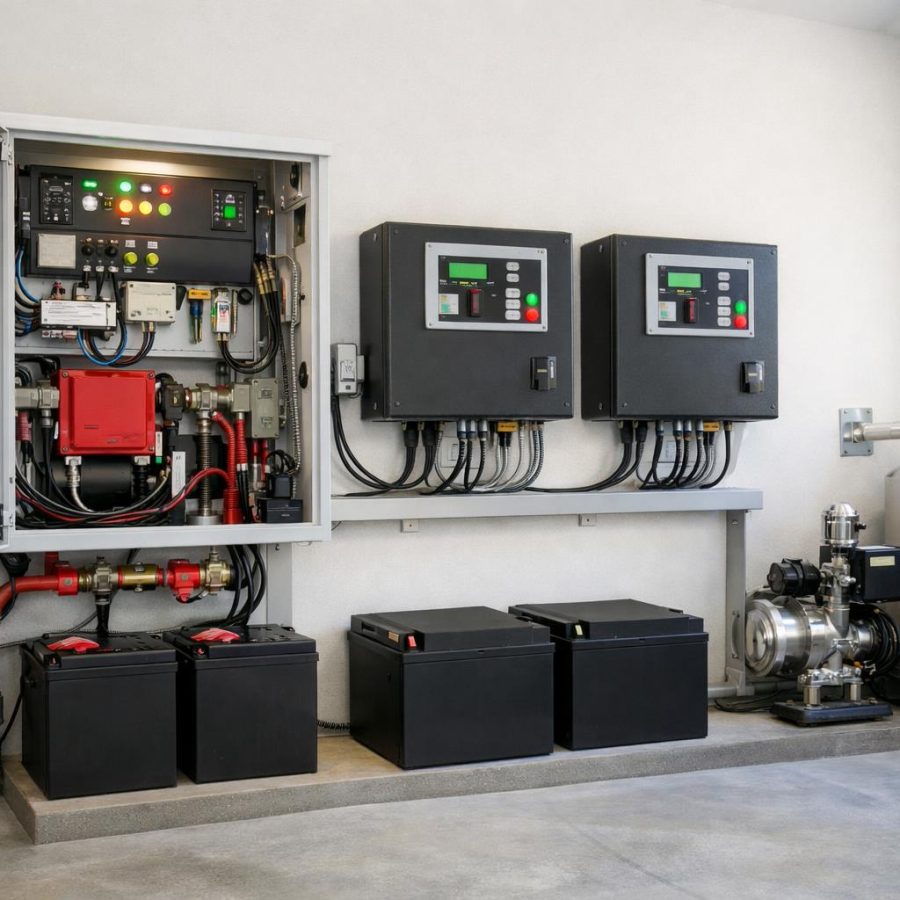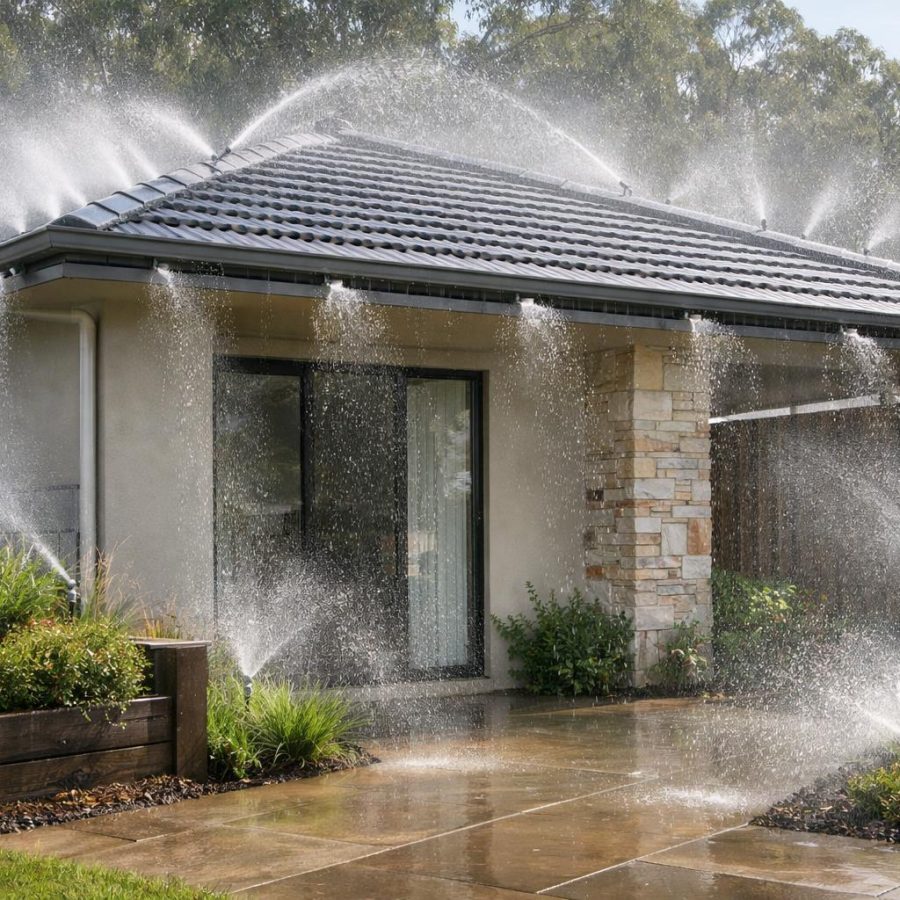
A bushfire protection system is only useful if it still works when the grid fails. During a bushfire, mains electricity can disappear without warning, so the home needs a backup-power design that keeps the critical fire systems alive automatically, safely and for long enough to matter.
Why backup power is part of bushfire protection
In this series, backup power is treated as a core protection layer, not an optional extra. If the home loses power during a fire, many important systems can stop at exactly the wrong time. That includes pumps, controllers, sensors, communications, ventilation and lighting.
The main point is simple: the bushfire protection system must be able to ride through a blackout without relying on someone to run outside, find a torch, start a machine or manually reconfigure a switchboard under stress. When conditions are already dangerous, the system should already be doing the right thing.
This part of the system contributes only a small portion of the overall readiness model, but it is still vital. Backup power does not guarantee survival, and it should never be described that way. It does, however, improve the chance that the rest of the protection system can keep doing its job when the local infrastructure fails.
The preferred power sequence: mains, battery, generator
The preferred sequence is straightforward: mains → battery → automatic generator. Each stage has a different role.
Mains power is the normal operating source. It runs the home and keeps the battery charged. When the mains fail, the battery should take over immediately and support the essential fire loads without delay. If the blackout continues and the battery state of charge falls to a chosen threshold, the generator should start automatically and take over the longer-duration load.
This sequence matters because it avoids a gap in protection. The battery bridges the first moments after a blackout, when the system needs to remain stable. The generator then supports the system for a longer period, reducing the chance that the battery is drained by extended emergency operation.
The battery may be part of the home’s normal solar and battery setup, or it may be a dedicated battery reserved for bushfire-system loads. Which approach suits a property depends on the home design, the size of the fire system, and the expected load during an emergency. The key requirement is that the battery must be able to support the essential loads immediately after mains failure.
What the battery must do in the first minutes
The first role of the battery is continuity. It must keep the critical systems alive while the house transitions away from mains power. That means the battery should be sized and configured to support the essential fire loads without hesitation.
In practical terms, the battery should keep the following running when mains power fails:
- fire pumps and pump controls
- system controllers
- selected sensors and monitoring equipment
- positive-pressure ventilation, if included and safe to run
- communications equipment used for alerts and status reporting
- essential lighting for safe awareness around the protected areas
Not every item will need full-power operation for the entire event. The purpose of the battery is to hold the system together while the generator prepares to take over. It should give the system a stable bridge, not a temporary afterthought.
Battery capacity should be selected according to the property, the expected fire loads and the duration the property may need to run before generator support begins. A compact property with modest loads may need less capacity than a larger site with multiple pumps, longer cable runs and more complex control logic. There is no single universal size that suits every home.
In some homes, the battery can also support normal household resilience between weather events. In others, a dedicated bushfire-system battery may be the safer design because it reduces competition with ordinary household loads.
Either way, the battery must be protected, monitored and integrated properly. It should not be treated as a spare box that happens to be sitting on the wall.
Generator start logic: automatic, but not simplistic
The generator should start automatically, but the start decision should be based on more than one signal. A well-designed system should consider a combination of the following:
- mains power failure
- battery state of charge
- current electrical load
- whether Fire Mode is active
This matters because not every power interruption is the same. A short interruption during a calm day does not need the same response as a power failure during a bushfire event. Fire Mode is therefore a useful signal. It tells the system that the environment is elevated and that the backup-power strategy should be more conservative.
For example, if mains power fails while Fire Mode is active and the essential load is already significant, the generator may need to start sooner than it would during normal weather. Likewise, if the battery is already partly depleted, the control logic should not wait too long before bringing the generator online.
Automatic start is the standard expectation. However, a manual generator override should also be available. That gives a trained and authorised adult a way to start the generator if the automatic sequence does not behave as expected or if the resident wants to prepare the system in advance under safe conditions.
Manual override should not be a substitute for proper automation. It is a fallback option, not the primary plan.
The best backup-power system is not the one that can be managed in an emergency under pressure. It is the one that already knows what to do.
Automatic load shedding keeps power for the right equipment
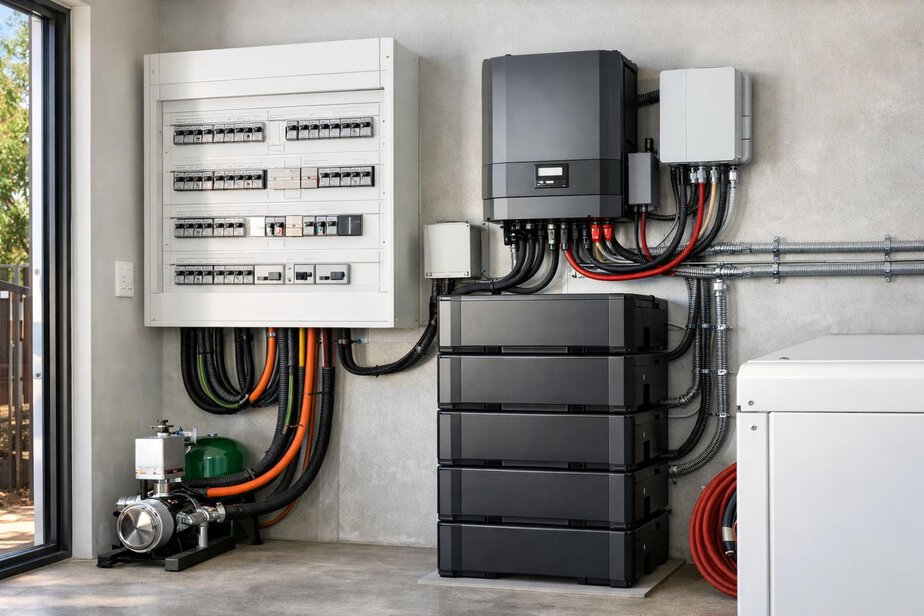
Automatic load shedding is standard and should be built into the design from the beginning. During Fire Mode, the system should disconnect non-essential household loads so that fire protection equipment has priority.
Useful examples of loads to shed include:
- EV charging
- pool pumps
- workshop circuits
- general appliance circuits
- other unnecessary equipment not required for fire protection
The main reason for load shedding is to protect the available power budget. If the backup system tries to support too many things at once, the battery will drain faster and the generator may be forced to carry unnecessary demand. That can reduce the system’s resilience at the exact moment it matters most.
Load shedding should not be confusing or improvised. The circuit list should be planned in advance, tested and clearly tied to the system’s emergency logic. Residents should understand that some household services will be unavailable during an active bushfire response. That is not a fault. It is part of the design.
When Fire Mode ends and normal conditions return, the system can restore those loads according to the designed sequence. Recovery should be controlled, not abrupt, so the home does not create a new electrical surge when everything comes back on at once.
Power priority: what stays on first
When power is limited, the system must put the most important equipment first. A clear priority order helps avoid confusion during a blackout and keeps the design consistent across the entire home.
| Priority | Typical equipment | Why it matters |
|---|---|---|
| 1 | Fire pumps | These deliver the core water protection response. |
| 2 | Controllers | The brains of the system must remain active. |
| 3 | Sensors | Detection and status information help the system respond correctly. |
| 4 | Positive-pressure ventilation | Useful while sufficient power exists and the design supports it. |
| 5 | Communications | Alerts and status messages help the resident stay informed. |
| 6 | Essential lighting | Supports safe movement and visibility around protected areas. |
| 7 | Essential-fire switchboard | The dedicated switchboard feeds and organises the critical loads. |
This order is not about convenience. It is about preserving the functions that most directly support bushfire protection. Some homes will have additional devices that seem important in daily life, but during a fire event the system should focus on the loads that actually protect the property.
The highest priority goes to fire pumps because water delivery is often the backbone of the response. Controllers and sensors follow closely because they coordinate the rest of the system and provide feedback. Ventilation can be important if it is part of the property’s protection strategy, but it should not be allowed to consume power needed by the core fire functions.
Communications and lighting are still useful, but they sit below the core protection loads. Their role is to support awareness and safe operation, not replace the primary fire-response equipment.
Why the essential-fire switchboard should be separate
A dedicated essential-fire switchboard is strongly preferred. It should be separate from normal household circuits so the critical fire equipment is easier to identify, isolate, protect and test.
This separation helps in several ways. First, it reduces the chance that a household fault takes down the entire protection system. Second, it makes load shedding clearer because the emergency circuits are grouped together logically. Third, it helps the commissioning process because the critical fire loads can be tested as a defined system rather than as a collection of unrelated household circuits.
Where practical, critical fire equipment should use protected electrical circuits and separate power paths. The aim is to avoid a single vulnerable cable, circuit or switchboard becoming a single point of failure. Redundancy should be used carefully and sensibly, but it should never depend on one exposed path if a better protected alternative is available.
This is one of the reasons electrical design matters so much in bushfire planning. A strong water system can still fail if the power architecture is weak.
Generator fuel, siting and bushfire exposure
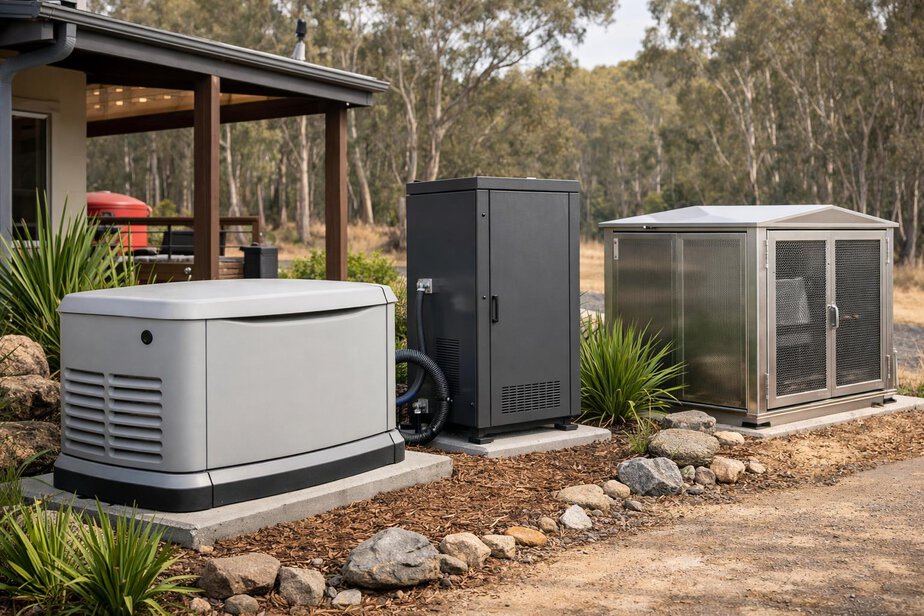
The generator must have enough fuel to do the job. Fuel capacity should be site-specific, but the design target should provide at least 8 hours of operation at the expected emergency load. That is a practical minimum for many properties, although some sites may need more.
The right fuel capacity depends on the load, the generator type, the expected duration of the event and how long the property may need to remain in emergency mode. A larger home with more equipment may need a different approach from a smaller home with a simpler system.
Fuel storage and generator location must also be protected appropriately from bushfire exposure. That means the generator should be housed in, or associated with, a suitably protected plant area. The design should consider heat, embers, smoke and access during an emergency.
Residents should not leave fuel arrangements as an afterthought. If the generator cannot safely operate because of its siting, or if fuel is unavailable when needed, the backup plan is incomplete.
Practical fuel management should include monitoring and early warnings. A low-fuel condition should trigger a readiness warning. Depending on severity, that may be an Amber or Red warning in the system’s alert logic. The important thing is that the resident is told early enough to act.
Fuel handling and storage should always follow the relevant product instructions and local safety requirements. Final design decisions should be made by appropriately qualified professionals.
Automatic testing and the resident’s test schedule
The generator should perform automatic scheduled test runs. These tests are important because a generator that has not been exercised properly may not start when the home needs it most.
The resident should choose the test schedule. That allows the testing to fit the household routine, noise constraints and local conditions. The schedule should still be regular enough to give useful confidence in the system’s condition.
The system should automatically report the following issues:
- failure to start
- low fuel
- electrical faults
- abnormal generator performance
Automatic testing should not be seen as a box-ticking exercise. The goal is to confirm that the complete backup chain can actually start, transfer load and keep the essential fire systems running. A test that only checks one component is not enough.
If the generator test creates a fault, the resident should receive a clear alert. The alert should be easy to understand and should show whether the problem affects the ability to support fire loads. If there is uncertainty, the system should fail safe and preserve the essential loads as much as practical.
What happens if the generator fails to start
A generator failure must not immediately stop the whole system. If the generator fails to start, the battery should continue supporting critical loads for as long as practical.
At the same time, the system should reduce non-essential fire loads automatically. That preserves energy for the most important protection functions and avoids wasting battery capacity on lesser priorities.
The resident should be alerted immediately. The alert should make it clear that the generator did not start and that the system is now relying on battery power alone. If the battery is running low, that warning becomes even more important.
This is also where good design discipline matters. The system should not assume that the generator is infallible. Instead, it should be prepared for failure and have a sensible fallback path.
The fallback path is not a perfect substitute for a working generator. It is a controlled degradation of service that keeps the most critical functions alive for as long as possible. That is far better than the system simply collapsing when one component fails.
A resilient bushfire system does not pretend every backup will work forever. It makes sure the next-best option is already in place.
Commissioning the whole backup-power system
The complete backup-power system must be tested under realistic load. Do not rely only on separate manufacturer tests for individual parts. A pump may pass on its own, a battery may pass on its own, and a generator may pass on its own, yet the combined system can still fail when everything is connected.
Commissioning should simulate mains failure and confirm the entire emergency chain works together. At a minimum, the test should confirm the following:
- battery takeover after mains failure
- generator automatic start
- automatic load shedding
- pump operation
- controllers functioning correctly
- sensors reporting correctly
- positive-pressure ventilation, where included
- fault alarms and alerts
- recovery to normal power when mains supply returns
The commissioning process should be practical and realistic. If the system will be expected to perform during a bushfire, it should be tested in a way that reflects that expectation. The aim is not to create risk during commissioning, but to confirm the equipment responds correctly under the same kinds of transitions it will face in real use.
Recovery matters as much as startup. When mains power returns, the system should shift back to normal operation in an orderly way. Loads should not all re-energise at once if that would create unnecessary stress or confuse the control logic. The system should know how to come back safely, not just how to start under pressure.
The final electrical design and commissioning should be completed by appropriately qualified professionals. Homeowners should understand the system and know how it behaves, but they should not be expected to engineer or re-engineer the backup architecture themselves.
Practical homeowner checklist for blackout readiness
For ordinary homeowners, the practical task is to make sure the design is clear, tested and maintained. A sensible checklist includes the following:
- confirm the battery can support the essential fire loads immediately after mains failure
- confirm the generator starts automatically when it should
- confirm manual generator override is available
- confirm non-essential loads are shed during Fire Mode
- confirm the essential-fire switchboard is clearly identified
- confirm the critical equipment uses protected circuits where practical
- confirm fuel capacity suits the site and expected emergency load
- confirm fuel storage and generator location are appropriately protected
- confirm automatic test runs occur on the chosen schedule
- confirm the alert system reports faults clearly and promptly
It is also wise to keep a simple household understanding of the system. Residents should know what sounds normal, what the warning lights mean, where the key isolators are located and who to call if the system reports a fault. That knowledge should be written down and kept somewhere accessible.
Good backup power is not just about equipment. It is also about clarity. When the fire event starts, the household should not be trying to guess how the power system behaves.
Conclusion: the backup system must stay automatic, protected and tested
The central lesson of this part is straightforward: a bushfire protection system must remain alive during a blackout. That means the system should not depend entirely on mains electricity, and it should not require improvised human action in a crisis.
The preferred sequence is mains → battery → automatic generator. The battery keeps the critical fire systems running immediately after a blackout. The generator then supports longer operation, provided the start logic, load shedding, fuel supply and protection measures are all designed properly.
For the homeowner, the key questions are simple. Does the battery bridge the outage cleanly? Does the generator start when it should? Are the non-essential loads dropped automatically? Are the most important fire systems protected by separate and sensible power paths? Have the complete system and its recovery sequence been tested under realistic conditions?
If the answer to any of those questions is unclear, the design needs more work before it should be relied on in a bushfire. Before publication or implementation, verify the facts, confirm local procedures and have the electrical design reviewed by appropriately qualified professionals.
FireRescue Training Hub
Access practical fire and emergency study support resources, downloads, checklists, audio guides, and member-only course content.
- Course library
- PDF downloads
- Audio guides
- Checklists
Study support only. Not accredited training or a replacement for workplace procedures.
About the author and safety review
Ken Walker
Former Station Officer and fire service educator
Former career firefighter with extensive career and volunteer fire service experience.
Qualifications: Associate Diploma of Applied Science in Fire Technology; Institute of Fire Engineers studies.
Author profilehttps://www.firerescue.com.au/about-us/