Key Takeaways
Effective underground transport fire evacuation demands clear planning, ongoing training, and a coordinated response between emergency services and transport authorities. Understanding the unique risks underground, such as limited airflow and constrained escape routes, is essential for safety.
This guide highlights current fire research, operational priorities, and how Australian emergency services work together to protect life and property in the event of a fire underground.
Underground Transport Fire Evacuation
A practical safety guide covering underground fire risks, smoke behaviour, evacuation priorities, emergency coordination in Australia, and the key actions that help protect life during an incident.
Understanding Underground Transport Fire Evacuation
Underground transport systems, including subways, tunnels, and underground rail networks, present distinct challenges in fire emergency situations. The enclosed spaces limit ventilation, and smoke can quickly build up, reducing visibility and air quality. Evacuation routes are often limited, requiring well-thought-out emergency procedures and fast, decisive action.
Given these factors, fire evacuation planning needs to be tailored specifically to underground environments. Emergency services, transport operators, and safety officers must collaborate to develop procedures that prioritise passenger safety while managing fire risks effectively.
Moreover, the psychological impact of a fire incident in confined underground spaces cannot be underestimated. Passengers may experience heightened anxiety or panic, which complicates evacuation efforts. Emergency plans therefore also include strategies for crowd control and passenger reassurance to maintain order and prevent stampedes during evacuation.
Technological advancements have introduced sophisticated fire detection and suppression systems tailored for underground transport. These include heat and smoke detectors linked to automated alarms, water mist systems, and chemical fire suppressants designed to quickly control or extinguish fires while minimising damage and disruption.
In addition to these systems, modern underground transport infrastructure often incorporates emergency communication networks that allow direct contact between passengers and control centres. This facilitates timely instructions and reassurance during incidents, improving overall evacuation outcomes.
Lighting also plays a critical role in underground fire evacuation. Emergency lighting systems activate automatically in the event of power failure, guiding passengers safely along evacuation routes. These systems are designed to function in harsh conditions, ensuring visibility even when smoke obscures normal lighting.
Furthermore, the design of underground stations and tunnels increasingly incorporates multiple evacuation points and refuge areas. These safe zones provide temporary shelter from smoke and fire, allowing emergency responders to conduct search and rescue operations more effectively.
Key Research and Fire Behaviour in Underground Settings
Recent fire research has improved understanding of how fires behave in underground transport environments. Smoke stratification can occur, meaning smoke layers may settle near ceilings or hang lower depending on airflow patterns. This affects how evacuation routes should be designed and ventilated.
Fire dynamics in tunnels show that fire growth can be rapid due to limited oxygen and the presence of combustible materials such as seats, cables, and plastics. Smoke inhalation remains the biggest threat to life, making early detection and smoke control systems critical components of underground transport safety.
Research also supports the use of compartmentation strategies and fire-resistant construction to limit fire spread and protect evacuation corridors. In Australia, standards set by regulatory authorities reflect these insights to improve the safety of underground transport infrastructure.
More recent studies focus on the impact of ventilation system design on smoke movement and fire suppression efficacy. Computational fluid dynamics (CFD) modelling is widely used to simulate fire scenarios and optimise ventilation controls, ensuring smoke is directed away from evacuation routes and critical infrastructure.
Additionally, fire-resistant materials and coatings are being developed to enhance the fire resilience of underground transport assets. These innovations aim to delay fire progression, providing crucial extra time for evacuation and emergency response.
Another area of active research involves the effects of smoke toxicity and heat on human survivability in confined underground spaces. Understanding these factors helps refine evacuation timing and the design of protective equipment for both passengers and emergency responders.
Studies also explore the potential for integrating smart sensor networks that monitor environmental conditions in real-time, providing dynamic data to control centres for faster decision-making and adaptive response strategies.
Emergency Planning and Coordination
Emergency planning for underground transport fire evacuation involves clear protocols developed jointly by Fire/Rescue NSW, local police, ambulance services, and the State Emergency Service (SES). Each agency has defined roles to ensure an efficient response.
Transport operators conduct regular fire drills and staff training to familiarise personnel with evacuation procedures. Signage and public announcements guide passengers during emergencies. Automated systems detect fires early and activate ventilation and alarm systems to improve safety.
Coordination between agencies includes shared communication channels, joint response exercises, and clear command structures. This ensures that when a fire occurs, resources are deployed quickly, evacuation is orderly, and medical assistance is available promptly.
In addition to inter-agency coordination, collaboration extends to transport infrastructure designers and maintenance teams. Ensuring that fire safety systems are regularly inspected, maintained, and updated is critical for emergency readiness.
Community engagement and public education campaigns also form part of holistic emergency planning. Informing regular commuters about evacuation procedures and safety features increases preparedness and reduces confusion during an incident.
Furthermore, emergency planning integrates lessons learned from past incidents worldwide to improve local protocols. Case studies and after-action reviews help identify gaps and enhance strategies for evacuation, communication, and resource deployment.
Training programs increasingly include realistic simulation exercises using virtual reality and scenario-based drills to prepare personnel for the complexities of underground fire emergencies. These methods improve decision-making under pressure and coordination among responders.

Operational Considerations During Underground Fire Evacuations
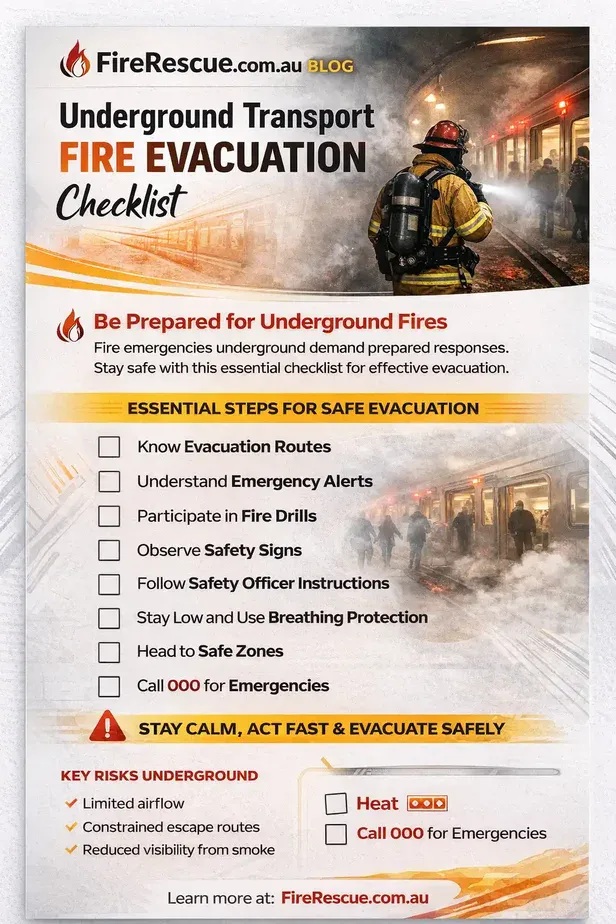
During a fire event underground, maintaining calm and following established procedures is vital. Passengers should listen carefully to instructions from train staff or emergency personnel. Evacuation routes should be chosen based on the safest path away from smoke and fire, often indicated by illuminated exit signs.
Emergency responders focus not only on extinguishing the fire but also on managing smoke, rescuing trapped individuals, and providing first aid. Ventilation systems are adjusted to control smoke movement, helping keep escape routes clear.
Communication with passengers is continuous, with updates on the situation and guidance on what to do next. Where possible, emergency lighting will assist visibility. Firefighters work to contain the fire and mitigate risks to both people and infrastructure.
Operational teams must also consider the challenges of limited access for firefighting equipment and personnel in underground settings. Fire engines and heavy apparatus may not be able to enter tunnels, so specialised equipment such as portable extinguishers, breathing apparatus, and remote monitoring devices are essential.
Another important operational factor is the management of power supply during a fire. Electrical systems powering trains, lighting, and ventilation may need to be isolated safely to prevent electrocution risks and further fire hazards, balancing safety with the need to maintain critical systems for evacuation.
Post-incident operations include scene preservation for investigation, infrastructure damage assessment, and rapid restoration to minimise disruption to transport services. Lessons learned from each event feed back into training and planning improvements.
Additionally, responders must manage the psychological welfare of evacuees during and after the incident. Providing access to counselling services and support networks helps mitigate trauma associated with underground fire emergencies.
Incorporating feedback from frontline responders and passengers after drills and real events also enhances operational protocols. Continuous improvement is key to adapting to evolving risks and technologies.
If you only do five things
If you find yourself in an underground transport fire evacuation, stay calm and follow official instructions closely. Do not attempt to re-enter the vehicle or tunnel once you’ve evacuated.
Use the nearest marked exit or safe path away from smoke and flames. Avoid running as it can cause panic and injuries.
Protect yourself from smoke by covering your mouth and nose with a cloth if possible. Stay low to the ground where the air is clearer if smoke is present.
Call emergency services on 000 once you are safe to report the incident or if you see others in danger requiring help.
Always follow local warnings and official agency advice before resuming travel. Your safety comes first.
Who does what in Australia?
Fire/Rescue services are the frontline responders for fires, handling firefighting, rescue operations, and fire safety advice in emergencies.
Police coordinate scene security, traffic control, and assist with evacuation to keep people safe and order maintained.
Ambulance services provide medical care on scene and transport injured or unwell people to hospital facilities.
The State Emergency Service (SES) supports with rescue operations, especially in complex or large-scale emergencies, and helps coordinate logistics and community support.
For life-threatening emergencies, always call 000 immediately.
Final Thoughts on Underground Transport Fire Evacuation
Underground transport fire evacuation requires a combination of good design, ongoing training, and effective emergency response. By understanding fire behaviour underground, maintaining clear evacuation routes, and coordinating closely with emergency services, the risks can be significantly reduced.
Passengers and transport workers should remain aware of safety procedures and always prioritise their personal safety by following official advice. Staying informed and prepared can make all the difference in an emergency.
Remember, in any underground transport fire situation, your calm response and cooperation with authorities help save lives.
Continued investment in research, technology, and training is essential to keep pace with evolving urban transport demands and fire risks. Public safety depends on the shared commitment of authorities, operators, and passengers alike.
FireRescue Training Hub
Access practical fire and emergency study support resources, downloads, checklists, audio guides, and member-only course content.
- Course library
- PDF downloads
- Audio guides
- Checklists
Study support only. Not accredited training or a replacement for workplace procedures.
About the author and safety review
Ken Walker
Former Station Officer and fire service educator
Former career firefighter with extensive career and volunteer fire service experience.
Qualifications: Associate Diploma of Applied Science in Fire Technology; Institute of Fire Engineers studies.
Author profilehttps://www.firerescue.com.au/about-us/