FireRescue Insights
Key takeaways
Understanding crowd movement during mass-casualty events is critical to ensuring timely, coordinated emergency responses that prioritise safety and minimise chaos.
Emergency services, including Fire/Rescue, Police, Ambulance, and the State Emergency Service (SES), each have defined roles that must be integrated to manage crowd flow and medical response effectively.
Practical considerations such as clear communication, controlled access points, and pre-planned evacuation routes can greatly reduce risks during complex emergencies.
Background and context
Mass-casualty events, by definition, involve incidents where the number of casualties overwhelms the usual emergency response capabilities. These events can range from natural disasters, large-scale accidents, to acts of terrorism. One of the most complex challenges during such events is managing the movement of crowds, which includes victims, bystanders, responders, and media personnel.
In Australia, emergency services operate under a coordinated framework that emphasises collaboration and clear communication. The Federal Emergency Management Framework supports states and territories in responding to these incidents, but at the local level, Fire/Rescue NSW, Victoria’s CFA, Queensland Fire and Emergency Services, and other agencies play frontline roles.
Understanding how crowds behave in emergencies, their movement patterns, and how to control them is vital for ensuring that first responders can access patients, conduct rescues, and maintain safety for all involved. This understanding is not only academic but also shapes the training and operational protocols that emergency services develop and refine continuously.
Historically, lessons learned from past mass-casualty incidents both in Australia and worldwide have highlighted the critical importance of crowd management. Failures in controlling crowd movement have often exacerbated casualties, delayed medical intervention, and complicated rescue efforts. These experiences underscore the necessity of integrating crowd dynamics into emergency response planning.
Crowd Movement Risk Snapshot
Historical stampede fatality triggers and related crowd-management context.
Fatality Share by Triggering Factor
137 global stampedes reviewedChart Data Table
Estimated fatality share by trigger| Triggering factor | Fatality share | Operational meaning |
|---|---|---|
| Narrow passage | 27% | Choke points, tunnel effects, blocked exits, compressed movement. |
| Overcrowding | 23% | Density overload, poor spacing, delayed movement, access breakdown. |
| Rumours / panic signals | 21% | Sudden directional shifts, confusion, surge behaviour, disorder. |
| Other triggers | 29% | Fire, structural failure, conflict, falls, and mixed-cause incidents. |
Why this matters for your post
This data supports the article’s main themes: protect exits, reduce bottlenecks, control density early, keep access routes open for responders, and use calm, clear communication to prevent dangerous crowd surges.
Understanding crowd movement dynamics
Human behaviour under stress
During mass-casualty events, people often act instinctively, seeking safety or attempting to assist others. Panic can lead to unpredictable movement and cause bottlenecks, trampling, or crush injuries. Understanding these behavioural patterns is essential for emergency planners and responders. Psychological studies show that while panic is often assumed, many individuals exhibit altruistic behaviour, helping others despite personal risk, which can both aid and complicate crowd movement.
Flow and congestion points
Crowd movement tends to funnel through available exits and pathways, which can quickly become congested. Identifying potential choke points and ensuring they remain clear are vital steps. Emergency responders must anticipate these areas and establish control measures to prevent crowd crush and ensure smooth evacuation. Advanced crowd modelling and simulation tools can help predict these congestion points before an incident occurs, enabling planners to design safer venues and event layouts.
Communication and signage
Clear, visible signage and audible instructions can guide crowds more efficiently during emergencies. In Australian contexts, multilingual and pictorial signage should be considered for diverse populations. Coordination with local authorities to deliver consistent messaging is critical to reduce confusion. Moreover, technological solutions such as mobile alerts and social media updates are increasingly used to provide real-time information and instructions, helping to manage and direct crowd flow effectively.
Additionally, training for event staff and volunteers in effective communication techniques can enhance crowd compliance and reduce panic. The use of calm, clear, and authoritative language during announcements helps maintain order and reassures those affected.
Roles of emergency services in crowd management
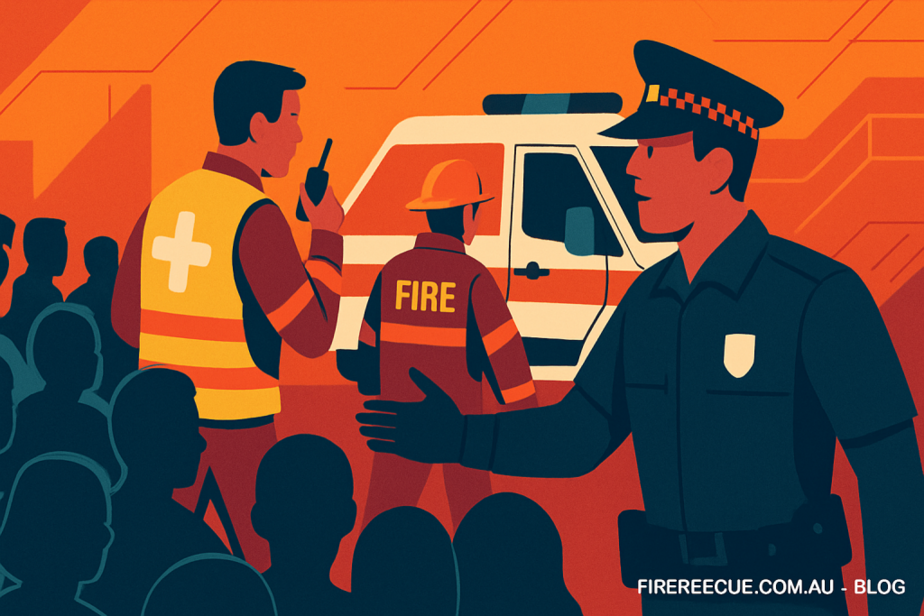
Fire and Rescue Services
Fire/Rescue teams are often among the first to arrive on scene, focusing on firefighting, rescue operations, and hazard mitigation. They play a crucial role in establishing safe zones and helping direct crowd movement away from danger areas. Their presence also supports clearing access routes for ambulance crews. Moreover, Fire/Rescue personnel are trained in rapid risk assessment to identify secondary hazards such as structural instability or hazardous materials that could further endanger crowds and responders alike.
Police
The Police coordinate scene security, crowd control, and traffic management. They are responsible for maintaining public order, securing perimeters, and assisting in evacuation efforts. Police also work closely with other emergency services to facilitate communication and resource allocation. Their training includes managing large crowds, negotiating with potentially distressed individuals, and implementing crowd dispersal tactics if necessary. Additionally, Police manage the interface with the media and public information officers to ensure accurate information is disseminated.
Ambulance Services
Ambulance paramedics handle triage, treatment, and transport of casualties. Their ability to reach victims swiftly depends heavily on unobstructed access and effective crowd management. Ambulance crews often coordinate with Fire/Rescue to identify casualty collection points and safe evacuation routes. They also implement mass triage protocols to prioritise patients based on injury severity, a critical step in managing limited resources during overwhelming incidents.
State Emergency Service (SES)
The SES provides specialist support in flood, storm, and other natural disaster responses. They assist in logistical coordination, infrastructure support, and sometimes in managing bystander safety in hard-to-access areas. SES volunteers may also support communications and provide resources to emergency services managing crowd movement. Their local knowledge and community connections often prove invaluable in coordinating evacuation efforts and ensuring vulnerable populations receive assistance.
In any mass-casualty event, the public should immediately call 000 to report the incident and receive guidance. Early notification ensures that the right combination of services can be dispatched promptly. Additionally, the public can support emergency services by following instructions, avoiding the scene unless necessary, and sharing verified information only through official channels.
Practical implications and guidance
Emergency planners and responders should incorporate crowd movement considerations into all mass-casualty preparedness exercises. This includes identifying potential evacuation routes, setting up staging areas, and rehearsing communication protocols with multi-agency teams. These exercises help identify unforeseen challenges and improve inter-agency coordination, which is critical during real events.
During an incident, establishing clear zones—such as hot zones, warm zones, and cold zones—helps control who moves where and when. Access control points should be staffed by trained personnel who can direct movement and prevent crossover that could endanger responders or casualties. This zoning also assists in managing contamination risks, especially in incidents involving hazardous materials or biological threats.
Use of technology, such as real-time location tracking and public address systems, can enhance situational awareness and improve crowd management. However, these tools should complement—not replace—on-the-ground coordination and human judgment. Drones and CCTV can provide aerial and remote surveillance, offering commanders a comprehensive view of crowd density and movement patterns to adjust tactics dynamically.
Importantly, members of the public should follow official instructions, avoid creating additional hazards, and remain calm. Calling 000 immediately remains the first and most critical step to activate the emergency response system. Public education campaigns on emergency preparedness and response behaviour can further enhance community resilience and reduce panic during actual events.
Coordination with event organisers, venue managers, and local councils before large public gatherings can also improve crowd management outcomes. Pre-event risk assessments and clear emergency plans tailored to specific venues and audiences facilitate faster, safer evacuations if required.
Conclusion
The management of crowd movement in mass-casualty events requires a multi-faceted approach that balances human behaviour insights, coordinated emergency service roles, and practical operational tactics. By understanding these dynamics and working collaboratively, Australian emergency services can improve outcomes, reduce harm, and save lives during critical incidents.
For the public, awareness of how to respond calmly and effectively, including contacting 000 without delay, can make a significant difference in the success of the emergency response. Community engagement and education remain vital components in building resilience against future mass-casualty incidents.
Continued investment in training, technology, and inter-agency collaboration will ensure that Australia remains prepared to manage the complexities of crowd movement during emergencies, ultimately safeguarding lives and property.